
Choosing the correct motorcycle windshield height can make a significant difference in riding comfort, wind protection, helmet turbulence, and forward visibility. A properly sized windshield redirects incoming air around the rider without creating excessive buffeting or interfering with the view of the road.
However, the optimal motorcycle windshield height is not determined by the rider’s standing height alone. Seated eye level, torso length, riding posture, motorcycle design, windshield angle, and airflow characteristics all influence the ideal configuration.
For many riders, a windshield that allows them to look comfortably over its upper edge offers a practical balance between visibility and weather protection. National Cycle recommends a sizing method based on seeing the road approximately 50 feet ahead over the windshield. Other manufacturers also offer taller, look-through configurations for riders who prioritize additional coverage.[1][2]
This guide explains how to measure motorcycle windshield height, compare different windshield styles, understand aerodynamic effects, resolve common problems, and choose a setup suitable for commuting, highway riding, and long-distance touring.
What Is the Correct Motorcycle Windshield Height?
There is no single windshield height that is correct for every motorcycle or rider. The appropriate height depends on where the upper edge sits relative to the rider’s eyes, how the windshield redirects airflow, and whether it provides an unobstructed view of the road.
A windshield that works well for an upright touring motorcycle may be unsuitable for a sport motorcycle with a forward-leaning riding position. Even riders using identical motorcycles can require different screen dimensions because their seated heights and body proportions differ.
Motorcycle Windshield Height: Definition and Purpose
Motorcycle windshield height describes the dimension of a windshield measured according to a specified reference point and measurement method. Depending on the manufacturer, this may be the distance from the windshield’s lower edge, the top of a headlight cutout, a mounting point, or the motorcycle’s fairing to the upper edge of the screen.
A distinction must be made between two measurements:
- Windshield surface length: The distance measured along the windshield’s sloping or curved surface.
- Installed vertical height: The vertical distance between a specified reference point and the windshield’s top edge.
These measurements are not necessarily equal. A heavily inclined windshield can have considerable surface length while remaining relatively low in front of the rider.
The primary purpose of a motorcycle windshield is to redirect oncoming airflow. Depending on its design, the screen can reduce direct wind pressure against the chest, shoulders, and helmet while offering partial protection from rain, insects, and road debris.
National Cycle confirms that windshield measurement conventions vary among handlebar-mounted, fork-mounted, and fairing-mounted designs. Consequently, comparing advertised heights without checking their measurement methods can lead to incorrect sizing.[1]
How to Determine the Optimal Windshield Height
The best starting point for determining optimal motorcycle windshield height is the rider’s eye position while seated naturally on the motorcycle.
Sit on the motorcycle with both wheels on level ground, allow the suspension to settle under your weight, and hold the handlebars as you normally would. Your head should remain in a comfortable riding position rather than being artificially raised or lowered.
For a conventional look-over windshield, National Cycle recommends positioning the upper edge approximately level with the tip of the rider’s nose or slightly below eye level. Its more functional recommendation is that the rider should be able to see the road 50 feet ahead over the windshield.[1]
The appropriate final position depends on several factors:
| Factor | Influence on windshield selection |
|---|---|
| Seated eye height | Determines the rider’s visual position relative to the screen |
| Torso length | Influences how high the rider’s head sits |
| Riding posture | Changes head position and airflow exposure |
| Motorcycle type | Determines available mounting positions and screen geometry |
| Riding speed | Influences aerodynamic pressure and turbulence |
| Weather conditions | Affects desired protection and visibility |
| Windshield angle | Changes installed height and airflow direction |
| Screen width and shape | Influences shoulder protection and airflow around the helmet |
A taller windshield may protect the upper body more effectively, but additional height does not guarantee quieter airflow. The objective is to find a configuration that provides acceptable protection without compromising vision, steering clearance, or aerodynamic stability.
Where Should the Windshield Top Edge Be?
For a typical look-over configuration, the windshield’s top edge should remain below the rider’s direct forward sightline while providing sufficient coverage against incoming air.
National Cycle identifies the nose-tip area or slightly below eye level as a useful initial reference. Memphis Shades recommends positioning its windshield top between the tip and bridge of the rider’s nose. These guidelines are similar, but neither should be treated as a universal measurement for every motorcycle.[1][3]
The position of the upper edge matters because airflow separates as it moves past the screen. Depending on its trajectory, this airflow can pass above the helmet, strike the helmet directly, or create turbulence around the rider’s head.
Signs that the windshield may be positioned incorrectly include:
- The upper edge repeatedly crosses the rider’s normal line of sight.
- The rider must stretch upward to see over the screen.
- Airflow causes persistent helmet shaking or pulsing.
- Wind pressure is concentrated around the forehead, visor, or upper helmet.
- The rider must adopt an uncomfortable posture to obtain acceptable wind protection.
A useful starting position is not necessarily the final aerodynamic setting. After confirming visibility and fitment, riders may need to test modest adjustments to height or inclination.
Look-Over Windshield Height vs. Look-Through Windshield Height
Motorcycle windshields generally support two approaches to forward visibility: looking over the screen or looking through it.
A look-over windshield has an upper edge low enough that the rider can view the road directly above the screen in the normal seated position. This reduces dependence on the windshield’s optical condition, particularly when rain, scratches, dirt, or reflections reduce transparency.
A look-through windshield extends sufficiently high that the rider’s normal forward view passes through its material. It can provide greater coverage against wind and weather, although its effectiveness depends heavily on optical quality and cleanliness.
| Characteristic | Look-over windshield | Look-through windshield |
|---|---|---|
| Normal forward vision | Primarily over the screen | Primarily through the screen |
| Wind protection | Depends on shape and airflow | Potentially greater coverage |
| Heavy rain visibility | Less dependent on screen clarity | More affected by water and dirt |
| Nighttime visibility | Fewer screen-related reflections | More susceptible to glare and distortion |
| Helmet turbulence | Depends on airflow trajectory | Also depends on airflow trajectory |
| Suitable applications | Commuting, touring, sport touring | Selected touring and large-screen applications |
Clearview Shields provides sizing instructions for both configurations. Its guidance recommends choosing the shorter available size when a look-over measurement falls between sizes. For certain look-through applications, it recommends a screen approximately 2 to 3 inches taller than the corresponding look-over measurement.[2]
That difference is a manufacturer-specific sizing approach, not a universal requirement. Riders should consider rain, nighttime visibility, material condition, and the motorcycle manufacturer’s recommendations before choosing a look-through windshield.
How Rider Dimensions and Ergonomics Affect Windshield Height
Two riders with identical standing heights can need noticeably different windshield configurations. Their torso proportions, arm lengths, preferred seating positions, and motorcycle modifications determine how their eyes align with the upper edge of the screen.
This is why windshield sizing should begin with the actual riding position rather than a generic height chart. The same rider may also require different windshield heights on a touring motorcycle, cruiser, adventure motorcycle, and sportbike because the seating geometry and head position change.
Rider Eye Level as the Primary Measurement Reference
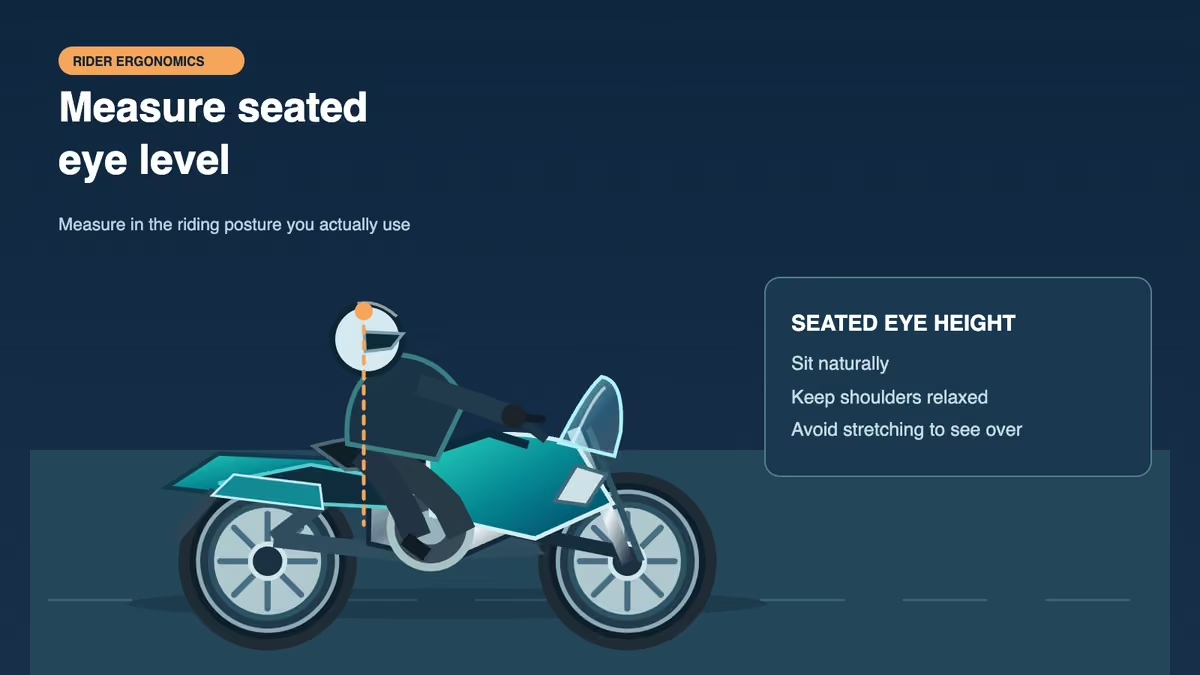
Rider eye level is the vertical position of the rider’s eyes when seated in the normal riding posture. It is the most useful initial reference for determining windshield top-edge placement because it directly relates to visibility over or through the screen.
To establish seated eye level, position the motorcycle securely on level ground and sit in your usual riding position while another person observes or measures your eye height.
Keep your shoulders relaxed, hold the handlebars naturally, and look forward rather than tilting your head upward. A helmet may change your posture slightly, so it is useful to repeat the visual check while wearing your usual riding equipment.
The desired windshield top-edge position can then be compared with your seated eye level and the road reference used in the 50-foot sightline method.
Seated Rider Height vs. Standing Height
Standing height measures the rider’s total body length, while seated rider height describes the upper-body position when sitting. Although these measurements are related, standing height alone cannot reliably predict windshield requirements.
For example, two riders measuring 180 cm tall may have different torso-to-leg proportions. The rider with the longer torso will often have a higher seated eye position when sitting on the same motorcycle.
This difference can make the same windshield appear relatively short to one rider and relatively tall to another.
National Cycle specifically identifies seated body proportions and the rider’s normal handlebar reach as important considerations when measuring windshield height.[1]
Manufacturer height charts can narrow the selection, but the final decision should be checked against the individual’s seated eye position, riding posture, and preferred level of wind protection.
How Rider Torso Length Influences Windshield Selection
Torso length is the distance associated with the rider’s upper-body proportions, typically considered from the seated pelvis region toward the shoulders or head. For windshield sizing, its practical importance is the effect it has on seated eye height.
A rider with a relatively long torso may sit higher above the windshield even when their overall standing height is average. Conversely, someone with a shorter torso may find that a screen advertised for their standing height extends too far into their field of view.
Arm reach also matters. A rider who leans forward to reach the handlebars may lower their head, changing the relationship between the helmet and the windshield.
Therefore, windshield sizing should account for the complete riding triangle formed by the seat, handlebars, and foot controls rather than torso length alone.
Motorcycle Seat Height and Its Effect on Windshield Fit
Motorcycle seat height is commonly specified as the distance between the seat and the ground, but this specification does not directly describe how high the rider’s eyes sit relative to the windshield.
What matters for windshield selection is the rider’s position in relation to the windshield and its mounting system.
A lowered seat can reduce the rider’s eye height, causing an unchanged windshield to appear taller. A thicker aftermarket seat, additional cushion, or substantially different seating position may raise the rider and make the screen appear shorter.
Suspension loading can also affect the relationship between the rider and windshield, particularly on motorcycles with frame-mounted screens. Passenger weight, luggage, preload settings, and rider sag may change the motorcycle’s attitude or relative geometry.
After significant seat or suspension modifications, repeat the windshield sightline assessment rather than assuming the previous screen height remains optimal.
Rider Ergonomics and Natural Riding Posture
Rider ergonomics describes how the motorcycle’s seating arrangement, handlebars, foot controls, and body position interact during riding.
An upright touring position generally places the rider’s head relatively high above the front fairing. A cruiser may combine low seating with swept-back handlebars, while an adventure motorcycle often provides an upright position with relatively tall bodywork.
Sport motorcycles are different. Their lower handlebars and more forward-leaning posture allow the rider to lower the upper body behind a compact windscreen, especially when adopting a tucked position.
A screen that works well while the rider sits upright may perform differently when the rider leans forward.
Measurements should therefore reflect the position normally used for sustained riding. Riders should not select a windshield based on a temporary posture that would be uncomfortable to maintain over longer distances.
How Rider Line of Sight Determines Windshield Height
The rider’s line of sight is the imaginary straight line extending from the eyes toward an object or location ahead.
When selecting a motorcycle windshield, this line helps determine whether the screen’s top edge creates an obstruction in the rider’s normal forward view.
For look-over sizing, the important question is whether the rider can view the roadway beyond the windshield without stretching the neck, sitting unnaturally upright, or looking through a potentially obscured section of the screen.
Clearview Shields and National Cycle both use a reference approximately 50 feet in front of the motorcycle to evaluate this relationship.[1][2]
The test should be performed using the motorcycle’s actual riding position, with the intended seat, handlebars, and normal load.
A clear, comfortable sightline is a basic requirement. Improved wind protection cannot compensate for a windshield position that significantly compromises the rider’s ability to see the road.
How to Measure Motorcycle Windshield Height Correctly
Measuring motorcycle windshield height requires more than placing a measuring tape against the screen. Different manufacturers use different reference points, and the screen’s inclination can substantially affect the relationship between its advertised length and actual installed height.
For accurate sizing, combine the manufacturer’s measurement convention with your seated eye position and normal riding posture. The following procedure applies to both choosing a new windshield and evaluating an existing screen, although the exact mounting reference must always be confirmed for the particular motorcycle.
Motorcycle Windshield Measurement: Tools and Preparation
Before measuring, position the motorcycle on a level, stable surface. The motorcycle must remain upright and securely supported, preferably with another person assisting so the rider can maintain a natural seated position.
You will need a measuring tape, a long straightedge or ruler, a removable marker or masking tape, and the windshield manufacturer’s dimensional instructions.
Follow these preparation steps:
- Park the motorcycle on level ground and ensure it is stable.
- Confirm that the tires are correctly inflated and the suspension is in its usual configuration.
- Sit on the motorcycle wearing your normal riding equipment.
- Allow the suspension to settle under your weight.
- Place your hands naturally on the handlebars.
- Ask a helper to identify your eye level and the intended windshield reference point.
- Record the measurements before comparing replacement options.
When measuring an existing windshield, document its current mounting position and top-edge height. When buying a replacement, use the manufacturer’s specified measurement baseline to compare available sizes.
Identifying the Windshield Mounting Reference Point
The windshield mounting reference point is the location from which the manufacturer measures its advertised screen height.
This point can differ significantly between motorcycle designs. Some manufacturers measure from the upper edge of the headlight cutout, while others measure from a lower mounting hole, the center of the windshield’s bottom edge, or a fixed position on the fairing.
National Cycle provides different conventions for different windshield categories, including handlebar-mounted screens, fork-mounted cruiser windshields, and fairing-mounted touring windscreens.[1]
| Windshield configuration | Possible measurement reference |
|---|---|
| Handlebar-mounted | Top-to-bottom screen dimension |
| Fork-mounted cruiser | Upper edge of headlight cutout |
| Fairing-mounted touring | Fairing edge or designated mounting point |
| Sport-touring replacement | Bottom center or another model-specific reference |
| Adjustable windshield | Specified fixed point at a defined adjustment setting |
These are examples, not universal standards. Even products from the same manufacturer can use different conventions.
Using the wrong reference point may cause a rider to purchase a windshield that is substantially taller or shorter than expected. Always consult the dimensional diagram for the exact product.
Windshield Surface Length vs. Vertical Height
Windshield surface length is measured along the screen’s inclination or contour. Vertical height is measured upward from a defined reference point, regardless of how much the windshield slopes backward.
The difference becomes important when comparing curved or steeply raked windscreens.
For a simplified straight windshield installed at an angle of 60 degrees above horizontal, a 40 cm surface length would have a vertical component of approximately:
[
40 times sin(60^circ) approx 34.6text{ cm}
]
This is only a geometric illustration. Actual windshield measurements may use different reference points, curved surfaces, setbacks, or mounting conventions.
Two screens with identical surface lengths can therefore place their top edges at different heights.
Clearview Shields specifically distinguishes surface measurements from vertical measurements and recommends using the vertical method when the relevant product specifications provide it.[2]
The practical rule is simple: compare windshield dimensions using the same manufacturer-defined measurement method, not just the advertised number.
How to Perform the 50-Foot Sightline Test
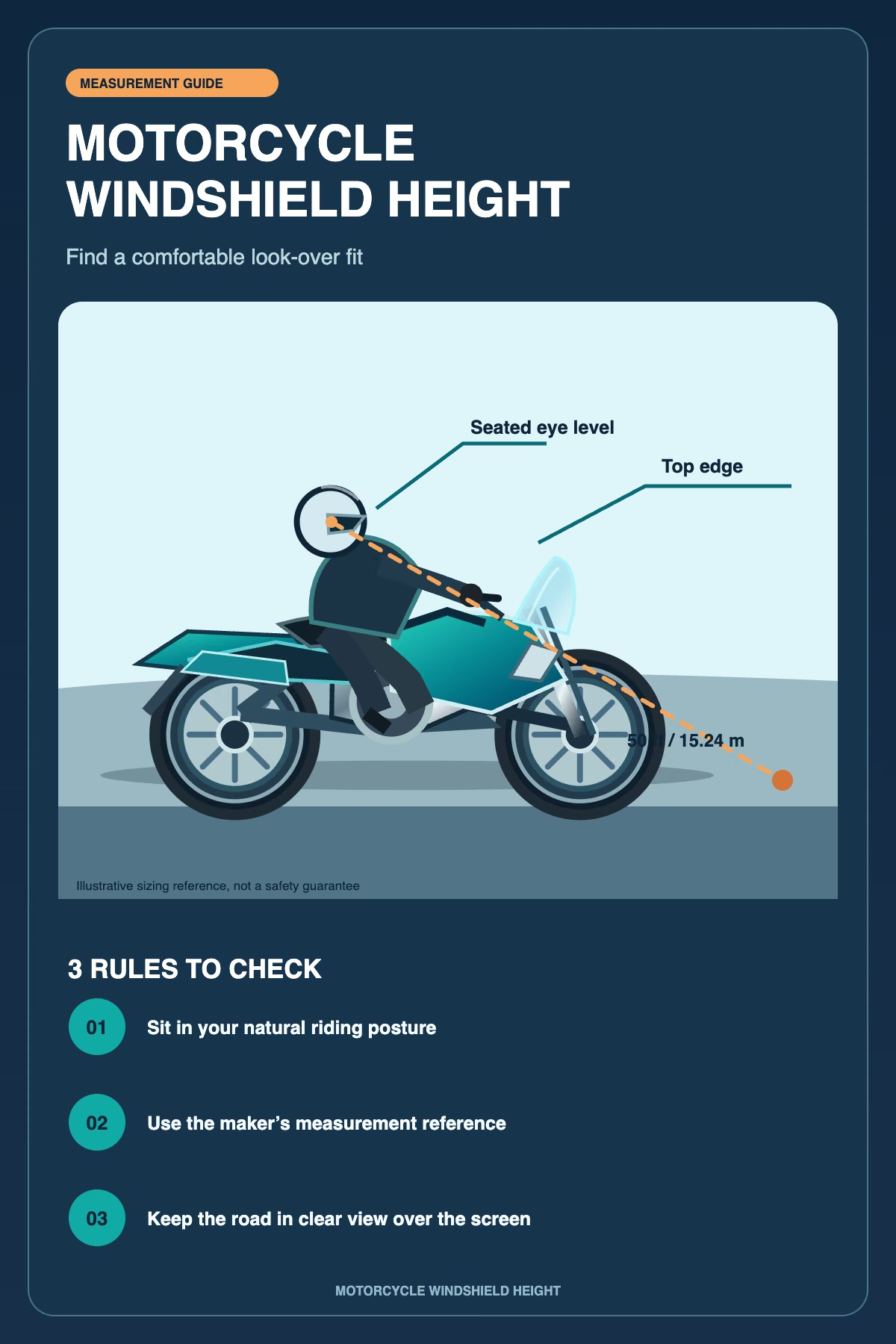
The 50-foot sightline test is a commonly used method for identifying an appropriate look-over motorcycle windshield height.
National Cycle describes the method as choosing a windshield that allows the rider to see the road approximately 50 feet ahead over the upper edge. Clearview Shields also incorporates a 50-foot reference into its sizing procedure.[1][2]
For example, suppose the measured height from the manufacturer’s reference point to the desired top-edge location is 38 cm. If compatible shields are available in 36 cm and 41 cm sizes, the shorter option may be more appropriate for preserving a look-over configuration, assuming the dimensions use the same measurement convention.
The 50-foot method is a sizing reference, not a universal legal requirement or guarantee of safe visibility. It does not replace checking closer road hazards, different riding positions, uneven terrain, or nighttime conditions.
Common mistakes include measuring with the motorcycle leaning on its side stand, using a standing-height estimate, adopting an unnatural seated posture, or comparing screens measured from different baselines.
Choosing the Right Windshield Height for Different Motorcycles
Motorcycle design strongly influences windshield requirements. Touring motorcycles generally accommodate larger screens and extensive front fairings, while sport motorcycles use compact windscreens intended to work with a forward-leaning rider.
Cruisers and naked motorcycles may have aftermarket fork-mounted or handlebar-mounted screens, while adventure motorcycles often use adjustable or taller fairing-mounted designs.
Each configuration has different mounting constraints, aerodynamic behavior, and visibility considerations. The correct choice must therefore account for motorcycle-specific fitment as well as rider dimensions.
Touring Windshield Height for Long-Distance Riding
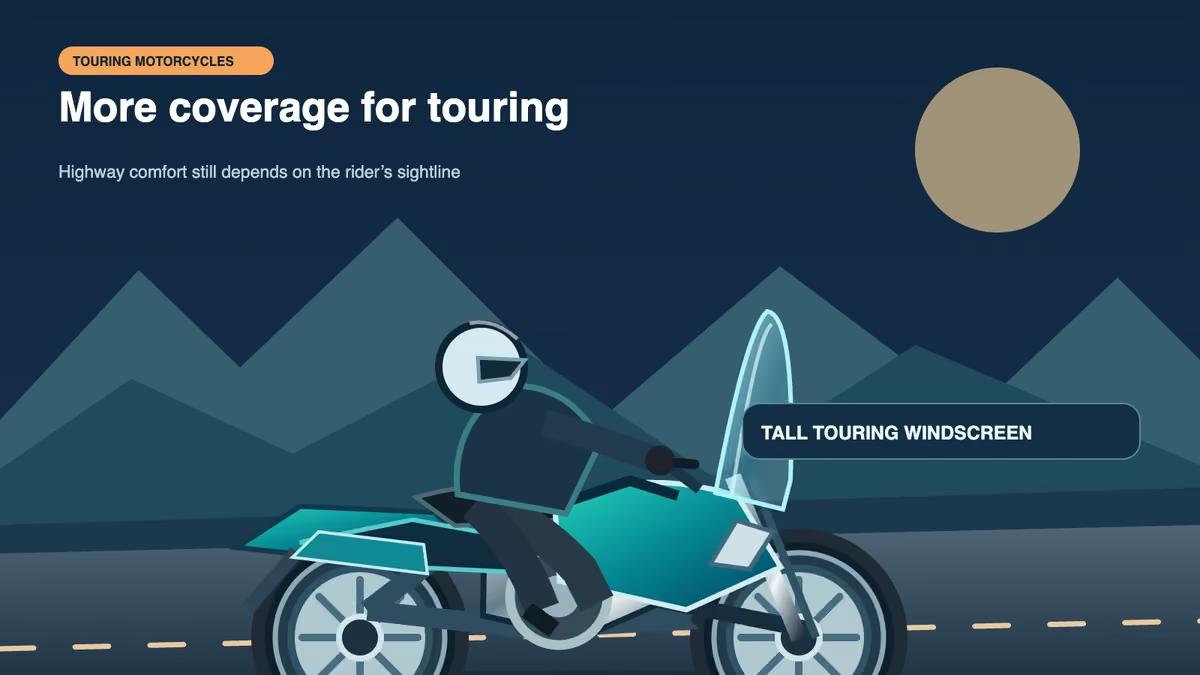
Touring motorcycle windshields are typically designed to reduce sustained wind pressure on the rider during extended journeys. Their larger dimensions can improve upper-body protection and reduce the exposure associated with long periods of highway travel.
Models such as the
Honda’s 2026 Gold Wing uses an electrically adjustable windshield with approximately 4.9 inches of vertical adjustment. The screen also changes inclination as it moves, demonstrating how height and angle can be linked in a factory-designed system.[4]
BMW offers a taller, wider comfort windshield for its R 1300 RT, designed to improve weather protection and manage airflow around the rider and passenger.[5]
Medium-height touring screens may provide a good balance between direct visibility and wind protection. Taller touring screens can improve shelter but may increase dependence on looking through the screen.
For long-distance riding, prioritize a comfortable seated sightline, manageable helmet turbulence, and sufficient protection without restricting forward visibility.
Short Motorcycle Windshield: Benefits and Limitations
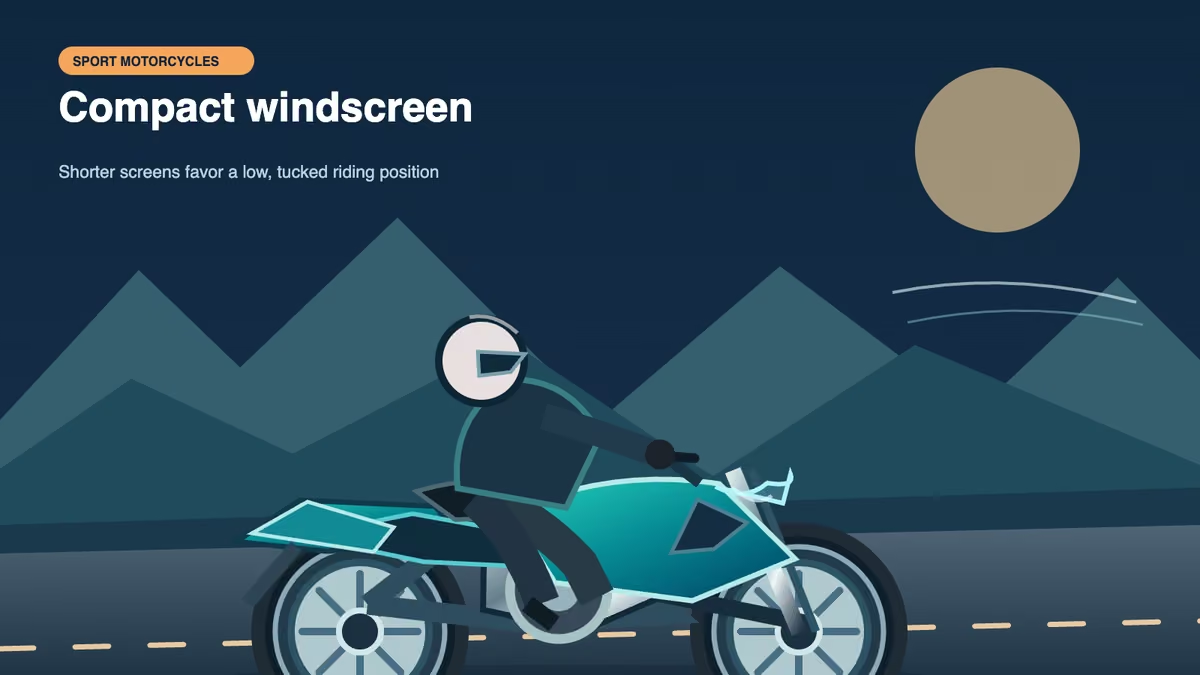
A short motorcycle windshield, sometimes called a flyscreen or sport screen, provides limited airflow deflection without extending far into the rider’s forward view.
Short screens are common on naked motorcycles, cruisers, sport motorcycles, and motorcycles designed primarily for urban or recreational riding.
Their advantages can include a compact appearance, unobstructed forward vision, and greater airflow around the helmet and upper body during hot weather.
However, a short windshield may direct airflow toward the chest, shoulders, neck, or helmet, depending on the riding position and screen shape.
A short screen does not automatically produce more helmet buffeting. On some motorcycles, reducing screen height can place the helmet in relatively undisturbed airflow instead of the turbulent wake created by a taller windshield.
The trade-off is usually less protection from wind pressure and adverse weather, particularly during sustained highway riding.
Adjustable Motorcycle Windshield vs. Fixed Windshield
A fixed motorcycle windshield maintains essentially the same height and inclination after installation, apart from any adjustment specifically provided by its mounting hardware.
An adjustable windshield allows the rider to change the screen’s position, often through a manual bracket system or an electric adjustment mechanism.
Manual adjustment
Usually involves sliding brackets, adjustment knobs, or specified mounting positions. Changes generally require the motorcycle to be stopped.
Electric adjustment
Uses a powered mechanism controlled by the rider, with operating procedures and restrictions determined by the motorcycle manufacturer.
MadStad Engineering produces aftermarket systems that permit height and angle changes through adjustable brackets. Its installation guidance emphasizes tightening adjustment hardware securely and making bracket adjustments only when stopped.[6]
Electric systems, such as those found on selected Honda and BMW touring models, provide more convenient adjustment within the manufacturer’s designed range.
Adjustable systems are useful when riding conditions change, but they introduce additional moving parts, brackets, or electrical components. Proper maintenance and mounting security remain essential.
Fairing-Mounted Windshield Height
A fairing-mounted windshield attaches to the motorcycle’s front bodywork or a supporting structure associated with the fairing.
This configuration is common on touring, sport-touring, adventure, and fully faired sport motorcycles.
Because the fairing determines the screen’s mounting position, advertised windshield height may describe only the visible portion above the fairing or the distance from a specific lower mounting reference.
A replacement windshield measuring 30 cm from its designated mounting point is not necessarily comparable to another screen advertised as 30 cm above the fairing edge.
Fairing-mounted screens may also work together with side deflectors, vents, mirrors, and body panels to shape airflow.
When selecting a replacement, verify the motorcycle model and year, original mounting geometry, fastener positions, and any adjustment hardware. A taller screen should not interfere with the fairing, instruments, handlebars, or other installed accessories.
Fork-Mounted Windshield Height
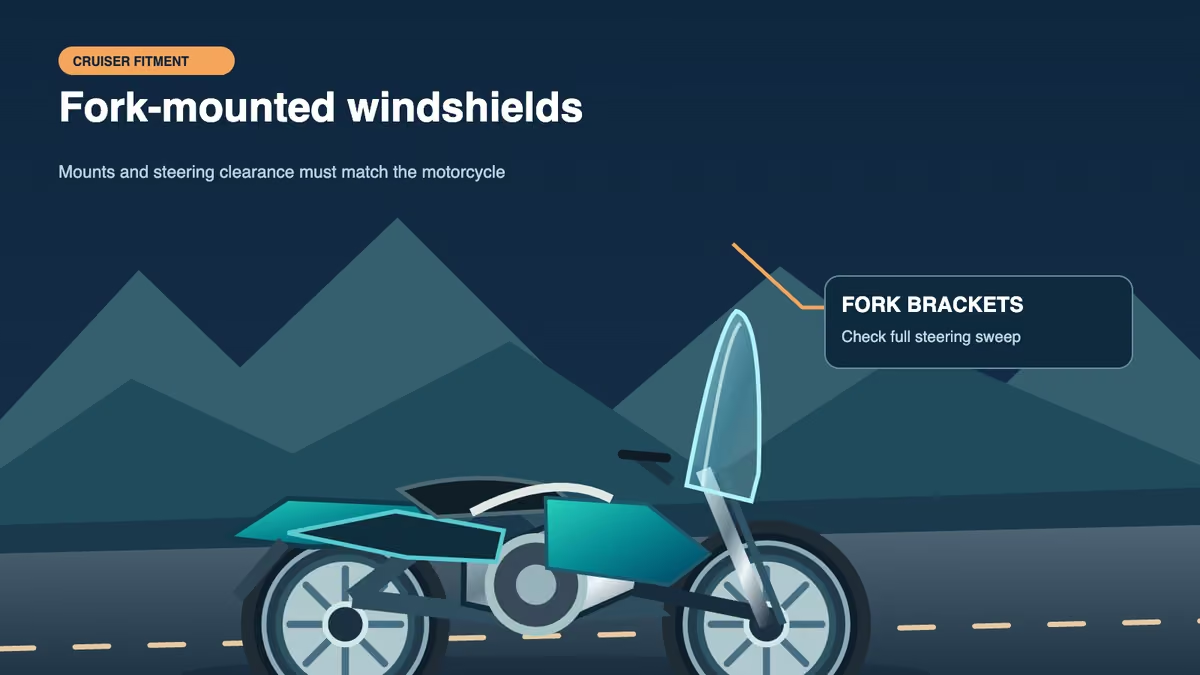
A fork-mounted windshield uses brackets attached to the motorcycle’s front fork assembly or associated mounting points.
This arrangement is common on some cruisers and standard motorcycles without extensive factory fairings.
Fork-mounted windshields generally move with the steering assembly, so the screen’s width, mounting position, and bracket geometry must permit unrestricted steering movement.
The fork angle can influence the windshield’s installed rake angle, although many mounting systems allow some adjustment independent of the forks.
A screen that is too wide or improperly positioned may interfere with mirrors, indicators, brake hoses, control cables, or nearby motorcycle components.
National Cycle offers fork-mounted windshield systems with model-specific fitment and measurement guidance.[1]
Always use the brackets and hardware specified for the motorcycle. Avoid improvising mounting locations or extending brackets beyond their approved adjustment range.
Handlebar-Mounted Windshield Height
Handlebar-mounted windshields attach through brackets or clamps designed to work with compatible handlebar dimensions and motorcycle configurations.
They are commonly used on standard motorcycles, smaller cruisers, and motorcycles without large front fairings.
The installed windshield height depends on the bracket geometry, handlebar position, screen shape, and permitted adjustment range.
Changing the handlebars or rotating them within their clamps may alter the windshield’s position relative to the rider. After such modifications, the original windshield setting should be reassessed.
Because the screen and its mounting assembly may move with the handlebars, careful clearance checks are essential.
Turn the steering fully in both directions while the motorcycle is stationary. Confirm that the windshield and mounting brackets do not contact the fuel tank, instrument cluster, brake lines, clutch cables, mirrors, or other components.
Motorcycle Model Fitment and Windshield Compatibility
Motorcycle windshield compatibility means that the windshield and mounting system are designed to fit a specific motorcycle configuration.
Compatibility often depends on the manufacturer, model, production year, fairing version, and installed equipment. Even motorcycles with similar appearances can use different mounting arrangements.
OEM windshields are designed for their specified motorcycle applications. Aftermarket windshields may offer alternative heights, widths, materials, and aerodynamic profiles, but they must still match the correct mounting system.
Before purchasing a replacement, verify the following:
- Exact motorcycle make, model, and production year.
- Applicable fairing or trim version.
- Manufacturer-confirmed windshield fitment.
- Whether original mounting hardware can be reused.
- Whether additional brackets or spacers are required.
- Compatible windshield height and adjustment range.
- Full steering and accessory clearance.
- Compatibility with handguards, mirrors, and luggage.
- Material, tint, optical clarity, and local road-use requirements.
National Cycle and Memphis Shades both emphasize model-specific fitment, including mounting kits and hardware compatibility.[3][17]
Do not assume that a windshield fits simply because its dimensions resemble those of the original screen.
How Motorcycle Windshield Height Affects Aerodynamics and Riding Comfort
Motorcycle windshield height changes the airflow encountered by the rider, but aerodynamic performance depends on more than vertical dimensions.
Airflow also responds to the windshield’s shape, angle, width, curvature, vents, and relationship to the rider’s position. The motorcycle fairing and surrounding bodywork contribute to the resulting flow field.
Experimental and computational studies confirm that changing windshield configuration can influence pressure distribution, wake behavior, and aerodynamic drag. However, the precise results depend on the motorcycle, rider position, and windshield geometry.[7][8][9]
Wind Deflection and Airflow Direction
Wind deflection occurs when a windshield changes the direction of incoming airflow around the motorcycle and rider.
At riding speed, air approaching the screen is redirected along its surface and around its upper and side edges. The resulting flow can pass above the rider’s head, travel around the shoulders, or interact with the helmet.
A shorter windshield may leave more of the upper body exposed to direct airflow. A taller screen can redirect more air upward, although its wake may also affect the rider.
The upper-edge position is particularly important because it influences where airflow leaves the screen and how the separated flow interacts with the helmet.
A 2021 experimental study of motorcycle windshield configurations found that windshield shape and rider posture influence aerodynamic behavior, including wake velocity fluctuations.[7]
This explains why height should be evaluated together with the rider’s posture rather than treated as an independent performance specification.
Aerodynamic Turbulence Around the Windshield
Aerodynamic turbulence describes irregular, fluctuating airflow rather than smooth, relatively steady movement.
As air passes around a motorcycle windshield, it may separate from the upper or side edges, producing a wake containing changing air velocities and pressures.
This disturbed flow can interact with the helmet, shoulders, and areas behind the windshield.
Windshield height, curvature, width, inclination, venting, and surrounding motorcycle bodywork all influence the resulting airflow.
A taller windshield may improve wind protection while shifting turbulent airflow into a position that causes discomfort. Conversely, a smaller screen may expose the rider to greater wind pressure while producing less pronounced helmet buffeting.
The exact result is motorcycle-specific. Aerodynamic studies should not be interpreted as proving that one windshield height is universally superior.
Helmet Buffeting: Causes and Windshield Height Solutions
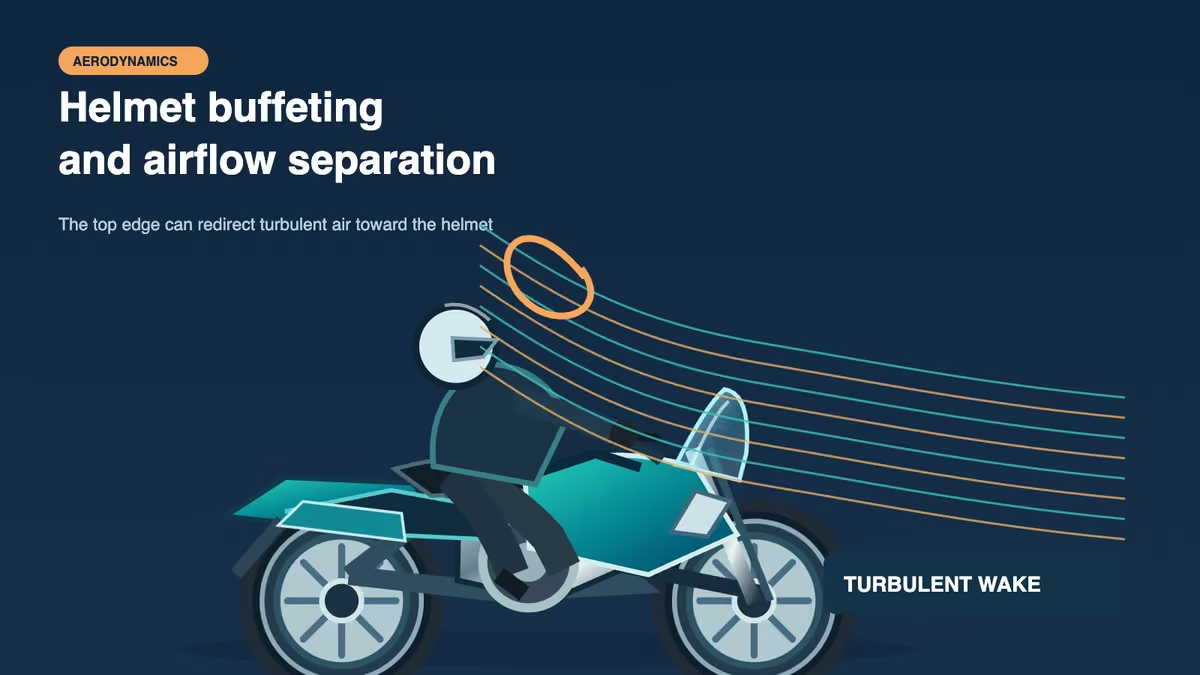
Helmet buffeting is the repeated shaking, pulsing, or unstable loading of a motorcycle helmet caused by disturbed airflow.
It commonly occurs when the rider’s helmet sits in a turbulent region created by the windshield, fairing, or surrounding components.
Typical symptoms include helmet vibration, pressure fluctuations around the head, and discomfort at certain speeds.
Several adjustments may improve the situation:
- Raise the windshield so more airflow passes above the helmet.
- Lower the windshield so the helmet receives cleaner, more consistent airflow.
- Adjust windshield inclination within the permitted range.
- Evaluate a compatible vented windshield or pressure-management system.
- Test a purpose-designed adjustable deflector or spoiler.
- Check whether rider posture or helmet shape contributes to the problem.
These are alternative troubleshooting options, not a sequence guaranteed to work.
Increasing windshield height does not always solve helmet buffeting. The problem may become worse if the new upper-edge position directs turbulent airflow toward the helmet.
Wind Noise Reduction Through Windshield Height Optimization
Motorcycle wind noise is produced partly by airflow interacting with the helmet and surrounding motorcycle components.
The windshield can influence noise exposure by changing the flow reaching the rider’s head. However, quieter airflow does not necessarily result from installing a taller screen.
A poorly matched windshield may direct turbulent air toward the helmet, producing greater perceived noise than a shorter configuration.
Helmet construction, visor sealing, rider posture, motorcycle bodywork, and riding speed also influence noise.
Research published in the International Journal of Occupational Safety and Ergonomics found that the measured acoustic attenuation of motorcycle helmets varies by frequency, with limited protection against low-frequency noise in the helmets studied.[10]
Windshield adjustment should not replace appropriate hearing protection. Properly fitted motorcycle-compatible earplugs can reduce noise exposure, and hearing protection should be selected so that important traffic sounds remain perceptible.[11]
Wind Blast Protection and Rider Fatigue
Wind blast is the pressure exerted on the rider by incoming airflow, particularly against the chest, shoulders, arms, and helmet.
At sustained highway speeds, this pressure can require continuous muscular effort to maintain a comfortable riding posture.
A windshield that redirects airflow away from the torso may reduce this physical loading and improve long-distance comfort.
The appropriate degree of protection depends on riding conditions. A commuter traveling short urban distances may prefer greater ventilation, while a touring rider covering long highway distances may prioritize sustained upper-body protection.
Height and width work together. A tall but narrow screen may protect the central torso while leaving the shoulders exposed.
A larger windshield can improve shelter, but it may also reduce airflow that would otherwise help cool the rider in hot weather.
The best configuration balances fatigue reduction, ventilation, and visibility.
Helmet Airflow and Ventilation
Motorcycle helmets use ventilation openings and internal channels to manage airflow around the head.
The effectiveness of these systems depends partly on the air reaching the helmet, which can change when windshield height or inclination is adjusted.
A tall windshield may place the helmet in a relatively sheltered region, reducing direct airflow through certain ventilation openings.
A shorter windshield may expose the helmet to stronger airflow, potentially improving ventilation but increasing wind pressure and noise.
The exact result depends on helmet design, intake locations, visor geometry, rider position, and riding speed.
During hot weather, some riders prefer a windshield setting that allows more airflow around the helmet and upper body.
In colder conditions, greater wind protection may feel more comfortable. However, ventilation remains important for managing visor fogging and maintaining a clear view.
Highway Windshield Performance
Motorcycle windshield behavior can change considerably as speed increases.
Aerodynamic dynamic pressure is proportional to the square of airflow speed:
[
q=frac{1}{2}rho v^2
]
Here, (q) represents dynamic pressure, (rho) is air density, and (v) is the speed of airflow relative to the motorcycle.
Under otherwise comparable conditions, doubling the relative airflow speed increases dynamic pressure by a factor of four.
This does not mean that every force on a motorcycle or windshield increases by precisely the same factor, because actual forces also depend on aerodynamic coefficients, geometry, and airflow conditions.
A 2024 computational study involving a Honda CB500X found differences in drag and rider-facing pressure among original and aftermarket windshield designs.[8] A separate 2026 computational investigation reported a trade-off between lower aerodynamic drag with shorter screens and reduced rider pressure with taller configurations in the geometries studied.[9] <Cite refs={[“turn213225search7″,”turn213225search10”]}/>
These findings support evaluating comfort and aerodynamic efficiency separately.
After adjusting a windshield, begin testing at low speeds in safe conditions. Gradually evaluate its performance at normal operating speeds while checking for vibration, unusual handling, and helmet turbulence.
Passenger Wind Buffeting on Touring Motorcycles
Passenger wind buffeting occurs when disturbed airflow reaches the passenger’s helmet or upper body, producing pressure fluctuations, noise, or head movement.
On touring motorcycles, the passenger is often seated higher than the rider, which may place the passenger in a different airflow region.
A windshield adjustment that improves the rider’s comfort can change the flow reaching the passenger. Consequently, both occupants may experience different results from the same configuration.
Windshield width, curvature, rearward airflow, and the distance between rider and passenger can all influence passenger exposure.
When a motorcycle is regularly used for two-up touring, test windshield performance with the normal passenger and luggage load.
Adjust the screen only within its approved range and verify that the rider retains sufficient visibility. A configuration that protects the passenger but compromises rider vision or handling is not appropriate.
Crosswind Stability and Windshield Height
Crosswind stability describes how a motorcycle responds to airflow arriving from the side rather than directly ahead.
A windshield creates an aerodynamic surface exposed to these lateral winds. Its shape, width, height, and mounting position influence the resulting side forces and moments.
A larger windshield does not necessarily make every motorcycle less stable, because the overall response depends on motorcycle geometry, fairing design, aerodynamics, speed, and the wind’s direction.
However, changing windshield dimensions can alter side-wind loading and steering feel.
For this reason, large aftermarket windshields should be installed only with compatible, structurally suitable mounting systems.
Watch for unusual flexing, vibration, or changes in steering response after installation.
Riders should also reduce speed as appropriate in strong or gusty crosswinds and follow the motorcycle manufacturer’s guidance on operating conditions and accessories.
How Windshield Shape and Accessories Influence Effective Height
The physical height of a motorcycle windshield is only one part of its aerodynamic performance. A shorter screen with carefully designed curvature or an upper-edge deflector may direct airflow differently from a taller conventional screen.
Similarly, windshield width, rake angle, ventilation openings, and aftermarket extensions can influence the area of protection and the position of turbulent airflow.
Understanding these characteristics can help riders solve wind-related problems without automatically purchasing the tallest available windshield.
Windshield Rake Angle and Effective Windshield Height
Windshield rake angle describes the inclination of the screen relative to a defined reference, commonly horizontal or vertical.
An upright screen generally places its top edge higher for a given surface length than a more inclined screen, assuming the lower mounting position remains unchanged.
However, rake angle also affects how air moves along the windshield and separates from its upper edge.
Changing the inclination can therefore influence both the installed vertical height and the airflow reaching the helmet.
For adjustable windshields, a small angle change may alter buffeting without requiring a substantial height adjustment.
The exact result depends on the windshield design and surrounding airflow.
Riders should evaluate height and angle together while remaining within the manufacturer’s specified adjustment range.
An adjustment that improves aerodynamic comfort must not create interference with the handlebars, instruments, or other motorcycle components.
Windshield Width and Upper-Body Coverage
Windshield width influences how much airflow is redirected around the rider’s shoulders, upper arms, and torso.
A narrow sport windshield may provide useful protection when the rider leans forward but leave much of the upper body exposed during upright riding.
A wider touring windshield can redirect airflow farther around the sides of the rider, potentially increasing shoulder and upper-body coverage.
However, width also affects lateral airflow and the aerodynamic behavior of the windshield’s side edges.
A very wide screen may introduce mounting-clearance issues involving handlebars, mirrors, handguards, or other accessories.
Windshield height and width should therefore be considered together.
For riders who experience strong shoulder-level wind pressure, a wider compatible windshield or appropriate side deflectors may be more useful than additional windshield height alone.
Windshield Curvature and Aerodynamic Performance
Windshield curvature describes the shape of the screen’s surface, including its lateral contour and any upward bend near the upper edge.
Curvature can influence the direction of airflow as it travels along and separates from the windshield.
Conventional screens may have relatively simple curved profiles, while specially designed touring windshields incorporate more complex shapes.
A recurve windshield has an upper portion shaped to influence the upward trajectory of airflow. This can sometimes provide additional aerodynamic protection without requiring the same physical top-edge height as a conventional screen.
Clearview Shields incorporates recurve profiles into selected products, while National Cycle uses a distinctive V-shaped profile in its VStream windshield range.
National Cycle describes VStream’s design as directing turbulent airflow away from the sides of the rider’s head.[12]
These are design-specific characteristics rather than guarantees of identical performance on every motorcycle.
Curvature must also be evaluated for optical distortion, especially where the rider’s normal sightline passes through a strongly curved section.
Vented Motorcycle Windshield and Pressure Management
A vented motorcycle windshield incorporates one or more openings that permit controlled airflow through the screen.
These openings can influence the pressure difference between the front and rear of the windshield.
Without sufficient airflow behind a screen, pressure differences and separated airflow can contribute to an uncomfortable wake around the rider.
A properly designed vent may help change the pressure distribution and airflow characteristics behind the windshield.
Some vents are fixed, while others allow the rider to modify airflow within a manufacturer’s designed range.
However, vent effectiveness depends on the screen geometry, opening position, motorcycle fairing, and riding conditions.
A vented windshield is not guaranteed to eliminate buffeting or wind noise.
Riders should choose purpose-designed, compatible vented systems rather than cutting unapproved openings into an existing windshield, which could weaken the screen or interfere with its protective coating.
Motorcycle Windshield Extension for Additional Height
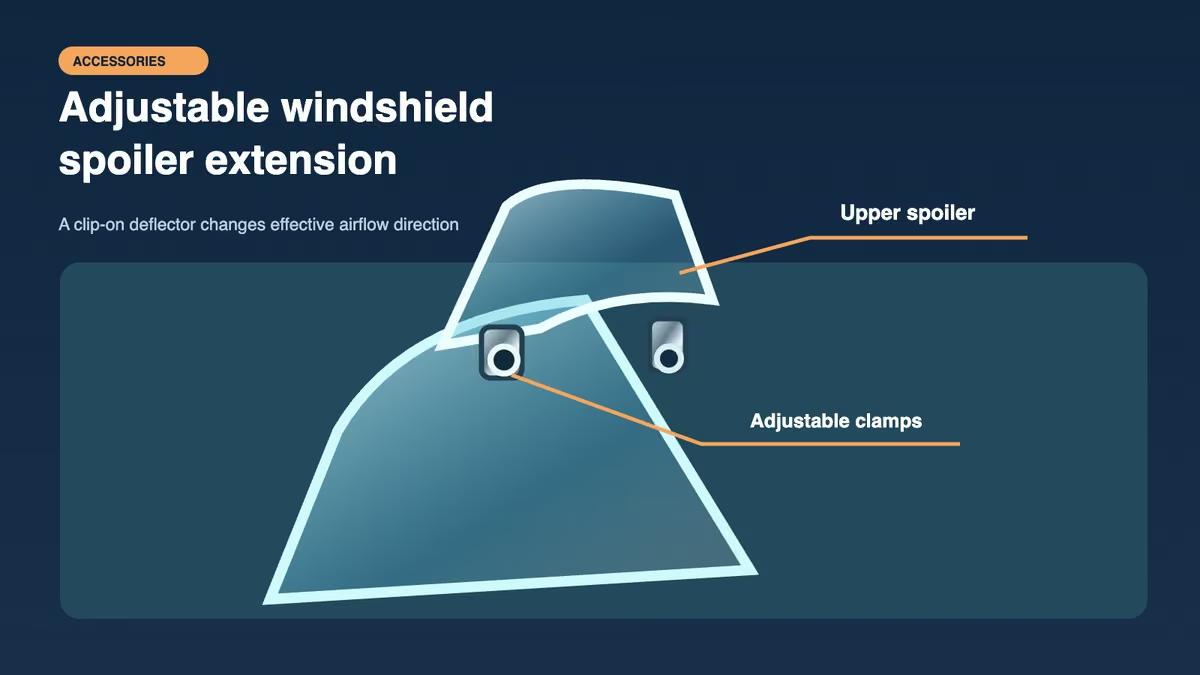
A motorcycle windshield extension is an accessory attached to an existing windshield to modify the effective upper-edge height or airflow direction.
Extensions commonly use clip-on, clamp-on, or purpose-designed fastening systems. Some provide fixed additional coverage, while others allow adjustments to height and inclination.
An extension can be useful when the existing windshield provides adequate torso protection but directs unwanted airflow toward the rider’s helmet.
The main advantage is that the rider may be able to modify the aerodynamic behavior without replacing the entire screen.
However, adding an extension introduces additional wind loading and mechanical stress on the original windshield and its mounts.
Before installation, verify the extension’s compatibility with the screen’s thickness, shape, material, and mounting design.
Check visibility, steering clearance, fastening security, and the effect on windshield vibration.
A full replacement may be preferable when the original screen is too small, damaged, optically poor, or structurally unsuitable for an extension.
Wind Deflector Lip vs. Taller Windshield
A wind deflector lip is a curved or adjustable component located near the windshield’s upper edge. Its purpose is to modify airflow leaving the main screen.
An integrated recurve lip forms part of the windshield itself. An aftermarket spoiler or deflector is attached as a separate component.
MRA offers adjustable spoiler systems designed to alter airflow around an existing windshield, while Puig produces clip-on and other adjustable deflectors.
Puig’s Multi-adjustable Visor 2.0 Clip-on provides height and inclination adjustment, although the manufacturer requires compatibility checks for the intended installation.[14]
MRA’s Vario spoiler systems similarly use an adjustable upper element to influence airflow near the windshield’s top edge.[13]
| Feature | Deflector lip or spoiler | Taller replacement windshield |
|---|---|---|
| Main function | Changes airflow direction near the upper edge | Changes screen coverage and airflow |
| Installation | Additional attachment to existing screen | Replacement of the main windshield |
| Height adjustment | Available on selected products | Depends on screen and mounting system |
| Structural loading | Adds load to existing mounts | Depends on replacement design |
| Optical considerations | Additional edge and possible overlap | Larger viewing surface |
| Best application | Fine-tuning a suitable existing screen | Correcting inadequate overall screen size |
Neither approach is universally superior. The appropriate solution depends on the original windshield’s size, condition, and aerodynamic performance.
How to Adjust or Modify Motorcycle Windshield Height
Motorcycle windshield adjustment should be a controlled process that preserves visibility, mechanical security, and compatibility.
Many wind-related problems can be improved through small changes to an existing adjustable windshield. In other cases, a purpose-designed replacement or compatible extension may be necessary.
Permanent modification, particularly trimming or drilling a windshield, requires greater caution because it can weaken the material, damage protective coatings, or invalidate the product warranty.
Whenever possible, begin with manufacturer-approved, reversible adjustments.
Windshield Height Adjustment Methods
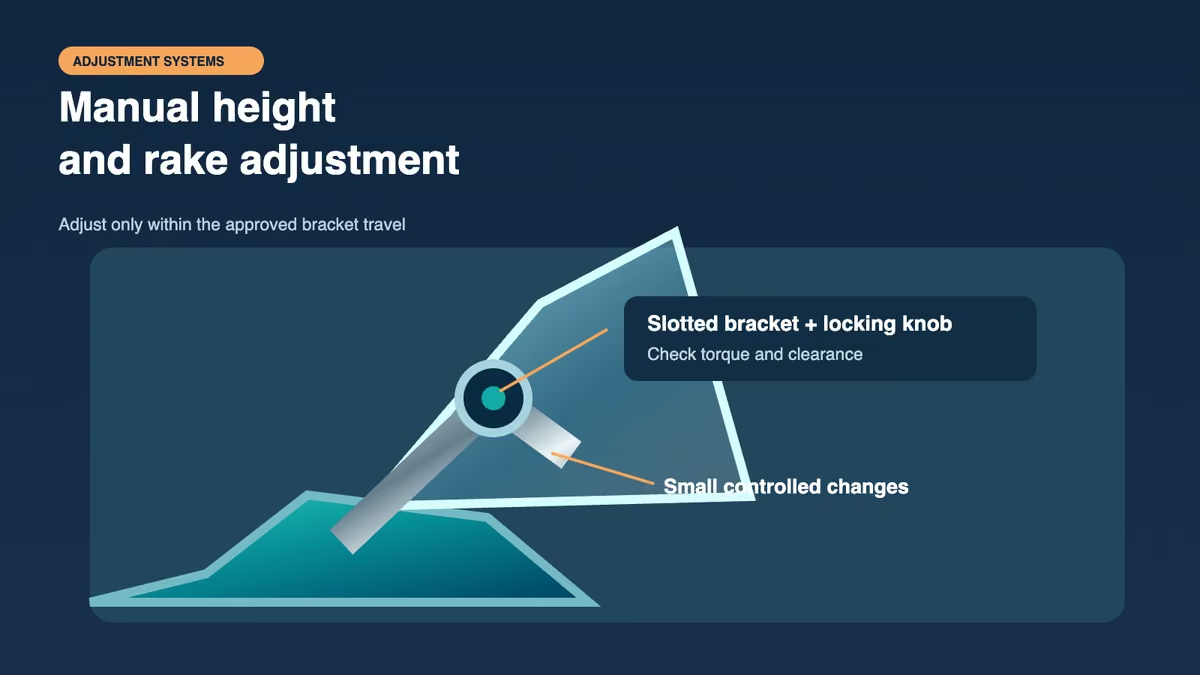
Windshield height adjustment involves changing the upper-edge position relative to the rider.
Depending on the motorcycle, this may be accomplished through an electric motor, sliding brackets, manual adjustment knobs, or several fixed mounting positions.
Follow this procedure for a manually adjustable system:
- Identify the manufacturer’s approved height and inclination adjustment ranges.
- Record the original screen position, using measurements or photographs.
- Park securely and stop the engine if required by the adjustment instructions.
- Loosen only the hardware designated for adjustment.
- Raise, lower, or tilt the screen slightly within the permitted range.
- Tighten all adjustment hardware according to the manufacturer’s instructions.
- Check the screen’s visibility, rigidity, and full steering clearance.
- Test the new configuration under safe riding conditions.
- Record the result before making another change.
Changing one adjustment at a time makes it easier to identify which setting improves or worsens the problem.
MadStad’s published adjustment instructions emphasize stopping before changing manually operated brackets, securing the knobs, and checking handlebar clearance.[6]
For electrically adjustable factory systems, follow the motorcycle owner’s manual. Do not assume that procedures applicable to one motorcycle also apply to another.
Windshield Trimming: When and How to Shorten a Screen
Windshield trimming involves permanently removing material to reduce the screen’s dimensions.
It may be considered when an otherwise compatible windshield is too tall, obstructs the rider’s normal sightline, or cannot be adjusted downward sufficiently.
However, trimming is irreversible and should not be the first solution.
Before cutting a windshield, confirm its material, coating, construction, and manufacturer instructions. Different acrylic and polycarbonate screens can require different handling, and inappropriate cutting methods may cause cracking, melting, chipping, or damage to the protective coating.
National Cycle publishes trimming instructions for certain windshields and explicitly states that trimming its windshield voids the product warranty.[16]
Where the manufacturer permits trimming, the general process involves establishing the finished height while seated, marking a smooth cutting line, using suitable cutting equipment, and carefully finishing the new edge.
Because improper modification can affect strength and optical safety, professional trimming by a workshop familiar with motorcycle windshield materials is preferable.
For expensive, coated, or structurally complex windshields, purchasing a correctly sized replacement may be the safer option.
Troubleshooting Windshield Height Problems
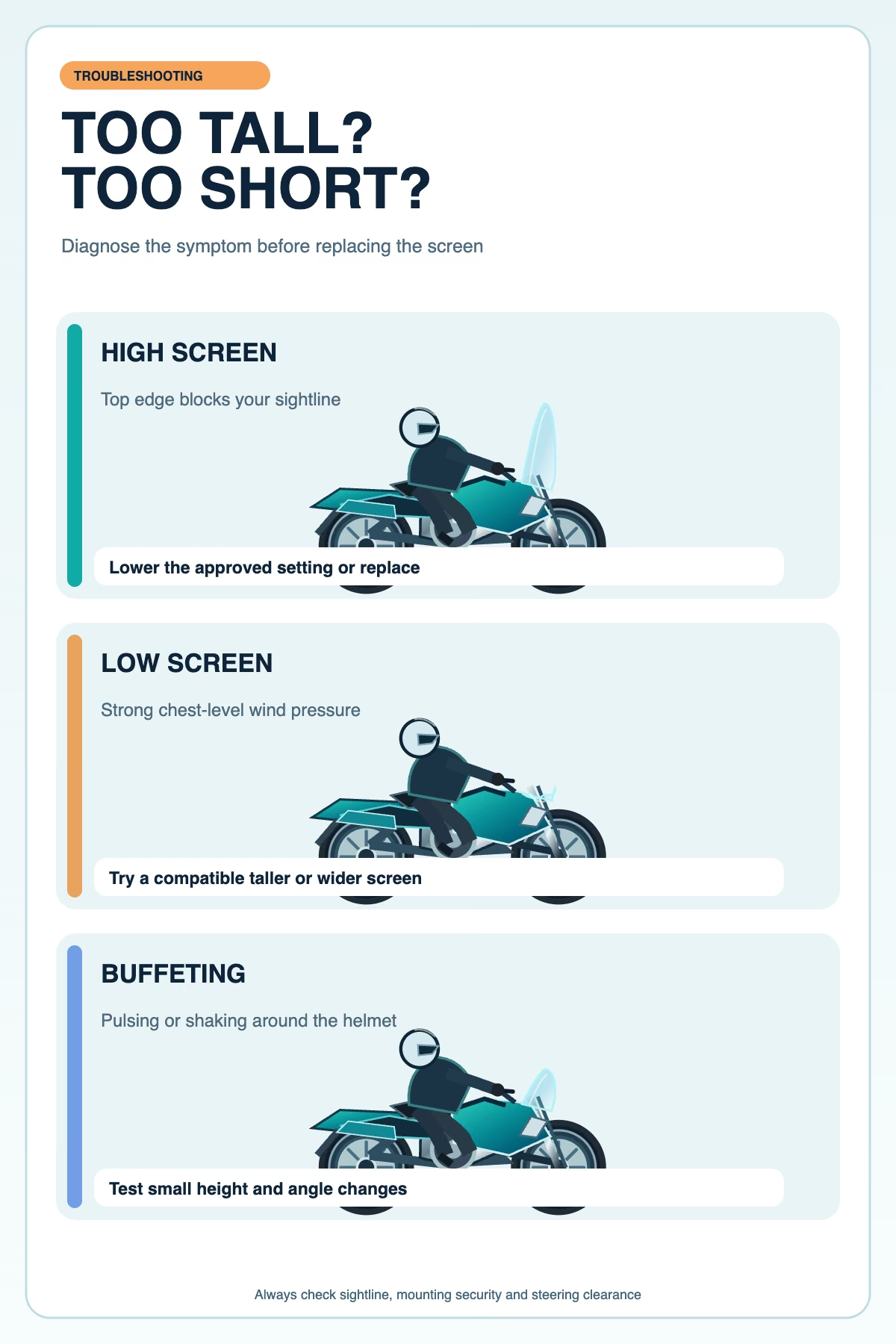
Windshield problems often have more than one possible cause. For example, helmet buffeting may result from an unsuitable top-edge position, excessive turbulence around the fairing, or interactions with the rider’s helmet.
Similarly, poor wind protection may be caused by insufficient windshield width rather than height.
Effective troubleshooting begins by identifying the precise symptom, checking the installation, and evaluating one change at a time.
The following comparison provides a practical starting point.
| Problem | Possible cause | First action to consider |
|---|---|---|
| Windshield too tall | Upper edge obstructs the sightline | Lower the screen or select a shorter replacement |
| Windshield too short | Excessive direct wind exposure | Evaluate a taller compatible screen |
| Helmet buffeting | Helmet sits in turbulent airflow | Test small height or angle changes |
| Excessive wind noise | Turbulence or helmet airflow interaction | Evaluate airflow position and hearing protection |
| Windshield vibration | Loose hardware, flexible mounts, or unsuitable fitment | Inspect mounting system before riding |
| Passenger discomfort | Disturbed airflow reaches passenger | Evaluate two-up windshield performance |
Windshield Too Tall
A motorcycle windshield may be too tall when its upper edge interferes with the rider’s normal forward vision or forces an uncomfortable riding posture.
Riders may find themselves looking through an area of the windshield that becomes difficult to see through during rain or low-light conditions.
A tall screen may also alter helmet airflow or create undesirable turbulence, depending on its geometry.
If an approved adjustment mechanism is available, first lower the windshield and reassess the sightline.
If the screen remains too tall, consider a shorter compatible replacement.
Trimming may be possible on certain products, but only when permitted by the manufacturer and performed using appropriate methods.
Windshield Too Short
A motorcycle windshield may be too short when it fails to provide the desired protection from direct wind pressure.
Common symptoms include strong airflow striking the chest, excessive exposure during cold weather, and discomfort during sustained highway riding.
However, a short screen should not automatically be considered unsuitable. It may provide good visibility, helmet ventilation, and relatively consistent airflow for a particular rider.
If additional protection is needed, first evaluate any approved height adjustment.
Other options include a taller replacement screen or a compatible upper-edge extension.
Before purchasing, determine whether the main problem is helmet exposure, chest-level wind pressure, or insufficient shoulder coverage. The solution may require changing width or shape rather than height.
Excessive Helmet Buffeting
Excessive helmet buffeting can produce repeated head movement, pressure fluctuations, and riding discomfort.
The problem often becomes noticeable within a particular speed range because airflow characteristics change with relative wind speed.
Begin by checking that the windshield and mounting hardware are secure.
Next, identify whether the helmet appears to be encountering turbulent airflow from the windshield’s top edge or sides.
If the windshield is adjustable, test small changes to height and inclination, using safe conditions and keeping other variables as consistent as possible.
A compatible spoiler, different screen profile, or pressure-management vent may help in selected installations.
If the buffeting becomes severe enough to interfere with vision, concentration, or control, stop riding until the problem is addressed.
Excessive Wind Noise
Excessive wind noise may result from airflow over the windshield, turbulence around the helmet, or the helmet’s own aerodynamic characteristics.
The windshield is only one component of the problem.
Check whether noise changes when the screen is moved within its approved adjustment range. A quieter setting may indicate that the previous configuration directed turbulent air toward the helmet.
Helmet fit, visor sealing, helmet ventilation, and riding posture should also be evaluated.
Do not assume that a taller windshield will automatically make the motorcycle quieter.
Research indicates that motorcycle helmet noise exposure depends on multiple interacting factors, including helmet characteristics and the rider’s position relative to the airflow.[10]
Appropriately fitted hearing protection remains important, particularly during prolonged riding.
Windshield Vibration
Windshield vibration refers to visible or noticeable movement of the screen during operation.
Possible causes include loose mounting hardware, damaged rubber isolators, incompatible brackets, excessive screen flex, or aerodynamic loading beyond what the mounting system was designed to handle.
Some movement may be characteristic of a particular design, but unusual, increasing, or severe vibration requires investigation.
With the motorcycle stopped, inspect the mounting points, brackets, fasteners, windshield material, and surrounding components.
Look for cracks near mounting holes, missing hardware, worn isolators, or contact with motorcycle bodywork.
Do not attempt to eliminate vibration by randomly overtightening plastic-mounted fasteners, because excessive tightening can damage the windshield.
If the cause is uncertain or the mounting system is visibly compromised, obtain professional inspection before riding.
Passenger Discomfort
Passenger discomfort can result from airflow that reaches the passenger differently from the rider.
This is particularly relevant on touring motorcycles where the passenger sits higher or farther behind the windshield.
A screen that creates a comfortable airflow region around the rider may still leave the passenger exposed to disturbed air.
To troubleshoot, evaluate the motorcycle with the normal passenger and luggage load, starting with the original windshield settings.
If adjustment is available, test modest changes while maintaining clear rider visibility.
Passenger helmet design, seating posture, and surrounding luggage or fairing components may also influence the experience.
The goal should be a configuration that provides acceptable comfort for both occupants without compromising handling, mounting security, or road visibility.
Windshield Height, Visibility, and Riding Safety
Visibility and mechanical security should take priority over aerodynamic comfort when selecting a motorcycle windshield.
A windshield can provide excellent wind protection yet still be unsuitable if it obstructs the rider’s view, produces significant optical distortion, interferes with steering, or has an insecure mounting system.
Rain, nighttime reflections, scratches, and dirt can make these problems more serious. For this reason, windshield selection should include both stationary fitment checks and controlled riding evaluations under appropriate conditions.
Rain Visibility and Windshield Height
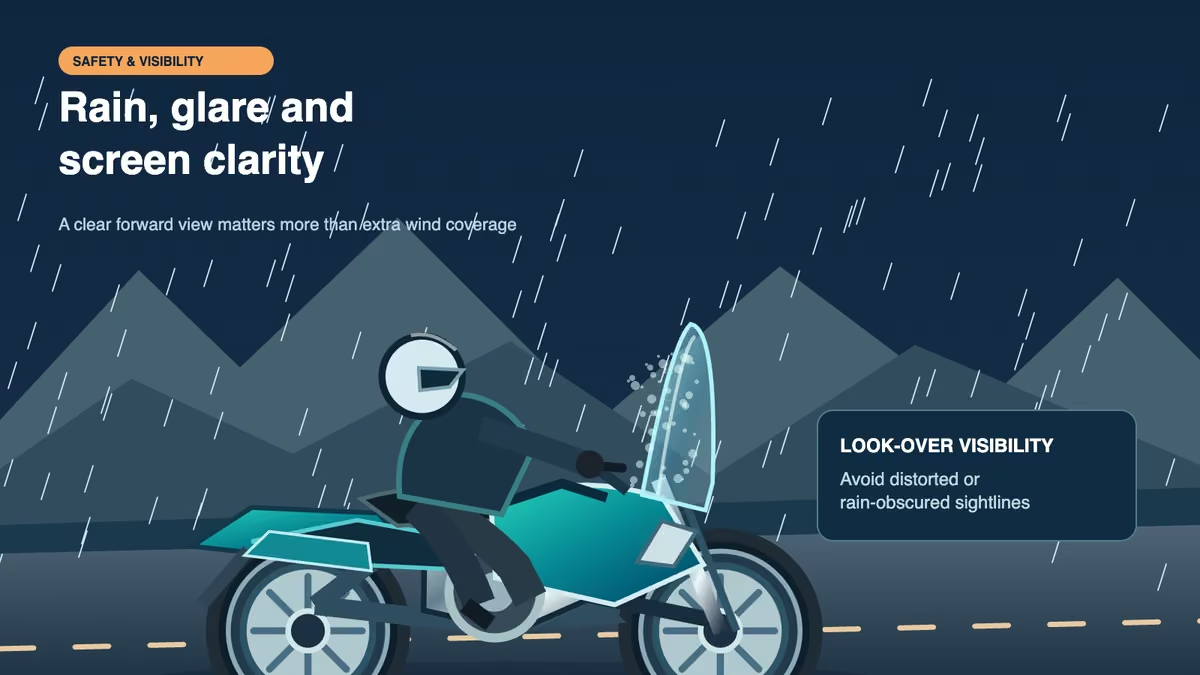
Rain visibility refers to the rider’s ability to see the road and surrounding traffic when precipitation, road spray, or moisture affects the motorcycle and protective equipment.
Rainwater accumulating on a windshield may interfere with vision, especially when droplets combine with dirt, insects, or road residue.
A look-over windshield allows the rider to view much of the road directly above the screen, reducing dependence on the windshield’s optical condition.
A look-through windshield may provide greater weather protection, but rainwater and contamination can directly affect the normal forward view.
Neither configuration eliminates the need for a clean helmet visor and appropriate wet-weather riding practices.
Windshield treatments should be selected carefully because some automotive glass products contain chemicals incompatible with motorcycle windshield plastics.
National Cycle warns against exposing its acrylic and polycarbonate screens to unsuitable cleaners containing alcohol, ammonia, or strong solvents.[15]
In wet conditions, reduce speed as appropriate, maintain a greater following distance, and ensure that both the helmet visor and windshield provide adequate visibility.
Windshield Optical Distortion and Visual Clarity
Optical distortion occurs when the windshield changes the apparent shape, position, or clarity of objects viewed through it.
This can be influenced by material quality, surface curvature, manufacturing defects, scratches, haze, and damage to protective coatings.
Distortion becomes particularly important when a rider’s normal forward sightline passes through the windshield.
Strong curvature, poorly finished edges, or damaged surfaces may produce noticeable visual effects. Reflections and glare can also become more troublesome during nighttime riding.
Proper maintenance helps preserve clarity.
Clean motorcycle windshields using products and methods approved for their specific material and coating. Avoid abrasive materials and cleaning chemicals that can attack plastic or remove protective treatments.
National Cycle recommends mild cleaning methods and cautions that some polishing products can damage the hard coating on particular windshields.[17]
A windshield with substantial scratches, clouding, cracks, or distortion in the rider’s viewing area should be assessed for replacement.
Final Safety Checklist Before Riding
After installing, adjusting, or replacing a motorcycle windshield, complete a final inspection before entering traffic.
A windshield should not be considered ready merely because it appears correctly positioned while the motorcycle is parked.
The installation must provide secure mounting, unobstructed steering, acceptable visual clarity, and stable behavior during normal operation.
Use the following checklist before riding, particularly after changing the windshield height, mounting brackets, handlebars, or seating arrangement.
Motorcycle windshield safety checklist
{@body const checks = [“Windshield is compatible with the motorcycle’s model and year”,”Top edge allows an acceptable forward sightline”,”Screen is clean, clear, and free of significant damage”,”Mounting brackets and fasteners are correctly secured”,”Handlebars can turn fully in both directions”,”Mirrors, cables, hoses, and handguards have adequate clearance”,”Adjustable mechanisms are locked or secured as specified”,”Screen does not contact fairings, instruments, or other components”,”Seat, suspension, and luggage configuration are accounted for”,”A controlled low-speed test shows no unusual vibration or interference”]}
{@body const [completed,setCompleted] = DIL.useState([])}
<button size=”xs” color=”secondary” variant=”outline” onClick={()=>setCompleted([])}>Reset
{#each checks as check, i}
<checkbox key={i} checked={completed.includes(i)} onChange={v=>setCompleted(old=>v?[…old,i]:old.filter(x=>x!==i))} lineThrough={false}>{check}
{/each}
<button block color=”primary” variant=”outline” onClick={()=>GenUI.copy(checks.map(c=>${completed.includes(checks.indexOf(c))?"[x]":"[ ]"} ${c}).join(“n”))}>
If a mounting problem, significant crack, steering obstruction, or unacceptable visibility issue is found, correct it before riding.
Frequently Asked Questions About Motorcycle Windshield Height
Motorcycle riders frequently encounter conflicting recommendations about screen height, eye-level positioning, and windshield adjustment.
Some manufacturers recommend screens that allow the rider to look over the top, while others provide products intended for looking through the windshield.
The answers below clarify the most common questions using manufacturer sizing guidance and established aerodynamic principles. They also distinguish practical starting points from measurements that must be confirmed for the individual motorcycle.
How Tall Should a Motorcycle Windshield Be?
A motorcycle windshield should be tall enough to provide the desired wind protection while maintaining clear forward visibility and acceptable aerodynamic comfort.
For a common look-over configuration, the upper edge may sit around the rider’s nose level or somewhat below eye level when seated naturally.
However, there is no universal height expressed in inches or centimeters that works for every motorcycle.
Rider eye height, seat configuration, handlebar position, and windshield geometry all affect the result.
The most reliable approach is to measure the actual seated sightline and compare it with manufacturer-specific windshield dimensions.
Should I Look Over or Through My Motorcycle Windshield?
Looking over the motorcycle windshield is often advantageous because the rider’s normal road view does not depend primarily on the screen’s transparency.
This becomes useful during rain, when dirt accumulates, or when surface scratches create glare.
Looking through a windshield can provide additional weather protection, particularly on larger touring motorcycles, but it places greater importance on optical clarity and maintenance.
Both arrangements are used in motorcycle applications.
For most riders evaluating an aftermarket replacement, a comfortable look-over configuration is a sensible starting point unless the motorcycle manufacturer specifies otherwise.
How Do I Measure Motorcycle Windshield Height?
Begin by identifying the measurement reference provided by the windshield manufacturer.
This could be the top of the headlight cutout, a fairing edge, the lower windshield mounting point, or another defined location.
Next, position the motorcycle upright and sit in your normal riding posture.
Use a helper to determine the desired upper-edge position based on your seated eye level and forward sightline.
Measure from the specified reference point and compare the result with the manufacturer’s available windshield dimensions.
Be careful to distinguish surface length from vertical height because the two are not interchangeable.
Can a Motorcycle Windshield Be Too Tall?
Yes. A motorcycle windshield can be too tall for the rider’s seated position or intended riding conditions.
An excessively high windshield may place its upper edge within an uncomfortable viewing area or force the rider to look through material that becomes obscured by rain, dirt, or scratches.
It may also produce unwanted aerodynamic effects, depending on its shape and angle.
The first solution is to lower the screen if the manufacturer provides an approved adjustment.
Otherwise, consider a shorter compatible replacement.
Trimming should only be considered when permitted by the windshield manufacturer.
Can a Motorcycle Windshield Be Too Short?
Yes. A windshield can be too short to provide the level of wind protection a rider needs.
This may result in strong pressure against the chest and shoulders, greater exposure to adverse weather, or uncomfortable airflow during long highway journeys.
However, short windshields are not inherently defective. They may work well on sport and naked motorcycles where ventilation and direct visibility are priorities.
If more protection is required, consider a taller compatible screen, an approved height adjustment, or an appropriate extension.
The goal is to correct the specific airflow problem rather than simply maximize windshield height.
Does a Taller Windshield Reduce Helmet Buffeting?
A taller windshield may reduce helmet buffeting if it moves turbulent airflow away from the rider’s helmet.
However, the result is not guaranteed.
Buffeting depends on the position of the helmet relative to the airflow leaving the windshield, as well as the screen’s angle, width, curvature, and surrounding motorcycle bodywork.
On some motorcycles, lowering the windshield can improve comfort by allowing the helmet to encounter more consistent airflow.
When troubleshooting, test small changes to height and angle separately.
If the existing screen cannot provide a comfortable configuration, a differently shaped replacement or compatible deflector may be appropriate.
What Is the 50-Foot Rule for Motorcycle Windshields?
The 50-foot rule is a windshield-sizing guideline used by manufacturers such as National Cycle and Clearview Shields.
It involves positioning the motorcycle on level ground and checking whether the rider can see a ground reference approximately 50 feet ahead over the windshield while maintaining a natural riding posture.
The method helps identify a suitable top-edge position for a look-over windshield.
It is not a universal legal rule, nor does it guarantee sufficient visibility under every riding condition.
The final selection must also account for close-range hazards, optical clarity, motorcycle geometry, and proper screen fitment.
Does Windshield Angle Affect the Height I Need?
Yes. Windshield angle influences both its installed vertical height and the direction of airflow leaving the upper edge.
A more upright screen generally places its top edge higher than a more inclined screen of similar surface length and mounting position.
However, changing the angle also changes the aerodynamic behavior of the windshield.
This can improve or worsen helmet buffeting, wind noise, and upper-body protection.
If your motorcycle has an adjustable system, evaluate height and rake angle together.
Always remain within the manufacturer’s approved adjustment range and check steering clearance after each change.
Can I Increase Windshield Height Without Replacing It?
Yes, provided the motorcycle and windshield support an appropriate adjustment or accessory.
Possible options include raising an adjustable factory windshield, using compatible height-adjustable brackets, or installing a purpose-designed windshield extension.
An upper-edge wind deflector may also improve airflow protection without increasing the main windshield’s dimensions substantially.
However, extensions and spoilers introduce additional mechanical loading and can affect visibility.
They should only be used when the original windshield and mounting system are suitable.
If the existing screen is damaged, too narrow, or fundamentally unsuitable, a properly sized replacement may be the better solution.
How Does Motorcycle Seat Height Affect Windshield Sizing?
Motorcycle seat height affects the rider’s position relative to the windshield, but the relationship depends on the motorcycle’s geometry.
A lowered seat may position the rider’s eyes closer to the windshield’s upper edge, making the screen appear taller.
A thicker seat cushion or different aftermarket seat may raise the rider’s head and reduce the apparent windshield height.
The rider’s torso proportions and posture also influence these changes.
Whenever the seat, suspension, or handlebar arrangement is significantly modified, repeat the seated sightline measurement.
Do not assume that a windshield selected for the original seating configuration will remain ideal.
What Windshield Height Is Best for Highway Riding?
The best motorcycle windshield height for highway riding provides a comfortable balance between wind protection, helmet airflow, visibility, and mounting stability.
A taller touring screen may reduce pressure against the upper body, especially during sustained highway travel.
However, a taller screen may also create unwanted turbulence if its upper edge directs disturbed airflow toward the helmet.
The appropriate choice depends on the motorcycle, rider posture, screen geometry, and typical riding conditions.
Begin with the correct seated sightline, then evaluate aerodynamic comfort using safe, controlled riding tests.
Avoid choosing a windshield solely because it is advertised as the tallest available option.
Should Motorcycle Windshield Height Be Measured Vertically or Along the Screen?
Motorcycle windshield height should be measured using the method specified by the windshield manufacturer.
Some products use a measurement along the windshield’s angled or curved surface. Others use a vertical distance from a fixed motorcycle reference point.
These methods produce different numbers, especially for screens with substantial inclination or curvature.
Consequently, a 40 cm windshield measured along its surface should not automatically be considered equivalent to a 40 cm windshield measured vertically.
Before ordering a replacement, review the dimensional diagram for the exact motorcycle application.
Consistent measurement methods are essential when comparing different screen sizes.
Final Recommendation: Choosing the Right Motorcycle Windshield Height
The correct motorcycle windshield height is the one that provides adequate protection without compromising the rider’s view of the road, normal riding posture, or motorcycle handling.
For many riders, the best starting point is a look-over windshield positioned around nose level or slightly below eye level, with the final sizing checked using the manufacturer’s recommended sightline procedure.
However, windshield height alone cannot determine aerodynamic performance.
A motorcycle windshield’s width, rake angle, curvature, vents, mounting position, and relationship to the rider’s helmet all influence comfort.
A taller windshield may provide more shelter, but it is not automatically quieter or safer. A shorter screen may produce more direct wind pressure while allowing smoother airflow around the helmet.
The most effective selection process is to:
- Measure your seated eye position in your normal riding posture.
- Use the manufacturer-specified mounting reference and dimensional method.
- Check the forward sightline, including the 50-foot reference where applicable.
- Select a motorcycle-specific windshield with suitable width, shape, and height.
- Install it using the specified hardware and instructions.
- Evaluate helmet buffeting, wind pressure, vibration, and visibility under safe riding conditions.
- Make small approved adjustments before considering additional accessories or replacement.
Ultimately, the optimal motorcycle windshield height is not the tallest possible screen, but the configuration that provides clear visibility, secure mounting, stable airflow, and comfortable protection for the individual rider.
Recommended Supporting Articles for Topical Authority
The following related articles would provide useful deeper coverage of subjects introduced in this guide. They can support a motorcycle windshield content cluster by addressing specific questions that require more detailed measurement instructions, troubleshooting, or product comparisons.
| Supporting article | Primary keyword |
|---|---|
| How to Measure Motorcycle Windshield Height | Motorcycle Windshield Measurement |
| Motorcycle Windshield Too Tall or Too Short | Motorcycle Windshield Too Tall |
| Motorcycle Windshield Height vs. Rider Height | Windshield Height for Rider Height |
| Best Windshield Height for Touring Motorcycles | Touring Windshield Height |
| Motorcycle Windshield Buffeting Solutions | Motorcycle Helmet Buffeting |
| Motorcycle Windshield Angle Adjustment Guide | Windshield Rake Angle |
| Motorcycle Windshield Extension vs. Replacement | Motorcycle Windshield Extension |
| How to Shorten a Motorcycle Windshield | Windshield Trimming |
| Motorcycle Windshield Height for Highway Riding | Highway Windshield Performance |
| Motorcycle Windshield Visibility in Rain | Motorcycle Windshield Rain Visibility |
These articles should provide additional technical depth rather than repeat the same general windshield-sizing advice. Internal links are most useful where the related topic directly expands on the section a reader is viewing.
Sources
The following sources include motorcycle windshield manufacturer guidance, official motorcycle specifications, published aerodynamic research, and hearing-protection guidance. Manufacturer recommendations are identified as product-specific guidance rather than universal scientific standards.
[1] National Cycle. Windshield Bible: Get the Right Height. Manufacturer sizing guidance covering seated eye height, motorcycle fitment, measurement conventions, and the 50-foot sightline method.
[2] Clearview Shields. Choosing Your Shield. Manufacturer instructions for windshield height measurements, look-over and look-through configurations, and the 50-foot sightline method.
[3] Memphis Shades. Frequently Asked Questions. Manufacturer recommendations for windshield height, model compatibility, mounting hardware, and cleaning.
[4] Honda Powersports. 2026 Honda Gold Wing. Official specifications and features, including the electrically adjustable windshield.
[5] BMW Motorrad. BMW R 1300 RT Customization. Official information regarding BMW touring windshield options and wind protection.
[6] MadStad Engineering. Adjusting the MadStad Brackets, Installation Manual. Installation and adjustment guidance reproduced from the manufacturer’s manual.
[7] Capone, A., and Romano, G. P. (2021). Effect of Windshield Configuration and Pilot Position on Motorcycle Performances. Journal of Wind Engineering and Industrial Aerodynamics, 218, 104753. Experimental study of motorcycle windscreen geometry, rider position, aerodynamic forces, and wake behavior.
[8] Ghazali, F., and Abdul Ghafir, M. F. (2024). Investigation of Different Windshield Designs for Aerodynamic Drag Force in Motorcycle. Progress in Aerospace and Aviation Technology, 4(1), 49–56. Computational investigation of windshield drag and pressure distribution on a Honda CB500X.
[9] Marzuki, M. A., and Abdul Ghafir, M. F. (2026). Aerodynamic Investigation of Motorcycle Windshield Design at Different Height Configurations. Progress in Aerospace and Aviation Technology, 6(1), 1–8. Computational investigation of windshield height, drag, and rider pressure.
[10] Młyński, R., Kozłowski, E., and Żera, J. (2009). Attenuation of Noise by Motorcycle Safety Helmets. International Journal of Occupational Safety and Ergonomics, 15(3), 287–293. Research on motorcycle helmet sound attenuation and its variation with frequency.
[11] National Institute for Occupational Safety and Health. Provide Hearing Protection. CDC guidance on selecting and correctly fitting hearing protection. General hearing-conservation guidance rather than motorcycle-specific windshield research.
[12] National Cycle. VStream Replacement Windscreen for Suzuki DL650/1000. Manufacturer description of the VStream aerodynamic profile and its intended effects on rider airflow.
[13] MRA. Vario Spoiler, Adjustable Motorcycle Windshield Deflector. Manufacturer information on adjustable spoiler design and mounting methods.
[14] Puig Hi-Tech Parts. Multi-adjustable Visor 2.0 Clip-on. Manufacturer specifications, adjustment characteristics, and compatibility guidance.
[15] National Cycle. Windshield Bible: Caring for Your Windshield. Windshield cleaning, chemical compatibility, storage, and material-care recommendations.
[16] National Cycle. Windshield Bible: Trimming Your Windshield. Manufacturer guidance and warranty considerations for trimming compatible windshields.
[17] National Cycle. National Cycle and ZTechnik Frequently Asked Questions. Additional manufacturer information about windshield fitment, maintenance, cleaning, and recommended height selection.