
Researched automotive guide | Updated November 17, 2026
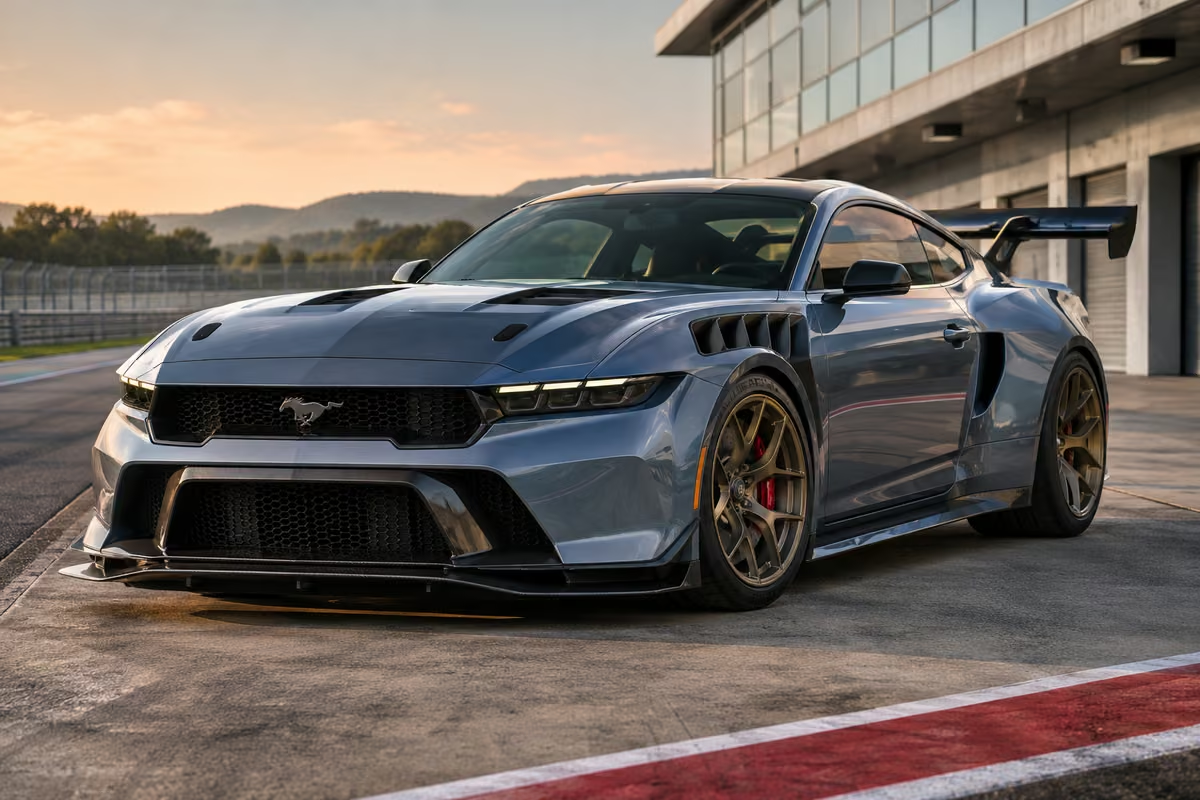
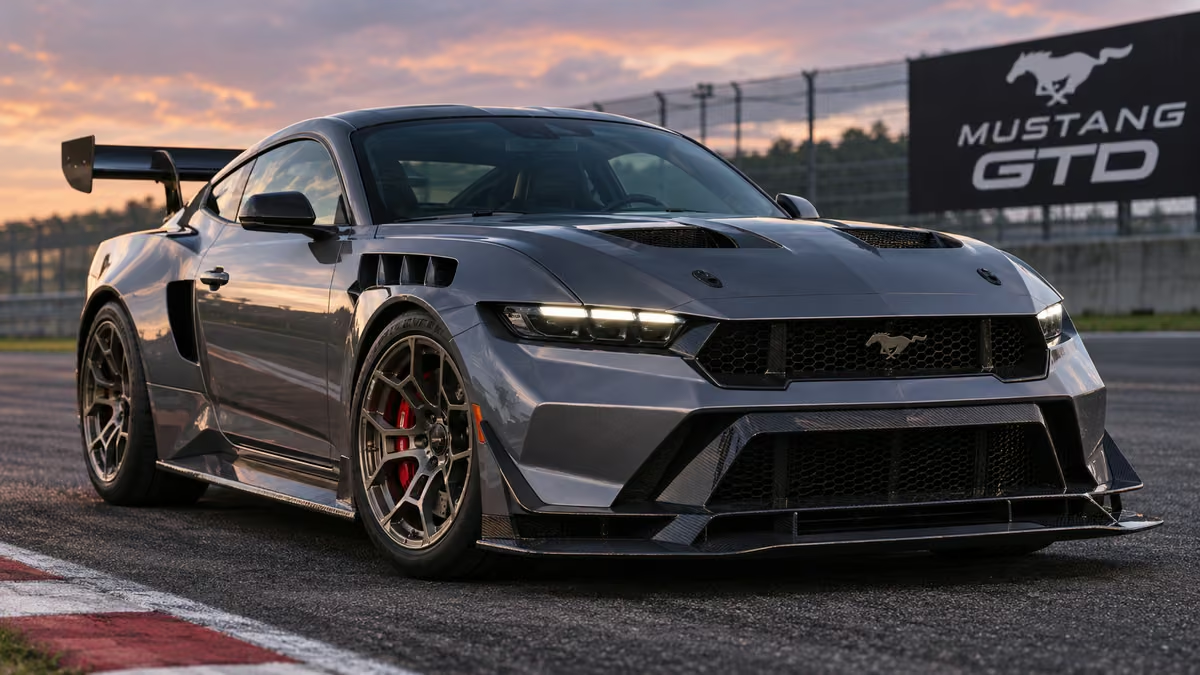
The Ford Mustang GTD takes the American muscle car concept into supercar territory. Developed by Ford Performance with engineering partner Multimatic, it combines an 815-horsepower supercharged V8, a rear-mounted eight-speed dual-clutch transaxle, carbon-fiber bodywork, sophisticated suspension technology and racing-derived aerodynamics.
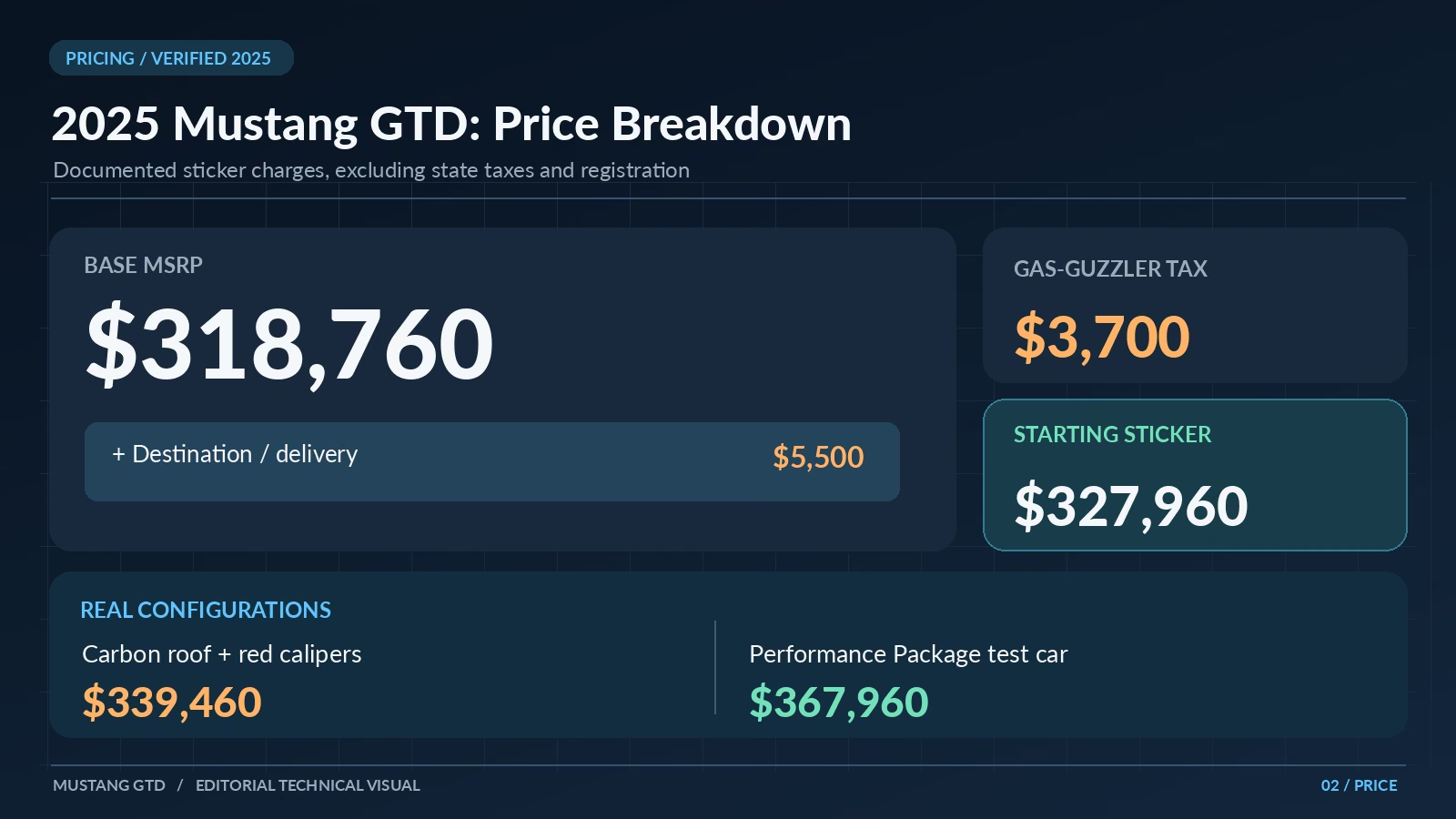
The 2025 Mustang GTD carries a documented base MSRP of $318,760, increasing to $327,960 with destination charges and the federal gas-guzzler tax. Optional equipment can raise that price substantially. Independent testing by Car and Driver recorded 0–60 mph in 2.8 seconds, while Ford claims a top speed of 202 mph. [2] [3]
The GTD’s significance extends beyond straight-line performance. Ford used the Nürburgring Nordschleife to demonstrate its engineering, eventually achieving a 6:40.835 lap in April 2026 with the more specialized Mustang GTD Competition. That result must be distinguished from the original GTD’s earlier lap times and specifications. [7]
Ford Mustang GTD Overview: What Makes This Supercar Special?
The Mustang GTD is not simply a higher-output version of the Mustang GT. Ford redesigned much of the vehicle around the requirements of circuit driving, giving it an unusually advanced suspension arrangement, substantial aerodynamic development and a performance-oriented transaxle layout. Its engineering approach is closer to that of specialized track-focused supercars than conventional performance coupes.
What Is the Ford Mustang GTD?
The Ford Mustang GTD is a limited-production, street-legal, front-engine supercar developed in connection with Ford’s Mustang GT3 motorsport program. The GTD designation refers to Grand Touring Daytona, a category within IMSA racing in which GT3-specification cars compete. The GTD road car is not an identical GT3 race car, however, because road-car regulations permit some equipment that motorsport technical regulations restrict.
Ford Performance led the program alongside Multimatic, which contributed specialized vehicle engineering, chassis technology and manufacturing expertise. The result retains recognizable seventh-generation Mustang styling while incorporating components developed specifically for this vehicle.
Unlike the regular Mustang GT and Dark Horse, the GTD uses a supercharged 5.2-liter V8, a rear-mounted transmission and extensively reworked chassis hardware. Compared with the earlier Shelby GT500, it places greater emphasis on aerodynamic efficiency, suspension geometry and sustained circuit performance. [1]
Mustang GTD Specifications at a Glance
The principal specifications below apply to the standard 815-hp Mustang GTD, with 2025 independent test measurements identified separately. This distinction matters because equipment, pricing and measured performance can change between vehicles and model years. The 2026 GTD Competition is also mechanically different from the original GTD.
| Specification | Ford Mustang GTD |
|---|---|
| Engine | 5.2L supercharged V8 |
| Displacement | 5,163 cc |
| Maximum power | 815 hp at 7,400 rpm |
| Maximum torque | 664 lb-ft |
| Engine redline | 7,650 rpm |
| Transmission | Tremec 8-speed dual-clutch |
| Drivetrain | Rear-wheel drive |
| Seating capacity | 2 |
| Top speed | 202 mph, Ford claim |
| 0–60 mph | 2.8 seconds, independently tested |
| Quarter-mile | 10.6 seconds at 133 mph |
| Brakes | Brembo carbon-ceramic |
| Suspension | Multimatic adaptive system |
| Front tires | 325/30ZR20 |
| Rear tires | 345/30ZR20 |
| 2025 base MSRP | $318,760 |
| 2025 price with mandatory charges | $327,960 |
| Tested Performance Package | $40,000 |
| 2025 tested curb weight | 4,404 lb |
Sources: Ford specifications and the 2025 Car and Driver instrumented test. [1] [2]
Is the Mustang GTD a Supercar or a Muscle Car?
The GTD retains important muscle-car characteristics, including a powerful front-mounted American V8, rear-wheel drive and an aggressive Mustang identity. Its hardware, however, extends well beyond what traditionally defines a muscle car.
Supercar characteristics include the carbon-fiber construction, inboard rear suspension, transaxle packaging, active aerodynamic capability and carbon-ceramic braking system. Its six-figure price and independently documented racetrack performance further support that classification.
The most accurate description is a Mustang-based, front-engine supercar that combines American muscle-car heritage with modern motorsport engineering. Its fundamental purpose is to deliver exceptional performance on a closed circuit while remaining suitable for legal public-road use.
Mustang GTD Price Breakdown: How Much Does It Cost?
Understanding Mustang GTD pricing requires separating its basic manufacturer price from mandatory charges, factory options and the final purchase transaction. The best-documented reference is a genuine 2025 window sticker, subsequently authenticated by Ford to Car and Driver. Ford’s public 2026 GTD website does not provide an equivalent universal MSRP, so older pricing should not be represented as a confirmed 2026 quotation. [3]
What Is the Ford Mustang GTD Base MSRP?
The documented 2025 Ford Mustang GTD base MSRP is $318,760. This is the advertised manufacturer price for the vehicle before destination and delivery, federal gas-guzzler tax, individually selected options and applicable state or local charges.
When Ford originally introduced the GTD in 2023, it anticipated pricing of approximately $300,000. That early estimate explains why older articles and product announcements sometimes present a lower starting price than subsequent window stickers.
A confirmed 2025 production sticker provides better pricing evidence than the initial estimate. For 2026 buyers, however, the precise MSRP needs to be confirmed using the specific model-year order documentation or actual vehicle sticker.
Mustang GTD Starting Price With Fees
A verified 2025 Mustang GTD window sticker lists two additional charges that raise the base price. The destination fee covers delivery-related expenses, while the federal gas-guzzler tax is associated with the vehicle’s fuel-economy classification. Neither charge is the same as an optional factory upgrade.
| 2025 price component | Amount |
|---|---|
| Base MSRP | $318,760 |
| Destination and delivery | $5,500 |
| Federal gas-guzzler tax | $3,700 |
| Starting price with fees | $327,960 |
The calculation produces a documented starting sticker price of $327,960 before factory options, sales tax, registration and other transaction-specific expenses. It provides a reliable historical reference, but it does not guarantee that every subsequent GTD carries identical pricing. [3]
Why Is the Destination and Delivery Fee So High?
The $5,500 destination and delivery charge appearing on the verified 2025 GTD sticker is substantially greater than the destination charges associated with typical mass-produced passenger vehicles. Destination charges generally cover the manufacturer’s transportation and delivery arrangements rather than serving as a measure of the car’s performance.
The GTD also follows an unusual production and completion process involving Ford and Multimatic facilities, although Ford has not established that any single logistical activity accounts for a particular portion of the $5,500 fee.
Buyers should therefore treat the charge as a documented invoice component rather than assume a precise explanation for how it was calculated. Future model-year charges also require separate verification.
How Does the Gas-Guzzler Tax Affect the GTD Price?
The US federal gas-guzzler tax applies to qualifying new passenger cars that fall below specified fuel-economy thresholds. The tax was established through the Energy Tax Act of 1978 and is administered through federal vehicle taxation requirements. The Environmental Protection Agency provides information for identifying affected models.
For the documented 2025 Mustang GTD, the tax adds $3,700 to the vehicle’s sticker price. It is separate from state sales taxes, license fees and registration charges.
Because the Mustang GTD achieves only 12 mpg combined under EPA testing, its poor fuel efficiency is directly relevant to the tax classification. The applicable tax must nevertheless be checked for the particular model year rather than estimated from the combined mpg figure alone. [4]
Configured GTD Price: Real Window-Sticker Example
One authenticated 2025 Mustang GTD window sticker provides a useful example of how optional appearance equipment raises the vehicle’s price. This car was ordered with an exposed-carbon roof treatment and red brake calipers, without the GTD Performance Package.
| Price component | Amount |
|---|---|
| Starting price with fees | $327,960 |
| Exposed carbon-fiber roof option | $10,000 |
| Red brake-caliper option | $1,500 |
| Configured vehicle price | $339,460 |
The two optional items increase the price by $11,500. This example establishes real-world factory option prices for that particular 2025 vehicle rather than hypothetical accessory costs.
The $339,460 figure is the vehicle’s sticker total, not necessarily its complete drive-away cost after tax, registration or dealer-related expenses. [3]
What Could the Total Mustang GTD Purchase Cost Include?
The final amount paid for a Mustang GTD may be greater than the manufacturer’s sticker price, depending on the buyer’s location, vehicle specification and transaction structure.
Possible additional expenses include sales tax, vehicle title and registration, dealer fees, insurance, financing charges, transport to the buyer’s location and any separately purchased accessories or services. A dealer or secondary-market seller may also ask a price that differs from the manufacturer’s MSRP.
For buyers comparing multiple GTD listings, a useful approach is to request the original window sticker, the complete options list, a written purchase quotation and details of all taxes and fees before comparing the final totals.
Mustang GTD Optional Packages and Customization Costs
The GTD’s options are particularly important because they can change the vehicle’s aerodynamic behavior, weight, appearance and driving experience. Some equipment is primarily cosmetic, while other packages are designed around circuit performance. Ford also introduced additional special editions as the GTD program developed through 2026.
GTD Performance Package: Features and Price
The optional GTD Performance Package is one of the most significant upgrades available for the original Mustang GTD. Ford developed it to improve track capability through a combination of additional aerodynamic hardware and weight-reduction measures.
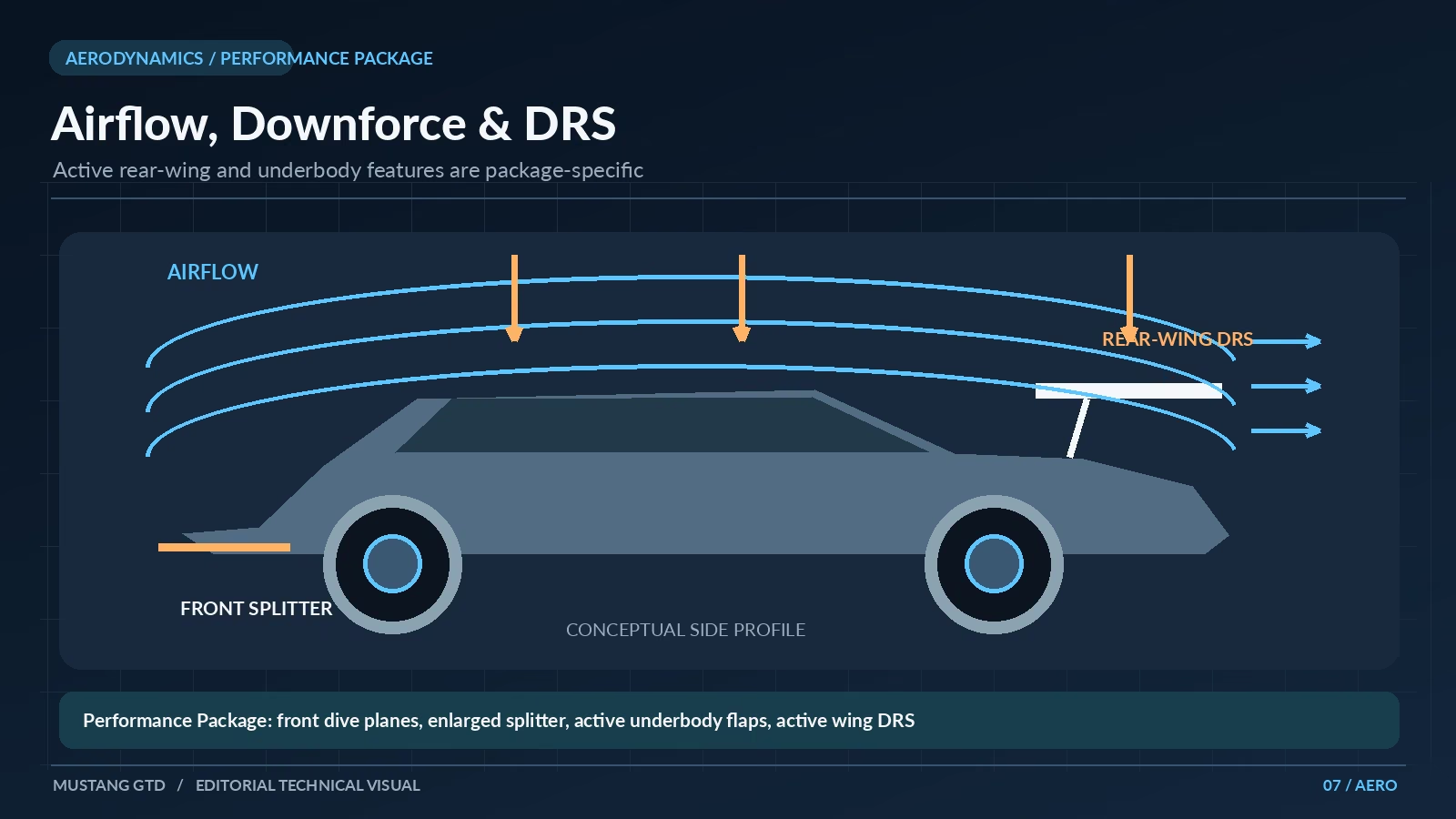
The package includes front dive planes, a larger front splitter, active underbody flaps and a drag-reduction function integrated into the rear wing. Ford also associates the Performance Package with its Lightweight Package and 20-inch magnesium wheels.
A 2025 Mustang GTD tested by Car and Driver carried a $40,000 Performance Package, producing the following price:
| Price component | Amount |
|---|---|
| 2025 starting price with fees | $327,960 |
| Performance Package | $40,000 |
| As-tested price | $367,960 |
This is the verified price of the tested configuration. It should not automatically be treated as the official Performance Package price for every market or 2026 special edition. [2] [5]
Lightweight Package: What Is Included?
Ford describes the Lightweight Package as part of the original GTD Performance Package, rather than a universally priced standalone option.
It reduces sound-deadening material and incorporates lightweight wheel equipment as part of the broader performance specification. Removing acoustic insulation helps reduce mass, but the trade-off is potentially greater road, drivetrain and tire noise inside the cabin.
A lighter vehicle generally requires less energy to accelerate, brake and change direction. Nevertheless, the actual improvement depends on where the mass is removed and how the suspension and aerodynamic systems are tuned.
Buyers should verify package content against their specific vehicle build because special editions may combine these features differently.
Magnesium Wheels: Benefits and Availability
The GTD comes with forged aluminum wheels in its standard configuration, while lightweight magnesium wheels are associated with the original Performance Package. Ford specified 20-inch magnesium wheels for that package when it was introduced.
Magnesium has a lower density than aluminum, allowing appropriately engineered wheels to reduce unsprung and rotating mass. Lower unsprung mass can help suspension components control wheel movement over uneven surfaces, while reducing wheel rotational inertia can also benefit transient response.
These benefits depend on the complete wheel design, not material alone. Magnesium wheels may carry different inspection, repair and replacement considerations than forged aluminum wheels.
Carbon-Fiber Roof Option: Is It Worth $10,000?
The $10,000 carbon-fiber roof option listed on the authenticated 2025 Mustang GTD sticker is best understood as an exposed-carbon appearance treatment. The standard GTD already uses carbon fiber extensively, including in its roof construction.
That distinction is important because an exposed-carbon option does not mean that a standard GTD uses a conventional steel roof.
Its value is therefore largely associated with visual presentation, customization and collector preference. Although carbon fiber is advantageous for vehicle weight management, no verified evidence from this particular option establishes that paying $10,000 produces a meaningful additional weight reduction compared with the standard roof.
Optional Brake-Caliper Colors and Their Prices
Ford offers cosmetic brake-caliper customization to complement the GTD’s exterior paint, wheels and carbon-fiber finishes. Depending on the specification and series, available treatments have included Race Red, Grabber Blue and black.
The authenticated 2025 sticker establishes a price of $1,500 for red brake calipers on one vehicle. It does not establish identical pricing for every color or model year.
Caliper paint should not be confused with a braking-system upgrade. The GTD already uses sophisticated Brembo carbon-ceramic brakes, and the selected caliper finish does not independently increase rotor dimensions, hydraulic capacity or braking performance.
Mustang GTD Carbon Series: What Makes It Different?
The Mustang GTD Carbon Series emphasizes the vehicle’s composite construction through exposed-carbon styling. Ford introduced it with visible carbon-fiber surfaces on the hood, roof and rear Tech Deck, together with distinctive wheel finishes and exterior customization opportunities.
The treatment can be combined with the GTD Performance Package, but the Carbon Series itself should not be described as synonymous with the aerodynamic upgrade.
Available combinations include contrasting stripes, different brake-caliper colors and alternative wheel treatments. The appearance is more visually distinctive than a conventionally painted GTD, but its primary identity is based on material presentation rather than a separately published engine-output increase. [5]
Other GTD Special Editions Introduced Through 2026
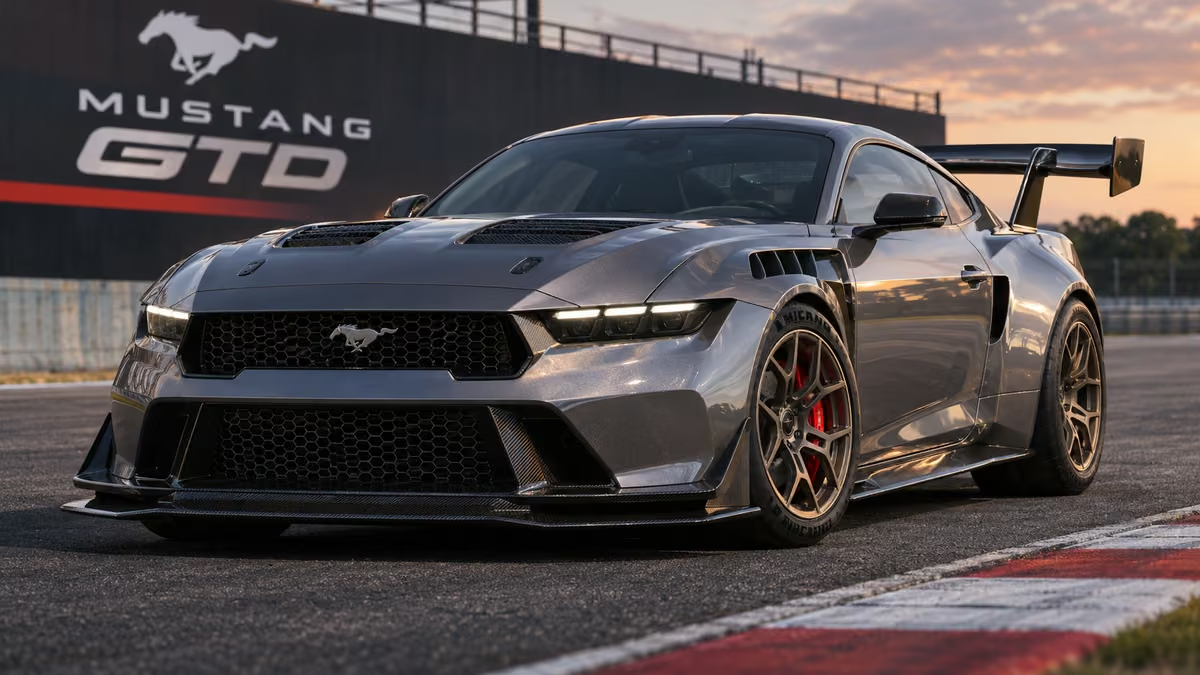
Ford’s 2026 GTD developments include the Liquid Carbon, Spirit of America and GTD Competition specifications.
The Liquid Carbon edition uses an exposed-carbon body treatment and additional weight-saving measures. Ford states that it saves approximately 5.9 kg compared with a Carbon Series GTD equipped with the Performance Package.
The Spirit of America edition uses distinctive red and blue graphics over a white exterior, commemorating American performance achievements. Its Performance Package is standard.
The GTD Competition is more substantial mechanically, using revised aerodynamics, tires, lighter components and engine changes targeting power beyond the original GTD’s 815 hp. Ford had not established a final certified engine output or universal retail price for that configuration in the cited April 2026 announcement. [6] [7]
Mustang GTD Standard vs Optional Equipment
The standard GTD already includes equipment normally associated with specialized motorsport machinery. Optional packages primarily enhance aerodynamic sophistication, reduce weight or add distinctive materials and visual treatments.
| Equipment | Standard GTD | Optional package or customization |
|---|---|---|
| Supercharged 5.2L V8 | Yes | Competition engine revisions |
| Eight-speed dual-clutch transaxle | Yes | No conventional manual option |
| Carbon-fiber body panels | Yes | Exposed-carbon finishes |
| Brembo carbon-ceramic brakes | Yes | Caliper color selection |
| Fixed rear wing | Yes | Active rear-wing DRS |
| Multimatic suspension | Yes | Package-specific calibration |
| Forged aluminum wheels | Yes | Magnesium wheels |
| Recaro front seats | Yes | Edition-specific seat treatments |
| Lightweight Package | No | Performance Package |
| Carbon Series appearance | No | Special configuration |
The verified 2025 optional prices include $40,000 for one tested Performance Package, $10,000 for an exposed-carbon roof and $1,500 for red brake calipers. Other combinations require vehicle-specific pricing.
Mustang GTD Engine Specs: Inside the 815-HP Supercharged V8
The GTD uses an advanced version of Ford’s supercharged 5.2-liter Predator V8 architecture. Its powertrain is designed around high engine speed, sustained cooling and repeatable performance, combining forced induction with dry-sump lubrication and a specialized exhaust system. Ford’s published specifications and owner documentation provide a detailed view of its construction.
5.2-Liter Supercharged V8 Engine Architecture
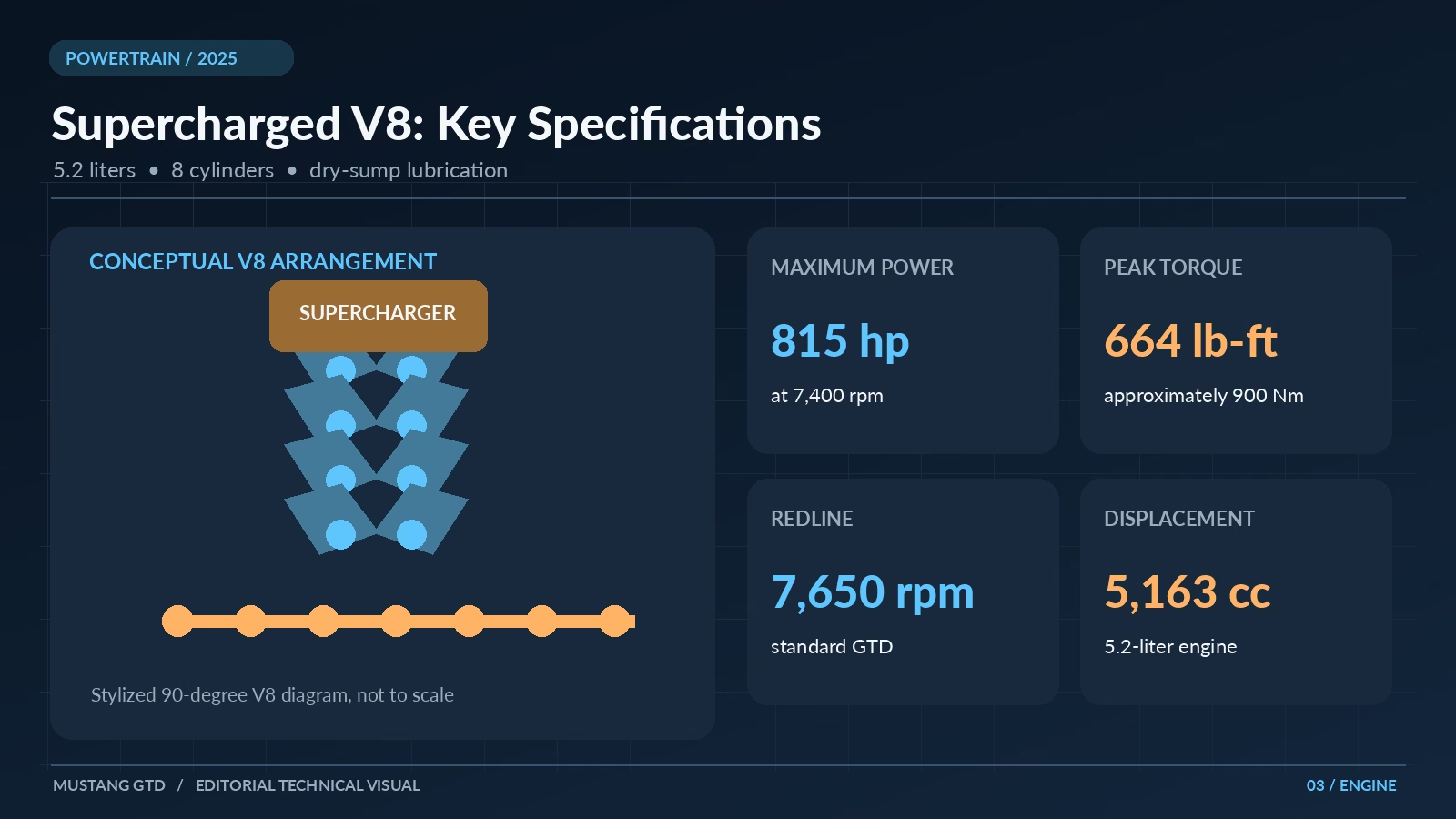
The Mustang GTD’s V8 displaces 5,163 cc and uses a 90-degree cylinder arrangement, double overhead camshafts and 32 valves. It employs a supercharger with charge-air cooling to increase the mass of air entering the cylinders.
The engine uses an aluminum block and cylinder heads, a forged steel cross-plane crankshaft, forged connecting rods and forged aluminum pistons. Ford lists a compression ratio of 9.5:1.
The engine also shares architectural heritage with the supercharged 5.2-liter Predator used in the earlier Shelby GT500. However, the GTD incorporates further development to support its higher output and more demanding performance objectives. [8]
How Does the Mustang GTD Produce 815 Horsepower?
Ford rates the standard Mustang GTD at 815 horsepower at 7,400 rpm. This output is achieved through a combination of displacement, supercharging, airflow management, intercooling, engine calibration and mechanical components engineered for sustained operation at high speed.
Horsepower is a measure of the rate at which an engine performs work. For a rotating engine, it is related to torque and rotational speed by the formula:
\[ \text{Horsepower}=\frac{\text{Torque (lb-ft)}\times\text{RPM}}{5252} \]
The high horsepower figure is therefore not solely the result of peak torque. The GTD’s ability to maintain substantial torque at high rpm is essential to its maximum output.
What Does 664 lb-ft of Torque Mean?
The GTD’s certified maximum torque is 664 lb-ft, approximately 900 Nm. Torque represents the twisting force generated by the engine, which is delivered to the driven wheels through the transmission, differential and final-drive gearing.
One detail requires attention when identifying the rpm of peak torque. Ford’s public GTD product information and Car and Driver specifications quote 4,800 rpm, while Ford’s owner-manual engine specifications list 4,500 rpm.
The 664 lb-ft peak value is consistent, but the published engine-speed discrepancy should not be silently resolved. Buyers needing exact calibration information should refer to documentation for the relevant VIN and model year. [1] [8]
Engine Redline and High-RPM Performance
Ford lists a 7,650-rpm engine redline for the standard Mustang GTD. This is above the 7,400-rpm point at which maximum horsepower is achieved.
The distinction matters because an engine does not necessarily produce additional horsepower all the way to its operational limit. Peak output occurs where the combination of torque and engine speed produces maximum power.
High-rpm operation places substantial demands on components such as the crankshaft, connecting rods, valve train and lubrication system. The GTD’s forged components, advanced cooling and dry-sump arrangement are relevant to managing those operating conditions.
Dry-Sump Lubrication: Why Does the GTD Need It?
Conventional wet-sump lubrication systems store engine oil primarily in a sump below the crankshaft. Under sustained high lateral acceleration, oil can move away from the pickup, increasing the risk of inadequate lubrication if the system is not designed for such conditions.
The GTD uses a dry-sump oil system to improve oil control during demanding cornering, braking and acceleration.
A dry-sump arrangement moves oil through dedicated scavenging and supply circuits, helping maintain lubrication under sustained high loads. This capability is particularly useful during circuit driving, where repeated high-grip cornering can create conditions substantially different from ordinary road use.
Akrapovič Titanium Exhaust: Sound, Material and Performance
A titanium exhaust developed with Akrapovič is standard equipment on the Mustang GTD. The system uses active valves, enabling its acoustic character to change according to selected operating modes.
Titanium offers a favorable combination of strength, heat resistance and low density compared with many conventional exhaust materials. These characteristics make it attractive for high-performance applications where heat management and mass are important.
Ford’s owner documentation describes a high-flow exhaust with an X-pipe and electronically controlled sound characteristics. Its aggressive sound is a deliberate part of the GTD’s character, but the exhaust is also a functional component of the vehicle’s overall powertrain design. [1]
Mustang GTD Complete Engine Specifications Table
The following table consolidates engine data from Ford’s documentation and independently published specifications. The standard GTD figures should not be assumed to apply unchanged to the later GTD Competition, which Ford describes as having additional engine hardware and calibration changes.
| Engine attribute | Specification |
|---|---|
| Engine family | Ford Predator V8 |
| Configuration | 90-degree V8 |
| Displacement | 5,163 cc / 315 cu in |
| Induction | Supercharged, intercooled |
| Valve train | DOHC, 32 valves |
| Horsepower | 815 hp at 7,400 rpm |
| Peak torque | 664 lb-ft |
| Compression ratio | 9.5:1 |
| Redline | 7,650 rpm |
| Bore | 94 mm |
| Stroke | 93 mm |
| Fuel injection | Port fuel injection |
| Crankshaft | Forged steel, cross-plane |
| Pistons | Forged aluminum |
| Connecting rods | Forged steel |
| Lubrication | Dry-sump system |
| Exhaust | Akrapovič titanium, active valves |
| Recommended fuel | Premium unleaded |
Mustang GTD Transmission and Drivetrain Specifications
Unlike a conventional Mustang with its transmission mounted immediately behind the engine, the GTD positions its transmission at the rear axle. This arrangement changes vehicle packaging and weight distribution while supporting the high torque generated by the supercharged V8. The drivetrain also incorporates features designed specifically for traction and high-speed circuit performance.
How the Eight-Speed Dual-Clutch Transmission Works
The Ford Mustang GTD uses an eight-speed Tremec dual-clutch transmission rather than a conventional manual gearbox or torque-converter automatic.
A dual-clutch transmission effectively uses two separate clutch systems to manage alternating gear groups. By preparing the next gear before the current shift is completed, it can deliver rapid changes with relatively small interruptions to power delivery.
The GTD can operate with automatic gear selection, while steering-wheel paddles allow the driver to control shifts manually.
Ford does not offer a traditional clutch-pedal manual transmission for the standard GTD. The dual-clutch arrangement prioritizes acceleration, repeatability and fast shifting over the mechanical involvement of a conventional manual.
Rear-Mounted Transaxle: Why Is the Gearbox at the Back?
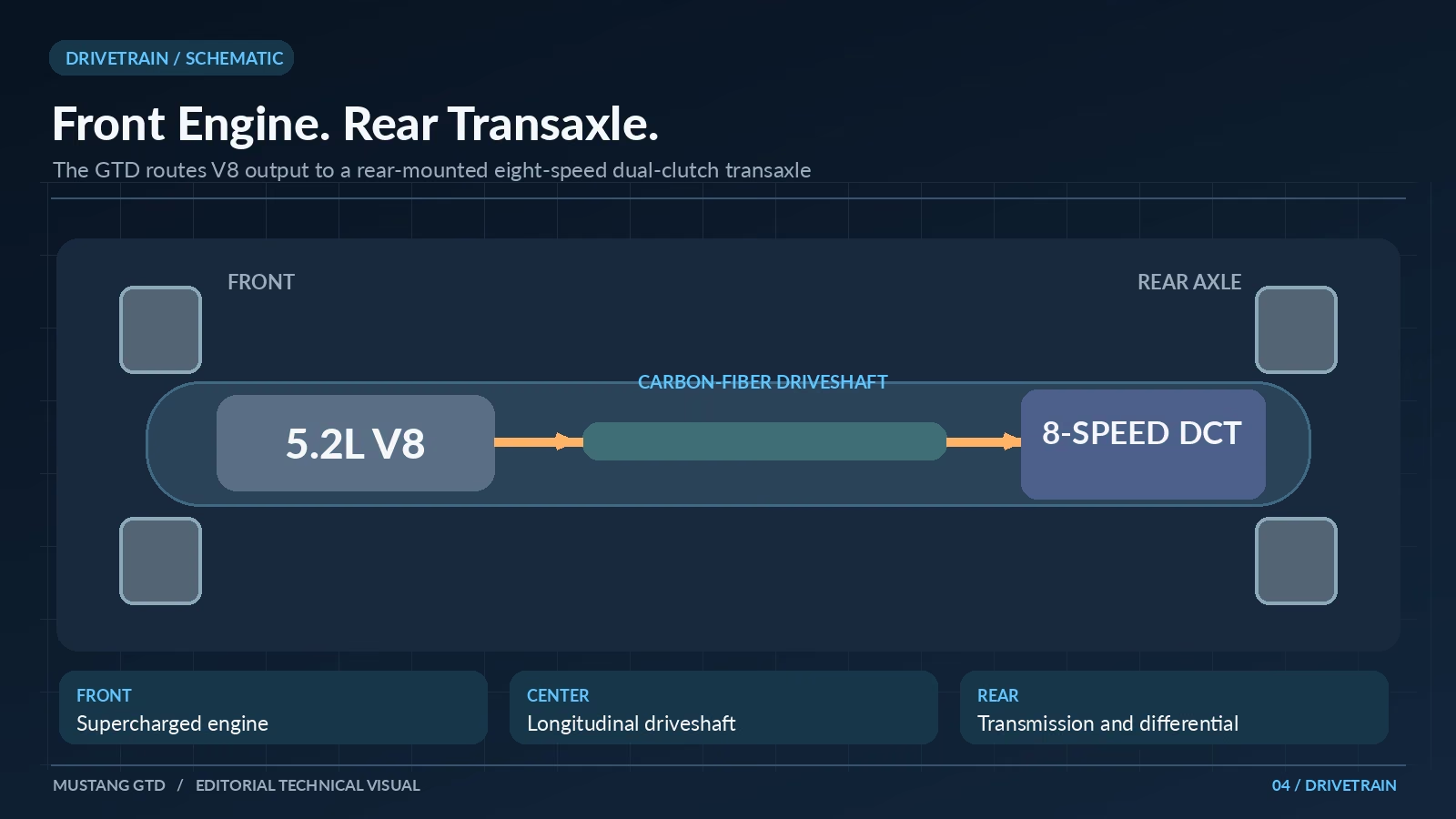
The GTD places its dual-clutch transmission in a rear-mounted transaxle assembly. A carbon-fiber driveshaft transfers power from the front-mounted engine to the rear gearbox and final drive.
Moving substantial drivetrain mass toward the rear contributes to the GTD’s near-50/50 weight-distribution objective. This can help balance front and rear axle loading, although actual handling characteristics also depend on suspension design, tire grip and aerodynamic forces.
A rear transaxle also creates opportunities for specialized drivetrain cooling and suspension packaging. Ford and Multimatic incorporated those systems into the vehicle’s broader chassis design rather than simply relocating an otherwise conventional transmission.
Mustang GTD Rear-Wheel-Drive Performance
The Mustang GTD sends all engine power to the rear wheels. Its drivetrain includes an electronically controlled limited-slip differential designed to help manage torque distribution between the driven wheels.
Rear-wheel drive allows the front tires to concentrate primarily on steering, while the rear tires provide propulsion. However, sending more than 800 horsepower through one axle also makes traction control, differential behavior and rear tire characteristics especially important.
The GTD’s 345-section rear Michelin tires provide a substantial contact area, but maximum acceleration still depends on surface conditions, tire temperature and driver inputs.
Its measured launch performance demonstrates how successfully Ford has integrated these systems.
Mustang GTD Performance: Top Speed, Acceleration and Track Times
The GTD’s performance credentials extend across several disciplines. Straight-line acceleration demonstrates its powertrain and traction capabilities, while braking distances and lateral grip provide additional information about chassis performance. Nürburgring lap times add another perspective, although they depend on vehicle configuration, testing conditions and classification.
Mustang GTD 202 mph Top Speed
Ford quotes a maximum speed of 202 mph, approximately 325 km/h, for the standard Mustang GTD.
Achieving this speed requires a balance between engine power, transmission ratios, aerodynamic drag and vehicle stability. Downforce improves high-speed grip but can also increase the power required to overcome air resistance.
The optional drag-reduction system addresses part of that compromise by changing aerodynamic behavior under appropriate conditions.
The 202-mph figure is a manufacturer-published specification, not a top-speed result independently verified by the Car and Driver instrumented test referenced in this article.
Mustang GTD 0–60 mph Acceleration
In instrumented testing, Car and Driver recorded 0–60 mph in 2.8 seconds for a 2025 Mustang GTD equipped with the Performance Package.
That result is particularly noteworthy because the GTD is a front-engine, rear-wheel-drive car weighing more than 4,400 pounds.
Acceleration performance depends on more than peak horsepower. Tire compound, road temperature, launch-control calibration, suspension behavior and dual-clutch engagement all influence how effectively torque reaches the pavement.
Testing methodology also matters. Car and Driver reports its standing-start acceleration figures with a one-foot rollout allowance, so the result should not be compared uncritically with measurements using different starting procedures. [2]
Mustang GTD Quarter-Mile Performance
The same independent test recorded a 10.6-second quarter-mile at 133 mph.
Quarter-mile elapsed time measures how quickly the car covers the full distance, while trap speed represents its speed near the end of the run. The two figures describe different aspects of acceleration performance.
A strong launch can improve elapsed time, but trap speed is particularly useful for understanding how effectively the vehicle continues accelerating as speed increases.
The GTD’s result confirms substantial high-speed acceleration capability. Nevertheless, vehicles with different traction systems or lower mass may record quicker short-distance results even when their peak horsepower is lower.
Mustang GTD Nürburgring Lap Time
The Nürburgring Nordschleife is a demanding German road circuit measuring approximately 20.8 km for modern official full-lap timing. Its mixture of corners, elevation changes and high-speed sections makes it a valuable proving ground for performance cars.
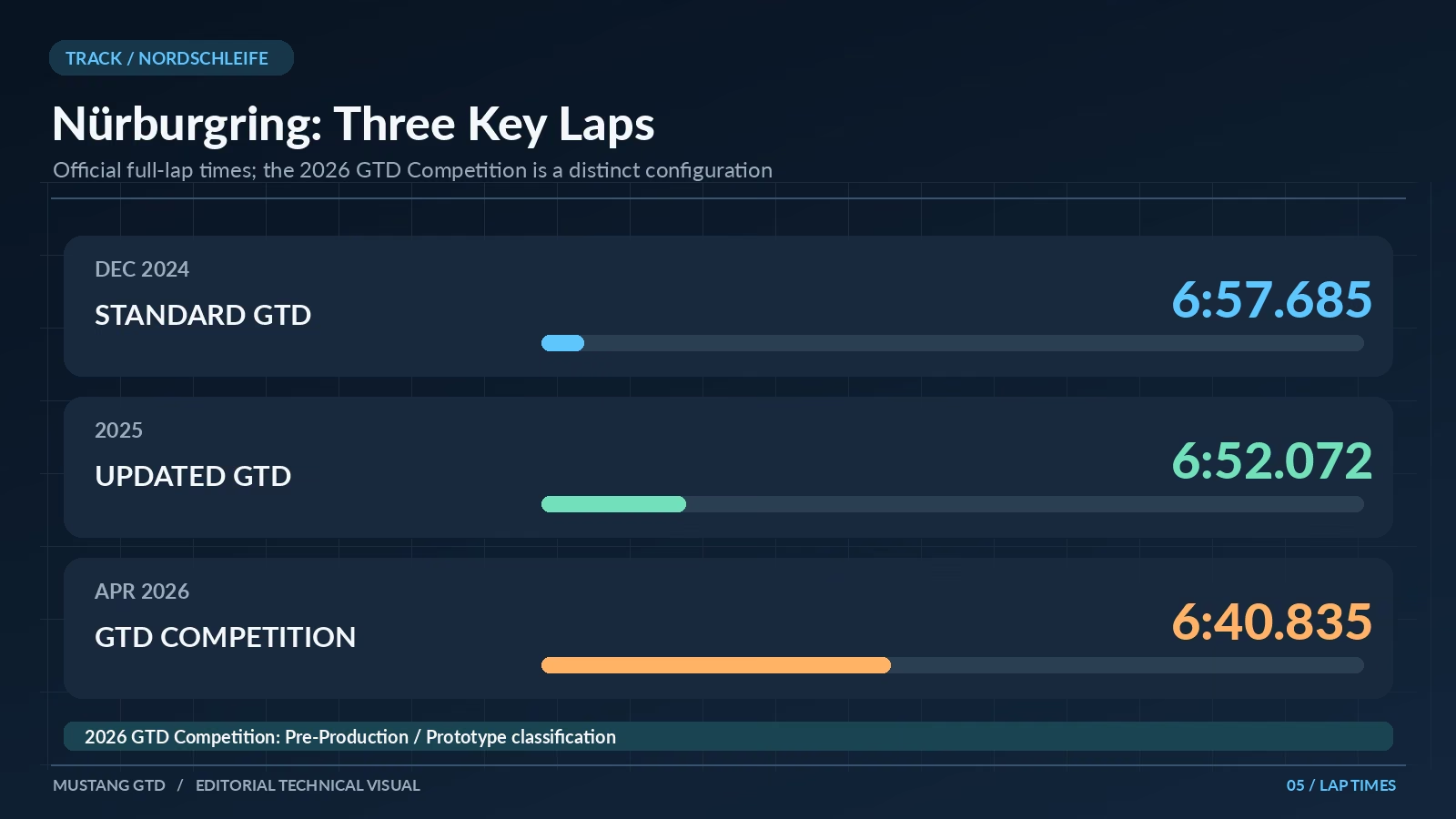
The GTD has recorded several important milestones:
| Date | Vehicle | Nürburgring lap |
|---|---|---|
| December 2024 | Original Mustang GTD | 6:57.685 |
| 2025 | Improved Mustang GTD | 6:52.072 |
| April 2026 | Mustang GTD Competition | 6:40.835 |
The original sub-seven-minute achievement made the GTD the first car from an American brand to complete the relevant official production-sports-car lap in less than seven minutes.
The later GTD Competition lap was driven by Dirk Müller. Ford identifies that vehicle’s result on the Nürburgring Pre-Production / Prototype Class leaderboard, rather than presenting it as an identical configuration to the earlier GTD.
Its revised powertrain, aerodynamics, tires and weight-reduction measures mean the 6:40.835 result should not be attributed to every 815-hp production GTD. [9] [10] [11]
Mustang GTD Performance Test Results Table
Independent instrumented testing provides a useful baseline for evaluating the GTD against other performance vehicles. The figures below come from a 2025 Performance Package test vehicle unless otherwise indicated.
| Performance measurement | Result |
|---|---|
| 0–60 mph | 2.8 seconds |
| 0–100 mph | 6.1 seconds |
| 0–130 mph | 10.0 seconds |
| 0–150 mph | 14.4 seconds |
| Quarter-mile | 10.6 seconds |
| Quarter-mile trap speed | 133 mph |
| 70–0 mph braking | 132 feet |
| 100–0 mph braking | 262 feet |
| 300-foot skidpad | 1.17 g |
| Top speed | 202 mph, Ford claim |
These results should not be interpreted as universal figures for all GTD specifications. Tire condition, options and environmental factors can alter measured performance. The Nürburgring records were conducted separately and are not part of the same instrumented road test. [2]
Mustang GTD Suspension and Chassis Engineering
The suspension is one of the GTD’s most distinctive technical features. Working with Multimatic, Ford incorporated adaptive dampers, sophisticated suspension geometry and an inboard rear arrangement that resembles specialist racing-car engineering. These components work with the tires, aerodynamic systems and vehicle structure to control movement during high-speed driving.
Multimatic Suspension: Race Technology for the Road
The GTD uses advanced Multimatic Adaptive Spool Valve suspension technology. Unlike passive dampers with fixed characteristics, its semi-active system can adjust damping behavior according to operating conditions and selected settings.
This enables Ford to provide different responses for road use and demanding track driving. A softer calibration can improve compliance over uneven roads, while firmer settings help control pitch, roll and rapid weight transfer.
The suspension also incorporates variable ride-height and spring-rate characteristics. These features give the GTD a broader operating range than a conventional fixed-rate performance suspension, although comfort remains secondary to its high-performance mission.
Inboard Rear Suspension Explained
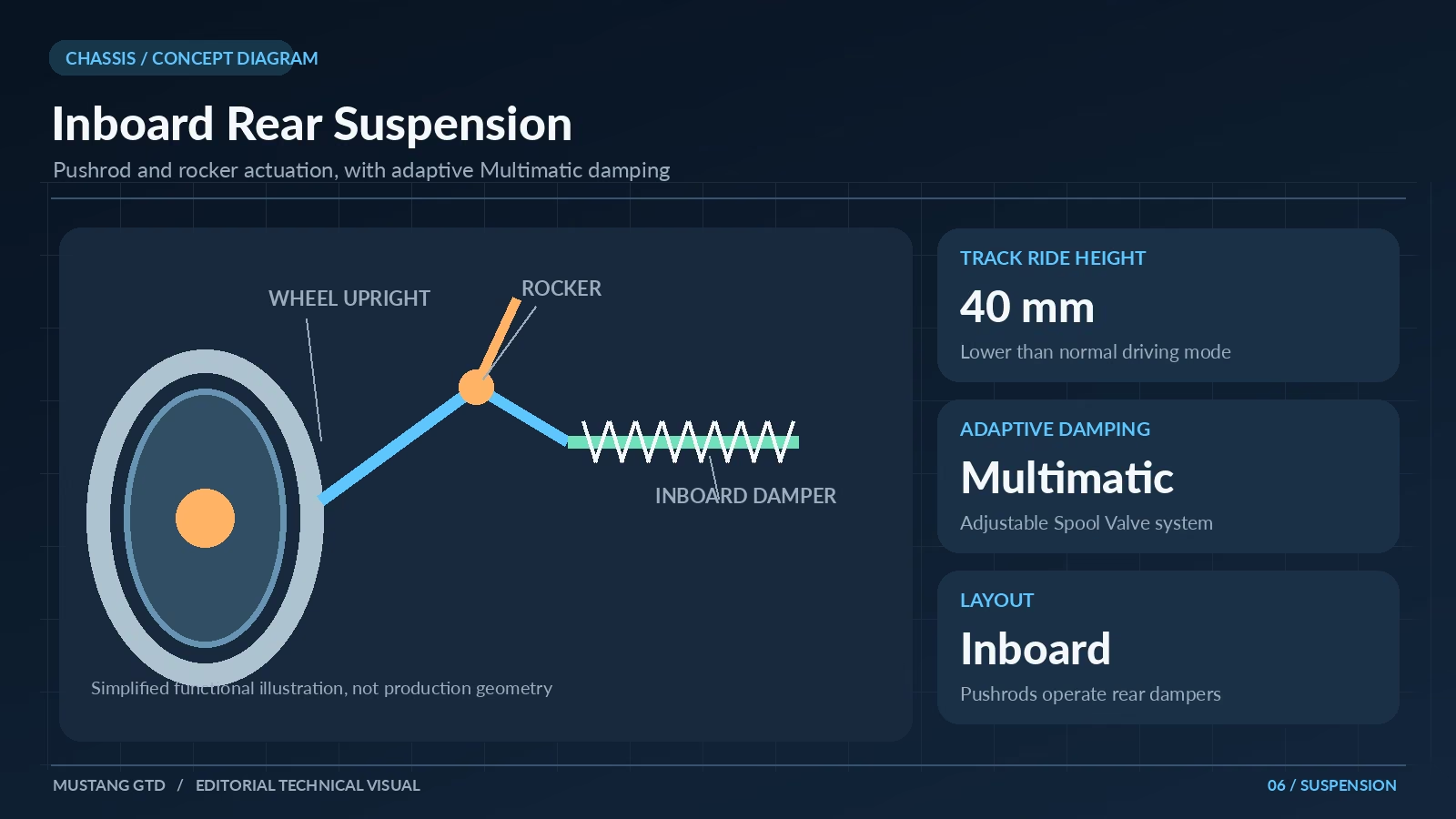
The GTD’s rear suspension uses pushrods and rocker mechanisms to transfer wheel movement to horizontally positioned inboard dampers and springs.
Instead of placing all the suspension components close to the wheel wells in a conventional arrangement, the design positions major components lower and farther inboard within the vehicle.
This configuration provides packaging flexibility, helps organize loads through the rear chassis structure and permits suspension geometry suited to specialized track driving.
The arrangement is related to concepts used in high-level motorsport, where engineers seek precise wheel control and efficient component placement. Ford even provides a polycarbonate viewing window that allows occupants to see the rear suspension hardware.
Track Ride-Height Adjustment: How the 40 mm Drop Works
The Mustang GTD can reduce its ride height by approximately 40 mm when entering its dedicated track configuration.
Lowering the car reduces its center-of-gravity height and changes the airflow beneath the vehicle. These changes can improve high-speed stability and support aerodynamic performance.
The system also adjusts suspension characteristics to suit more aggressive driving. However, the lower position makes clearance over speed bumps, ramps and uneven surfaces more challenging.
Ford provides a front-axle lift function to help negotiate certain road obstacles, highlighting the distinction between the GTD’s road and circuit operating requirements. Track mode is intended for closed-course use, not normal public roads. [1] [12]
How the GTD Chassis Improves Cornering
The GTD’s cornering capability results from the interaction of mechanical grip, suspension control, vehicle balance and aerodynamic downforce.
Wide, high-performance Michelin tires generate significant grip, while adaptive damping manages vertical wheel movement and controls body motion. The rear-mounted transaxle contributes to balanced axle loading, and the aerodynamic systems increase tire loading at higher speeds.
No single component can explain the GTD’s lap-time performance. The suspension, brakes, cooling system, steering calibration and aerodynamic package must operate together.
This integrated engineering approach is particularly important during rapid transitions between braking, cornering and acceleration.
Mustang GTD Aerodynamics and Carbon-Fiber Construction
Aerodynamic development is central to the Mustang GTD’s design. Ford moved beyond traditional styling accessories by incorporating extensive airflow management, a large rear wing and specialized underbody components. The optional Performance Package adds active systems to manage the trade-off between low drag and high downforce.
Active Aerodynamics: How the GTD Generates Downforce
Aerodynamic downforce pushes a vehicle toward the road as speed increases, raising the vertical load on its tires without adding an equivalent amount of static vehicle mass.
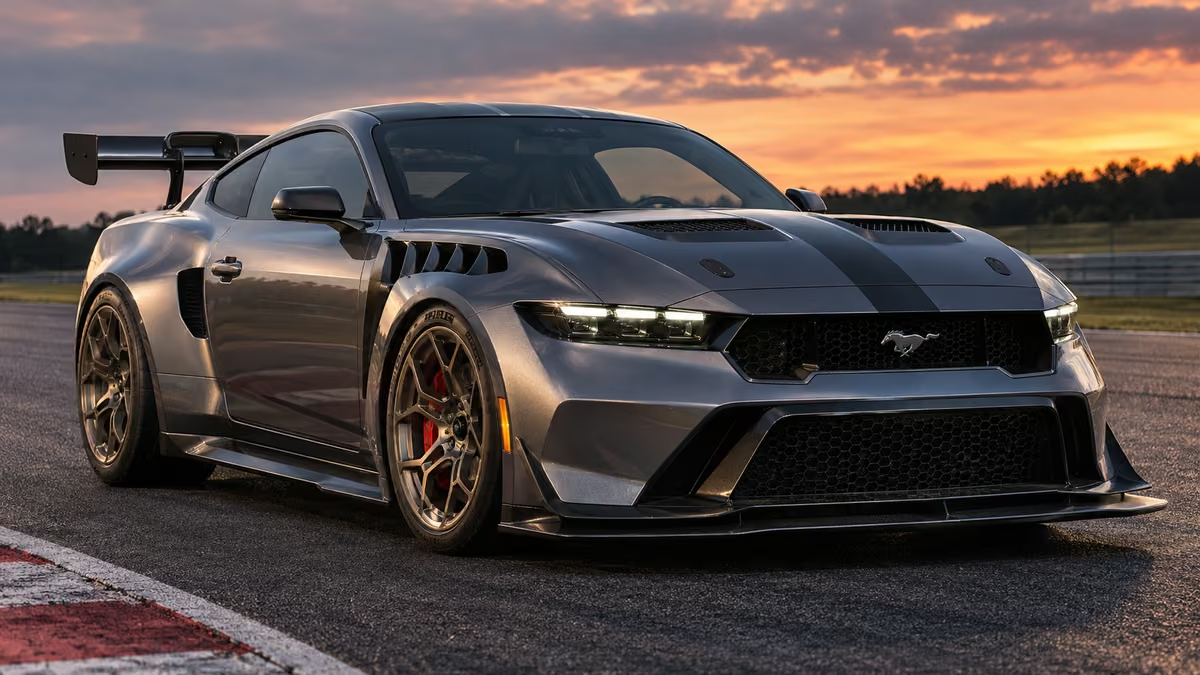
The GTD uses a front splitter, fender vents, underbody surfaces, a rear diffuser and a substantial C-pillar-mounted rear wing to manage airflow.
These components help control pressure around the vehicle and improve stability during high-speed cornering.
The standard GTD uses fixed aerodynamic components, including its rear wing, while the optional Performance Package introduces more sophisticated adjustable elements. The distinction matters because not every GTD has the same drag-reduction hardware.
Drag Reduction System (DRS): How Does It Work?
The GTD’s optional Drag Reduction System changes aerodynamic behavior to improve efficiency under conditions where maximum downforce is not required.
Its system incorporates an adjustable rear-wing element and active underbody flaps. By changing the position of these elements, the car can reduce aerodynamic resistance during suitable straight-line operation.
When cornering demands more grip, the system can prioritize downforce instead.
Unlike the GTD’s fixed standard aerodynamic hardware, this functionality was introduced as part of the Performance Package. Its purpose is not simply to increase peak speed, but to make the aerodynamic system more adaptable across the different sections of a racetrack. [5]
Carbon-Fiber Bodywork: Which Panels Use Carbon Fiber?
Carbon fiber is used extensively throughout the standard Mustang GTD. Ford’s vehicle documentation identifies composite components including the hood, fenders, roof, quarter panels, rear diffuser and other specialized exterior sections.
The material offers high strength and stiffness relative to its mass when designed and manufactured appropriately.
Its use helps manage weight despite the substantial hardware required for the GTD’s engine, cooling systems, drivetrain and advanced suspension.
Carbon-fiber construction should not be confused with exposed-carbon appearance options. Many standard GTD composite surfaces are painted, while special treatments showcase the underlying material for visual effect.
Mustang GTD Standard Aerodynamics vs Performance Package
The standard GTD already incorporates significant aerodynamic development, but the Performance Package adds control and optimization that can be especially valuable during circuit driving.
| Aerodynamic feature | Standard GTD | Performance Package |
|---|---|---|
| Front splitter | Standard configuration | Enlarged design |
| Front dive planes | Not the package-specific version | Added |
| Rear wing | Fixed aerodynamic function | Active DRS functionality |
| Underbody system | Fixed aerodynamic surfaces | Additional active flaps |
| Drag reduction | No package-specific active DRS | Yes |
| Track emphasis | High | More specialized |
The Performance Package’s advantage is principally its ability to improve aerodynamic behavior across different operating conditions. The total benefit depends on circuit layout, speed and vehicle setup rather than one fixed downforce figure.
Mustang GTD Brakes, Wheels and Tires
The GTD requires exceptional braking and tire performance to manage its speed and relatively substantial mass. Ford selected large Brembo carbon-ceramic brakes and track-oriented Michelin rubber to support repeatable deceleration and cornering. Wheel design and available materials also contribute to the vehicle’s suspension response and performance characteristics.
Carbon-Ceramic Brakes: Stopping Power Explained
The Mustang GTD uses a Brembo carbon-ceramic braking system with large ventilated discs.
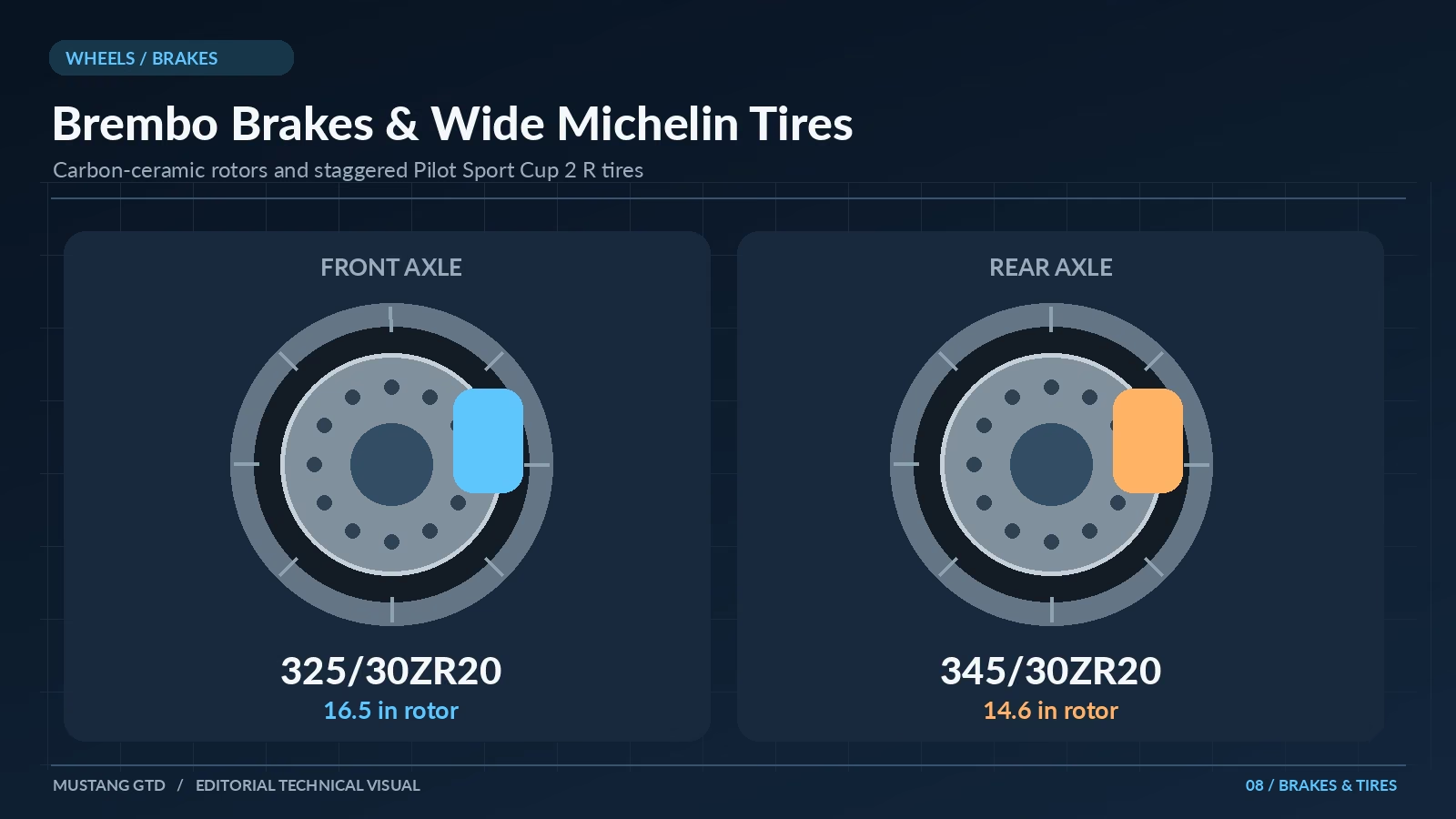
Independent specifications list front rotors measuring approximately 16.5 inches in diameter and rear rotors measuring 14.6 inches. Ford identifies six-piston front calipers and four-piston rear calipers.
Carbon-ceramic rotors are designed to tolerate substantial heat loads while providing high-performance braking characteristics. Their thermal properties make them attractive for repeated heavy braking during circuit sessions.
Nevertheless, stopping distance also depends on tire grip, ABS calibration, road conditions and vehicle mass.
Carbon-ceramic components can be costly to replace, and owners should follow Ford’s inspection and maintenance procedures rather than assume their durability eliminates normal servicing requirements.
Michelin Pilot Sport Cup 2 R Tires
The GTD uses Michelin Pilot Sport Cup 2 R tires, a high-performance tire developed with a strong emphasis on dry-surface grip and track capability.
Such tires use specialized compounds and tread designs to maximize traction in demanding conditions. Their performance characteristics differ from conventional touring tires designed primarily around long tread life, wet-weather usability and comfort.
The GTD’s Michelin tires contribute significantly to its acceleration, braking and cornering results.
However, drivers must account for temperature, road moisture and wear. Track-oriented tires may provide substantially less reassurance in cold or wet conditions than their dry-weather performance suggests.
Mustang GTD Front and Rear Tire Sizes
The GTD uses a staggered tire arrangement with different dimensions at the front and rear.
| Position | Tire specification |
|---|---|
| Front | 325/30ZR20 |
| Rear | 345/30ZR20 |
The first number identifies nominal tire-section width in millimeters. The second is the aspect ratio, expressing sidewall height as a percentage of section width. The final number identifies the nominal wheel diameter in inches.
The ZR designation indicates a tire designed for high-speed use, with the exact speed capability determined by the complete tire service description.
The wider rear tires help manage acceleration forces, while the large front tires support braking and steering grip.
Magnesium Wheels vs Forged Aluminum Wheels
Forged aluminum wheels are standard on the original GTD, with magnesium wheels offered through performance-oriented configurations.
Forging can improve the mechanical characteristics of a wheel by shaping material under substantial pressure. Magnesium’s relatively low density also creates opportunities to reduce wheel mass.
Weight reduction at the wheels can be particularly valuable because wheels are both rotating components and part of the vehicle’s unsprung mass.
However, material alone does not determine performance or durability. Wheel geometry, strength, manufacturing technique and intended operating loads are equally important.
Owners should use approved wheels and follow specialized inspection and repair guidance, especially after track use or impact damage.
Mustang GTD Weight, Dimensions and Exterior Design
Despite its composite construction, the Mustang GTD remains a comparatively heavy high-performance coupe. Its large engine, transmission, advanced suspension, structural reinforcements and extensive cooling equipment all contribute to its mass. The exterior design accommodates those components while maintaining enough of the Mustang silhouette to make the car immediately recognizable.
GTD Curb Weight: How Heavy Is It?
Car and Driver measured a curb weight of 4,404 pounds, approximately 1,998 kg, for its tested 2025 Mustang GTD.
Curb weight generally represents a vehicle equipped with its operating fluids and standard road equipment, without occupants or cargo. Independently tested weight may differ from manufacturer estimates and from vehicles with other options.
The GTD’s carbon-fiber components help control mass, but they do not make the car unusually light.
Its supercharged V8, large braking system, rear transaxle, elaborate suspension and associated cooling hardware are substantial components that help explain why the final curb weight remains above two metric tonnes in some configurations.
Mustang GTD Dimensions: Length, Width, Height and Wheelbase
The GTD is wider and more visually aggressive than a conventional Mustang, reflecting its enlarged fenders, tire requirements and aerodynamic development.
| Dimension | 2025 tested specification |
|---|---|
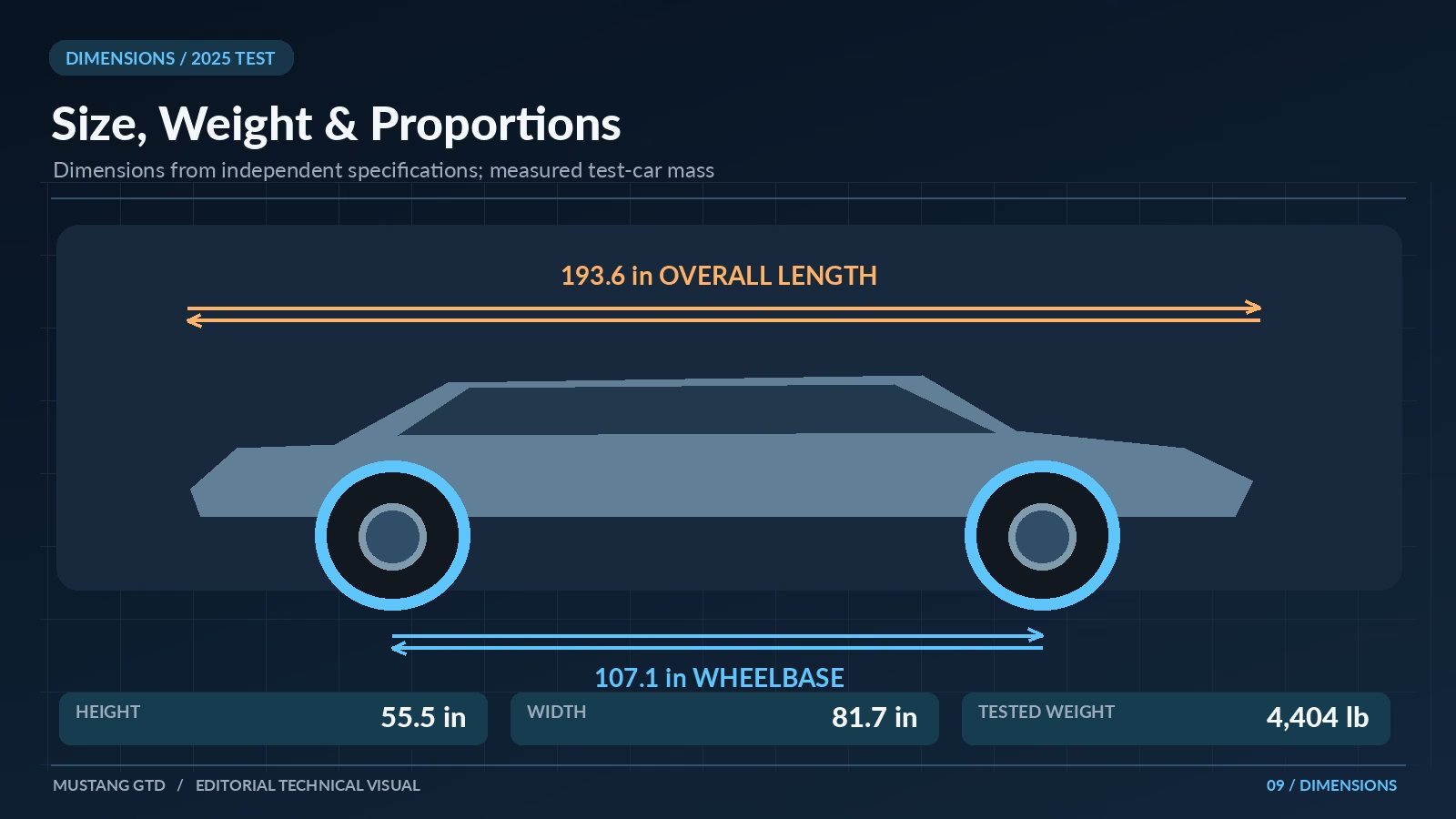
| Length | 193.6 inches |
| Width | 81.7 inches |
| Height | 55.5 inches |
| Wheelbase | 107.1 inches |
| Measured curb weight | 4,404 lb |
Ford states that the GTD’s track width is approximately four inches greater than the Mustang Dark Horse’s, although exact front and rear track measurements should be taken from model-specific engineering documentation.
Ground clearance is also variable because of the adjustable suspension, making a single unspecified ground-clearance figure potentially misleading. [2]
Mustang GTD Power-to-Weight Ratio
Using Ford’s certified 815-hp output and Car and Driver‘s measured 4,404-pound weight, the GTD achieves approximately 5.40 lb per horsepower, or 408 hp per metric tonne.
A high power-to-weight ratio can improve acceleration, particularly as vehicle speed rises and traction becomes less limiting.
It is not, however, a complete measure of performance. Aerodynamic drag, downforce, tires, braking capacity and transmission efficiency all influence acceleration and lap times. These factors help explain why vehicles with less horsepower can sometimes outperform more powerful cars on particular circuits.
How the GTD Differs Visually From a Regular Mustang
The GTD retains familiar Mustang proportions but modifies nearly every major exterior area to support its performance objectives.
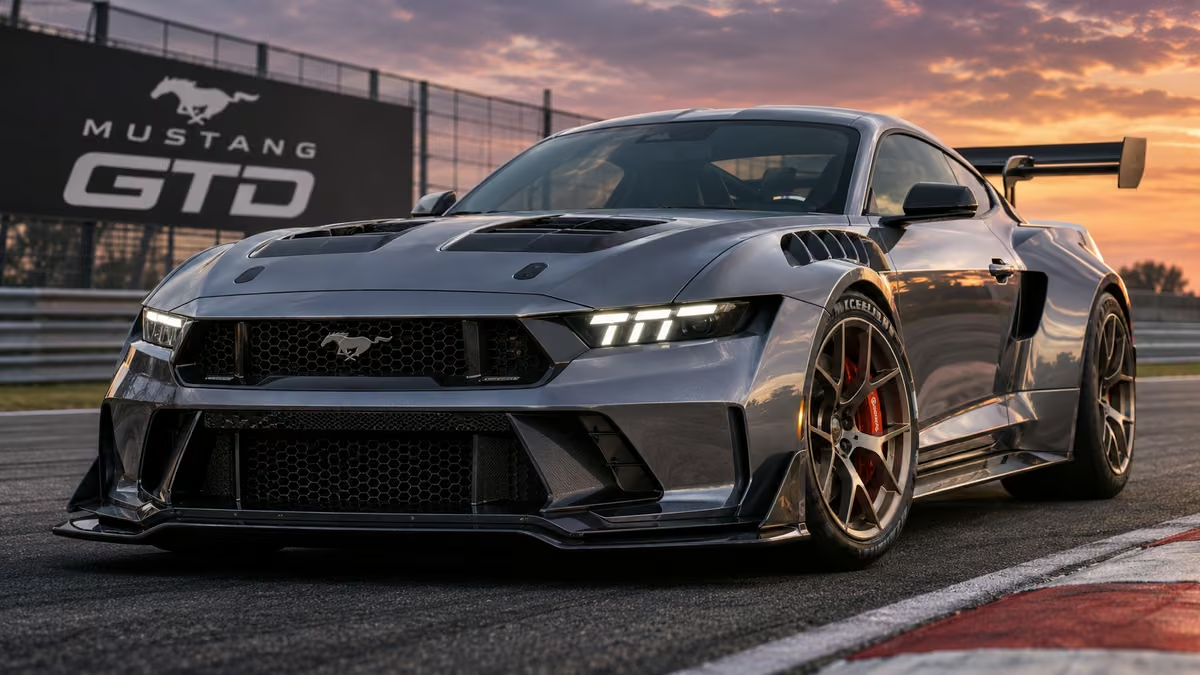
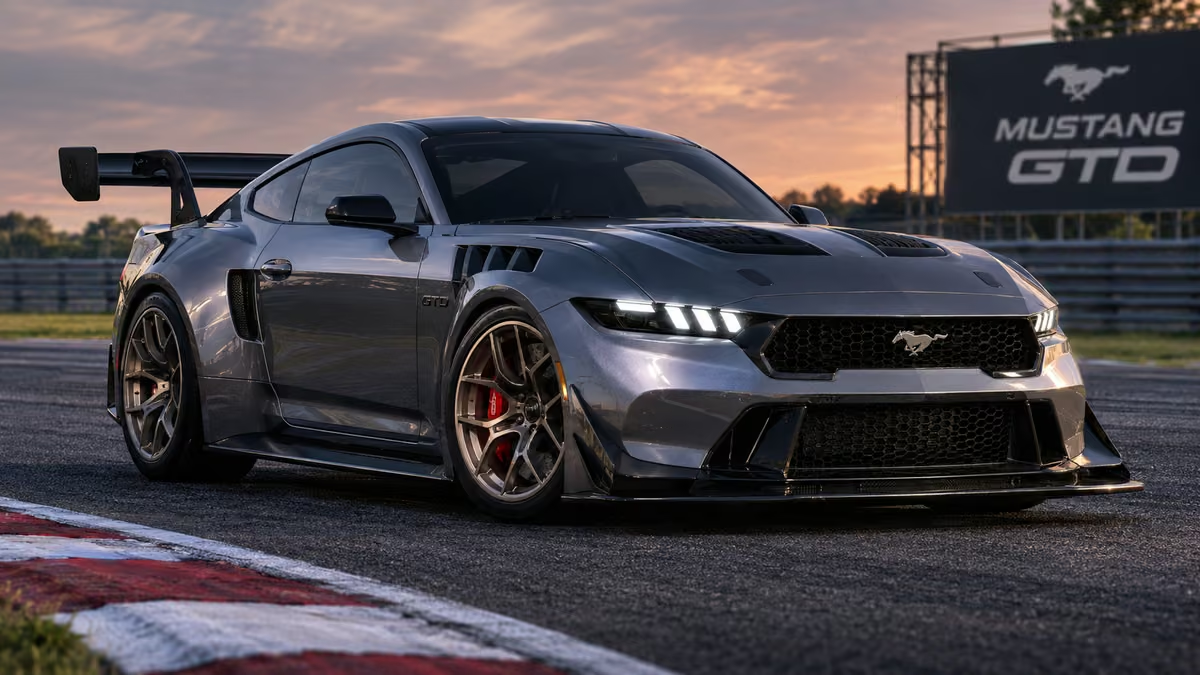
Large front fenders accommodate the 325-section tires, while enlarged vents help manage airflow around the wheel wells. The hood incorporates substantial cooling and airflow features, and the rear bodywork supports an unusually large aerodynamic wing.
The rear diffuser and underbody treatment also contribute to aerodynamic management.
These details are functional rather than purely stylistic. They reflect the need to cool mechanical components, manage air pressure and maintain stability at speeds beyond those ordinarily associated with road-going Mustangs.
Mustang GTD Interior, Seating and Driver Technology
The GTD’s interior balances recognizable Mustang technology with components specifically developed for high-performance driving. It uses a two-passenger configuration, supportive front seating, dedicated performance displays and unique driver controls. Some high-end details are cosmetic, while others have direct functional benefits when operating the vehicle on a circuit.
Recaro Performance Seats: Built for Track Driving
Standard Recaro performance seats provide increased body support during aggressive cornering.
Their design emphasizes lateral restraint, helping drivers and passengers maintain a stable seating position when the vehicle generates substantial sideways acceleration.
Ford uses distinctive upholstery materials and trim details, including Miko suede treatments on specified configurations.
Supportive seats also improve driver control by reducing the effort required to remain positioned during braking and cornering. Nevertheless, comfort depends on body shape and driving duration.
Potential buyers should assess seat fit and driving position carefully because a specialized performance seat may not suit every driver as comfortably as a conventional adjustable touring seat.
Two-Passenger Interior Layout: Why Are There No Rear Seats?
The Mustang GTD has two passenger positions rather than the conventional Mustang’s four-seat arrangement.
Ford removed the normal rear seating area to accommodate its specialized vehicle layout and reduce unnecessary equipment. Space behind the seats incorporates a package shelf, while a transparent panel provides a view of the distinctive inboard rear suspension.
This design emphasizes engineering presentation and weight management rather than family practicality.
The absence of rear seats makes the GTD unsuitable for buyers requiring more than two occupants. Cargo capacity is also more limited in practical terms than that of a conventional performance coupe intended for everyday transport.
Mustang GTD Cockpit and Digital Displays
The GTD uses a 12.4-inch digital instrument cluster together with a 13.2-inch central infotainment display.
These screens run Ford’s SYNC 4 interface with specialized graphics developed for the GTD. Ford incorporated visual technologies associated with Unreal Engine to create more distinctive instrument and infotainment presentations.
Dedicated performance information is designed to place important driving data prominently in the driver’s field of view.
Track-oriented display layouts reduce unnecessary visual clutter and prioritize information such as engine speed and gear selection.
Despite these changes, the cockpit retains a meaningful connection to the standard seventh-generation Mustang’s digital architecture. [5]
Steering Wheel, Shift Paddles and Interior Customization
The GTD uses a thick-rimmed, flat-bottom steering wheel with integrated controls for features including suspension settings and exhaust operation.
Additional interior controls provide access to performance functions and the front-axle lift system.
Ford has also offered titanium shift paddles, selector components and serialized trim pieces. Some available titanium parts are manufactured using material reclaimed from retired Lockheed Martin F-22 aircraft.
These details contribute to the car’s exclusivity but do not independently establish faster acceleration or improved handling.
The most important functional differences from a regular Mustang remain the specialized driving controls, seating configuration and performance-oriented digital instrumentation.
Mustang GTD Fuel Economy and Ownership Costs
Although the Mustang GTD is designed around performance, its running costs remain relevant to buyers. Fuel consumption, specialized tires, maintenance requirements and insurance can materially increase the total cost of ownership. Track use may accelerate component wear beyond what would typically be expected from road driving.
GTD Fuel Economy: MPG Ratings Explained
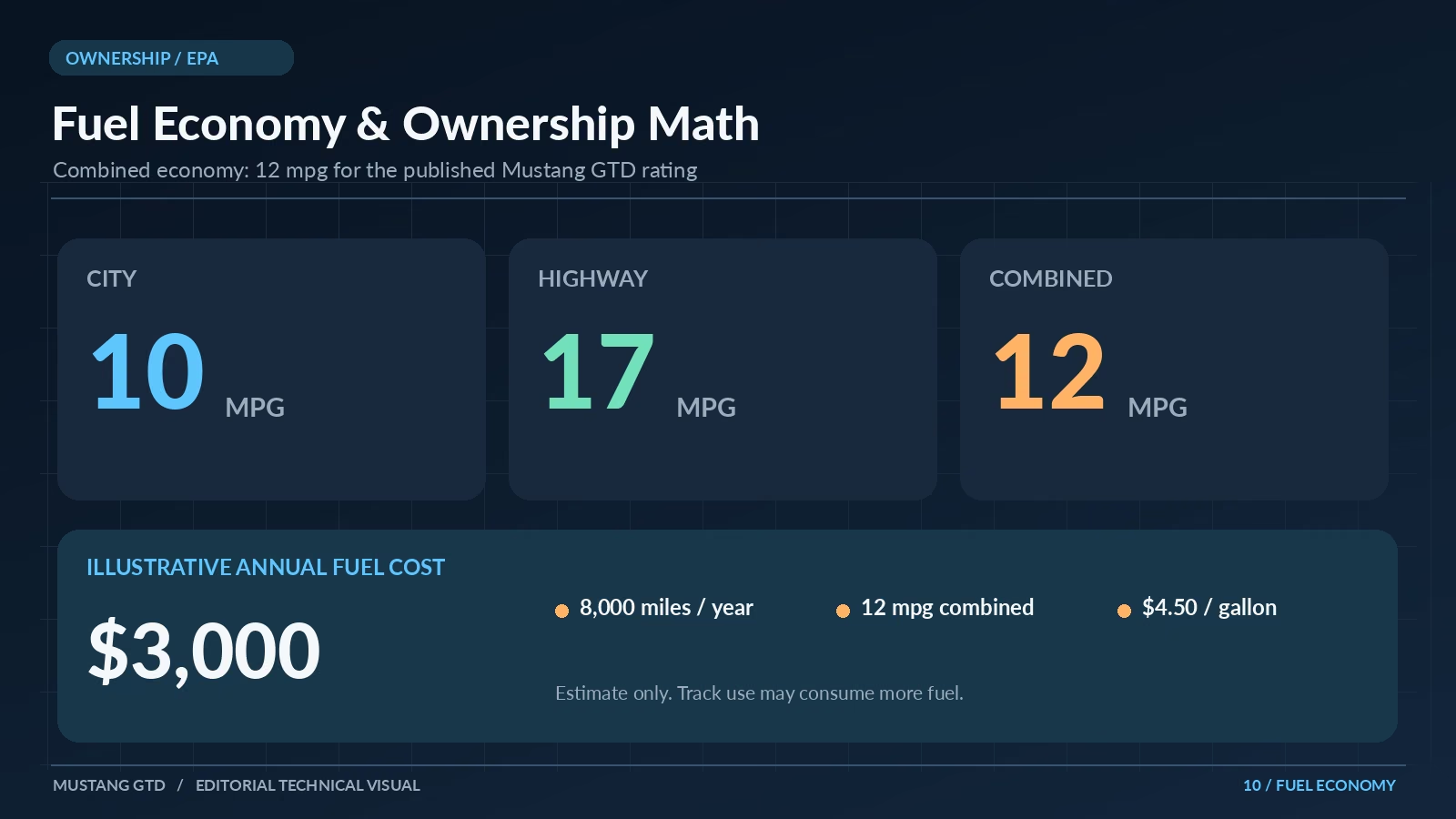
The EPA rates the 2025 and 2026 Mustang GTD at:
| Driving cycle | EPA fuel economy |
|---|---|
| City | 10 mpg |
| Highway | 17 mpg |
| Combined | 12 mpg |
These figures make the GTD one of the least fuel-efficient vehicles in the contemporary Mustang lineup.
The low combined rating reflects its powerful supercharged V8 and the energy demands associated with its performance-oriented design.
Actual fuel consumption depends on driving conditions and use. Sustained high-speed or circuit driving can consume substantially more fuel than the standardized EPA combined-cycle result suggests.
The federal rating also helps explain why a gas-guzzler tax appears on the documented 2025 window sticker. [13]
How Much Does It Cost to Fuel a Mustang GTD?
Ford’s owner documentation identifies a fuel-tank capacity of approximately 16 US gallons. The 2026 GTD requires premium unleaded gasoline with a minimum 91 AKI octane rating, while Ford recommends 93 AKI or higher for optimum performance.
Fuel expenses can be estimated using:
\[ \text{Annual fuel cost}=\frac{\text{Annual miles}}{\text{MPG}}\times\text{Price per gallon} \]
For example, assuming 8,000 miles annually, 12 mpg combined and premium gasoline costing $4.50 per gallon:
| Calculation | Estimate |
|---|---|
| Annual mileage | 8,000 miles |
| Fuel consumed | Approximately 667 gallons |
| Assumed fuel price | $4.50/gallon |
| Estimated annual fuel expense | $3,000 |
| Approximate 16-gallon fill | $72 |
This is an illustrative calculation rather than a prediction of fuel prices or actual driver consumption. [14] [15]
Mustang GTD Insurance, Maintenance and Tire Costs
The GTD’s insurance and maintenance requirements can differ substantially from those of an ordinary Mustang.
Limited production, expensive body panels, specialized drivetrain components and performance-focused tires can increase repair costs and affect insurance underwriting.
Michelin Pilot Sport Cup 2 R tires may also wear relatively quickly during aggressive circuit use, while carbon-ceramic brakes require appropriate inspection and specialist maintenance.
Ford’s GTD owner documentation includes specific instructions for track operation, including oil changes, tire inspections, fluid checks and brake-system monitoring.
Buyers should request vehicle-specific insurance quotations and consult qualified Ford or specialist service providers rather than rely on generic Mustang maintenance-cost estimates.
Mustang GTD Warranty Coverage
Published US warranty information for the Mustang GTD includes a three-year/36,000-mile limited warranty and five-year/60,000-mile powertrain coverage, with the applicable terms depending on the vehicle’s market and model year.
Track use requires particular attention. Ford’s GTD owner documentation distinguishes organized competitive events involving multiple vehicles from other closed-course driving activities.
The manual states that participation in qualifying multi-vehicle competitive racing can void the warranty. That does not mean all noncompetitive track driving automatically produces the same outcome.
However, damage associated with misuse, inadequate maintenance or excluded activities may still fall outside warranty protection.
Owners should review their actual warranty booklet and current operating manual before participating in track events. [16]
Mustang GTD Production, Availability and Buying Process
The GTD uses a limited-production model with a purchasing process different from that of a mainstream Mustang. Rather than relying solely on normal dealership inventory, Ford has offered applications and special allocation opportunities to prospective customers. Availability, ordering procedures and production plans may differ by region and edition.
How Many Mustang GTD Cars Will Ford Produce?
Ford describes the Mustang GTD as a strictly limited-production vehicle but does not publish a definitive global lifetime production total on its public GTD product page.
Some third-party reports have discussed figures around 1,700 or 2,000 vehicles. Those estimates should not be treated as an officially guaranteed total.
Ford did announce that approximately 500 GTDs were expected for Europe in its September 2026 application update. That figure concerns a regional allocation, not global production.
Manufacturing involves Ford’s vehicle production operations and Multimatic’s specialized assembly work, reflecting the substantially more complex construction process than a conventional Mustang. [6]
Mustang GTD Application and Allocation Process
Ford has used an application-based customer selection process for the GTD, allowing interested buyers to register for the opportunity to purchase a vehicle.
Submitting an application does not automatically result in a confirmed allocation. Production capacity, regional availability and Ford’s selection procedures influence whether applicants receive an opportunity to place an order.
In Europe, Ford reopened registrations on September 14, 2026, with an application deadline of October 16, 2026.
That specific application window has now passed. Prospective buyers should consult Ford’s current GTD information channels for future availability rather than assume historical application portals remain open.
Can You Buy a Mustang GTD From a Dealership?
A Mustang GTD should not be approached like a normal Mustang GT that can be selected from widely available dealer inventory.
Factory allocations have been tightly controlled, and availability depends on regional ordering programs and individual vehicle circumstances.
However, a GTD may also appear through resale or specialist automotive dealerships after initial delivery.
Such listings can differ materially in price from the original MSRP, particularly where the vehicle has unusual options, low mileage or a distinctive production history.
Buyers considering a pre-owned example should verify the VIN, original sticker, service records, ownership documentation and any restrictions associated with the specific transaction.
Will the Mustang GTD Hold Its Value?
The GTD’s limited production, distinctive engineering and connection to Ford’s motorsport program may support collector interest.
Its unusual place in Mustang history could also make certain specifications particularly desirable to enthusiasts.
Nevertheless, scarcity does not guarantee appreciation. Resale values depend on broader collector-market conditions, demand, mileage, originality, condition, accident history and the number of comparable vehicles available for purchase.
Special editions may attract attention, but their future value cannot be established simply from rarity or Nürburgring achievements.
Buyers should evaluate the GTD primarily on the performance, ownership experience and engineering it delivers, rather than on an assumption of future investment returns.
Mustang GTD vs Other High-Performance Cars
The GTD competes in a market containing several distinct performance philosophies. Some alternatives emphasize lower mass, others prioritize extremely high engine output, and others offer sophisticated aerodynamic systems with greater everyday practicality. Comparing the vehicles therefore requires more than examining horsepower and MSRP alone.
Mustang GTD vs Mustang Dark Horse
The 2026 Mustang Dark Horse produces 500 horsepower and 418 lb-ft of torque from a naturally aspirated 5.0-liter V8. Ford lists a starting MSRP of $65,080, making it dramatically less expensive than the GTD’s documented 2025 price.
The Dark Horse offers a more conventional Mustang platform with performance suspension, upgraded cooling and available manual transmission equipment.
The GTD adds 315 horsepower, a supercharged engine, rear transaxle, much wider tires, advanced aerodynamics and a substantially more specialized chassis.
For enthusiasts who want occasional track use while preserving affordability and conventional Mustang practicality, the Dark Horse offers a more accessible proposition. The GTD serves a fundamentally different level of performance ambition. [17]
Mustang GTD vs Shelby GT500
The previous-generation Shelby GT500 also used a supercharged 5.2-liter Predator V8, rated at 760 horsepower and 625 lb-ft of torque.
That engine was paired with a seven-speed Tremec dual-clutch transmission, rather than the GTD’s eight-speed rear-mounted transaxle.
The 2022 GT500 carried an MSRP of approximately $80,795 according to published vehicle specifications, far below the GTD’s documented 2025 price.
Although the GT500 was an extremely capable performance Mustang, the GTD extends the engineering concept through additional power, carbon-fiber construction, specialized suspension and more comprehensive aerodynamic development.
The two cars also occupy different collector categories, and GT500 transaction prices today depend on the used market rather than historical MSRP. [18]
Mustang GTD vs Porsche 911 GT3 RS
The 992-generation Porsche 911 GT3 RS uses a naturally aspirated 4.0-liter flat-six producing 518 horsepower. It places a major emphasis on aerodynamics, low mass and detailed circuit-focused chassis control.
By comparison, the Mustang GTD uses a far larger supercharged V8 and significantly greater peak output.
Porsche listed the 2025 GT3 RS at a US base MSRP of $241,300 before destination and other charges.
The GT3 RS also recorded an official 6:49.328 Nürburgring lap in 2022. That result was achieved in a different vehicle configuration and at a different point in development history than Ford’s 2026 GTD Competition lap.
The comparison demonstrates two different approaches to track performance, not a controlled same-day test between identical vehicle classes. [19] [20]
Mustang GTD vs Chevrolet Corvette ZR1
The 2025 Chevrolet Corvette ZR1 uses a mid-mounted 5.5-liter twin-turbocharged V8 producing 1,064 horsepower and 828 lb-ft of torque.
Chevrolet announced a starting price of $174,995 including destination for its 2025 1LZ coupe. The manufacturer also reported a maximum speed of 233 mph in its high-speed testing program.
In independent Car and Driver testing, a 2025 ZR1 reached 60 mph in 2.2 seconds, compared with the GTD’s 2.8-second result.
The Corvette’s mid-engine arrangement provides a different vehicle balance and traction approach. It delivers greater engine output and superior measured straight-line acceleration at a substantially lower original MSRP.
The GTD differentiates itself through Mustang-specific engineering, exclusivity and its unusual rear-transaxle layout. [21] [22]
Mustang GTD Competitor Specifications Comparison
The table below uses model-year-specific manufacturer pricing and clearly identifies independently tested figures. Prices do not all include the same charges, so they should not be interpreted as directly comparable final purchase totals.
| Vehicle | US starting price reference | Engine | Power | Torque | 0–60 mph |
|---|---|---|---|---|---|
| 2025 Mustang GTD | $327,960* | 5.2L supercharged V8 | 815 hp | 664 lb-ft | 2.8 sec, tested |
| 2026 Dark Horse | $65,080 | 5.0L NA V8 | 500 hp | 418 lb-ft | Not compared |
| 2022 Shelby GT500 | $80,795 | 5.2L supercharged V8 | 760 hp | 625 lb-ft | 3.4 sec, 2020 test |
| 2025 Porsche 911 GT3 RS | $241,300 | 4.0L NA flat-six | 518 hp | 342 lb-ft | 2.7 sec, earlier test |
| 2025 Corvette ZR1 | $174,995** | 5.5L twin-turbo V8 | 1,064 hp | 828 lb-ft | 2.2 sec, tested |
The GTD figure includes the documented 2025 destination and gas-guzzler charges. The Corvette figure includes the announced destination charge. Other prices are historical base MSRP references, generally excluding additional fees.
This comparison also illustrates why raw specifications are insufficient to establish the fastest vehicle around a particular circuit. The GTD’s appeal is not based solely on engine output or launch acceleration.
Mustang GTD Frequently Asked Questions
The following answers address the most common Mustang GTD pricing, specification and ownership questions. They distinguish verified 2025 pricing from later model-year availability and separate independently tested performance results from Ford’s own published figures.
How Much Is a Ford Mustang GTD?
A verified 2025 Ford Mustang GTD has a base MSRP of $318,760. Adding the documented $5,500 destination charge and $3,700 gas-guzzler tax produces a starting sticker price of $327,960 before optional equipment and local transaction costs.
Ford does not publish an equivalent universal 2026 GTD MSRP on its public product page. Buyers considering a 2026 example should obtain the current build sheet or original window sticker rather than assume the historical 2025 price remains unchanged.
What Is the Mustang GTD Price With All Options?
There is no reliably established universal maximum-option Mustang GTD price because available equipment differs by specification and model year.
One verified 2025 car with an exposed-carbon roof and red calipers carried a $339,460 sticker price. A separate Performance Package test car was priced at $367,960.
These configurations are examples, not a definitive maximum price. Special editions, other factory customization choices and local transaction charges can increase the purchase total.
Is the Mustang GTD Performance Package Worth $40,000?
The GTD Performance Package is most compelling for buyers who intend to use the car frequently on demanding circuits.
It introduces active aerodynamic hardware, additional front aerodynamic elements and lightweight components that support its track-focused performance objectives.
The documented $40,000 price comes from a particular 2025 tested vehicle. Whether that amount is worthwhile depends on how much the buyer values maximum circuit capability compared with road comfort, appearance and ownership costs. It is less essential for primarily occasional road use.
How Much Horsepower Does a Mustang GTD Have?
The standard Ford Mustang GTD produces an SAE-certified 815 horsepower at 7,400 rpm and 664 lb-ft of peak torque from its supercharged 5.2-liter V8.
The output exceeds that of the earlier 760-hp Shelby GT500 and naturally aspirated Mustang Dark Horse.
However, the later GTD Competition uses revised engine hardware and tuning. Ford announced a targeted output beyond the standard GTD’s rating, so the original 815-hp specification should not automatically be applied to that special edition.
How Fast Is the Mustang GTD From 0 to 60 mph?
An independently tested 2025 Ford Mustang GTD reached 60 mph in 2.8 seconds during Car and Driver instrumented testing.
The tested vehicle carried the Performance Package and used Michelin Pilot Sport Cup 2 R tires.
Actual acceleration can vary with tire temperature, road surface, atmospheric conditions and testing methodology. This 2.8-second figure is a measured result, not a guarantee that every GTD configuration will reproduce the exact time under ordinary driving conditions.
What Is the Top Speed of the Mustang GTD?
Ford publishes a maximum speed of 202 mph, approximately 325 km/h, for the standard 815-hp Mustang GTD.
This speed reflects the combination of its supercharged engine, transmission gearing and aerodynamic engineering.
The figure should be identified as a manufacturer claim unless supported by an independent verified top-speed measurement. The GTD Competition’s revised powertrain and aerodynamic hardware also mean that the standard GTD specification should not automatically be assigned to every special edition.
What Is the Mustang GTD Nürburgring Lap Time?
The original Mustang GTD achieved 6:57.685 at the Nürburgring in December 2024 and subsequently improved to 6:52.072 in 2025.
A different and more specialized vehicle, the GTD Competition, recorded 6:40.835 in April 2026 with Dirk Müller driving.
Ford identified the Competition result within the Nürburgring Pre-Production / Prototype classification. Therefore, articles should specify both the lap time and the corresponding vehicle configuration instead of treating all three records as interchangeable.
Does the Mustang GTD Have a Manual Transmission?
No. The standard Mustang GTD uses an eight-speed Tremec dual-clutch transmission, with power delivered to a rear-mounted transaxle.
Drivers can select gears using steering-wheel paddles, but the car does not feature a conventional clutch pedal and manual shift lever.
This arrangement is designed to support rapid shifting and consistent high-performance operation. Enthusiasts seeking a traditional manual Mustang should instead consider compatible Mustang GT or Dark Horse specifications.
Is the Mustang GTD Street Legal?
Yes. The standard Mustang GTD was developed as a street-legal production performance car, rather than a GT3 race car intended exclusively for closed circuits.
Its equipment includes systems necessary for road use, such as vehicle lighting, emissions controls and conventional driving functions.
However, legal availability can depend on the market and applicable vehicle approval requirements. Buyers importing or registering a GTD outside its original sales market should verify local homologation and registration requirements before purchase.
Does the Mustang GTD Have Rear Seats?
No. The Mustang GTD is a two-passenger coupe with two front seats.
Its rear passenger area has been replaced by specialized packaging and storage provisions associated with the car’s unique engineering.
A visible rear suspension arrangement further differentiates the cabin from a regular Mustang.
The absence of rear seats helps support weight and packaging objectives, but it also makes the GTD much less practical for buyers who routinely carry additional passengers.
Is the Mustang GTD Made With Carbon Fiber?
Yes. The Mustang GTD incorporates extensive carbon-fiber construction as standard.
Ford identifies composite components in areas including the hood, roof, fenders, quarter panels and rear aerodynamic structures.
These components support the vehicle’s weight-management and structural objectives.
The optional exposed-carbon treatments should not be confused with the underlying material specification. A conventionally painted GTD already contains carbon-fiber components, while Carbon Series and roof customization options emphasize their visual appearance.
How Many Mustang GTDs Will Be Built?
Ford confirms that Mustang GTD production is limited but has not published a definitive global lifetime total on its main product page.
In September 2026, Ford stated that approximately 500 vehicles were expected for Europe in connection with its regional application program.
That figure is not a global production total.
Reports discussing larger worldwide production estimates should be treated as provisional unless Ford establishes an official figure. Specific GTD Competition and special-edition production volumes may also be controlled separately.
Can You Daily Drive a Mustang GTD?
The GTD is road legal and includes features intended to make ordinary driving possible, including adjustable suspension settings and a front-axle lift system.
Nevertheless, daily usability is compromised by its low ride height, specialized tires, two-seat layout, fuel consumption and expensive performance components.
The EPA’s 12-mpg combined rating also makes commuting costly.
Drivers who regularly encounter rough pavement, heavy traffic or poor weather should carefully evaluate whether the GTD’s performance-focused design suits their everyday requirements.
Why Is the Mustang GTD So Expensive?
The GTD’s price reflects far more than its engine output.
Its engineering includes a rear-mounted transaxle, sophisticated Multimatic suspension, extensive carbon-fiber body construction, Brembo carbon-ceramic brakes and significant aerodynamic development.
Limited production and specialized manufacturing also distinguish it from conventional Mustang models.
The optional Performance Package adds further engineering complexity through active aerodynamic hardware and weight-reduction measures.
These features place the GTD in a specialized supercar category, although whether its cost represents good value ultimately depends on the buyer’s intended use.
Final Verdict: Is the Mustang GTD Worth Its Price?
The Ford Mustang GTD is one of the most technically ambitious vehicles produced under the Mustang name. It demonstrates how extensively Ford can modify a familiar front-engine performance-car platform to achieve specialized supercar capability.
Its value proposition depends on more than horsepower or speed. Buyers are paying for the integration of race-derived technologies, limited production and a distinctively American interpretation of the high-performance road car.
What Buyers Get for the Money
A standard Mustang GTD delivers an 815-hp supercharged V8, an eight-speed rear-mounted transaxle, advanced Multimatic suspension, extensive carbon-fiber construction and Brembo carbon-ceramic brakes.
The vehicle also provides exceptionally high measured performance, including 2.8-second acceleration to 60 mph and 1.17 g of skidpad grip in independent testing.
Optional active aerodynamics increase the engineering sophistication further, particularly for dedicated circuit use.
These features establish a substantial technical distinction between the GTD and conventional Mustangs. The car’s value lies in its complete performance architecture rather than any individual specification.
Who Should Consider Buying the Mustang GTD?
The GTD is most appropriate for enthusiasts who prioritize advanced driving dynamics, track capability and distinctive factory engineering.
It may also interest established Mustang collectors seeking an unusual vehicle from Ford Performance’s modern history.
However, buyers focused primarily on straight-line acceleration should compare alternatives such as the Corvette ZR1, which offers stronger independently measured acceleration at a lower original manufacturer price.
Drivers seeking a more practical and accessible performance Mustang may find the Dark Horse better aligned with their requirements.
The GTD makes the most sense when its complete engineering concept is the main attraction.
Final Mustang GTD Specs and Price Summary
The 2025 Mustang GTD begins at a verified $327,960 including destination and federal gas-guzzler charges. One example with appearance options reached $339,460, while an independently tested Performance Package vehicle carried a $367,960 price.
Its key specifications include 815 horsepower, 664 lb-ft of torque, a claimed 202-mph top speed and independently tested 2.8-second acceleration to 60 mph.
Ford’s later 2026 GTD Competition demonstrates the platform’s further development, but its 6:40.835 Nürburgring record belongs to a revised vehicle and should not be confused with the standard GTD.
Is the Mustang GTD worth its price? For a buyer seeking maximum horsepower per dollar, probably not. Several competitors offer greater output or faster acceleration for less money. For an enthusiast who values the GTD’s integrated chassis engineering, aerodynamic capability, motorsport connection and exclusivity, the price has a more substantial justification.
The GTD is not simply the most expensive traditional Mustang. It represents Ford’s effort to build a genuine, race-derived supercar around the Mustang identity.
Sources
The article uses primary manufacturer documents, government fuel-economy information and independently recorded performance tests. Prices and records are identified by their relevant model years.
[1] Ford Motor Company, Mustang GTD official product information. Manufacturer specifications, equipment, top speed and product overview.
[2] Car and Driver, 2025 Ford Mustang GTD instrumented test. Independently measured acceleration, weight, braking, roadholding and test-car pricing.
[3] Car and Driver, Mustang GTD official window-sticker pricing, June 11, 2025. Authenticated base MSRP, mandatory charges and option prices.
[4] US Environmental Protection Agency, Gas-Guzzler Tax. Federal tax explanation and applicability.
[5] Ford, Mustang GTD Performance Package and Carbon Series announcement, June 12, 2024. Package contents, aero technology, interior features and customization.
[6] Ford, What’s New: Mustang GTD, September 14, 2026. Model updates, special editions, production allocation and European availability.
[7] Ford, Mustang GTD Competition Nürburgring record, April 17, 2026. 6:40.835 lap and vehicle modifications.
[8] Ford, 2025 Mustang GTD Owner’s Manual, Engine Specifications. Engine construction, compression ratio, output and redline.
[9] Ford, Mustang GTD original Nürburgring achievement, December 2024. Original sub-seven-minute lap.
[10] Ford, Mustang GTD improved Nürburgring lap, May 2025. Verified 6:52.072 lap.
[11] Ford, Mustang GTD Competition technical and record announcement. Updated vehicle and record classification.
[12] Ford, Mustang GTD suspension and ride-height technology. Suspension systems and 40 mm lowering capability.
[13] US Department of Energy and EPA, 2026 Mustang GTD fuel economy. Official EPA mpg ratings.
[14] Ford, 2025 Mustang GTD Owner’s Manual, Fuel Tank Capacity. Fuel-tank specification.
[15] Ford, 2026 Mustang GTD Owner’s Manual, Fuel Requirements. Required and recommended octane ratings.
[16] Ford, Mustang GTD Owner’s Manual, Track Use. Track-use procedures and warranty precautions.
[17] Ford, 2026 Mustang models and pricing. Dark Horse specifications and MSRP.
[18] Car and Driver, 2022 Shelby GT500 specifications. Historical MSRP, engine output and transmission.
[19] Porsche, 2025 911 model-year pricing announcement. Official GT3 RS MSRP.
[20] Porsche, 911 GT3 RS Nürburgring record, October 2022. Verified 6:49.328 lap.
[21] Chevrolet, 2025 Corvette ZR1 pricing and performance, January 2025. Manufacturer pricing, output and maximum speed.
[22] Car and Driver, 2025 Chevrolet Corvette ZR1 instrumented test. Independent acceleration, braking, weight and vehicle specifications.