
The compact SUV market has become increasingly competitive, but the 2026 Toyota RAV4 enters the segment with an unusually strong combination of efficiency, performance, technology, and practicality. Toyota has redesigned its popular crossover for a sixth generation, replacing the gasoline-only option with a fully electrified U.S. lineup consisting of hybrid and plug-in hybrid powertrains.
The changes are significant. The standard hybrid now produces up to 236 horsepower with all-wheel drive, while the plug-in hybrid delivers 324 horsepower and offers substantial electric-only driving capability. Toyota has also introduced a more modern interior, updated driver-assistance technology, and distinct styling options for everyday commuters, families, and outdoor enthusiasts.
These improvements make the RAV4 a formidable competitor to the Honda CR-V, Kia Sportage, Hyundai Tucson, Mazda CX-5, Subaru Forester, and Mazda CX-50. However, its rivals still offer meaningful advantages in affordability, cabin design, driving characteristics, and specialized capabilities.
The central question is whether Toyota has created the most well-rounded compact SUV available, or whether competing models can still provide better value for particular buyers.
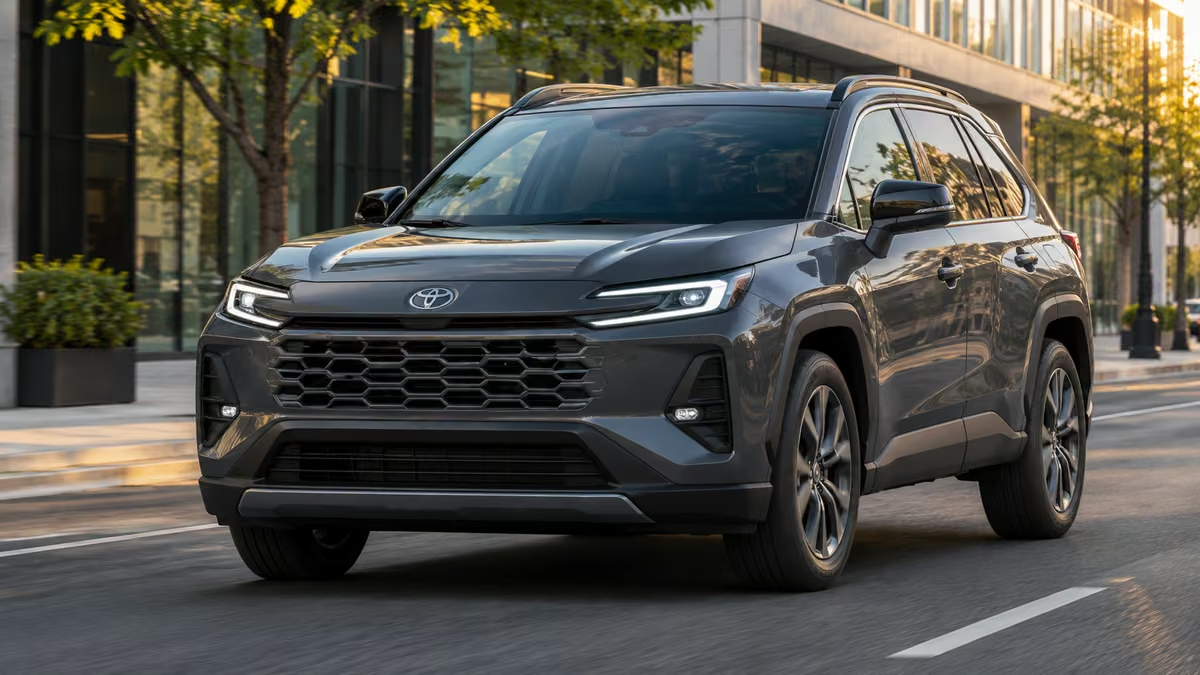
How the Sixth-Generation Toyota RAV4 Changes Compact SUV Competition
The sixth-generation RAV4 represents more than an exterior redesign. Toyota has reworked its powertrain strategy, expanded equipment availability, improved the digital cabin, and refined the chassis. These changes reflect the growing expectations of compact SUV shoppers who want efficiency without sacrificing acceleration, passenger comfort, or useful everyday capability.
Toyota’s decision to make electrification standard is particularly important because many competing compact SUVs still offer traditional gasoline engines as their entry-level powertrains. The RAV4 therefore approaches the market with a different starting proposition. [1]
The Evolution of the Sixth-Generation RAV4
The Toyota RAV4 first arrived in the United States for the 1996 model year, helping establish the modern compact crossover formula. Its unibody construction, manageable dimensions, and practical interior provided an alternative to larger, truck-based SUVs.
The fifth-generation RAV4 expanded that formula through hybrid availability, improved safety technology, and increasingly specialized trims. The sixth generation builds on those strengths with more angular styling, additional structural rigidity, revised suspension components, and updated hybrid systems.
Unlike the outgoing lineup, the 2026 U.S. model no longer offers a gasoline-only engine. Toyota has also introduced front-wheel drive to the conventional hybrid range, providing buyers with a less expensive alternative to AWD.
These developments allow the redesigned RAV4 to appeal to efficiency-focused shoppers while maintaining the versatility associated with the nameplate. [1]
Why Compact SUV Competition Has Become More Intense
Compact SUVs occupy an important position in the American vehicle market because they balance passenger accommodation, cargo flexibility, relatively manageable dimensions, and everyday convenience.
Manufacturers compete across several priorities rather than a single specification. Honda emphasizes the CR-V’s interior practicality and hybrid driving experience. Kia and Hyundai offer extensive equipment choices and electrified options. Subaru highlights standard all-wheel drive and all-weather usability, while Mazda emphasizes steering response, cabin design, and driving engagement.
Electrification has added another dimension to these comparisons. Buyers increasingly evaluate fuel consumption, battery warranties, available electric range, charging requirements, and the price difference between gasoline and hybrid models.
Consequently, a successful compact SUV must deliver competitive performance across several categories instead of relying on one standout feature.
The RAV4’s Competitive Value Proposition
The RAV4’s value proposition begins with its standard hybrid powertrain, but it extends well beyond fuel economy.
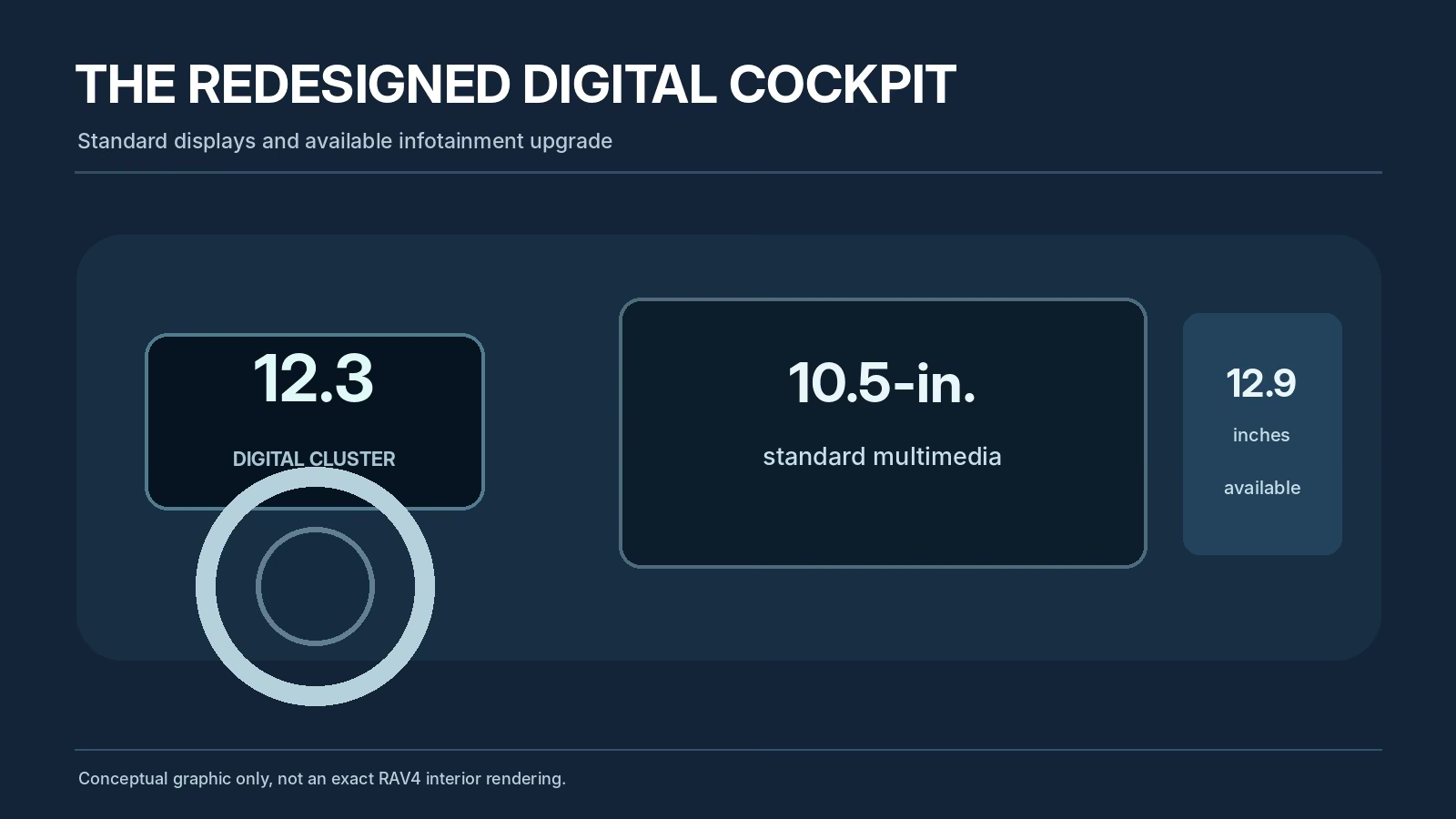
For the 2026 model year, Toyota combines hybrid propulsion with a standard 12.3-inch digital instrument cluster, a 10.5-inch multimedia display, wireless smartphone integration, and Toyota Safety Sense 4.0.
The entry-level LE starts at $31,900 before applicable destination and other charges. That price is not the lowest in the segment, but it includes electrified propulsion rather than a conventional gasoline-only powertrain. [2]
Buyers must still consider insurance, financing, service costs, and depreciation. Nevertheless, the RAV4’s equipment, fuel efficiency, and functional versatility create a compelling package for people who want one vehicle to satisfy several transportation needs.
| Specification | 2025 RAV4 | 2026 RAV4 |
|---|---|---|
| Generation | Fifth | Sixth |
| U.S. powertrain choices | Gasoline, hybrid, PHEV | Hybrid and PHEV |
| Conventional hybrid FWD | Not offered | Available |
| Conventional hybrid AWD output | 219 hp | 236 hp |
| PHEV combined output | 302 hp | 324 hp |
| Standard digital gauge cluster | Equipment varied | 12.3 inches |
| Standard multimedia touchscreen | 8 inches | 10.5 inches |
| Standard safety suite | Toyota Safety Sense 2.5 | Toyota Safety Sense 4.0 |
Comparison reflects U.S.-market specifications. Equipment and availability vary by configuration. [1]
Why the Electrified Powertrain Lineup Is the RAV4’s Biggest Advantage
Toyota’s most consequential decision for 2026 is eliminating the gasoline-only RAV4 from the U.S. lineup.
Every RAV4 now uses electrical assistance as part of its propulsion system, either through a conventional hybrid or a plug-in hybrid.
This approach provides buyers with improved efficiency and greater power than the previous entry-level gasoline model, although it also removes the possibility of choosing a simpler, non-hybrid configuration. [1]
The End of Gasoline-Only RAV4 Models
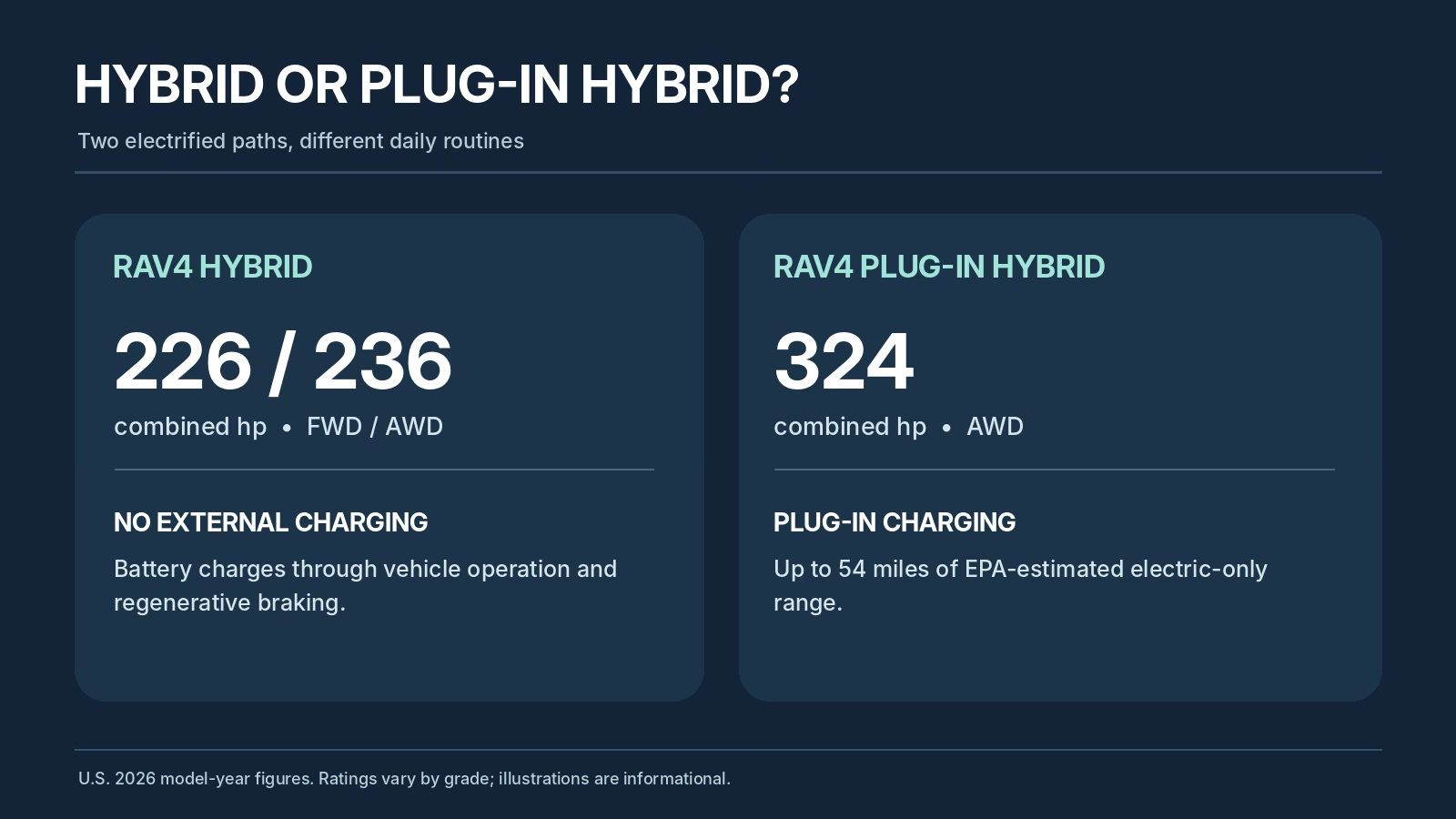
Traditional gasoline vehicles rely on an internal combustion engine as their propulsion source. Conventional hybrids combine a gasoline engine with electric motors and a relatively small traction battery. Plug-in hybrids use a larger rechargeable battery and can complete more substantial distances using electricity alone.
For 2026, Toyota has standardized the latter two approaches across the RAV4 lineup.
This decision matters because competing gasoline-only compact SUVs can offer lower purchase prices but generally consume more fuel than comparable hybrid models.
The RAV4’s strategy prioritizes efficient daily driving without making buyers pay an additional premium simply to access conventional hybrid propulsion. However, drivers who specifically prefer a non-hybrid powertrain must now consider another model.
Toyota RAV4 Hybrid and Its Standard Hybrid Powertrain
The conventional Toyota RAV4 Hybrid uses a 2.5-liter gasoline engine working alongside electric motor-generators and a traction battery.
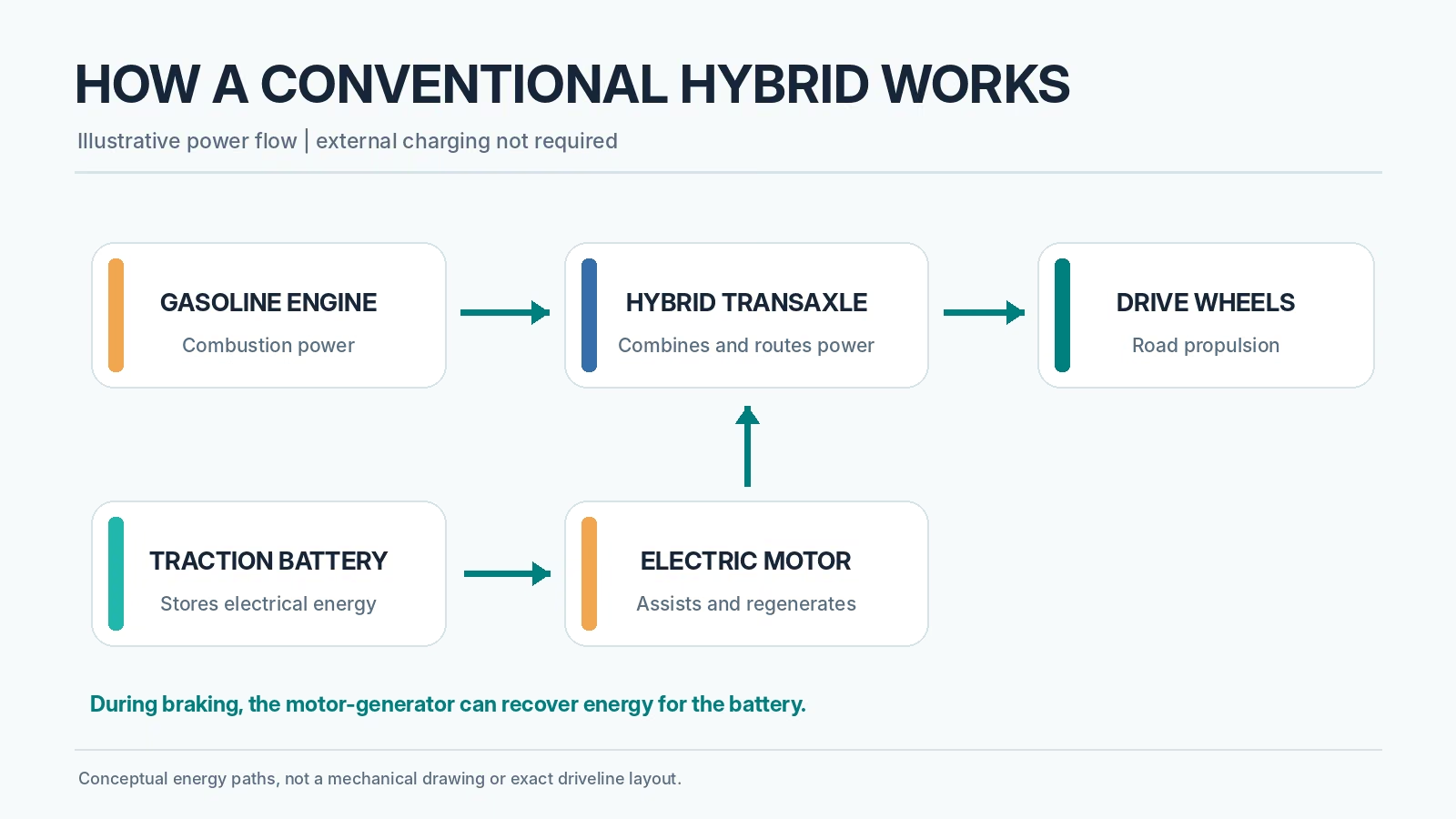
During acceleration, electrical assistance supplements gasoline-engine output. Under suitable low-load conditions, the vehicle can operate briefly using electrical propulsion. When slowing down, regenerative braking allows the electric motor-generator to recover some kinetic energy and store it in the battery.
A conventional RAV4 Hybrid does not need to be plugged into an external charger. Its battery is managed automatically through regenerative braking and the gasoline engine.
That makes it particularly convenient for drivers without access to home charging, including apartment residents and commuters who frequently travel through stop-and-go traffic.
The Fifth-Generation Toyota Hybrid System
The 2026 RAV4 Hybrid uses Toyota’s fifth-generation hybrid system, which combines revised electrical components, power management, and electric motor assistance.
The redesigned hybrid produces 226 net combined horsepower in front-wheel-drive configurations and 236 horsepower with all-wheel drive.
For comparison, the previous RAV4 Hybrid AWD generated 219 horsepower. The new system therefore increases output while retaining strong fuel-economy performance. [1]
A power-split hybrid transmission coordinates the gasoline engine and electric motor-generators to provide suitable propulsion under changing driving conditions.
The system can vary engine operation and electrical assistance based on acceleration demands, battery charge, and vehicle speed, helping reduce fuel consumption without requiring driver intervention.
The Role of the 2.5-Liter Four-Cylinder Engine
Both electrified powertrain families use a 2.5-liter four-cylinder gasoline engine as an important component of their propulsion systems.
In the conventional hybrid, the engine supplies mechanical power while participating in the management of electrical energy. The hybrid system allows engine operation to be optimized over a broader range of driving conditions.
Toyota’s Dynamic Force engine architecture emphasizes thermal efficiency, helping support lower fuel consumption when combined with electric assistance.
The gasoline engine does not operate independently from the hybrid system during normal driving. Instead, the vehicle’s control software determines how much propulsion should come from gasoline and electrical power.
This coordinated operation is central to the RAV4’s combination of relatively strong acceleration and competitive fuel economy.
Toyota RAV4 Plug-in Hybrid and the Sixth-Generation PHEV System
The Toyota RAV4 Plug-in Hybrid uses the company’s sixth-generation PHEV system, combining the 2.5-liter gasoline engine with a larger traction battery and more powerful electric propulsion.
Its total system output reaches 324 horsepower, considerably exceeding the conventional hybrid versions.
The PHEV can travel substantial distances without routinely running its gasoline engine, provided the battery has sufficient charge and operating conditions permit electric driving.
Once usable electric-only energy is depleted, the vehicle continues operating as a hybrid rather than becoming immobile.
The PHEV is most attractive for drivers who can recharge regularly and want electric driving for local journeys without depending entirely on public charging infrastructure for longer trips. [1]
| Feature | RAV4 Hybrid | RAV4 Plug-in Hybrid |
|---|---|---|
| Propulsion | Gasoline-electric hybrid | Rechargeable gasoline-electric hybrid |
| Combined horsepower | 226 FWD / 236 AWD | 324 |
| Drivetrain | FWD or AWD, depending on grade | AWD standard |
| External charging | Not required | Supported |
| Extended electric-only driving | No | Yes |
| Highest listed electric range | Not applicable | 54 miles, SE |
| Starting MSRP | $31,900 | $41,500 |
| Best suited to | Commuters without charging access | Drivers who can recharge frequently |
Electric range is an EPA estimate for the applicable configuration. MSRP excludes applicable additional charges. [2] [4]
Hybrid Performance, Horsepower, and All-Wheel-Drive Capability
Hybrid powertrains are often associated primarily with fuel savings, but the 2026 Toyota RAV4 demonstrates that electrification can also improve acceleration and everyday responsiveness.
Toyota has increased the combined system output across its conventional hybrid range while giving the PHEV considerably more power.
However, horsepower is only one performance measurement. Vehicle weight, transmission behavior, tire grip, and traction conditions all influence how an SUV actually accelerates and handles.
How Much Hybrid Performance Has Improved
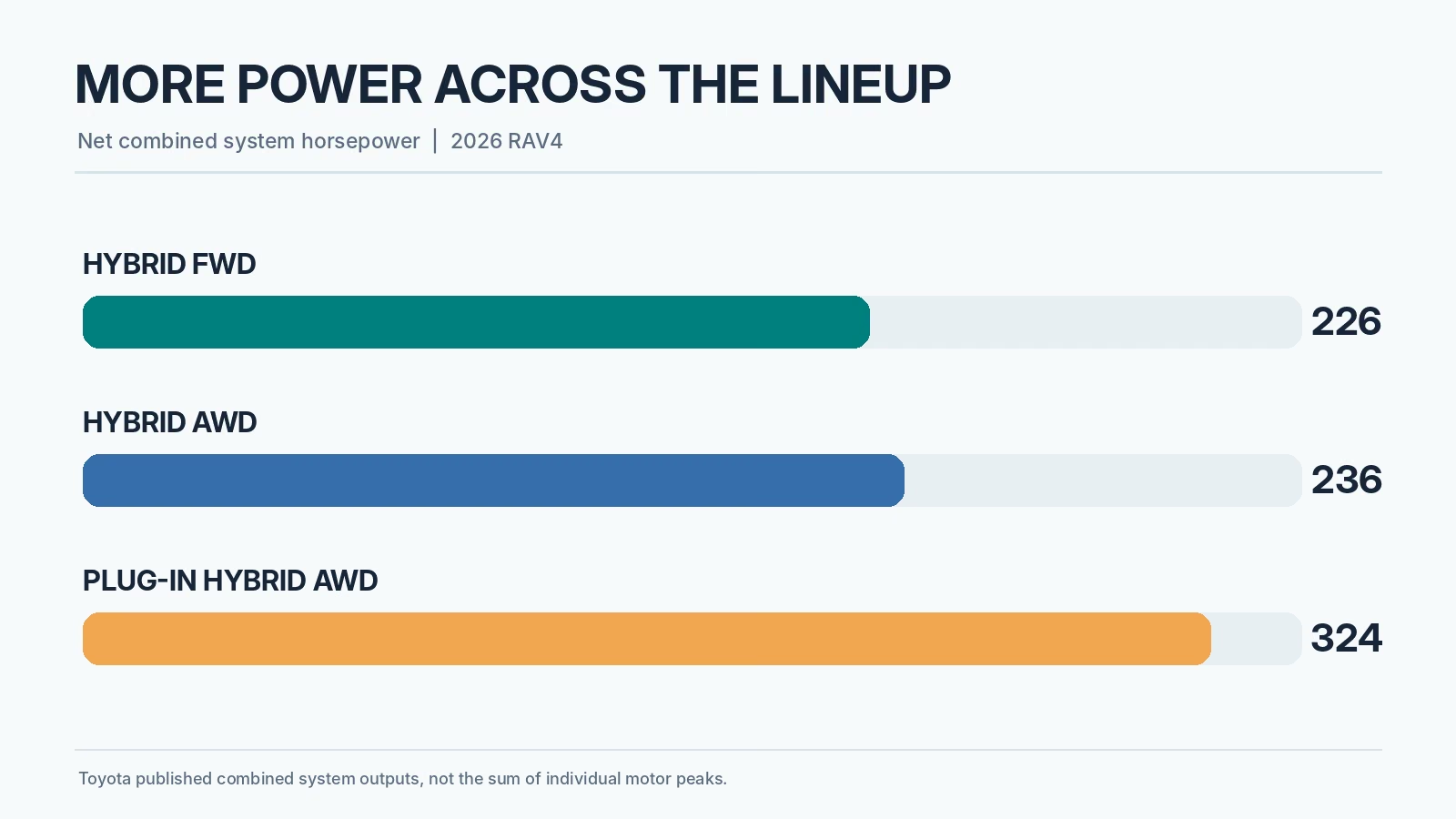
The outgoing gasoline-powered RAV4 produced 203 horsepower, while the previous conventional hybrid AWD generated 219 horsepower.
For 2026, even the front-wheel-drive hybrid produces 226 horsepower. The AWD hybrid increases output to 236 horsepower, and the plug-in hybrid reaches 324 horsepower.
This additional output can help during highway merging, overtaking, and accelerating with passengers or luggage.
Electrical assistance also helps deliver a responsive initial driving feel because electric motors can produce substantial torque from low rotational speeds.
Nevertheless, stronger peak output should not be interpreted as proof that every RAV4 variant accelerates faster than every competing compact SUV. Real-world results depend on the specific configuration and testing conditions. [1]
Understanding Combined System Horsepower
Combined system horsepower describes the maximum output that a hybrid propulsion system can deliver as a coordinated unit.
It is not necessarily equal to the simple addition of the gasoline engine’s maximum horsepower and every electric motor’s individual peak rating.
These components may achieve their maximum outputs at different rotational speeds or operating conditions. Battery power limits and system management also influence simultaneous output.
Toyota rates the 2026 RAV4 Hybrid at 226 horsepower with FWD and 236 horsepower with AWD. Its PHEV is rated at 324 horsepower.
These are useful manufacturer figures for comparing variants, but performance evaluation should also consider acceleration testing, vehicle mass, and the way power is delivered. [1]
Why Instant Electric Torque Matters
Electric motors can provide strong torque at low rotational speeds, which makes hybrid vehicles feel responsive when moving away from a stop.
In a compact SUV, this characteristic is useful when entering traffic, accelerating through intersections, or climbing moderate inclines.
The electric motor assists the gasoline engine when the control system determines that additional propulsion is beneficial.
Compared with an engine-only drivetrain, the result can be smoother low-speed power delivery and reduced reliance on high engine speeds during gentle acceleration.
However, the amount of assistance depends on battery charge, temperature, driving mode, and operating demands. Electric torque does not eliminate traction limits or guarantee superior acceleration in every situation.
Front-Wheel Drive vs Electronic On-Demand AWD
The 2026 RAV4 Hybrid is available with front-wheel drive or Toyota’s Electronic On-Demand All-Wheel Drive system, depending on the trim.
FWD models direct propulsion to the front wheels and generally provide a lower purchase price and favorable fuel economy.
AWD hybrids add an electrically driven rear axle to provide additional traction when needed. The system can distribute driving force between the axles according to vehicle operating conditions.
The RAV4 PHEV comes with AWD as standard.
AWD can improve acceleration traction on slippery surfaces, but it does not shorten braking distances automatically. Tire selection, road conditions, and driver behavior remain critical to safety.
Drivers who rarely encounter difficult traction conditions may find the FWD hybrid sufficient, while AWD provides additional flexibility for varying weather and road surfaces.
| Powertrain configuration | Combined horsepower | Primary benefit |
|---|---|---|
| RAV4 Hybrid FWD | 226 hp | Lower entry cost and efficiency |
| RAV4 Hybrid AWD | 236 hp | Additional traction and performance |
| RAV4 PHEV AWD | 324 hp | Strong acceleration and electric driving |
Fuel Economy, Electric Range, and Charging Technology
Fuel efficiency is central to the RAV4’s competitive position, but buyers should distinguish three different measurements: conventional miles per gallon, electric energy efficiency, and electric-only driving range.
These figures describe different aspects of vehicle operation.
The 2026 RAV4 Hybrid delivers strong EPA fuel-economy ratings, while the PHEV adds the possibility of completing local trips using externally supplied electricity. [3] [4]
Why Fuel Economy Remains a Major Buying Factor
Fuel costs accumulate throughout vehicle ownership, making small differences in efficiency financially meaningful over several years.
For example, a compact SUV achieving 43 mpg consumes substantially less gasoline over 12,000 miles than one averaging 30 mpg.
Hybrids can be particularly effective in urban environments because regenerative braking recovers some energy during deceleration and the gasoline engine can operate less frequently during suitable conditions.
However, fuel economy varies with speed, traffic, weather, tire pressure, and driving style.
A vehicle achieving excellent city efficiency may offer a smaller relative advantage during sustained highway driving. Buyers should therefore evaluate their typical driving pattern rather than relying solely on the highest published MPG figure.
Understanding Miles Per Gallon (MPG)
Miles per gallon measures the distance a vehicle can travel using one U.S. gallon of fuel.
The EPA publishes separate city, highway, and combined ratings. The combined rating provides a standardized estimate based on a prescribed mixture of driving conditions.
For the 2026 RAV4, the EPA lists 43 mpg combined for the front-wheel-drive hybrid configurations and 42 mpg for the LE and SE AWD hybrids. Higher-grade AWD versions generally achieve 41 mpg, while the Woodland Hybrid is rated at 38 mpg combined. [3]
These standardized estimates are intended for comparison, not as guaranteed real-world results.
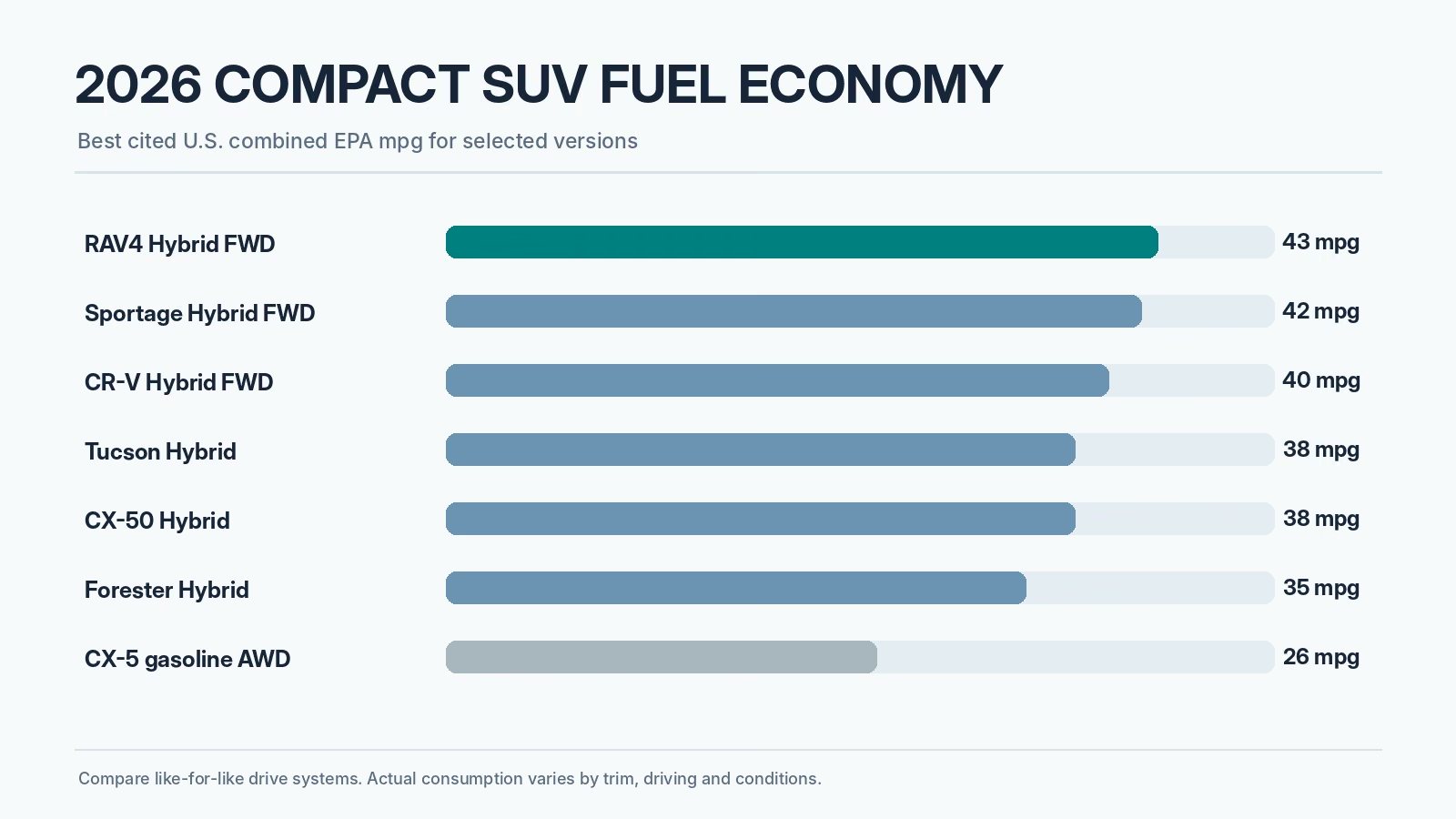
| 2026 RAV4 Hybrid configuration | City MPG | Highway MPG | Combined MPG |
|---|---|---|---|
| LE, SE, XLE Premium FWD | 47 | 40 | 43 |
| LE and SE AWD | 46 | 39 | 42 |
| XLE Premium AWD | 45 | 38 | 41 |
| XSE and Limited AWD | 43 | 37 | 41 |
| Woodland AWD | 41 | 35 | 38 |
EPA ratings. Actual mileage varies. [3]
Consider a hypothetical driver traveling 12,000 miles annually with gasoline priced at $3.50 per gallon:
| Combined fuel economy | Annual fuel consumption | Annual fuel expense |
|---|---|---|
| 30 MPG | 400 gallons | $1,400 |
| 38 MPG | 316 gallons | $1,105 |
| 43 MPG | 279 gallons | $977 |
Under these assumptions, the 43-mpg vehicle saves approximately $423 annually compared with the 30-mpg vehicle. This is an illustrative calculation, not a projection of actual fuel prices or ownership costs.
The Toyota RAV4’s All-Electric Driving Range
Electric-only range describes how far a PHEV can travel using stored electrical energy under standardized testing conditions before gasoline operation becomes necessary.
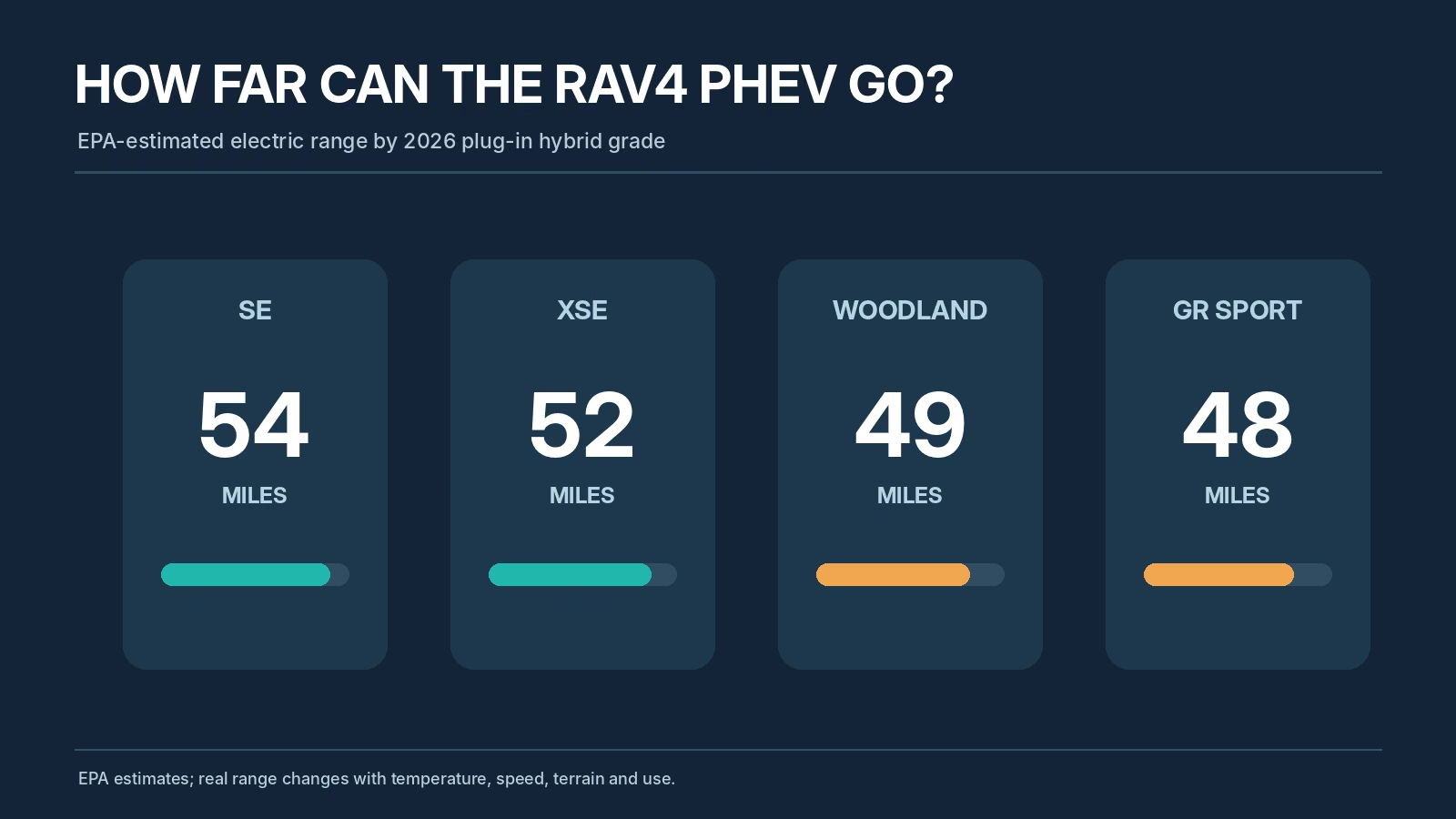
Toyota’s current U.S. product information lists an EPA-estimated 54-mile electric range for the 2026 RAV4 PHEV SE. The XSE is rated at approximately 52 miles, Woodland at 49 miles, and GR SPORT at approximately 48 miles.
Toyota’s original launch announcement projected up to 52 miles for the SE and XSE. The current 54-mile SE figure represents an updated rating rather than an unchanged early projection. [1] [4]
These ranges make electric commuting practical for drivers whose daily mileage fits within their available battery capacity.
Actual range can decrease with high speeds, cold weather, heating or air-conditioning use, steep terrain, and battery aging.
DC Fast Charging and the CCS Charging Connector
The RAV4 PHEV offers different charging capabilities depending on the grade.
The XSE and Woodland models feature an 11-kW onboard AC charger and CCS1 charging connection supporting DC fast charging. Toyota estimates a charging session from approximately 10% to 80% in around 30 minutes under suitable conditions.
The SE and GR SPORT use a 7-kW onboard AC charger and J1772 connection for Level 1 and Level 2 AC charging. They do not offer the same factory DC fast-charging functionality.
The difference matters because DC fast charging bypasses the vehicle’s onboard AC conversion hardware to supply high-voltage DC energy directly to the battery.
For owners with reliable home charging, overnight AC charging may be sufficient. Drivers who frequently travel longer distances may place greater value on the XSE or Woodland’s fast-charging capability. [1]
| RAV4 PHEV grade | Electric range | AC charger | DC fast charging |
|---|---|---|---|
| SE | 54 miles EPA-estimated | 7 kW | No |
| XSE | 52 miles | 11 kW | Yes |
| Woodland | 49 miles | 11 kW | Yes |
| GR SPORT | Approximately 48 miles | 7 kW | No |
Charging estimates and electric range depend on operating conditions and applicable ratings.
2026 Toyota RAV4 Pricing and Trim-Level Strategy
Toyota positions the redesigned RAV4 across several price brackets, ranging from the entry-level hybrid LE to the more expensive plug-in hybrid GR SPORT.
This breadth is important because compact SUV shoppers do not all prioritize the same features.
Some value the lowest possible entry price, while others prefer premium seating, all-weather equipment, stronger performance, or enhanced charging functionality.
Toyota’s three exterior design families also create clear distinctions between everyday, sporty, and rugged configurations. [2]
Understanding the RAV4 Starting MSRP
The 2026 RAV4 LE Hybrid FWD starts at $31,900 in the United States.
MSRP means Manufacturer’s Suggested Retail Price and excludes applicable destination, taxes, registration, dealer fees, and optional equipment.
The actual transaction price can differ because of dealership pricing, inventory conditions, incentives, and selected packages.
Toyota’s base MSRP is higher than the starting prices of some gasoline-only competitors, but that comparison overlooks its standard hybrid powertrain.
For a fair value assessment, buyers should compare the RAV4 with similarly equipped hybrid competitors while separately evaluating the possibility of saving money by choosing a non-hybrid SUV.
How the RAV4 Trim-Level Strategy Serves Different Buyers
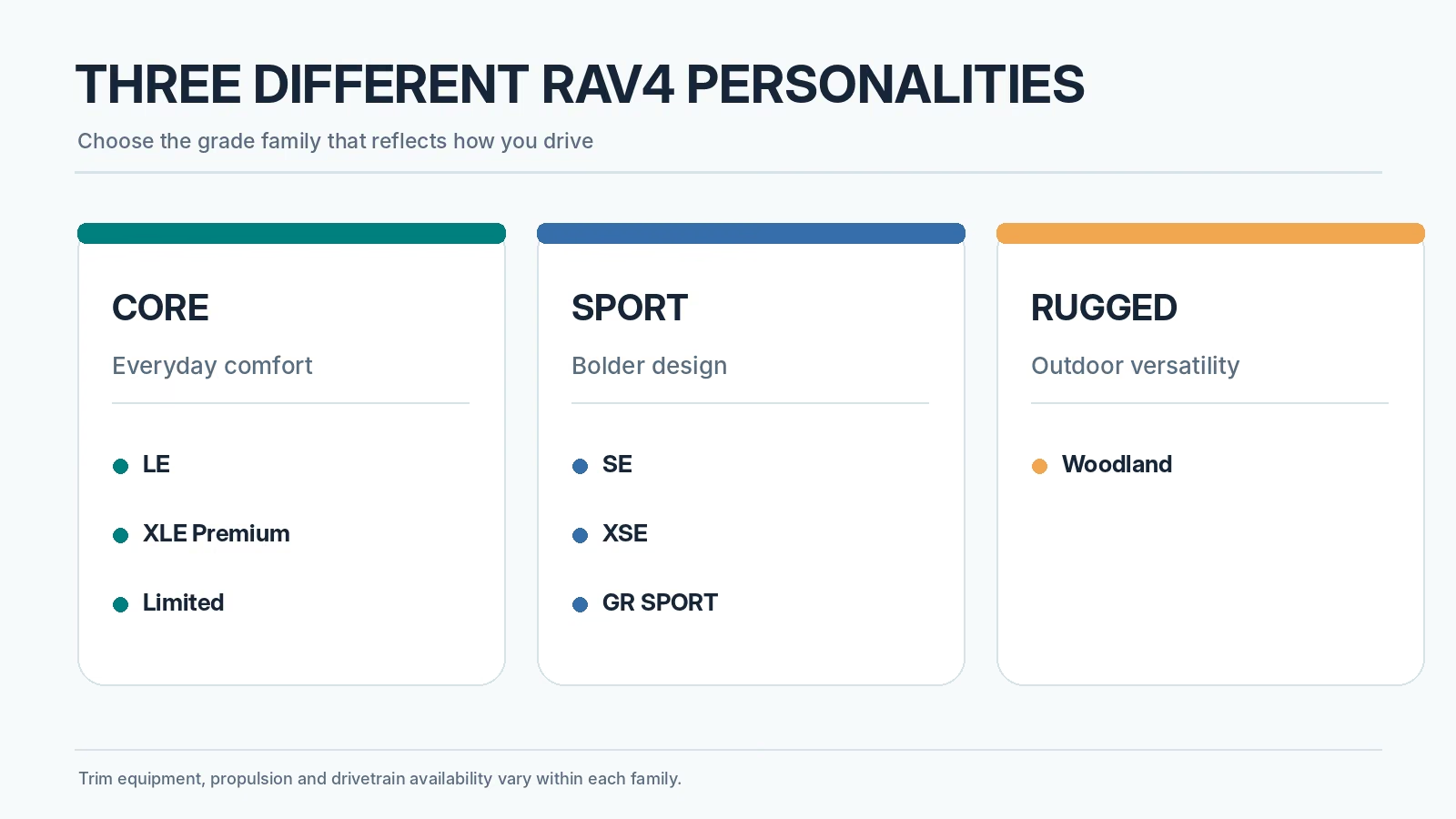
Toyota organizes the 2026 RAV4 into core, sport, and rugged styling families.
The core family includes LE, XLE Premium, and Limited. SE, XSE, and GR SPORT represent sport-oriented designs, while Woodland emphasizes outdoor utility.
The selection also determines drivetrain availability, technology, and charging features.
A higher trim is not automatically a better purchase. More equipment increases the initial price, while larger wheels and additional features can affect replacement costs.
The most economical long-term choice depends on which equipment a buyer will actually use, not simply the number of standard features included.
Toyota RAV4 LE: The Accessible Entry Point
The RAV4 LE provides the essential elements of Toyota’s redesigned compact SUV without requiring buyers to select an expensive equipment package.
It includes standard hybrid power, a 10.5-inch multimedia touchscreen, a 12.3-inch digital instrument cluster, wireless smartphone compatibility, and Toyota Safety Sense 4.0.
Front-wheel drive is standard, while AWD is available at additional cost.
The LE is most appropriate for buyers who prioritize efficiency, basic functionality, and purchase affordability over premium interior materials or convenience equipment.
It is also a strong starting point for comparing the cost of the RAV4 against gasoline-only compact SUVs.
Toyota RAV4 SE: Affordable Sporty Styling
The RAV4 SE adds sport-oriented styling and equipment while remaining relatively accessible within Toyota’s lineup.
Its exterior includes distinctive black trim treatments, sport wheels, and visual details that separate it from the core grades.
Buyers can choose a conventional hybrid configuration with FWD or AWD, or move to the substantially more powerful SE PHEV with standard AWD.
The SE therefore offers two different ownership propositions: a conventional hybrid with sportier appearance or a plug-in hybrid with much greater electric capability.
For shoppers who prefer athletic styling without paying for every premium feature, the conventional hybrid SE is worth considering.
Toyota RAV4 XLE Premium: The Balanced Middle Ground
The XLE Premium occupies an important position between the entry-level LE and the more expensive Limited.
It includes upgrades such as SofTex-trimmed seating, heated front seats, a power-adjustable driver’s seat, a power liftgate, and additional charging conveniences.
These features can make a meaningful difference for families, frequent commuters, and drivers who regularly take longer trips.
FWD and AWD configurations are available, although towing capability differs between them.
The XLE Premium is particularly attractive to buyers who want a noticeably more comfortable daily vehicle without moving into the highest-priced trim levels.
Toyota RAV4 Woodland: Rugged Adventure-Oriented Utility
The Woodland is Toyota’s outdoor-focused RAV4 configuration, available as a conventional hybrid or PHEV.
It features standard AWD, 18-inch wheels with all-terrain tires, raised roof rails, distinctive exterior styling, and a tow hitch receiver.
Toyota also specifies 8.5 inches of ground clearance and a maximum towing rating of 3,500 pounds for the appropriately equipped Woodland.
The PHEV version adds substantial electric driving capability and DC fast charging.
These features make Woodland suitable for camping trips, gravel access roads, outdoor equipment, and recreational travel.
However, it remains a compact crossover rather than a dedicated body-on-frame off-road vehicle with low-range gearing. [1]
Toyota RAV4 XSE: Sporty Premium Technology
The RAV4 XSE combines sport styling with a more technology-focused cabin.
Its equipment includes a 12.9-inch multimedia touchscreen, distinctive 20-inch wheels, upgraded seat materials, heated and ventilated front seats, and additional convenience features.
Toyota offers the XSE with either conventional hybrid or plug-in hybrid propulsion, both using AWD.
The PHEV version is particularly significant because it combines 324 horsepower with DC fast-charging capability.
Buyers comparing the XSE Hybrid and XSE PHEV should consider whether their driving patterns and charging access justify the substantial increase in purchase price.
Toyota RAV4 Limited: Comfort and Technology Emphasis
The Limited emphasizes interior convenience, upgraded technology, and comfort rather than sport or adventure styling.
Toyota equips it with AWD hybrid propulsion, a 12.9-inch multimedia display, premium JBL audio, and additional seating amenities.
Available or standard equipment, depending on configuration, includes driver-assistance and parking conveniences designed to reduce everyday effort.
The Limited is particularly relevant for drivers who spend significant time behind the wheel and value cabin features more than maximum acceleration.
However, its higher price makes direct comparison with similarly equipped Honda, Hyundai, Kia, and Mazda models especially important.
Toyota RAV4 GR SPORT: The Performance-Focused Choice
The GR SPORT represents the most overtly performance-oriented RAV4 configuration in the 2026 U.S. lineup.
Developed with involvement from Toyota Gazoo Racing, it includes the 324-horsepower PHEV system, standard AWD, revised steering calibration, sport-tuned suspension components, and functional aerodynamic elements.
Its distinctive wheels, exterior trim, and sport-focused cabin further separate it from conventional hybrid models.
Unlike the XSE and Woodland PHEVs, the GR SPORT does not feature DC fast charging.
Its summer performance tires also deserve consideration because they are not appropriate for every climate or winter driving condition.
The GR SPORT is primarily intended for buyers who value sharper driving characteristics and distinctive styling.
Complete 2026 Toyota RAV4 Trim Comparison
The following table uses published U.S. base MSRPs and the applicable EPA or Toyota-listed combined fuel-economy figures. Prices exclude destination and other applicable charges.
| Model | Starting MSRP | Drivetrain | Horsepower | Combined MPG | Primary appeal |
|---|---|---|---|---|---|
| LE Hybrid | $31,900 | FWD | 226 | 43 | Budget commuting |
| SE Hybrid | $34,700 | FWD | 226 | 43 | Sport styling |
| XLE Premium Hybrid | $36,100 | FWD | 226 | 43 | Comfort and value |
| Woodland Hybrid | $39,900 | AWD | 236 | 38 | Outdoor versatility |
| XSE Hybrid | $41,300 | AWD | 236 | 41 | Sport and technology |
| Limited Hybrid | $43,300 | AWD | 236 | 41 | Premium comfort |
| SE PHEV | $41,500 | AWD | 324 | 40 gas-only | Electric commuting |
| Woodland PHEV | $45,300 | AWD | 324 | 37 gas-only | Electric adventure |
| XSE PHEV | $47,200 | AWD | 324 | 40 gas-only | Performance and charging |
| GR SPORT PHEV | $48,500 | AWD | 324 | 36 gas-only | Performance emphasis |
Hybrid prices and MPG reflect the listed base configurations. Optional AWD changes the price and economy of certain hybrid grades. PHEV gasoline MPG excludes electricity consumption. [2] [3] [5]
Exterior Design and the Evolution of the RAV4’s Appearance
The redesigned RAV4 adopts a more angular visual identity while maintaining recognizable SUV proportions.
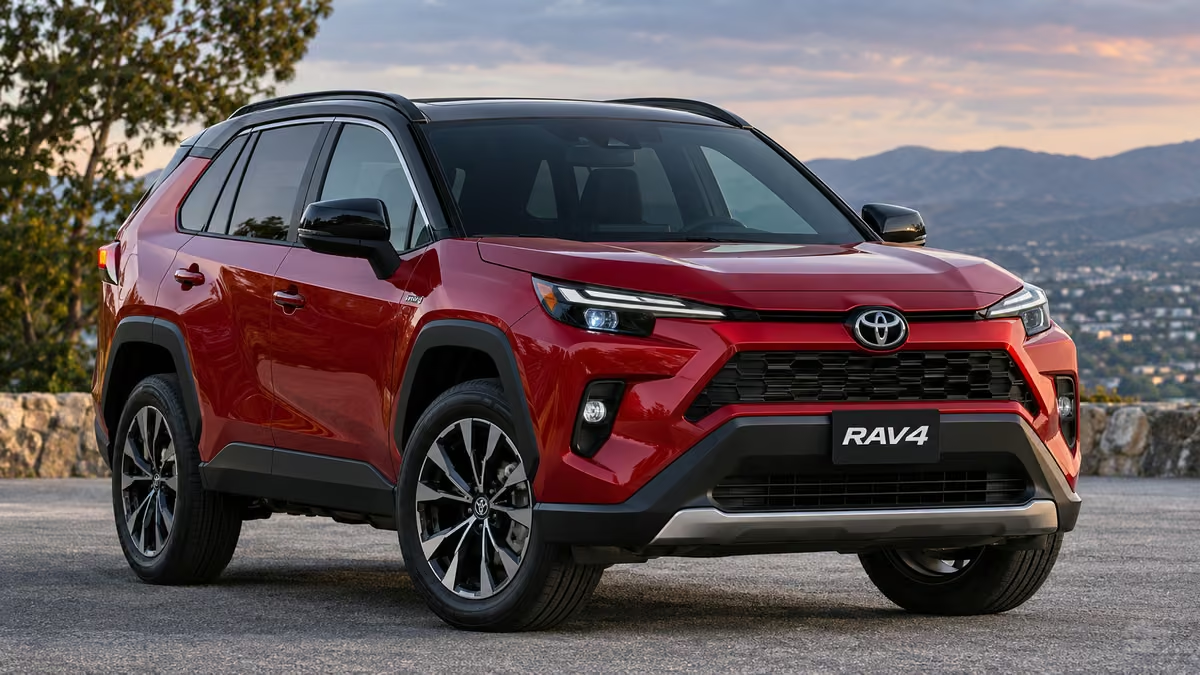
Toyota combines its contemporary hammerhead front-end design with prominent fenders, a relatively upright cargo area, and distinctive lighting elements.
Instead of applying identical visual treatments across every grade, Toyota differentiates core, sport, and rugged versions to broaden appeal.
Exterior styling remains subjective, but its greater variety gives shoppers more opportunities to select a vehicle that matches their preferences.
The Redesigned Hammerhead Exterior Design
Toyota’s hammerhead styling language places greater emphasis on the front lighting elements, hood contours, and grille arrangement.
On the redesigned RAV4, these features create a more prominent front-end appearance while retaining the upright proportions associated with practical compact SUVs.
Angular wheel arches and stronger body detailing reinforce the crossover’s visual character.
Some of these design elements resemble themes found elsewhere in Toyota’s contemporary lineup, helping establish a more consistent family identity.
The appearance may appeal to buyers who prefer a more assertive SUV design, although those who favor understated styling may prefer competitors with smoother exterior surfaces.
Core, Sport, and Rugged Identities
The core grades use relatively restrained exterior treatments intended to emphasize everyday practicality.
Sport grades introduce more prominent black accents, larger wheels, distinctive grille detailing, and more aggressive styling elements.
Woodland takes a different direction with all-terrain tires, roof rails, rugged exterior accents, and details that visually communicate outdoor capability.
These differences extend beyond cosmetic features in certain versions because wheel sizes, tire specifications, equipment, and drivetrain choices can affect real-world usability.
The variety enables Toyota to address different customer preferences without developing separate crossover platforms for every lifestyle category.
Does the New RAV4 Look More Premium?
The redesigned RAV4 has a more contemporary exterior, but premium appearance is influenced by personal taste and specific trim equipment.
Larger wheels, updated lighting, stronger body proportions, and modernized interior technology can create a more sophisticated impression.
Nevertheless, competing compact SUVs approach design differently.
The Hyundai Tucson emphasizes distinctive lighting and angular bodywork, while the Mazda CX-5 uses a cleaner, more restrained design language. Honda’s CR-V prioritizes mature proportions and visual simplicity.
Buyers should assess appearance alongside outward visibility, body dimensions, wheel replacement costs, and practical considerations rather than treating styling sophistication as an objective measurement of quality.
Interior Technology and Connected Vehicle Features
The 2026 RAV4 introduces substantial technology changes designed to make the cabin more contemporary and easier to use.
Digital displays are now prominent across the lineup, while the latest Toyota Audio Multimedia system integrates smartphone compatibility, connected services, and updated voice-control functionality.
These upgrades address areas where competing compact SUVs have rapidly advanced.
However, screen size alone does not determine usability. Menu organization, physical controls, display visibility, and subscription requirements remain equally important.
The 10.5-Inch Touchscreen
The standard 10.5-inch Toyota Audio Multimedia touchscreen provides access to audio, compatible smartphone functions, vehicle settings, and connected features.
Wireless Apple CarPlay and Android Auto compatibility allows supported smartphones to connect without requiring a cable.
Toyota has also introduced a customizable interface and revised voice-assistant functionality intended to simplify access to frequently used controls.
For everyday driving, the important advantages are readable information, straightforward navigation between functions, and reliable smartphone connectivity.
Buyers should test the interface while parked and verify whether their preferred navigation or entertainment features require a smartphone connection or a paid connected service.
The 12.3-Inch Digital Instrument Cluster
Every 2026 RAV4 grade includes a 12.3-inch digital instrument cluster.
Unlike a traditional analog display, a digital cluster can present speed, driving information, assistance-system status, and other vehicle information in customizable layouts.
Hybrid models can also display information relevant to energy management and vehicle operation.
The larger screen gives Toyota flexibility to organize information according to different driving situations.
However, the benefit depends on display clarity and the driver’s ability to locate important information quickly.
A well-configured cluster can reduce unnecessary attention shifts, while excessive information may create distraction if settings are not adjusted appropriately.
The Available 12.9-Inch Multimedia Display
Higher RAV4 grades offer a 12.9-inch multimedia touchscreen, increasing the display area available for maps, menus, and entertainment functions.
The larger screen can make navigation information easier to read and provide more space for interface elements.
Toyota includes this display on premium configurations such as the XSE and Limited.
Its value depends on how frequently an owner uses navigation, smartphone applications, or connected vehicle features.
For buyers who primarily listen to music and use basic phone connectivity, the standard 10.5-inch display may already provide sufficient functionality.
A larger screen should therefore be evaluated as a convenience upgrade rather than an essential requirement.
Toyota Arene Platform and Software Development
The 2026 RAV4 introduces Arene, a software-development platform created by Woven by Toyota.
Arene provides a foundation for integrating vehicle software, including aspects of connected technology, safety systems, and future software development.
Toyota describes its introduction as an important step toward software-defined vehicles, where software architecture increasingly influences vehicle functionality.
This development may help Toyota develop and integrate advanced vehicle systems more consistently.
However, the existence of a software platform does not guarantee that every vehicle will receive every future feature through an update.
Buyers should make purchasing decisions based on currently confirmed vehicle functions rather than unannounced software capabilities. [1]
Connected Vehicle Technology
The redesigned RAV4 includes wireless smartphone integration, Bluetooth connectivity, and Toyota connected-service options.
Available digital-key functionality allows compatible devices to provide certain vehicle access and starting capabilities.
Some connected features depend on compatible hardware, mobile network coverage, active subscriptions, or trial periods.
Toyota also incorporates updated connectivity capabilities into the multimedia system, including support for its connected-service ecosystem.
Before purchasing, owners should identify which functions remain available without payment and which services may require renewal.
This distinction is especially important for navigation, remote functions, enhanced driving assistance, and connected entertainment because recurring charges contribute to long-term ownership expenses.
JBL Premium Audio and Premium Interior Equipment
Toyota offers JBL premium audio on higher RAV4 configurations, including the Limited.
The upgraded audio system provides additional speakers and specialized components compared with the standard arrangement.
Premium grades also introduce features such as heated or ventilated seating, enhanced upholstery, additional power adjustments, and convenience equipment.
These upgrades can improve perceived cabin quality and comfort during long journeys.
However, the value of premium equipment varies considerably among buyers.
Someone who regularly travels long distances may benefit from upgraded seating and sound quality, while a short-distance commuter might prefer a lower purchase price and simpler equipment.
| Technology feature | Standard or available |
|---|---|
| 10.5-inch touchscreen | Standard |
| 12.3-inch digital instrument cluster | Standard |
| Wireless Apple CarPlay and Android Auto | Standard |
| Toyota Safety Sense 4.0 | Standard |
| 12.9-inch touchscreen | Available on higher grades |
| JBL premium audio | Available, depending on grade |
| Digital-key functionality | Available |
| Advanced parking assistance | Available |
| Connected navigation and enhanced services | Feature and subscription dependent |
Availability varies by trim and optional equipment.
Safety Technology and Driver Assistance
Safety is a significant part of the redesigned RAV4’s value proposition.
Toyota introduces Toyota Safety Sense 4.0 across the lineup and offers additional systems on selected grades.
The SUV also has independent crash-test results available from the Insurance Institute for Highway Safety.
Nevertheless, buyers should distinguish between the presence of electronic driver-assistance features and independently verified crashworthiness. The two address related but different aspects of vehicle safety.
Toyota Safety Sense 4.0
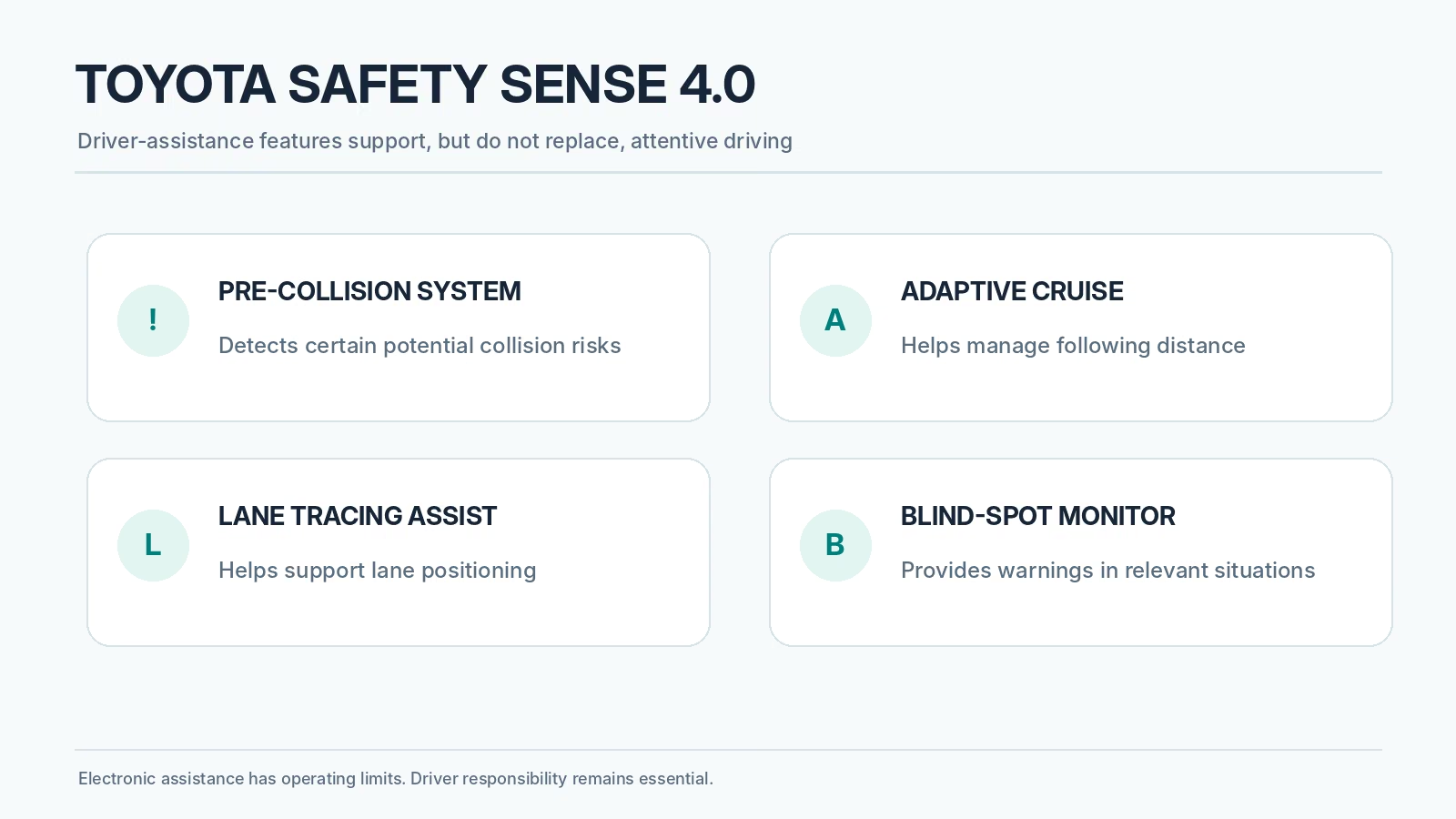
Toyota Safety Sense 4.0 is the manufacturer’s updated collection of active-safety and driver-assistance systems.
It includes technologies designed to identify certain collision risks, assist with lane positioning, manage following distance, and provide warnings under specified operating conditions.
The updated system incorporates revised sensing and detection capabilities.
Features such as Pre-Collision System, Dynamic Radar Cruise Control, Lane Tracing Assist, and related functions are intended to support the driver during everyday operation.
These technologies have limitations involving road conditions, visibility, weather, sensor performance, and detected objects.
They do not make the RAV4 a self-driving vehicle. The driver must remain attentive and responsible for safe operation. [1]
Additional Safety Equipment and Convenience Systems
The 2026 RAV4 adds standard Blind Spot Monitor with Rear Cross-Traffic Alert across the lineup.
These features can provide useful warnings when changing lanes or reversing from parking spaces.
Depending on configuration, Toyota also offers systems such as Front Cross-Traffic Alert, Lane Change Assist, parking assistance, and Traffic Jam Assist.
Certain advanced features require additional equipment or connected-service access.
The availability of standard blind-spot monitoring is particularly relevant because some competing vehicles reserve similar technology for higher trims.
However, assistance-system effectiveness varies according to operating conditions, and drivers should never rely exclusively on electronic warnings.
Safety Comparisons with Competing Compact SUVs
Independent crash testing provides important evidence beyond the manufacturer’s equipment list.
The IIHS reports that the 2026 RAV4 Hybrid received Good ratings in its small-overlap front and updated side-impact evaluations, while its updated moderate-overlap front evaluation received an Acceptable rating.
Its standard front crash-prevention systems also earned Good ratings in the applicable IIHS evaluations. [6]
These results support the RAV4’s safety credentials but do not establish that it is superior to every rival in every test.
Honda, Kia, Hyundai, Mazda, and Subaru offer their own driver-assistance suites. Differences in crash-test results, trim equipment, headlights, and system performance should be evaluated using the same model year and testing criteria.
A model’s previous-year safety award should not automatically be treated as proof of identical performance following a redesign.
Cargo Space, Practicality, and Towing Capability
Compact SUV shoppers often need a vehicle that can transport passengers, luggage, groceries, child equipment, and recreational gear without the expense or dimensions of a larger SUV.
The RAV4 remains designed around those everyday requirements.
Toyota combines a five-passenger cabin with flexible rear seating and substantial cargo capacity.
Its available towing capability provides an additional advantage over some competing hybrid SUVs, although capacity varies significantly between configurations.
Cargo Practicality for Families and Daily Life
The 2026 RAV4 provides up to approximately 37.8 cubic feet of cargo space behind the second row in several hybrid configurations.
Certain equipment combinations, including versions with a panoramic roof, have a smaller published cargo measurement of approximately 36.6 cubic feet. [18]
The rear seatbacks fold to accommodate larger objects, helping the RAV4 support shopping, luggage, sports equipment, and recreational use.
Toyota has also redesigned aspects of the folding rear-seat arrangement and available power liftgate.
Cargo volume is useful for initial comparison, but practical accommodation depends on the shape of the cargo area, lift-over height, rear-seat arrangement, and dimensions of the items being transported.
Families should also check rear-seat legroom and child-seat installation space before choosing a vehicle.
How Towing Capacity Strengthens the RAV4’s Position
Maximum towing capacity describes the greatest trailer weight a manufacturer permits under specified vehicle and equipment conditions.
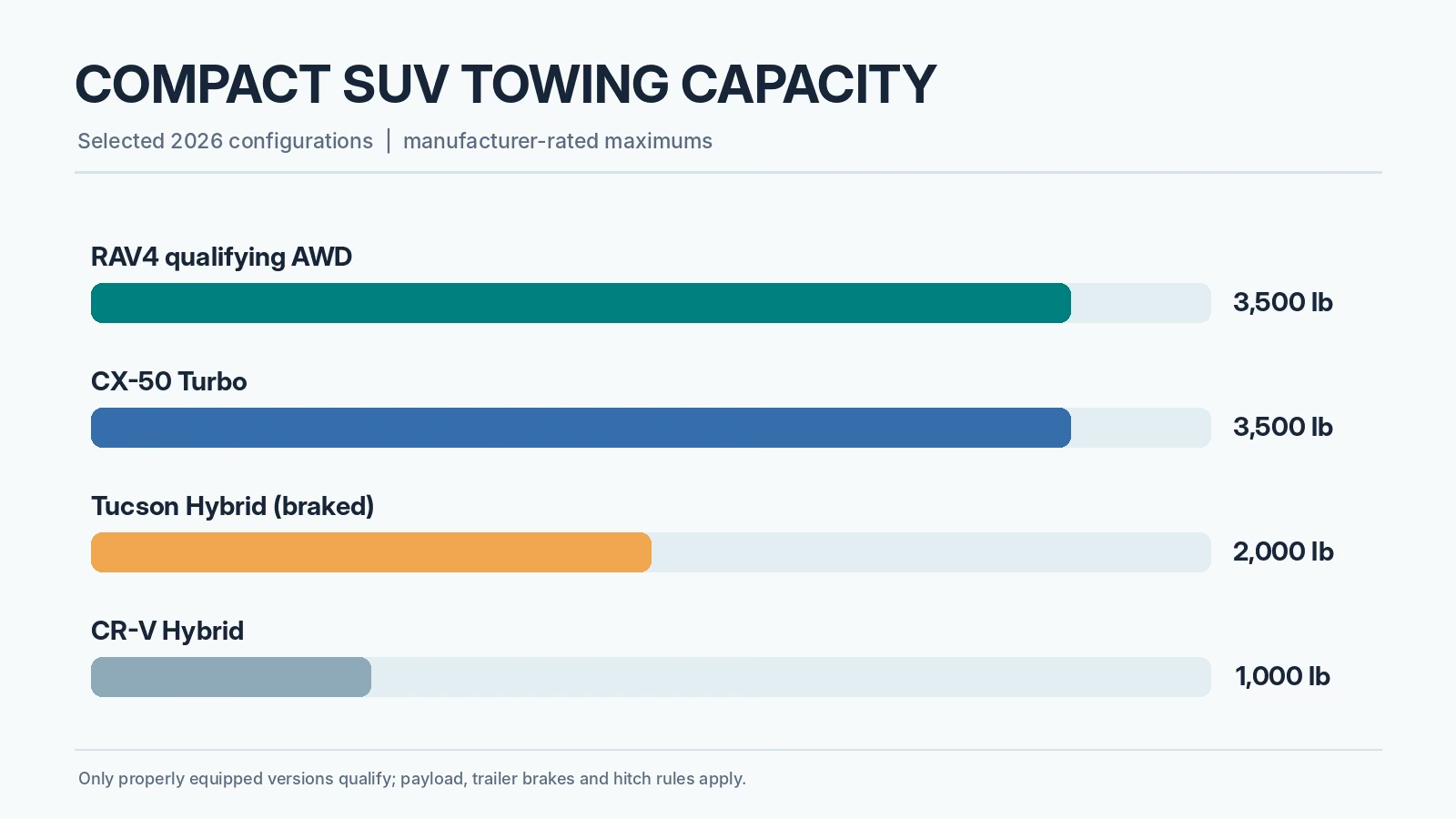
Properly equipped 2026 RAV4 AWD configurations can tow up to 3,500 pounds.
However, that figure does not apply to every RAV4. For example, the LE has a lower 1,750-pound towing rating, while the XLE Premium AWD and Woodland can reach the higher figure. [1]
This distinction matters when comparing the RAV4 with competitors.
The 2026 Honda CR-V Hybrid is rated to tow up to 1,000 pounds, while the gasoline CR-V has a 1,500-pound limit. Certain Mazda CX-50 turbocharged configurations can reach 3,500 pounds, although the CX-50 Hybrid is limited to 1,500 pounds. [7] [14]
Actual towing also requires compliance with hitch specifications, payload, tongue-weight limitations, and the owner’s manual.
How the Woodland Grade Expands Outdoor Usability
The Woodland grade is designed for buyers who regularly transport outdoor equipment or travel beyond smooth paved roads.
Its all-terrain tires, standard AWD, raised roof rails, and towing equipment increase practical flexibility for camping and recreational travel.
Toyota also lists 8.5 inches of ground clearance, which helps provide additional clearance over uneven surfaces.
Nevertheless, traction depends heavily on tire condition, weather, surface grip, and driver judgment.
The Woodland is not intended to replace a specialized off-road vehicle for severe rock crawling, deep water crossings, or extreme terrain.
Its principal advantage is combining ordinary compact SUV efficiency with equipment better suited to occasional outdoor adventures.
| 2026 vehicle | Seats | Representative maximum towing capacity |
|---|---|---|
| Toyota RAV4 | 5 | Up to 3,500 lb, qualifying configurations |
| Honda CR-V gasoline | 5 | 1,500 lb |
| Honda CR-V Hybrid | 5 | 1,000 lb |
| Hyundai Tucson Hybrid | 5 | Up to 2,000 lb with trailer brakes |
| Mazda CX-50 Hybrid | 5 | 1,500 lb |
| Mazda CX-50 turbo | 5 | Up to 3,500 lb |
Maximum ratings apply only to the appropriate configurations and manufacturer towing conditions. Equipment, trailer brakes, payload, and hitch requirements may differ.
Long-Term Reliability, Resale Value, and Ownership Expenses
Long-term ownership value is especially important for compact SUV buyers who expect to keep their vehicles for several years.
The purchase price is only the beginning of the financial commitment.
Fuel, electricity, insurance, service, repairs, financing, and depreciation can collectively exceed the difference between competing vehicles’ starting prices.
Toyota’s hybrid experience provides relevant historical context, but the newly redesigned 2026 RAV4 must also be evaluated on evidence specific to its latest components and systems.
Long-Term Reliability and Toyota’s Hybrid Reputation
Toyota has extensive experience producing gasoline-electric hybrid vehicles, making its established hybrid engineering an important consideration for potential buyers.
However, a manufacturer’s historical dependability cannot establish the future reliability of a newly redesigned vehicle.
The 2026 RAV4 introduces revised powertrains, software architecture, electrical components, and other changes that need time to establish long-term reliability records.
Toyota provides a 10-year or 150,000-mile limited hybrid battery warranty in the United States, whichever comes first, subject to applicable terms.
Other hybrid-related components receive separate warranty coverage. [15]
Buyers should examine maintenance records, technical service information, recalls, and independent owner surveys as additional model-specific evidence becomes available.
RAV4 Resale Value
Resale value represents the amount a vehicle retains when sold or traded after a period of ownership.
Toyota’s established market presence and the RAV4’s popularity may support demand for used vehicles, but neither factor guarantees a particular resale price.
Future values depend on mileage, condition, local market demand, supply, repair history, and broader economic conditions.
The increasing availability of hybrid vehicles may also influence how buyers evaluate used gasoline-only and electrified SUVs.
Projected resale values should therefore be treated as forecasts rather than observed transaction outcomes.
For a meaningful comparison, buyers should use the same ownership period, annual mileage, vehicle condition, and pricing assumptions across the RAV4 and its competitors.
Vehicle Depreciation Over Five Years
Depreciation measures the reduction in a vehicle’s market value over time.
For example, a vehicle purchased for $35,000 and sold five years later for $20,000 has experienced $15,000 in depreciation, excluding additional transaction-related costs.
A more expensive vehicle does not necessarily produce greater depreciation in percentage terms, but its higher initial price can still create a larger dollar loss.
Factors such as accident history, mileage, trim level, regional demand, and maintenance records influence retained value.
Because the redesigned 2026 RAV4 is still relatively new, precise five-year depreciation forecasts carry considerable uncertainty.
Buyers should avoid treating preliminary estimates as guaranteed financial outcomes.
Total Cost of Ownership
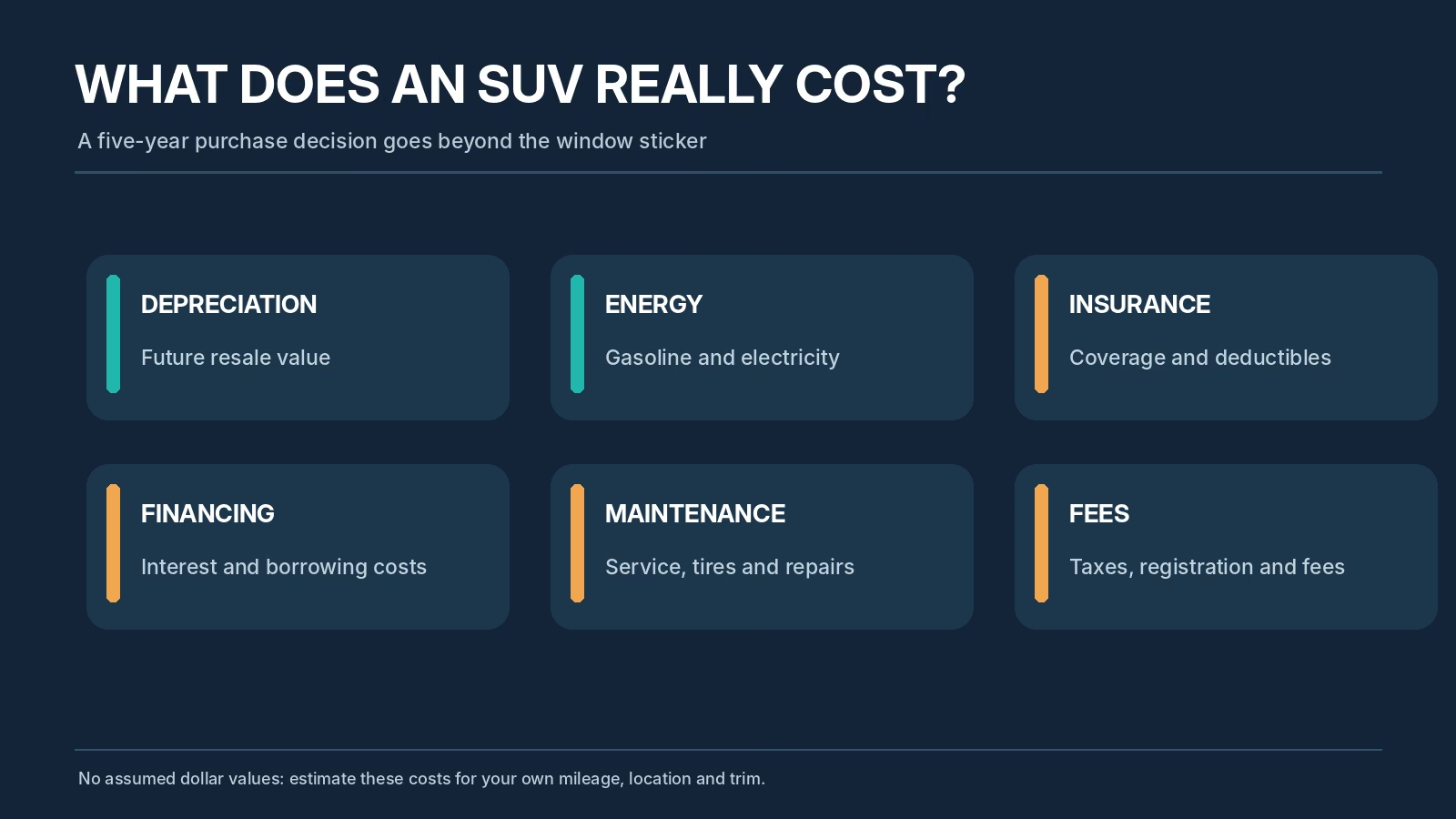
Total cost of ownership combines the major expenses incurred throughout vehicle ownership.
These include depreciation, financing, taxes, insurance, energy, scheduled maintenance, repairs, and fees.
A conventional hybrid can lower gasoline expenses, but those savings must be compared with the purchase-price differences and potential ownership costs of competing vehicles.
A PHEV adds electricity expenses and typically costs considerably more to purchase.
Consider the $6,800 base MSRP difference between the RAV4 SE Hybrid and SE PHEV. Even if regular charging reduces energy expenses, recovering that difference through energy savings alone may take many years, depending on fuel and electricity prices.
The appropriate comparison should use realistic annual mileage, electricity rates, charging frequency, and actual transaction prices.
Toyota RAV4 vs Its Biggest Compact SUV Rivals
The redesigned RAV4 competes against several capable vehicles with different strengths.
A fair comparison requires matching model years and distinguishing hybrid from gasoline-only configurations.
Comparing a fully equipped RAV4 against the least expensive version of another model can exaggerate its advantages or disadvantages.
The following comparisons focus on the 2026 U.S. market and prioritize verified powertrain specifications, pricing, efficiency, capability, and practical differences.
Toyota RAV4 vs Honda CR-V
The Honda CR-V is one of the RAV4’s most direct competitors, with a strong emphasis on cabin usability and everyday refinement.
The 2026 CR-V LX gasoline model starts at $30,920, while the Sport Hybrid starts at $35,630. The hybrid delivers 204 combined horsepower and reaches 40 mpg combined in FWD form.
By comparison, the RAV4 Hybrid starts at $31,900, produces 226 horsepower in FWD form, and achieves 43 mpg combined. [3] [7]
The CR-V remains appealing for its interior layout, passenger accommodation, and driving characteristics.
Honda also offers a 39.3-cubic-foot cargo area in certain gasoline configurations, although hybrid versions have different cargo measurements.
The RAV4 has the advantage in maximum available towing capability, while buyers seeking a comfortable family crossover should evaluate both vehicles in person.
Toyota RAV4 vs Kia Sportage
The Kia Sportage offers a broad equipment selection, distinctive interior technology, and a conventional hybrid alternative.
The 2026 Sportage Hybrid launched with a $30,490 starting MSRP, below the RAV4 Hybrid’s $31,900 entry price.
The EPA rates the Sportage Hybrid FWD at 42 mpg combined, compared with 43 mpg for the comparable RAV4 FWD. [8] [9]
That difference in efficiency is relatively modest.
Buyers may prefer the Sportage for its cabin layout, available technology, styling, or equipment packages.
Kia also offers a plug-in hybrid, although electric range and charging functionality differ from Toyota’s system.
Warranty terms and actual dealership pricing should be included in a complete ownership comparison.
Toyota RAV4 vs Hyundai Tucson
The Hyundai Tucson combines modern interior design, extensive equipment choices, and multiple powertrain options.
For 2026, the Tucson Hybrid starts at approximately $31,300 and offers a 231-horsepower combined hybrid system.
The EPA rates applicable Tucson Hybrid configurations at up to 38 mpg combined, below the RAV4 FWD Hybrid’s 43-mpg rating. [10]
However, the Tucson offers its own advantages in cabin presentation, equipment selection, and available driving features.
Hyundai also offers a Tucson Plug-in Hybrid for buyers interested in external charging.
The RAV4 provides stronger maximum towing potential in qualifying configurations and longer electric-only capability in its applicable PHEV grades.
Drivers prioritizing interior technology and comfort should consider both vehicles rather than relying exclusively on fuel economy.
Toyota RAV4 vs Mazda CX-5
The 2026 Mazda CX-5 has undergone its own substantial redesign, making it a particularly relevant alternative to the RAV4.
Mazda’s updated CX-5 starts at $29,990 with a 2.5-liter gasoline engine producing 187 horsepower, a six-speed automatic transmission, and standard AWD.
Its EPA combined fuel-economy rating is approximately 26 mpg. Mazda has announced a hybrid version for 2027 rather than offering one at the 2026 model’s initial launch. [11]
The CX-5 emphasizes steering response, chassis refinement, cabin materials, and a more driver-focused character.
The RAV4 has a substantial fuel-efficiency advantage, but some buyers may prefer the Mazda’s conventional automatic transmission and driving experience.
A test drive is essential because these differences are not adequately represented by specification tables.
Toyota RAV4 vs Subaru Forester
The Subaru Forester is well known for standard Symmetrical All-Wheel Drive, practical visibility, and outdoor-oriented usability.
The 2026 Forester begins at $29,995 with gasoline propulsion, while the Premium Hybrid starts at $34,730.
Subaru lists the Forester Hybrid at approximately 35 mpg combined, with 35 mpg city and 34 mpg highway. [12]
The RAV4 offers stronger combined fuel-economy figures in its most efficient configurations, along with the option of a significantly more powerful PHEV.
The Forester remains attractive for drivers who prioritize outward visibility, standard AWD, and familiar Subaru driving characteristics.
For buyers in regions with frequent snow or rough access roads, tire selection, ground clearance, and specific drivetrain capabilities are especially important.
Toyota RAV4 vs Mazda CX-50
The Mazda CX-50 emphasizes outdoor-oriented design and engaging driving characteristics.
Its 2026 lineup includes gasoline and conventional hybrid options, with the CX-50 Hybrid beginning at $34,750.
The hybrid delivers 219 horsepower and achieves an EPA-estimated 38 mpg combined with electronic AWD. [13] [14]
The RAV4 offers higher fuel efficiency in its FWD hybrid configurations and substantially greater combined output in its PHEV.
Both vehicles offer adventure-oriented versions, but buyers should distinguish between the CX-50’s powertrains when evaluating towing.
Certain turbocharged CX-50 models can tow up to 3,500 pounds, while the hybrid is rated at 1,500 pounds.
The Mazda remains compelling for buyers who prioritize road feel, design, and a more outdoor-focused driving personality.
Which Compact SUV Actually Wins?
There is no universal winner because compact SUV shoppers prioritize different characteristics.
The RAV4 performs particularly well when combining hybrid efficiency, available towing capability, powertrain flexibility, and standard technology.
However, the Sportage can offer lower hybrid entry pricing, the CR-V provides a strong family-oriented alternative, and the Forester emphasizes all-weather usability.
Mazda’s vehicles also appeal to buyers who place significant weight on handling and interior design.
A balanced purchase decision should compare actual transaction prices, seating comfort, driving impressions, energy expenses, and relevant equipment rather than relying on a single headline specification.
| 2026 SUV | Starting price of listed version | Best combined MPG of listed version | Key competitive characteristic |
|---|---|---|---|
| Toyota RAV4 Hybrid | $31,900 | 43 | Efficiency, power, versatility |
| Honda CR-V Hybrid | $35,630 | 40 | Comfort, cabin practicality |
| Kia Sportage Hybrid | $30,490 | 42 | Pricing and equipment |
| Hyundai Tucson Hybrid | $31,300 | 38 | Technology and comfort |
| Subaru Forester Hybrid | $34,730 | Approximately 35 | Standard AWD and visibility |
| Mazda CX-50 Hybrid | $34,750 | 38 | Outdoor styling and handling |
| Mazda CX-5 gasoline | $29,990 | 26 | Driving dynamics and refinement |
U.S. starting MSRPs exclude destination and other charges. MPG values are EPA combined ratings for the most efficient listed configurations. Mazda CX-5 is included as a gasoline-only alternative because its new hybrid powertrain is planned for 2027.
Final Verdict: Is the 2026 Toyota RAV4 the Compact SUV to Beat?
The 2026 Toyota RAV4 makes a strong argument for being one of the most complete compact SUVs in the U.S. market.
Toyota has improved its standard powertrain, expanded technology, strengthened performance, and preserved the practicality that has supported the RAV4’s popularity.
Most importantly, these improvements apply across a lineup that includes entry-level commuters, premium family vehicles, sport-oriented models, and outdoor-focused configurations.
Its competitors remain capable, but matching the RAV4’s breadth requires careful consideration of trim-level differences.
Five Reasons the 2026 RAV4 Is a Serious Competitor
The redesigned RAV4 has five principal competitive strengths.
First, hybrid propulsion is standard throughout the U.S. lineup, eliminating the need to select an optional hybrid upgrade.
Second, output reaches 236 horsepower in conventional AWD hybrids and 324 horsepower in PHEV configurations.
Third, Toyota offers a broad grade selection serving different budgets and lifestyles.
Fourth, the standard technology package includes modern displays and Toyota Safety Sense 4.0.
Finally, its strong EPA fuel-economy ratings create meaningful potential for long-term gasoline savings.
Together, these features make the RAV4 competitive across multiple buying priorities.
Areas Where Competing SUVs May Still Have an Advantage
The RAV4 does not offer the lowest entry price in the compact SUV segment.
Gasoline-powered competitors can cost less initially, while some hybrid alternatives also have lower starting MSRPs.
Other manufacturers offer different cabin layouts, steering characteristics, suspension tuning, and technology interfaces that buyers may prefer.
A vehicle with greater interior comfort or lower purchase cost could provide better value for an individual household even if it consumes more fuel.
The PHEV’s higher price also requires careful financial consideration.
As a result, the RAV4’s strong overall specification package should not prevent shoppers from evaluating alternatives that better match their personal requirements.
Who Should Buy the Toyota RAV4?
The RAV4 LE and SE Hybrid are appropriate starting points for buyers prioritizing fuel efficiency and everyday affordability.
Families seeking additional comfort and convenience should evaluate the XLE Premium or Limited.
The Woodland is particularly relevant for buyers who regularly carry outdoor equipment, tow recreational loads, or travel on unpaved access roads.
Drivers interested in stronger acceleration can consider the XSE PHEV or GR SPORT.
However, shoppers who cannot charge regularly should carefully evaluate whether a PHEV offers sufficient benefit over the conventional hybrid.
The ideal trim is the one that meets actual transportation needs without requiring unnecessary spending on features that will rarely be used.
Final Assessment
The redesigned 2026 Toyota RAV4 is a serious threat to compact SUV rivals because it combines characteristics that competitors often distribute across separate configurations.
Its standard hybrid propulsion provides strong efficiency, while available AWD and higher towing ratings support a wider range of practical uses.
The PHEV adds meaningful electric range and performance, and the modernized technology package makes the cabin competitive with newer alternatives.
Nevertheless, buyers should still evaluate competing vehicles for seating comfort, purchase price, driving experience, and equipment preferences.
The RAV4’s greatest strength is not dominance in every individual category. It is the balance of efficiency, performance, technology, and utility within one versatile compact SUV family.
Frequently Asked Questions
Is the 2026 Toyota RAV4 Hybrid-Only?
Yes, the 2026 Toyota RAV4 uses an exclusively electrified powertrain lineup in the United States. Buyers can choose a conventional hybrid electric vehicle or a plug-in hybrid electric vehicle. Neither version is a battery-electric-only SUV, because both retain a gasoline engine. The conventional hybrid does not require external charging, while the PHEV supports charging from an external electricity supply. Toyota has discontinued the gasoline-only RAV4 option for this model year.
What Is the Starting Price of the 2026 Toyota RAV4?
The 2026 RAV4 LE Hybrid FWD has a starting U.S. MSRP of $31,900. The SE Hybrid begins at $34,700, and the XLE Premium Hybrid starts at $36,100. The PHEV range begins at $41,500 for the SE. These figures exclude applicable destination charges, taxes, registration, dealership fees, and optional equipment. Actual transaction prices may vary considerably depending on location, inventory, incentives, and selected configurations.
Is the 2026 Toyota RAV4 Better Than the Honda CR-V?
The RAV4 offers advantages in EPA fuel economy for its most efficient conventional hybrid, available combined horsepower, and maximum towing capacity. The Honda CR-V remains competitive because of its cabin design, passenger accommodation, and driving experience. The most appropriate choice depends on the specific trim levels being compared. Buyers prioritizing efficiency and towing may favor the RAV4, while those emphasizing seating comfort or interior preferences may prefer the CR-V.
How Much Horsepower Does the 2026 RAV4 Have?
The 2026 Toyota RAV4 Hybrid produces 226 net combined horsepower with front-wheel drive and 236 horsepower with all-wheel drive. The Toyota RAV4 Plug-in Hybrid produces 324 net combined horsepower and includes AWD as standard. These are combined system outputs, accounting for the coordinated operation of gasoline and electric propulsion components. Actual acceleration depends on drivetrain configuration, vehicle weight, traction conditions, battery operation, and other variables.
How Far Can the RAV4 Plug-in Hybrid Drive on Electricity?
Toyota currently advertises an EPA-estimated electric range of up to 54 miles for the 2026 RAV4 PHEV SE. Other versions have different ratings, including approximately 52 miles for XSE, 49 miles for Woodland, and 48 miles for GR SPORT. Actual electric range varies with driving speed, temperature, climate-control use, terrain, and battery condition. The gasoline engine allows continued driving when the available electric-only energy is depleted.
Does the 2026 RAV4 Support DC Fast Charging?
Selected 2026 RAV4 PHEV grades support DC fast charging. The XSE and Woodland include compatible CCS1 charging hardware, and Toyota estimates a charging session from 10% to 80% in approximately 30 minutes under suitable conditions. The SE and GR SPORT PHEVs use AC charging and do not include the same DC fast-charging functionality. The conventional RAV4 Hybrid does not support external charging because its traction battery is managed internally.
Which 2026 Toyota RAV4 Trim Offers the Best Value?
The LE Hybrid offers a strong entry-level value proposition because it includes standard hybrid propulsion, modern displays, and Toyota Safety Sense 4.0. The SE adds sport-oriented styling, while the XLE Premium introduces comfort and convenience upgrades. For many families, XLE Premium may represent a useful compromise between affordability and equipment. However, value depends on transaction price, the need for AWD, annual driving distance, and which features the owner will regularly use.
Can the 2026 Toyota RAV4 Tow 3,500 Pounds?
Yes, certain properly equipped 2026 Toyota RAV4 configurations have a maximum towing capacity of 3,500 pounds. These include qualifying AWD grades such as Woodland and XLE Premium AWD. However, the rating does not apply universally. The LE, for example, has a lower towing limit. Before towing, owners must verify their specific vehicle’s rating, hitch equipment, trailer weight, tongue weight, payload, and any trailer-brake requirements in the manufacturer’s documentation.
Is the Toyota RAV4 Expensive to Maintain?
Routine RAV4 maintenance includes engine-oil servicing, tire inspections, brake checks, cooling-system maintenance, filters, and other scheduled procedures. Hybrid vehicles also incorporate high-voltage components that require appropriate service practices. Toyota provides substantial warranty coverage for hybrid battery systems, but warranty protection does not eliminate normal maintenance expenses. Actual costs depend on mileage, usage, labor rates, vehicle age, and repairs. Long-term maintenance evidence for the newly redesigned 2026 model is still developing.
Is the Toyota RAV4 a Good SUV for Long-Term Ownership?
The RAV4 has several characteristics that support a positive long-term ownership proposition, including strong fuel economy, practical passenger accommodation, and extensive hybrid engineering experience within Toyota. The manufacturer’s hybrid battery warranty is another relevant consideration. However, the sixth-generation model introduces new technology and components whose long-term dependability must be demonstrated over time. Buyers should compare warranty terms, insurance quotations, actual purchase prices, maintenance requirements, and emerging reliability evidence before making a final decision.
—
Sources
The following sources provide the official specifications, government fuel-economy information, independent safety evidence, and competitor data used throughout this article. U.S.-market prices and specifications were reviewed for the November 2026 publication context.
[1] Toyota USA Newsroom. The Next Adventure Begins: 2026 RAV4 Arrives This Winter. October 22, 2025
[2] Toyota USA Newsroom. All-New 2026 Toyota RAV4 Takes Center Stage. Official pricing and model information
[3] U.S. Department of Energy and EPA. 2026 Toyota RAV4 Fuel Economy Ratings
[4] Toyota USA. 2026 Toyota RAV4 Plug-in Hybrid. Current specifications, EPA-estimated electric range, and equipment
[5] Toyota USA. 2026 RAV4 Plug-in Hybrid Full Specifications
[6] Insurance Institute for Highway Safety. 2026 Toyota RAV4 Crash-Test Ratings
[7] Honda News. 2026 Honda CR-V Pricing and EPA Ratings. See also Honda’s updated January 2026 pricing and specifications
[8] Kia America. 2026 Sportage Hybrid Pricing Announcement. July 30, 2025
[9] U.S. Department of Energy and EPA. 2026 Kia Sportage Fuel Economy Ratings
[10] Hyundai USA. 2026 Tucson Hybrid Specifications
[11] Mazda USA Newsroom. All-New 2026 Mazda CX-5 Pricing and Equipment. January 13, 2026
[12] Subaru USA. 2026 Subaru Forester Model Information
[13] Mazda USA Newsroom. 2026 Mazda CX-50 Model Information
[14] Mazda USA. 2026 Mazda CX-50 Hybrid Specifications
[15] Toyota USA. Hybrid Battery and Electrified Vehicle Warranty Coverage
[16] Hyundai USA. 2026 Tucson Gasoline Model Specifications
[17] National Highway Traffic Safety Administration. 2026 Model-Year Vehicles Selected for NHTSA Testing
[18] Toyota USA. 2026 RAV4 Cargo and Capacity Specifications
Editorial note: Prices, equipment, fuel-economy ratings, and range estimates apply to the specified U.S. model-year configurations. Manufacturer estimates and EPA-certified figures are distinguished where applicable. Future reliability and depreciation have not been presented as established results for the newly redesigned vehicle.