
Choosing the correct motorcycle windshield height can make a significant difference in riding comfort, visibility, wind protection, and helmet noise. However, finding the right windshield is not as simple as matching its height to your standing height.
Two riders who are both 5 feet 10 inches tall may need completely different windshields. Their torso lengths, riding postures, seat positions, and motorcycle designs can place their eyes and helmets at different heights relative to the windshield.
An incorrectly sized windshield can direct turbulent air toward your helmet, increase buffeting, obstruct your view in heavy rain, or leave your upper body exposed to uncomfortable wind pressure.
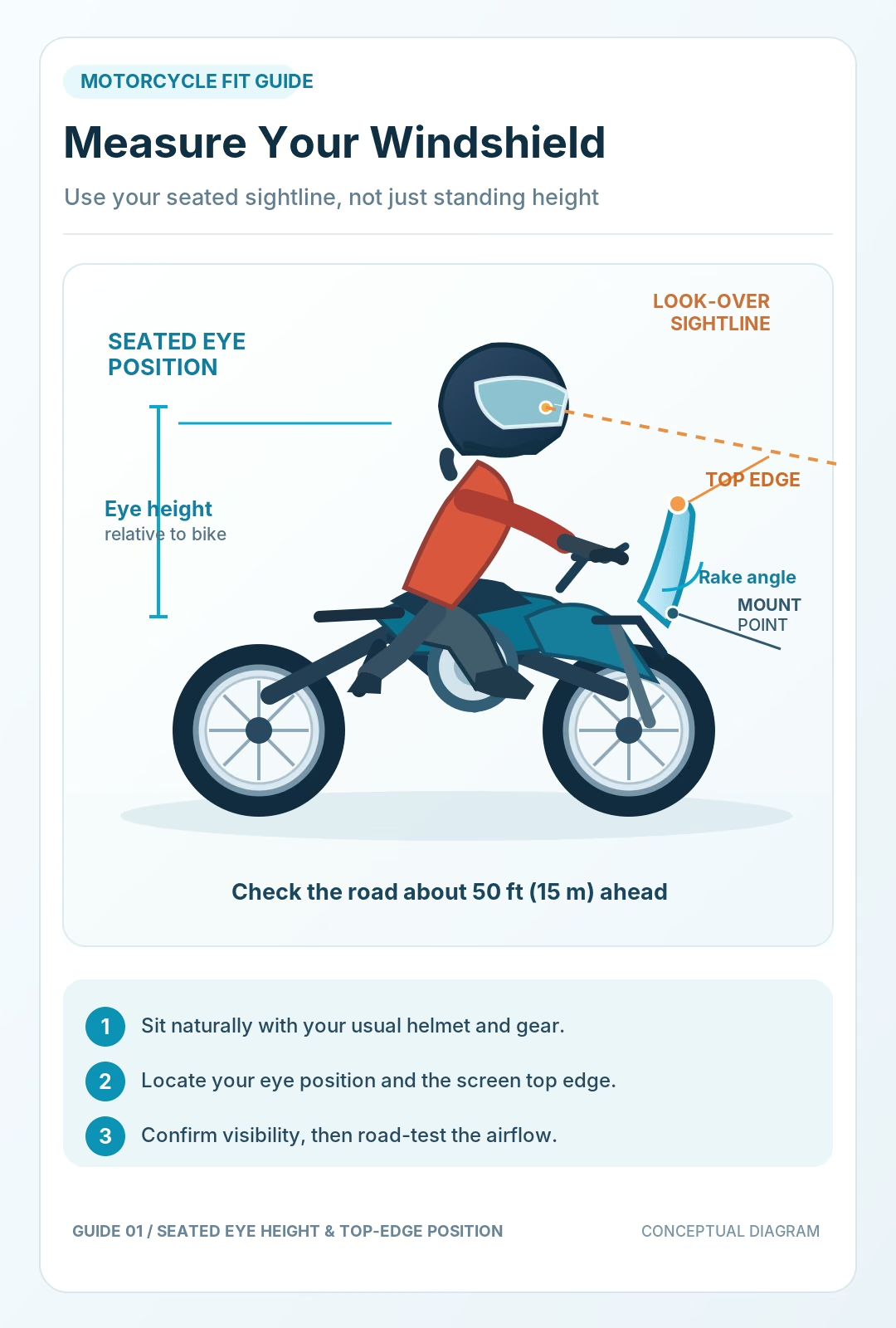
The ideal motorcycle windshield height depends primarily on your seated eye height, normal riding posture, motorcycle geometry, and desired wind protection. For a look-over configuration, the upper edge should allow you to see the road clearly above the shield. National Cycle and Clearview Shields both recommend evaluating the rider’s sightline toward a point approximately 50 feet (15.2 meters) ahead rather than selecting a windshield based on standing height alone. [1][2]
This guide explains how to measure windshield height correctly, understand airflow and turbulence, compare different motorcycle designs, and find a practical configuration that balances safety with riding comfort.
How Does Rider Height Affect Motorcycle Windshield Height?
Rider height influences where the head and shoulders sit relative to the motorcycle’s windshield, but it does not provide enough information to determine the correct screen size independently.
What matters more is the rider’s actual position when seated on the motorcycle. Body proportions, seat shape, handlebar reach, and riding posture all influence the relationship between the helmet and the windshield’s upper edge.
Understanding these variables helps explain why a windshield that works perfectly for one rider may cause excessive wind pressure or helmet buffeting for another rider of similar height.
Understanding the Relationship Between Rider Height and Windshield Size
Rider height is the person’s overall standing height, typically measured from the floor to the top of the head. Motorcycle windshield height describes a dimension of the windshield, but the exact measurement method varies by manufacturer and motorcycle design.
A taller rider may sit with their helmet farther above the windshield, increasing exposure to direct airflow. A shorter rider may find the same windshield obstructs their normal forward sightline.
However, there is no reliable universal formula that converts standing rider height directly into ideal windshield height.
For example, a 6-foot rider on a low sport motorcycle may have a lower seated eye position than a shorter rider sitting upright on an adventure motorcycle. Therefore, windshield selection must consider the complete rider-and-motorcycle arrangement.
Why Seated Eye Height Matters More Than Standing Height
Seated eye height describes the vertical position of the rider’s eyes while sitting in the normal riding position. For windshield sizing, the most useful measurement is the eye position relative to a consistent reference point on the motorcycle, such as the fairing or windshield mounting area.
This measurement directly influences whether the rider looks over the windshield, through it, or across its upper edge.
Two people of identical standing height can have different seated eye levels because their body proportions differ.
For a look-over windshield, the upper edge should remain below the rider’s intended forward sightline. Clearview Shields recommends checking this relationship while looking toward a low target approximately 50 feet ahead. [2]
This practical test accounts for the rider’s actual eye position and provides a more useful starting point than standing height alone.
How Rider Torso Length Changes Windshield Requirements
Torso length is the distance associated with the upper body between the pelvis and shoulders, with head and neck proportions also affecting actual eye height.
A rider with a relatively long torso generally sits higher above the seat than a similarly tall rider with a shorter torso, assuming comparable posture and seating conditions.
For example, consider two riders measuring 5 feet 10 inches tall. One has longer legs and a shorter torso, while the other has shorter legs and a longer torso.
The long-torso rider may have their helmet positioned higher relative to the windshield, potentially exposing it to more direct airflow.
The shorter-torso rider may sit lower behind the same screen, gaining greater wind coverage but possibly encountering a higher windshield edge within their field of vision.
These differences demonstrate why seated measurements are essential when choosing motorcycle windshield height.
How Rider Inseam Length Influences Windshield Fit
Inseam length is generally measured along the inside of the leg from the crotch to the floor. Motorcyclists commonly use this measurement to evaluate motorcycle seat accessibility and whether they can reach the ground comfortably.
Inseam does not directly establish windshield height, but it provides useful context about body proportions.
A rider with a relatively long inseam may have a shorter torso than another rider of the same overall height. Consequently, their seated eye positions may differ.
Inseam also influences motorcycle selection and seat modifications. A rider who installs a lower seat to improve ground reach may change their eye position relative to the windshield.
For this reason, inseam should be treated as a secondary ergonomic reference, not a replacement for measuring seated eye height.
How Riding Posture Changes the Required Windshield Height
Riding posture determines the position of the head relative to the windshield. Even without changing motorcycles, a rider can noticeably alter wind exposure by changing their upper-body position.
Three common riding postures illustrate this relationship:
- Upright touring posture: The back remains relatively vertical, positioning the head higher and farther behind the screen.
- Neutral standard posture: The rider leans slightly forward, with the helmet positioned according to handlebar reach and seat geometry.
- Forward-leaning sport posture: The rider’s upper body is inclined toward the fuel tank, bringing the helmet lower and often closer to the windshield.
A sport motorcycle’s short screen may provide useful protection while the rider is tucked, but much less when the rider sits upright.
Research examining motorcycle windscreen configurations and rider positions confirms that rider posture can materially affect aerodynamic behavior. [7]
How to Measure Motorcycle Windshield Height Correctly
Measuring a motorcycle windshield requires more than checking its physical length with a tape measure.
Different manufacturers use different reference points and measurement conventions. Some describe windshield height along its curved or inclined surface, while others specify the vertical distance from a fixed motorcycle component to the upper edge.
These measurements are not necessarily interchangeable.
Before ordering a replacement windshield, identify exactly how the manufacturer measures its products. Then compare the windshield’s installed upper-edge position with your normal seated eye position and sightline.
Understanding Windshield Height Measurement
Motorcycle windshield height can refer to the length of the screen itself or its installed height above a particular motorcycle component.
A surface-length measurement follows the windshield’s profile, sometimes from a headlight cutout or lower edge to the upper edge.
A vertical-height measurement instead describes the upright distance between a specified reference point and the windshield’s upper edge.
These values can differ substantially on inclined or curved windshields.
For example, two windshields may both have a stated surface length of 16 inches, yet their upper edges may reach different heights when mounted.
Clearview Shields specifically distinguishes surface length from vertical height and advises riders to check the measurement convention associated with their motorcycle model. [4]
Identifying the Windshield Mounting Reference Point
The windshield mounting reference point is the fixed location from which a manufacturer measures windshield height.
Depending on the product, it may be the upper edge of the headlight cutout, a point on the fairing, or another model-specific location.
National Cycle, for example, describes mounted windshield height in relation to the headlight cutout for relevant products. Other manufacturers use fixed fairing reference points. [1][2]
When comparing windshields, confirm that their published measurements use equivalent references.
A 20-inch windshield measured from one location cannot automatically be considered taller than an 18-inch windshield measured from another location.
The best approach is to use the exact measurement instructions supplied for your motorcycle and windshield model.
Measuring Effective Vertical Windshield Height
Effective vertical windshield height describes how high the screen’s upper edge sits relative to a chosen reference when installed.
This is especially important because motorcycle windshields are commonly inclined rather than perfectly upright.
Consider a simplified example involving a straight windshield with a 40-centimeter length. If the screen leans 30 degrees backward from vertical, its vertical projection would be approximately 34.6 centimeters.
The relationship can be expressed as:
Vertical projection = Screen length × cos(angle from vertical)
This calculation is only a simplified geometric illustration. Real motorcycle windshields may be curved, have complex mounting arrangements, or change their upper-edge position as they tilt.
For practical sizing, directly measure the installed upper-edge elevation rather than relying only on theoretical calculations.
How Windshield Rake Angle Affects Effective Height
Windshield rake angle describes the screen’s inclination relative to an appropriate reference, usually vertical or the motorcycle’s mounting geometry.
A more upright windshield typically places its top edge higher than an equally long windshield leaning farther backward, assuming the same lower mounting reference.
Changing the rake also alters how approaching air travels along the screen and separates from its upper edge.
However, the resulting aerodynamic effect is not determined by rake alone. Windshield curvature, motorcycle fairing geometry, rider position, and air entering behind the screen all influence the final airflow.
Research involving racing motorcycle windshield configurations demonstrates that windshield geometry and rider position interact aerodynamically. [7]
Adjustable systems allow these relationships to be evaluated without immediately replacing the windshield.
Step-by-Step: Measure Your Windshield Relative to Your Riding Position
Accurate measurements should be taken with the motorcycle in a stable position and the rider seated naturally.
Use the following procedure:
- Position the motorcycle securely. Use a level surface and appropriate support. Have another person assist so you do not need to balance the motorcycle while measuring.
- Wear normal riding equipment. Put on your helmet and usual riding clothing.
- Adopt your natural riding posture. Keep your hands positioned normally and avoid deliberately stretching or slouching.
- Identify your seated eye level. Have an assistant mark or record its height relative to a fixed motorcycle reference.
- Locate the windshield’s upper edge. Record its position using the manufacturer’s stated measurement method.
- Check your forward sightline. Look toward a low target about 50 feet ahead and establish whether the screen interferes with your direct view.
- Record the measurements. Include the screen setting, rake position, and any relevant seat modifications.
National Cycle and Clearview Shields both describe sightline-based sizing methods that emphasize the rider’s normal seated position. [1][2]
Repeat the measurements whenever you change the seat, handlebar arrangement, or windshield mounting position.
Where Should the Motorcycle Windshield Top Edge Sit?
The windshield’s upper edge is one of the most important elements in determining whether a screen provides appropriate visibility and wind protection.
A properly positioned top edge should not interfere with the rider’s ability to observe the roadway, identify hazards, or see through changing weather conditions.
At the same time, its position influences where air separates from the windshield and how that airflow interacts with the helmet.
Manufacturers offer different sizing recommendations because windshields, motorcycles, and rider preferences vary. These recommendations should be treated as starting points rather than universal rules.
Understanding Windshield Top Edge Position
Windshield top-edge position refers to where the uppermost portion of the screen sits relative to the rider’s eyes and normal forward sightline.
When the top edge is relatively low, the rider can usually look directly over it, but more airflow may reach the helmet.
When the top edge sits higher, the screen may redirect more airflow above the rider, depending on its shape and mounting geometry.
However, an excessively high screen can force the rider to look through a surface that may become wet, dirty, scratched, or distorted.
The ideal position balances clear visibility with useful wind deflection and should be evaluated on the actual motorcycle.
How the Rider’s Line of Sight Determines Windshield Placement
A rider’s line of sight is the direction along which they look toward the road or another object ahead.
For motorcycle windshield sizing, it is useful to evaluate the downward-forward viewing angle used when observing the road at a practical distance.
National Cycle recommends that riders be able to look just over the windshield toward the road approximately 50 feet ahead. Clearview Shields provides a similar method for establishing an appropriate look-over height. [1][2]
The reason this matters is that a windshield edge may appear comfortably below eye level while the motorcycle is stationary yet still intersect the rider’s view of the road.
Road gradients, head movement, body posture, and suspension movement can further change the relationship between the eyes and screen.
Look-Over Windshield Configuration
A look-over windshield is positioned so the rider views the road directly above its upper edge during normal riding.
This arrangement reduces dependence on windshield transparency for forward visibility.
It is particularly useful when riding in rain, road spray, or dusty conditions because the rider can still see over a windshield that becomes temporarily obscured.
National Cycle recommends this approach, including when considering windshield trimming. [15]
The tradeoff is that a shorter screen may allow more airflow to reach the helmet, especially at highway speeds.
An appropriately shaped windshield with an effective upper-edge profile may nevertheless provide substantial wind protection while preserving direct visibility over the screen.
Look-Through Windshield Configuration
A look-through windshield extends high enough that the rider normally observes the road through its transparent surface.
This arrangement is sometimes selected for touring motorcycles when the rider wants extensive upper-body and helmet wind protection.
However, it creates greater dependence on the windshield’s optical quality.
Scratches, discoloration, rain droplets, glare, and dirt can interfere with visibility. Looking through the windshield also means the rider may be looking through both the helmet visor and windshield simultaneously.
Clearview Shields describes look-through sizing as a separate configuration from look-over sizing, with a higher upper edge. [2]
For regular riding in unpredictable weather, carefully evaluate these visibility limitations before selecting a tall screen.
Is Nose-Level Windshield Alignment a Useful Starting Point?
Nose-level alignment is a traditional windshield-sizing guideline in which the top edge sits around the rider’s nose when they are seated normally.
Memphis Shades recommends an upper-edge position between the tip and bridge of the rider’s nose as a general starting point. [3]
This approach provides a quick initial estimate because it normally places the upper edge below eye level.
However, nose-level alignment alone does not establish where the rider’s road sightline crosses the windshield.
The distance between the rider and windshield, the screen angle, and the rider’s posture all matter.
Therefore, use nose-level positioning as a preliminary reference, then verify the actual sightline and assess wind protection during a controlled road test.
How Windshield Optical Clarity Affects Visibility
Optical clarity describes how accurately the rider can see objects through the windshield without significant distortion or visual obstruction.
Even a transparent windshield can create viewing problems if its curvature, condition, coating, or installation causes distortion.
Scratches may scatter light and create glare, particularly at night. Dirt, insect residue, and mineral deposits can further reduce clarity.
A look-through windshield requires especially careful inspection because a significant portion of the forward view passes through its material.
Clearview Shields discusses tint selection and emphasizes visibility considerations when choosing windshield materials and finishes. [2]
Use cleaning products and methods approved for the windshield material. If a screen is visibly distorted or damaged within the normal viewing area, replacement may be safer than continued use.
Rain Visibility and Windshield Height
Rain can significantly change the practical advantages of a motorcycle windshield.
A tall screen may reduce some direct wind and precipitation reaching the rider, but droplets and road spray can accumulate on its surface.
At night, moisture and contamination may also interact with surrounding headlights and create distracting reflections or glare.
With a look-over screen, the rider can maintain a direct view of the road above the windshield when its surface becomes obscured.
GIVI specifically identifies rain visibility as a consideration when selecting and adjusting windshield height. [9]
For riders who frequently travel in changing weather, maintaining an unobstructed forward sightline should generally take priority over maximizing windshield coverage.
Look-Over vs. Look-Through Windshield Comparison
| Feature | Look-Over Windshield | Look-Through Windshield |
|---|---|---|
| Normal road view | Directly above the screen | Through the screen |
| Rain visibility | Less dependent on screen clarity | More dependent on screen clarity |
| Wind protection | Varies with height and design | May offer greater coverage |
| Helmet airflow | Potentially more exposed | Potentially more sheltered |
| Optical requirements | Lower reliance on screen transparency | High optical clarity is essential |
| Typical applications | Commuting, touring, adventure riding | Some touring configurations |
| Main consideration | Balancing airflow with sightline | Maintaining visibility in all conditions |
Neither configuration guarantees a quieter or more comfortable ride. The outcome depends on the entire aerodynamic arrangement.
How Windshield Height Affects Motorcycle Aerodynamics
Motorcycle windshields work by altering the airflow approaching the motorcycle and rider.
Their effectiveness depends not only on height but also on width, curvature, rake angle, mounting arrangement, and interaction with the motorcycle’s existing fairing.
A windshield may substantially reduce pressure on the rider’s chest while simultaneously producing turbulent airflow around the helmet.
Understanding these aerodynamic relationships helps explain common complaints such as wind buffeting, increased helmet noise, and discomfort at highway speeds.
Understanding Wind Deflection
Wind deflection occurs when the approaching airflow changes direction as it encounters a windshield.
Some air travels upward along the screen and over its upper edge. Other airflow moves around its sides or enters through gaps and vents.
The precise pattern depends on the windshield’s shape and the surrounding motorcycle geometry.
A taller screen generally changes where the upper airflow separates from the windshield, but it does not necessarily direct that airflow completely above the rider.
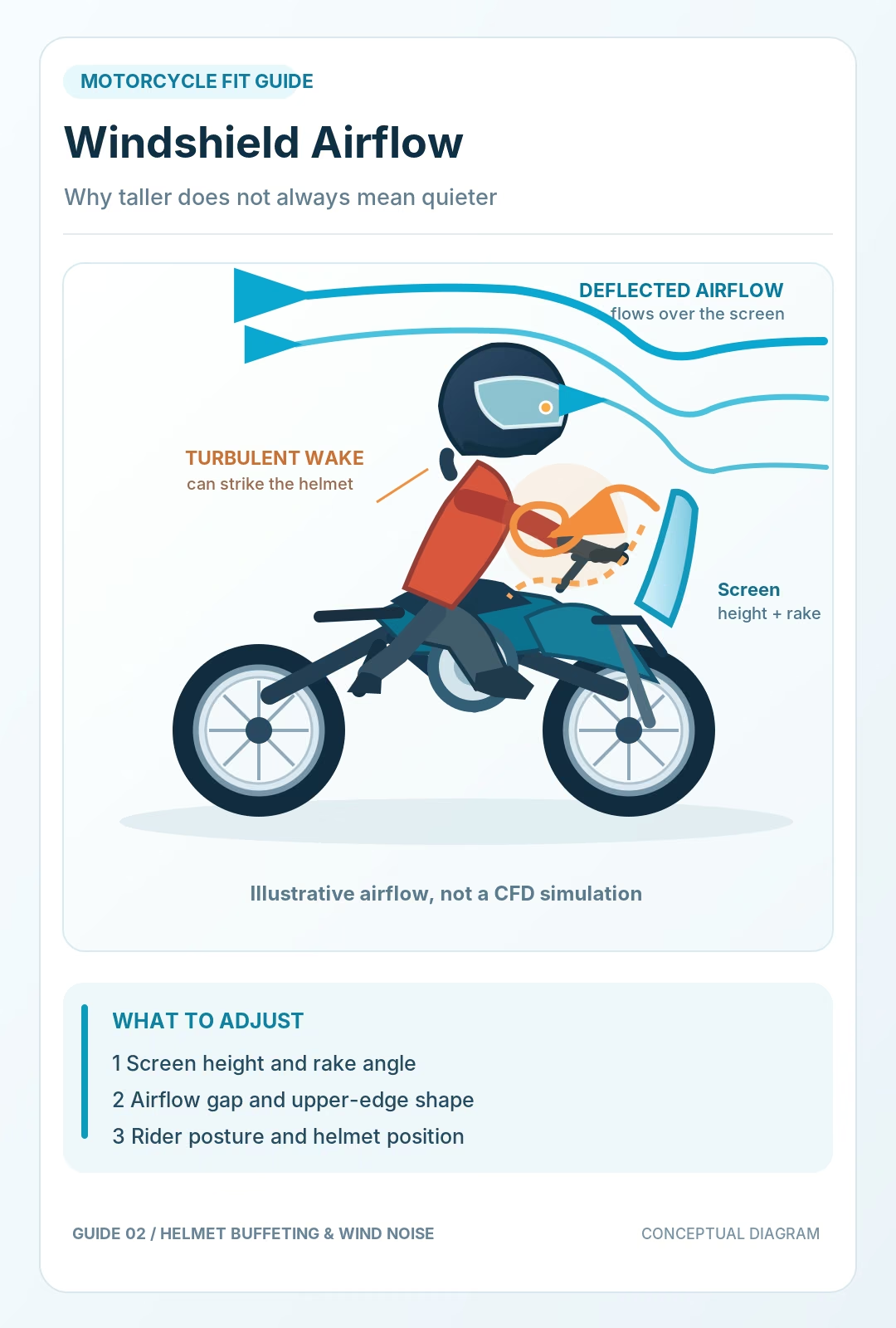
The rider’s helmet may still intersect separated or turbulent airflow.
Consequently, windshield height should be evaluated together with screen profile, rake angle, and actual riding position rather than treated as an isolated aerodynamic variable.
What Is the Wind Protection Zone?
The wind protection zone is the relatively sheltered region behind a motorcycle windshield where direct exposure to the approaching airflow is reduced.
This area is sometimes called the riding pocket.
A well-designed windshield can decrease wind pressure on the chest and upper body by redirecting a portion of the approaching air around the rider.
However, the sheltered region is not necessarily uniform or completely free of turbulence.
Its size and shape depend on windshield height, width, curvature, mounting arrangement, and the rider’s position.
A rider who changes from an upright position to a forward tuck may move their helmet into a different part of this airflow region, changing both wind pressure and noise.
How Windshield Turbulence Develops
Windshield turbulence develops when airflow becomes irregular after moving around the windshield’s edges or interacting with surrounding motorcycle components.
Airflow separation can create vortices and fluctuating pressure within the wake behind the screen.
When these disturbances reach the rider, they may produce inconsistent wind pressure, vibration, and noise.
Research on motorcycle windshield flow has identified different aerodynamic regions around the rider’s helmet, including relatively undisturbed airflow, turbulent wake regions, and more sheltered areas. [5]
Windshield mounting geometry and airflow from below the screen can also influence these conditions.
The practical implication is that adjusting the windshield by a relatively small amount may noticeably change comfort even when the overall screen size remains unchanged.
Why Helmet Buffeting Happens with Incorrect Windshield Height
Helmet buffeting is the repeated shaking or fluctuating pressure experienced when irregular airflow strikes the rider’s helmet.
It commonly occurs when the helmet intersects turbulent air produced near the upper or side edges of a motorcycle windshield.
The rider may experience rapid head movement, pulsing pressure, or a sensation that the helmet is being pushed unpredictably.
Windshield height is one contributing factor because it influences the position of the turbulent wake.
However, buffeting can also result from screen width, rake, motorcycle fairing design, pressure differences, and rider posture.
Research on motorcycle helmet aerodynamics supports evaluating the rider, helmet, windshield, and motorcycle together. [5]
Simply installing the tallest available windshield does not guarantee that buffeting will disappear.
How Windshield Height Influences Helmet Wind Noise
Helmet wind noise is generated partly by aerodynamic airflow around the helmet and its interaction with the motorcycle.
It differs from mechanical noise produced by the engine, transmission, or exhaust system.
Windshield height influences which airflow region reaches the helmet. Moving the screen’s upper edge may shift turbulent airflow toward or away from the rider’s head.
A study published in the Journal of the Acoustical Society of America investigated motorcycle helmet noise using both road and wind-tunnel measurements, demonstrating the importance of aerodynamic sources and riding conditions. [6]
Another study found meaningful differences in noise associated with windshield airflow and rider position. [5]
Therefore, reduced chest wind pressure does not automatically mean lower helmet noise.
Windshield Width vs. Windshield Height
Windshield height primarily affects how airflow travels over the screen and toward the rider’s upper body and helmet.
Windshield width influences how air passes around the sides and how much of the rider’s shoulders, upper arms, and torso remain exposed.
A tall but narrow windshield may provide good central coverage while allowing substantial lateral airflow to reach the shoulders.
Conversely, a wider screen may improve upper-body coverage without requiring an excessively high upper edge.
National Cycle’s VStream designs illustrate how upper-edge shape and lateral airflow management are considered together when developing wind protection. [11]
However, increasing width can also alter aerodynamic forces and steering behavior, depending on the motorcycle and mounting arrangement.
How Highway Riding Speed Changes Windshield Performance
Windshield performance often feels different at highway speeds because aerodynamic forces increase strongly with airspeed.
For a fixed aerodynamic configuration, dynamic pressure is proportional to the square of airflow speed.
This means that doubling relative airspeed produces four times the dynamic pressure, although actual force changes also depend on geometry and aerodynamic coefficients. [8]
At urban speeds, a windshield may feel comfortable because the pressure fluctuations affecting the helmet are relatively mild.
At higher speeds, turbulence, wind noise, and instability may become much more noticeable.
For practical evaluation, test the windshield at speeds representative of your normal riding conditions, where those speeds are legal and safe.
Aerodynamic Drag and Windshield Size
Aerodynamic drag is the force opposing motion through the surrounding air.
It depends on factors such as air density, speed, frontal area, and aerodynamic drag coefficient.
A commonly used expression is:
Drag force = ½ × air density × velocity² × drag coefficient × reference area
NASA explains that shape, inclination, and the interaction between airflow and the object strongly influence aerodynamic resistance. [8]
A larger windshield can increase the area exposed to approaching air, but it may also improve how air flows around the rider.
Therefore, a taller windshield does not necessarily produce greater total motorcycle drag in every configuration.
Wind-tunnel measurements or reliable vehicle-specific testing are needed to establish actual aerodynamic differences.
How Crosswind Exposure Affects Windshield Selection
Crosswinds are winds that approach the motorcycle from the side rather than directly ahead.
A windshield changes the surfaces exposed to these side winds and can therefore influence the forces acting on the motorcycle.
Large, tall, or wide screens may produce more noticeable aerodynamic reactions under certain conditions, particularly when combined with fairings or handlebar-mounted accessories.
GIVI identifies changes in motorcycle stability and the potential sail effect as considerations when selecting taller windscreens. [9]
The actual response depends on motorcycle geometry, mounting position, speed, and wind conditions.
A windshield should not be selected solely for maximum weather protection without considering stability, steering feel, and the manufacturer’s fitment recommendations.
How Motorcycle Geometry Changes Windshield Height Requirements
Two motorcycles fitted with windshields of identical dimensions may provide substantially different wind protection.
The reason is that windshield performance depends on the motorcycle’s overall geometry, including seat placement, handlebar position, fairing design, windshield distance from the rider, and mounting angle.
Even the same rider can occupy very different positions relative to the airflow when switching between motorcycle categories.
Evaluating these geometric relationships helps explain why windshield sizing recommendations should always be motorcycle-specific.
Motorcycle Seat Height and Rider Eye Position
Motorcycle seat height usually describes the vertical distance between the ground and the upper seating surface under specified conditions.
Although useful for evaluating ground reach, this measurement does not directly determine windshield fit.
For windshield sizing, the relevant relationship is the rider’s seated eye position relative to the screen.
A motorcycle with a relatively tall seat may also have a tall fairing and windshield mounting location.
Similarly, a low-seat motorcycle may position its windshield much lower relative to the rider’s head.
Seat modifications are especially important.
Installing a thicker touring seat, replacing the original seat with a lower model, or changing seating position can alter the rider’s eye height and therefore the appropriate windshield configuration.
Rider Seating Ergonomics and Windshield Fit
Rider seating ergonomics concerns the relationship among the seat, handlebars, footpegs, and rider’s body.
These components determine how naturally the rider sits and how the head is positioned relative to the motorcycle.
Handlebar risers may encourage a more upright posture, while lower handlebars may increase forward lean.
Footpeg position and seat contour also influence posture and the ability to move around the motorcycle.
When these components change, the helmet may enter a different airflow region even if the windshield remains untouched.
This is why windshield recommendations should consider the actual riding setup, including aftermarket seats, modified handlebars, and other ergonomic accessories.
How Motorcycle Suspension Sag Can Affect Windshield Alignment
Suspension sag describes how much the suspension compresses under the motorcycle’s own weight and the additional weight of the rider, passenger, and luggage.
Changes in suspension loading can alter the motorcycle’s ride height and attitude.
For example, additional luggage or a passenger may increase rear suspension compression, potentially changing the motorcycle’s pitch and windshield orientation.
However, suspension sag is normally a secondary windshield-sizing consideration.
Rider torso proportions, seat position, screen geometry, and riding posture generally provide more direct information about windshield fit.
Suspension should first be adjusted according to the motorcycle manufacturer’s recommendations for handling and load management.
Windshield adjustments should then be evaluated with the motorcycle in its normal riding configuration.
Motorcycle Fairing Geometry and Airflow
Motorcycle fairing geometry refers to the shape, size, and arrangement of the bodywork designed to influence airflow and protect motorcycle components and riders.
A full-fairing touring motorcycle generally provides a different airflow environment from a minimally faired standard motorcycle.
Half-fairings, sport fairings, and adventure motorcycle front assemblies also produce different aerodynamic conditions.
The fairing determines how air approaches the windshield, moves around its sides, and enters the region behind it.
This means two windshields with similar height and width may generate different wind protection zones when fitted to different motorcycles.
The motorcycle’s front-end design must therefore be considered alongside windshield dimensions.
Motorcycle Model Compatibility
Motorcycle windshield compatibility means that a windshield and its mounting system are designed or verified for a particular motorcycle model and relevant model years.
Compatible fitment includes more than whether the mounting holes appear to align.
A properly selected screen must provide sufficient clearance around handlebars, controls, mirrors, brake lines, and other moving components.
Original equipment manufacturer windshields are designed for specific motorcycle configurations, while aftermarket products may offer different heights, widths, and airflow profiles.
National Cycle and other windshield manufacturers provide model-based fitment tools to help riders identify suitable products. [1]
Before ordering, verify the exact motorcycle model, production year, mounting requirements, and any modifications that could affect fitment.
Windshield Mounting Hardware and Installation Position
Windshield mounting hardware includes brackets, clamps, bolts, washers, spacers, and adjustment mechanisms that secure the screen to the motorcycle.
Different mounting systems may attach to the forks, handlebars, fairing, or dedicated structural supports.
The mounting location influences the windshield’s position, adjustment range, and potential movement under aerodynamic loads.
Harley-Davidson’s official installation instructions emphasize correct fastening, maintaining clearance throughout steering movement, and periodically inspecting mounting hardware. [13]
A loose or improperly installed windshield can create vibration, distraction, or handling problems.
Always use the supplied hardware and specified installation procedure. If fitment or clearance is uncertain, have the installation evaluated by a qualified motorcycle technician.
Choosing Windshield Height for Different Motorcycle Types
Motorcycle categories use different seating positions and aerodynamic designs, making a single windshield height recommendation impractical.
Touring motorcycles generally emphasize sustained wind and weather protection. Sport motorcycles prioritize compact bodywork and airflow around a forward-leaning rider.
Adventure motorcycles must accommodate both seated and standing riding positions, while cruisers often combine upright seating with comparatively exposed front-end designs.
Selecting an appropriate windshield therefore requires understanding how the motorcycle is intended to be ridden.
Touring Motorcycle Windshield
Touring motorcycle windshields are designed primarily to improve comfort during sustained travel, particularly at higher road speeds.
They often provide substantial chest and upper-body wind protection and may offer manual or electronic adjustment.
The Honda Gold Wing is a relevant example. Honda’s 2026 model information describes an electrically controlled windscreen that changes both height and angle during adjustment. [12]
Touring riders may prefer different windshield positions depending on temperature, weather, passenger comfort, and highway conditions.
However, greater windshield coverage should not compromise forward visibility.
For a touring motorcycle, measure the rider’s seated eye height and evaluate the complete fairing and screen combination rather than choosing the tallest replacement available.
Sport Motorcycle Windshield
Sport motorcycle windshields are generally compact and integrated into the motorcycle’s front fairing.
They are shaped partly around the forward-leaning position commonly used during spirited or high-speed riding.
Motorcycles such as the Yamaha YZF-R1 and various Kawasaki Ninja models illustrate this general design approach.
When the rider lowers their torso behind the screen, the helmet occupies a different aerodynamic position than when riding upright.
Consequently, the same sport windshield may feel comfortable in a tucked position but expose the helmet to substantial airflow during ordinary commuting.
A replacement screen should be evaluated in the rider’s normal street posture, not only in an extreme racing tuck.
Adventure and Dual-Sport Motorcycle Windshields
Adventure and dual-sport motorcycles frequently use upright seating positions and relatively elevated handlebar arrangements.
Many adventure motorcycles also accommodate standing riding on uneven terrain.
Standing raises the rider’s eyes and helmet substantially relative to the windshield, changing both visibility and airflow exposure.
A screen that provides useful protection while seated cannot be expected to deliver the same coverage while standing.
Tall screens and extension spoilers may also interfere with movement or create contact concerns during off-road riding.
For mixed-surface motorcycles, prioritize appropriate model compatibility, secure mounting, clear visibility, and adequate room for normal body movement.
An adjustable screen may provide useful versatility between paved-road touring and off-road use.
Cruiser Motorcycle Windshields
Cruiser motorcycles often position riders upright or slightly reclined, with relaxed seating ergonomics and comparatively exposed upper bodies.
Some cruisers use detachable windshields mounted near the handlebars or front forks, while touring-oriented models incorporate larger screens and fairings.
The correct windshield height depends on the rider’s seated eye position, mounting arrangement, and desired coverage.
Shorter cruiser windshields can reduce direct chest pressure while maintaining an unobstructed view.
Taller touring shields may improve weather coverage but require careful evaluation of helmet airflow, optical clarity, and steering behavior.
Windshield width is especially relevant when determining how much wind reaches the rider’s shoulders and upper arms.
Comparing Windshield Requirements Across Riding Styles
Riding style changes the relative importance of visibility, weather protection, aerodynamic comfort, and flexibility.
An urban commuter may prioritize a direct view of traffic and manageable airflow at moderate speeds.
A long-distance touring rider may place greater emphasis on reducing sustained upper-body wind pressure.
A sport rider may need a screen that works with a forward-leaning posture, while an adventure rider may require compatibility with changing body positions.
Rather than treating one windshield dimension as universally ideal, evaluate the screen according to the motorcycle’s normal riding conditions and the rider’s comfort priorities.
Motorcycle Type and Windshield Selection Comparison
| Motorcycle type | Typical posture | Windshield priority | Important visibility factor | Best measurement approach |
|---|---|---|---|---|
| Touring | Upright | Long-distance wind and weather protection | Clear forward sightline | Seated eye height and installed top edge |
| Sport | Forward leaning | Airflow management around helmet and fairing | Visibility when upright or tucked | Normal street posture and fairing reference |
| Adventure | Upright, sometimes standing | Versatility and balanced protection | Clear view during body movement | Seated and standing clearance checks |
| Dual-sport | Upright and active | Lightweight protection and movement | Off-road sightline and clearance | Normal riding posture and control clearance |
| Cruiser | Upright or relaxed | Chest and upper-body wind relief | Look-over visibility | Seated eye height and headlight reference |
| Standard | Neutral | Balanced commuting comfort | Unobstructed traffic view | Installed height relative to rider eyes |
These are general design priorities, not fixed windshield-size specifications.
Adjustable Windshields and Accessories for Different Rider Heights
Adjustable motorcycle windshields and airflow accessories provide ways to modify wind protection without necessarily purchasing several complete screens.
Depending on the motorcycle, the rider may be able to change windshield height, rake angle, or upper airflow direction.
Other options include extension spoilers, recurve windshields, and purpose-designed ventilation systems.
Each solution addresses a different aspect of windshield performance, and none guarantees improved comfort on every motorcycle.
What Is an Adjustable Windshield?
An adjustable windshield is a motorcycle screen mounted on a system that allows its position or angle to be changed within a designed range.
Some systems use manual levers, sliding brackets, or tool-assisted adjustments.
Others incorporate electric motors that raise and lower the screen.
Adjustment may affect height, rake angle, or both.
The Honda Gold Wing demonstrates the electronically adjustable approach, with the screen changing height and angle together. [12]
Adjustable systems are particularly useful when riders have different torso proportions or frequently alternate between city commuting and highway travel.
However, each available setting must still provide safe visibility and appropriate motorcycle clearance.
When a Windshield Extension Spoiler Helps
A windshield extension spoiler is an additional aerodynamic element mounted near the upper edge of the primary windshield.
Its purpose is to alter the direction of airflow leaving the main screen.
Depending on its design, an extension can provide a higher effective airflow trajectory without requiring an equally tall replacement windshield.
GIVI’s AIRFLOW system uses an adjustable upper element to modify protection and accommodate different rider heights. [17]
However, an extension introduces additional mounting hardware, mass, and aerodynamic loading.
Before installation, verify compatibility with the main windshield and ensure that the accessory does not obstruct visibility or interfere with motorcycle components.
Avoid using an unverified universal attachment simply because its clamp appears to fit.
How a Recurve Windshield Changes Airflow
A recurve windshield has a shaped upper section that curves to redirect airflow as it leaves the screen.
The goal is often to direct air upward more effectively while keeping the screen’s physical upper edge relatively low.
This can provide useful wind protection without necessarily increasing the height of the rider’s viewing obstruction.
Clearview Shields describes its recurve designs as a method of raising the airflow trajectory compared with certain conventional windshield profiles. [2]
However, the aerodynamic benefit depends on the complete design.
A recurve windshield is not automatically equivalent to a taller flat windshield across every motorcycle, riding speed, or rider posture.
Why the Windshield Airflow Gap Matters
The windshield airflow gap is the opening that allows air to pass underneath or behind the windshield.
Depending on the motorcycle’s design, controlled airflow through this region can influence pressure differences between the front and rear of the screen.
Some windshield systems use vents or designed gaps to reduce uncomfortable pressure fluctuations and modify the riding pocket.
Clearview Shields describes ventilation as one method of managing the low-pressure region behind a motorcycle windshield. [10]
However, more airflow through a gap is not always better.
Incorrect changes can alter weather protection, turbulence, or mounting integrity.
Only use manufacturer-approved airflow adjustments and compatible ventilation components.
Comparing Motorcycle Windshield Adjustment Options
Different windshield modifications solve different problems. The correct choice depends on whether the rider needs more coverage, improved helmet airflow, better visibility, or simply a different upper-edge position.
Start with adjustments available on the existing motorcycle before purchasing replacement components.
Change one variable at a time, because simultaneous modifications make it difficult to identify which change improved or worsened the result.
Motorcycle Windshield Adjustment Decision Matrix
| Adjustment | Problem addressed | Main benefit | Compatibility requirement | Potential tradeoff |
|---|---|---|---|---|
| Raise existing screen | Excessive direct wind | Potentially greater upper-body coverage | Approved adjustment range | Possible visibility or buffeting changes |
| Lower existing screen | Obstructed view or helmet turbulence | Improved look-over visibility | Approved adjustment range | More direct wind exposure |
| Change rake angle | Uncomfortable airflow trajectory | Changes upper-edge position and airflow | Adjustable mounting system | May alter coverage or clearance |
| Add extension spoiler | Airflow striking upper helmet | Redirects upper airflow | Verified mounting compatibility | Extra loading and potential visual obstruction |
| Choose recurve windshield | Need airflow lift with lower physical edge | Different airflow trajectory | Model-specific screen design | Performance varies by motorcycle |
| Install vented windshield | Pressure-related turbulence | Additional airflow management | Purpose-designed venting system | Potential rain or cold-air entry |
| Replace with wider screen | Exposed shoulders and upper torso | Improved lateral coverage | Model-specific fitment | Additional aerodynamic forces |
How to Find the Optimal Windshield Height for Your Motorcycle
Finding the optimal motorcycle windshield height requires a repeatable evaluation process rather than relying entirely on product descriptions or recommendations from other riders.
The most effective approach begins with measurements and progresses through visibility assessment, wind protection evaluation, component selection, and controlled road testing.
The objective is not to eliminate every sensation of moving air.
Instead, it is to achieve a practical balance among visibility, helmet comfort, weather protection, secure fitment, and predictable motorcycle handling.
Define What Optimal Windshield Height Means
Optimal windshield height is the installed height that best balances the rider’s visibility requirements and desired aerodynamic comfort within the motorcycle’s safe operating configuration.
For one rider, this may mean a relatively short windshield that keeps turbulent airflow below or away from the helmet.
For another, it may mean a taller adjustable screen that provides greater protection during extended highway riding.
The ideal configuration should satisfy several conditions: clear forward visibility, manageable helmet buffeting, acceptable wind noise, adequate upper-body protection, and stable handling.
No single height automatically optimizes all these factors.
The best choice is therefore motorcycle-specific and rider-specific.
Step 1: Measure the Rider’s Seated Eye Height
Sit on the actual motorcycle wearing your usual riding equipment.
Adopt the posture you naturally maintain during normal travel rather than exaggerating an upright or tucked position.
Have an assistant identify your eye position relative to a fixed motorcycle reference point.
If the motorcycle has an adjustable windshield, measure your eye position with the screen in a known setting.
Record the seat arrangement, including any aftermarket padding or seat modifications.
This provides a repeatable baseline for comparing alternative windshields.
Do not use your standing height as the only measurement because it does not adequately describe where your eyes sit relative to the motorcycle.
Step 2: Evaluate the Existing Windshield Top Edge
Identify where the upper edge of your existing windshield sits in relation to your normal forward sightline.
Use a clear, level location where you can safely evaluate a low target approximately 50 feet ahead.
Check whether you look directly over the upper edge, through the screen, or across the edge itself.
If you intend a look-over configuration, ensure the windshield does not interfere with observing the road ahead.
Also consider how your head position changes when you relax your posture or shift in the seat.
National Cycle and Clearview Shields describe similar sightline-based approaches to initial windshield sizing. [1][2]
Step 3: Evaluate Current Wind Protection
Before purchasing or adjusting a windshield, identify the actual problem you want to solve.
Pay attention to where the airflow reaches your body.
Direct wind against the chest may indicate insufficient torso coverage, while turbulent pressure around the helmet may suggest an unfavorable airflow trajectory.
Record whether you experience helmet shaking, excessive noise, shoulder pressure, or uncomfortable airflow from below the windshield.
Also note the conditions under which the symptoms occur.
A screen that feels comfortable during city commuting may behave differently at highway speeds.
Separating these observations helps prevent unnecessary modifications.
Step 4: Compare Compatible Windshield Dimensions
Once your measurements and comfort concerns are documented, compare windshields designed for your exact motorcycle model.
Review the manufacturer’s published height, width, shape, tint, mounting arrangement, and adjustment range.
Most importantly, verify how each height is measured.
A windshield’s nominal size may describe surface length rather than the upper edge’s installed vertical position.
If comparing products from different manufacturers, use consistent reference points wherever possible.
Consider whether the replacement offers a different upper profile, recurve, or ventilation arrangement.
Do not assume that a windshield advertised as two inches taller will necessarily raise the airflow trajectory by exactly two inches.
Step 5: Choose a Look-Over or Look-Through Setup
Decide whether you want to look over the windshield during normal riding or intentionally use a look-through configuration.
A look-over setup provides direct visibility above the screen, which is valuable in rain and dusty conditions.
A look-through setup may offer greater wind coverage in some applications, but it requires consistently good optical clarity.
Consider your normal weather conditions, commuting environment, and frequency of night riding.
If you regularly encounter rain, road spray, or changing visibility, a look-over arrangement is a sensible starting point.
Whichever configuration you choose, confirm that the windshield does not create unacceptable blind areas or visual distortion.
Step 6: Perform Windshield Road-Test Adjustment
Windshield road testing evaluates how the selected configuration performs under actual riding conditions.
Begin with the windshield correctly installed and adjusted within the manufacturer’s approved range.
Choose a safe route with manageable traffic and weather conditions.
Evaluate wind pressure, helmet movement, noise, and handling at appropriate legal speeds.
When comparing settings, change only one variable at a time.
For manually adjustable systems, stop in a safe location before loosening or repositioning the windshield.
Never adjust clamp-mounted brackets while riding.
Motorcycle windshield installation guidance emphasizes secure mounting, appropriate clearances, and maintaining safe control operation. [13]
Record the setting that provides the best combination of visibility and riding comfort.
Step 7: Validate the Final Configuration
After identifying a promising windshield setting, perform a final safety and comfort inspection.
Confirm that the forward sightline remains clear in your normal riding posture.
Check that the windshield and mounting hardware are secure and that steering movement is unrestricted.
Ensure the screen does not contact mirrors, cables, brake lines, or other components.
Evaluate the setting under representative riding conditions, including highway travel where safe and lawful.
If the windshield introduces instability, severe buffeting, or a visibility problem, do not treat it as an acceptable final configuration.
Reassess the installation or seek advice from the windshield manufacturer or a qualified motorcycle technician.
Common Problems Caused by Incorrect Motorcycle Windshield Height
A windshield can create discomfort even when it fits the motorcycle correctly.
Common complaints include insufficient wind protection, excessive helmet buffeting, increased noise, reduced visibility, and uncomfortable airflow at higher speeds.
These symptoms do not always indicate that the windshield is simply too short or too tall.
Screen angle, width, ventilation, helmet design, and riding posture may contribute.
A systematic troubleshooting process helps identify the relevant variable before replacing parts unnecessarily.
Motorcycle Windshield Too Short
A windshield may be functionally too short when it leaves the rider exposed to more direct airflow than desired.
Common signs include strong chest pressure, increased upper-body fatigue during sustained travel, and limited protection from cold air or precipitation.
However, a short screen is not automatically unsuitable.
Some riders prefer shorter windshields because they maintain direct visibility and avoid directing turbulent airflow toward the helmet.
If additional protection is needed, consider a compatible taller windshield, approved height adjustment, or suitable extension spoiler.
Evaluate the resulting helmet airflow before deciding that increased windshield height has solved the problem.
Motorcycle Windshield Too Tall
A windshield may be too tall for a particular rider when its upper edge obstructs the normal forward sightline or forces excessive reliance on looking through the screen.
This can become especially problematic when rain, dirt, scratches, or reflections reduce optical clarity.
A taller windshield may also change steering feel or aerodynamic behavior, depending on its width and mounting arrangement.
Possible solutions include lowering an adjustable screen or selecting a shorter model-specific replacement.
National Cycle advises choosing windshield height with the rider seated normally and considering the ability to see over the screen when its surface becomes obscured. [15]
Do not modify or trim a windshield unless the manufacturer specifically supports that procedure.
Windshield Causes Helmet Buffeting
When a windshield causes helmet buffeting, the helmet may be positioned within an irregular airflow region produced near the screen.
The solution is not necessarily to increase windshield height.
Start by noting whether buffeting affects the chin area, visor region, or upper helmet.
Then evaluate the existing screen height, rake angle, ventilation arrangement, and rider posture.
A small approved adjustment may move the turbulent airflow away from the helmet.
If adjustment is insufficient, consider a compatible alternative with a different upper-edge profile or ventilation design.
Research on motorcycle helmet noise supports evaluating airflow and rider position together. [5][6]
Windshield Reduces Wind but Increases Noise
A windshield can reduce direct wind pressure on the torso while increasing the noise experienced inside the helmet.
This happens because the quieter, sheltered airflow behind the screen may coexist with turbulent air near the helmet.
The result can be reduced chest fatigue but greater acoustic discomfort.
Wind noise also depends on helmet design, visor sealing, speed, and surrounding motorcycle geometry.
First, compare the current windshield setting with other manufacturer-approved positions.
If noise decreases when the windshield is lowered or tilted, that suggests the original configuration was directing unfavorable airflow toward the helmet.
Appropriate motorcycle hearing protection may also be beneficial, even when the windshield is adjusted successfully. [6][16]
Windshield Works at Low Speed but Feels Uncomfortable on Highways
A windshield that performs adequately at low speeds may create noticeable turbulence, vibration, or wind pressure during faster travel.
Aerodynamic forces increase strongly with relative airspeed, making airflow problems more apparent as speed rises.
The situation may be aggravated by natural wind conditions, nearby traffic, and the motorcycle’s fairing design.
If the helmet experiences increased buffeting at highway speeds, evaluate whether the windshield’s turbulent wake is reaching the rider’s head.
Test alternative approved screen positions under comparable conditions.
Avoid making sudden posture changes or attempting mechanical adjustments while moving.
If handling becomes unpredictable, discontinue testing until the cause has been investigated.
Windshield Fit Changes After Seat or Suspension Modifications
Changing the motorcycle seat or suspension setup can alter the relationship between the rider’s eyes and windshield.
A thicker touring seat may raise the rider’s head, while a lower seat may move the rider deeper into the sheltered airflow region.
Changes to handlebar position can also shift the helmet forward or backward relative to the windshield.
Suspension modifications may alter motorcycle attitude and the angle of the mounted screen.
After significant ergonomic changes, repeat the original windshield measurements and visibility assessment.
Do not assume that the previous windshield configuration remains ideal merely because the motorcycle and screen are otherwise unchanged.
Motorcycle Windshield Troubleshooting Table
| Symptom | Possible contributing factors | What to check | Potential solution |
|---|---|---|---|
| Excessive chest wind | Low or narrow screen | Height and width | Compatible taller or wider screen |
| Helmet buffeting | Turbulent wake reaching helmet | Top edge, rake, venting | Adjust screen position or profile |
| Increased helmet noise | Turbulence around helmet or visor | Helmet position and screen setting | Test alternative approved settings |
| Poor rain visibility | Screen obstructing direct sightline | Look-over clearance | Lower or replace screen |
| Excessive side wind | Narrow screen profile | Shoulder coverage | Evaluate compatible wider design |
| Uncomfortable highway riding | Speed-dependent aerodynamic forces | Buffeting and handling | Reassess geometry and test safely |
| Steering interference | Incorrect mounting or incompatible hardware | Full steering travel | Correct installation before riding |
| Windshield vibration | Loose or unsuitable mounts | Fasteners and brackets | Inspect and repair mounting system |
Motorcycle Windshield Height vs. Rider Height: Practical Comparison Scenarios
Practical examples illustrate why selecting a motorcycle windshield based on standing height alone can lead to inaccurate recommendations.
The following scenarios are hypothetical and demonstrate common geometric relationships rather than establishing universal windshield dimensions.
Each situation considers how the rider’s seated position, motorcycle design, and preferred riding conditions influence windshield selection.
The correct final size still requires measurements and fitment verification on the actual motorcycle.
Shorter Rider on a Tall Touring Motorcycle
Consider a rider measuring 5 feet 4 inches tall who uses a large touring motorcycle with an upright seating position and substantial front fairing.
The existing windshield may provide extensive upper-body coverage but position its upper edge directly across the rider’s normal sightline.
In this situation, the main concern is not necessarily a lack of wind protection.
Instead, the rider should evaluate whether the windshield can be lowered while maintaining useful airflow coverage.
If the available adjustment range is insufficient, a shorter compatible windshield may be appropriate.
The rider should establish the correct size through seated eye measurements and forward sightline testing.
Taller Rider on a Standard Motorcycle
Consider a 6-foot-2-inch rider using a standard motorcycle with neutral ergonomics and a relatively compact windshield.
If the rider has a long torso, their helmet may sit substantially above the screen’s upper edge.
This could expose the chest, shoulders, and helmet to considerable direct airflow.
However, installing a much taller windshield is not automatically the best solution.
A moderately taller screen, different upper profile, or compatible adjustable system may provide better overall comfort.
The correct choice depends on whether the rider wants reduced chest pressure, less helmet turbulence, or improved weather coverage.
Each objective may require a different windshield configuration.
Two Riders of Equal Height with Different Torso Lengths
Imagine two riders who are both 5 feet 10 inches tall.
The first rider has comparatively long legs and a shorter torso. The second has shorter legs and a longer torso.
Although their standing heights are identical, the second rider may sit with their eyes higher relative to the motorcycle’s windshield.
A screen that provides good helmet coverage for the first rider may expose the second rider to greater airflow.
Conversely, a taller windshield selected for the second rider might interfere with the first rider’s sightline.
This example illustrates why standing height is an incomplete sizing measurement.
Seated eye position provides a more direct basis for comparing suitable windshield configurations.
One Rider Using Both Touring and Sport Motorcycles
A rider who owns both a touring motorcycle and a sport motorcycle may require very different windshield designs.
On the touring motorcycle, the rider may sit upright with the helmet positioned relatively far behind a large adjustable windshield.
On the sport motorcycle, the same rider may lean forward behind a compact fairing-mounted screen.
The differences in posture, fairing geometry, and helmet position change how the airflow interacts with the rider.
A windshield-height recommendation based solely on the rider’s standing height would overlook these differences.
Each motorcycle should therefore be evaluated independently using its normal riding position and intended operating conditions.
Rider with an Adjustable Windshield for City and Highway Use
Consider a rider who regularly commutes through urban traffic but also undertakes longer highway journeys.
During city riding, the rider may prefer a lower windshield position for direct visibility and comfortable ventilation.
During sustained highway travel, a higher approved setting may reduce upper-body wind pressure.
However, the taller setting might also direct turbulence toward the helmet.
The rider should test both configurations and identify which provides the best balance at representative speeds.
If the motorcycle has a manufacturer-designed electronic adjustment system, follow its operating instructions.
For manually adjustable brackets, stop the motorcycle safely before making any changes.
Frequently Asked Questions About Motorcycle Windshield Height and Rider Height
Motorcycle riders commonly search for a specific windshield size based on their standing height.
Although height categories can help narrow product options, they cannot reliably determine the ideal screen without information about the motorcycle and rider’s seated posture.
The following answers explain how to approach common sizing questions and avoid assumptions that may lead to uncomfortable or unsuitable windshield choices.
How Tall Should a Motorcycle Windshield Be for a 5’6″ Rider?
A rider who is 5 feet 6 inches tall should select windshield height according to seated eye position, motorcycle model, and preferred wind coverage rather than choosing a universal dimension.
The rider may sit relatively upright on a cruiser or adventure motorcycle but lean forward on a sport motorcycle.
These differences change the eye-to-windshield relationship.
For a look-over configuration, begin by sitting naturally on the motorcycle and evaluating the upper edge against the sightline toward a low target approximately 50 feet ahead.
Choose a compatible screen that preserves clear visibility and then assess helmet airflow during a safe road test.
What Windshield Height Is Best for a 5’10” Rider?
For a 5-foot-10-inch rider, the best windshield height depends on torso length, seat position, motorcycle geometry, and riding posture.
Two riders of this standing height may have noticeably different seated eye levels.
A 5-foot-10-inch rider on a touring motorcycle may also need a different screen from someone of equal height using a cruiser or sport motorcycle.
Begin by measuring seated eye position and identifying the windshield manufacturer’s measurement reference.
Then compare compatible screen dimensions and evaluate whether the upper edge allows your preferred sightline.
Avoid purchasing based solely on a generic rider-height chart.
What Motorcycle Windshield Height Should a 6-Foot Rider Choose?
A 6-foot rider may benefit from a relatively tall windshield on some motorcycles, but overall height alone does not justify selecting the tallest available option.
Long torso proportions may position the helmet higher, while a forward-leaning posture may place it lower and closer to the screen.
The motorcycle’s seat height, fairing, and windshield mounting location also matter.
Measure your normal seated eye position and determine whether your current screen directs airflow toward your chest, shoulders, or helmet.
Choose a model-compatible windshield based on the actual problem and verify its performance through controlled testing.
Should I Look Over or Through My Motorcycle Windshield?
A look-over windshield allows the rider to observe the road directly above the screen, reducing dependence on windshield transparency during rain or contamination.
A look-through windshield can provide extensive wind coverage in certain touring arrangements but requires careful attention to optical clarity.
For riders who frequently encounter unpredictable weather, a look-over configuration is generally a practical starting point.
Manufacturers such as National Cycle recommend positioning the screen so the rider can see over its upper edge toward the roadway ahead. [1]
Ultimately, safe visibility must take priority over maximum wind protection.
Should a Motorcycle Windshield Reach the Rider’s Nose or Eyes?
Nose-level windshield alignment is a common preliminary sizing guideline.
Memphis Shades recommends positioning the top edge around the tip-to-bridge area of the rider’s nose as a starting point. [3]
However, this is not a universal requirement.
The correct position depends on the rider’s line of sight, screen distance, windshield angle, and motorcycle geometry.
A windshield can sit below the rider’s eyes yet still obstruct part of the forward road view.
Therefore, confirm the actual sightline while seated normally rather than relying entirely on the windshield’s apparent height relative to your face.
Can a Motorcycle Windshield Be Too Tall?
Yes. A motorcycle windshield can be too tall for a particular rider and motorcycle configuration.
A high upper edge may force the rider to look through the screen, increasing dependence on its transparency during rain, road spray, dirt accumulation, and glare.
A larger windshield can also alter aerodynamic forces or handling characteristics.
However, not every tall windshield is unsuitable.
The important questions are whether it preserves safe visibility, uses compatible mounting hardware, maintains adequate clearance, and provides comfortable airflow.
If these conditions are not satisfied, lowering the screen or selecting a different design may be appropriate.
Does a Taller Motorcycle Windshield Reduce Helmet Buffeting?
A taller windshield may reduce helmet buffeting if it redirects turbulent airflow away from the rider’s head.
However, this outcome is not guaranteed.
A change in windshield height can also move the turbulent wake directly into the helmet’s position, potentially making buffeting worse.
The result depends on screen geometry, rake angle, ventilation, rider posture, and motorcycle fairing design.
Research on motorcycle helmet noise demonstrates that airflow around the rider and windshield can significantly influence the acoustic environment. [5][6]
If a taller setting increases buffeting, test other approved configurations instead of assuming that even more height is required.
How Does Windshield Angle Affect Rider Comfort?
Windshield angle changes the upper edge’s position and the direction in which airflow leaves the screen.
A more upright setting may increase effective vertical height, while a more inclined setting may move the upper edge lower or farther from the rider, depending on the mounting geometry.
These changes can affect wind pressure, turbulence, and helmet noise.
However, angle alone does not determine aerodynamic performance.
Windshield curvature, fairing design, pressure differences, and riding posture remain important.
If the mounting system permits rake adjustment, make small changes while the motorcycle is stationary and compare performance under similar riding conditions.
Does Motorcycle Seat Height Affect Windshield Sizing?
Motorcycle seat height can influence windshield sizing, but the measurement itself is not sufficient to determine the correct screen.
Seat height usually describes the seating surface’s elevation above the ground.
Windshield sizing instead requires understanding where the rider’s eyes sit relative to the mounted screen.
Different motorcycles can have similar seat heights but very different windshield arrangements.
Additionally, seat contour, padding, suspension loading, and rider proportions change the actual seated position.
If you install a taller or lower seat, repeat your windshield measurements because the upper edge may no longer align with your previous sightline or preferred airflow region.
Are Adjustable Motorcycle Windshields Worth Considering for Tall Riders?
Adjustable windshields can be particularly useful for tall riders who struggle to obtain adequate upper-body protection from fixed-height screens.
They allow the rider to experiment with the position of the upper edge without immediately replacing the main windshield.
Some systems also permit rake adjustment, providing additional ways to influence airflow.
However, adjustment range and compatibility vary considerably by motorcycle.
A system that cannot raise the screen sufficiently may provide little benefit, while an excessively high setting could reduce visibility.
Check the available range, mounting requirements, and manufacturer instructions before choosing an adjustable windshield.
How Do I Measure a Motorcycle Windshield Before Ordering?
Before ordering, identify the manufacturer’s windshield measurement method.
Some manufacturers measure along the screen’s surface, while others provide vertical height from a fixed fairing or headlight reference.
These figures are not directly interchangeable.
Sit on your motorcycle in the normal riding position and have an assistant record the intended upper-edge location.
Use the manufacturer-specific reference point when comparing available windshield sizes.
Also verify width, rake, mounting compatibility, and adjustment range.
Clearview Shields specifically advises checking the reference method associated with the motorcycle model rather than comparing windshield length alone. [2][4]
Why Does My Windshield Cause More Wind Noise After Being Raised?
Raising a windshield changes where airflow separates from its upper edge.
If the new position directs turbulent air toward the helmet, the rider may experience increased wind noise even though the chest receives less direct wind pressure.
The resulting noise may also depend on the helmet’s shape, visor arrangement, and rider posture.
A controlled comparison between the original and raised settings can help identify whether the windshield adjustment contributed to the problem.
If supported by the mounting system, test alternative height or angle settings while stationary.
Do not assume that raising the screen further will necessarily improve the situation.
Final Motorcycle Windshield Height Selection Checklist
Before purchasing or adjusting a motorcycle windshield, review the rider measurements, screen dimensions, motorcycle compatibility, and riding conditions together.
This checklist is intended to reduce common sizing mistakes and help organize the information needed for a successful installation.
It can be used when evaluating an existing windshield, comparing aftermarket replacements, or discussing fitment with a specialist.
Complete the final safety checks before riding with a newly installed or adjusted windshield.
Rider Measurements
Confirm that the rider measurements reflect the actual motorcycle and normal riding equipment rather than only standing height.
The objective is to understand where the rider’s eyes and helmet sit relative to the mounted windshield.
A measurement taken without normal riding posture may lead to an unsuitable upper-edge position.
Check the following items before comparing windshield dimensions:
- [ ] Standing rider height recorded.
- [ ] Seated eye height evaluated on the actual motorcycle.
- [ ] Rider torso proportions considered.
- [ ] Normal riding posture established.
- [ ] Seat position and ergonomic modifications documented.
- [ ] Typical helmet and riding equipment considered.
Windshield Measurements
Windshield dimensions should be interpreted according to the manufacturer’s stated measurement method.
Before ordering, distinguish the physical length of the screen from its installed vertical height.
If possible, compare alternative windshields using the same motorcycle reference point.
Also evaluate the top edge against the rider’s direct forward sightline rather than considering the numerical dimensions alone.
Complete these measurement checks:
- [ ] Windshield height measurement method identified.
- [ ] Manufacturer’s mounting reference point confirmed.
- [ ] Installed vertical height evaluated.
- [ ] Windshield rake angle considered.
- [ ] Top-edge position checked against the normal sightline.
- [ ] Windshield width and upper profile reviewed.
- [ ] Look-over or look-through preference established.
Motorcycle Fitment
A windshield should be selected for the specific motorcycle model and fitted with compatible hardware.
An attractive screen or apparently suitable dimension does not establish safe installation compatibility.
Improper mounting can restrict steering, interfere with controls, or create excessive vibration.
Manufacturer installation instructions should take precedence over improvised adjustments.
Review these fitment requirements:
- [ ] Motorcycle model and production year verified.
- [ ] Fairing and mounting geometry considered.
- [ ] Seat and suspension configuration accounted for.
- [ ] Mounting brackets and fasteners checked.
- [ ] Full steering movement confirmed.
- [ ] Cable, mirror, and control clearances verified.
- [ ] Extension or adjustment compatibility confirmed.
- [ ] Installation follows manufacturer instructions.
Riding Comfort and Safety
Final validation requires evaluating how the windshield behaves during normal riding, not merely how it looks while parked.
The screen should preserve visibility, provide useful protection, and avoid creating unacceptable vibration or handling problems.
A setting that feels comfortable at low speed may require further evaluation during ordinary highway travel.
Confirm these final conditions:
- [ ] Forward visibility is unobstructed.
- [ ] Wind protection meets the rider’s needs.
- [ ] Helmet buffeting is manageable.
- [ ] Helmet wind noise has been evaluated.
- [ ] Rain and poor-weather visibility considered.
- [ ] Motorcycle handling remains predictable.
- [ ] Crosswind response evaluated where safely possible.
- [ ] All mounting hardware remains secure.
- [ ] Approved adjustments have been tested safely.
- [ ] Final windshield settings recorded for future reference.
Conclusion: Choose Windshield Height Based on Seated Eye Level, Not Height Alone
The relationship between motorcycle windshield height and rider height is more complex than a simple measurement chart.
Standing height provides basic information about the rider, but seated eye height, torso proportions, riding posture, and motorcycle geometry determine how the rider actually interacts with the windshield.
The windshield’s installed position, rake angle, width, curvature, and ventilation arrangement also influence its aerodynamic performance.
A taller windshield may provide greater wind coverage, but it can also create visibility problems or direct turbulent airflow toward the helmet. A shorter windshield may offer clearer sightlines while exposing the rider to more direct wind.
The best motorcycle windshield height is the one that preserves clear forward visibility while directing airflow comfortably around the rider in their normal riding position.
Begin with accurate seated measurements, compare model-compatible windshield dimensions, and evaluate the actual upper-edge position.
Then use safe, incremental adjustments and controlled road testing to find the configuration that works best for your motorcycle and riding conditions.
Sources
The following references include motorcycle manufacturer guidance, windshield technical resources, official safety information, and published aerodynamic and acoustic research.
[1] National Cycle. Windshield Selection and Frequently Asked Questions.
[2] Clearview Shields. Choosing Your Shield: Windshield Height, Measurement, and Aerodynamic Considerations.
[3] Memphis Shades. Frequently Asked Questions: Choosing Motorcycle Windshield Height.
[4] Clearview Shields. Choosing the Correct Motorcycle Shield Height.
[5] Kennedy, J., Carley, M., Holt, N., and Walker, I. (2011). The Effects of Windscreen Flow on Noise in Motorcycle Helmets. Proceedings of Meetings on Acoustics.
[6] Kennedy, J., Carley, M., Walker, I., and Holt, N. (2013). On-Road and Wind-Tunnel Measurement of Motorcycle Helmet Noise. Journal of the Acoustical Society of America, 134(3), 2004–2010.
[7] Capone, A., and Romano, G. P. (2021). Effect of Windshield Configuration and Pilot Position on Motorcycle Performances. Journal of Wind Engineering and Industrial Aerodynamics, 218.
[8] NASA Glenn Research Center. Drag Equation and Aerodynamic Force Principles.
[9] GIVI. (2022). AIRFLOW: Windshield Protection, Visibility, and Aerodynamic Stability.
[10] Clearview Shields. Motorcycle Windshield Venting and Air Pressure Management.
[11] National Cycle. VStream Windscreens: Upper-Edge Geometry and Airflow Management.
[12] Honda Powersports. 2026 Honda Gold Wing: Electric Windscreen and Touring Features.
[13] Harley-Davidson. Official Windshield Installation Instructions and Mounting Safety.
[14] Motorcycle Safety Foundation. If You Ride a Motorcycle: General Motorcycle Safety Guidelines.
[15] National Cycle. Windshield Trimming and Rider Visibility Guidance.
[16] Młyński, R., Kozłowski, E., and Żera, J. (2009). Attenuation of Noise by Motorcycle Safety Helmets. International Journal of Occupational Safety and Ergonomics, 15(3), 287–293.
[17] GIVI. AIRFLOW Adjustable Motorcycle Windscreen System.