
The 2026 Toyota GR86 upgrade introduces a series of engineering refinements designed to make Toyota’s rear-wheel-drive sports coupe more responsive, predictable, and enjoyable to drive. Rather than adding horsepower or introducing an entirely new platform, Toyota GAZOO Racing has concentrated on improving the connection between the driver, accelerator, steering, and manual transmission.
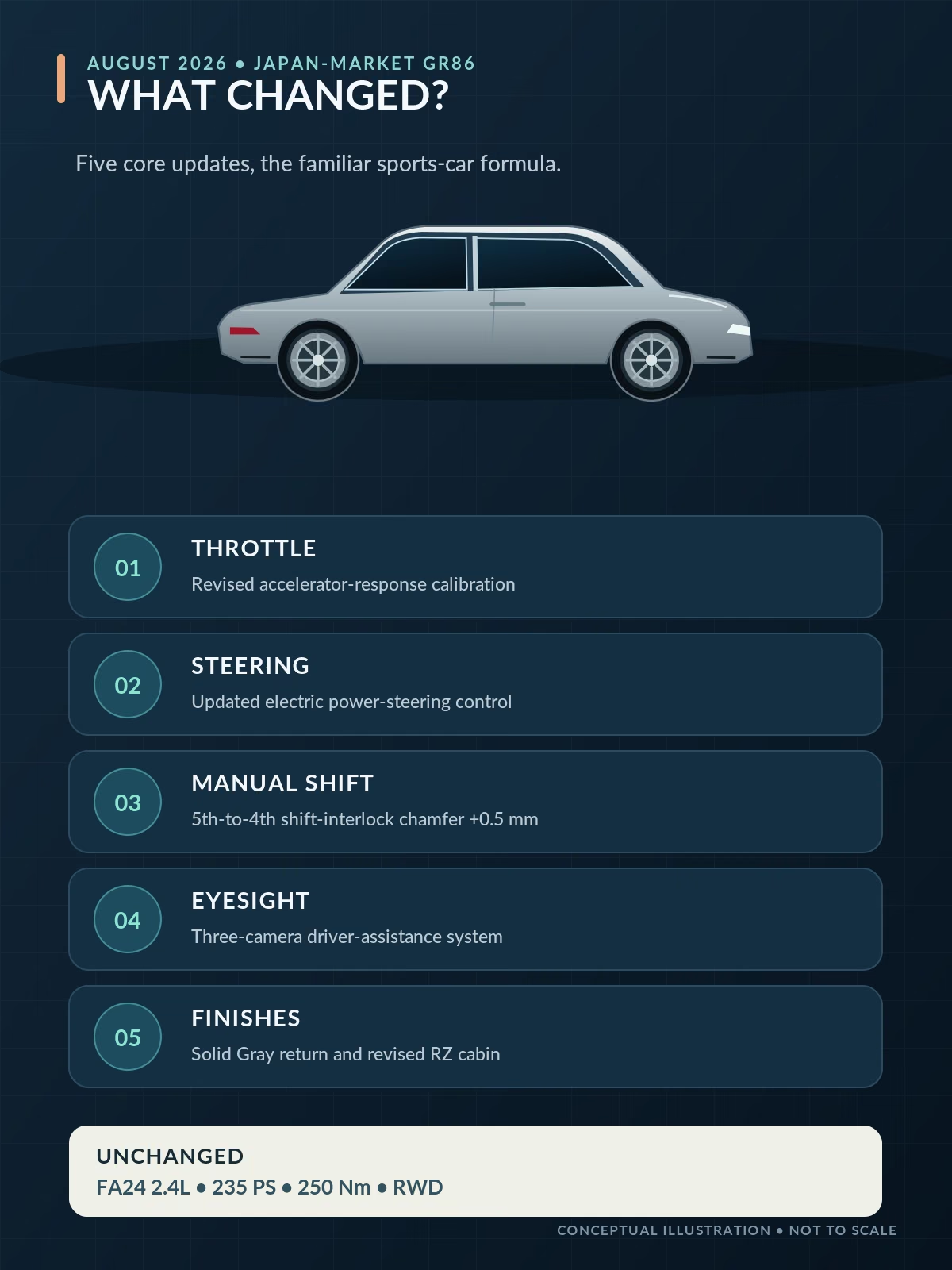
Announced in Japan on August 6, 2026, the updated GR86 receives revised electronic throttle control, recalibrated electric power steering, improved manual transmission shift operability, a three-camera EyeSight driver-assistance system, and subtle exterior and interior changes. These improvements result from development work involving professional racing drivers, Toyota evaluation drivers, and engineers. [1]
However, the GR86’s defining characteristics remain familiar. It still uses a naturally aspirated 2.4-liter FA24 boxer engine, a front-engine, rear-wheel-drive layout, and a lightweight two-door coupe architecture. The emphasis is on improving the existing driving experience rather than transforming the vehicle into something fundamentally different.
One important distinction is that the August 2026 Japanese-market refresh is not the same as the American 2026 GR86. Toyota announced comparable engineering and equipment changes for the U.S.-market 2027 GR86, while the U.S. 2026 lineup includes the GR86 Yuzu Edition and carries forward earlier tuning improvements. Understanding this difference is essential when comparing specifications, pricing, and available features. [3][4]

What’s New in the 2026 Toyota GR86?
The latest Japanese-market GR86 refresh focuses on changes that may be difficult to recognize from a photograph but could become noticeable behind the wheel. Toyota has revised how the car responds to accelerator inputs, how its steering assistance behaves under demanding conditions, and how the manual transmission feels during a specific downshift. The safety camera arrangement and RZ interior have also received meaningful updates.
An Overview of the 2026 GR86 Refresh
The GR86 has followed a philosophy of incremental improvement since the current generation arrived in 2021. Instead of waiting for an entirely new generation to introduce changes, Toyota GAZOO Racing continues refining its sports cars through engineering development, driver feedback, and motorsport experience.
For the August 2026 Japanese-market update, Toyota brought together professional drivers, internal evaluation drivers, and engineers for extensive circuit and test-course evaluations. The resulting improvements target precision, controllability, and consistency, particularly when accelerating out of corners, steering over uneven surfaces, and selecting fourth gear during deceleration.
Importantly, these refinements are not equivalent to a redesigned chassis or a more powerful engine. The changes primarily concern control calibration, a small mechanical transmission modification, driver-assistance hardware, and selected cabin components. [1]
The Biggest Changes at a Glance
The most important difference between the refreshed model and its immediate Japanese-market predecessor is how familiar mechanical systems have been refined. The engine and basic vehicle architecture remain intact, but several driver interfaces have changed. The following comparison summarizes Toyota’s announced upgrades and distinguishes them from characteristics that continue unchanged.
| Area | What Changed | What Stayed the Same |
|---|---|---|
| Engine | Revised electronic throttle calibration | 2.4-liter naturally aspirated FA24 boxer-four |
| Power output | No announced increase | 235 PS in Japan |
| Torque | More precisely managed accelerator response | 250 Nm peak torque |
| Steering | Revised electric power steering calibration | Existing steering architecture and RWD layout |
| Manual transmission | 0.5 mm wider shift-interlock chamfer | Six-speed manual configuration |
| Driver assistance | Three-camera EyeSight system | Driver remains responsible for vehicle operation |
| Exterior | Solid Gray paint returns | Fundamental coupe body design |
| Interior | Revised RZ controls, finishes, and color treatment | Driver-oriented cockpit |
| Motorsport | Automatic GR86 Cup Car Basic added | GR86/BRZ Cup competition purpose |
Comparison applies specifically to the August 2026 Japanese-market GR86 update. [1][2]
Throttle Response and Acceleration Control Receive Important Refinements
One of the most significant engineering improvements concerns the relationship between accelerator pedal movement and engine response. In a naturally aspirated rear-wheel-drive sports car, precise throttle control is important not only for straight-line acceleration but also for maintaining balance through corners. Toyota’s updated calibration is intended to make acceleration easier to manage without increasing the engine’s maximum output.
Electronic Throttle Mapping and Throttle Response Recalibration
Modern electronic throttle systems use sensors to detect accelerator pedal position and electronic controls to manage throttle opening according to engine operating conditions. The relationship is not necessarily a fixed, one-to-one correspondence. Engineers can adjust the system’s response to make acceleration feel more progressive or more immediate.
For the refreshed GR86, Toyota modified throttle-control settings to improve the driver’s ability to regulate acceleration precisely. The company specifically identifies corner exits and low-friction surfaces as situations where better control is desirable.
The important distinction is that a more responsive accelerator does not automatically mean more horsepower. Throttle mapping changes how available engine output responds to the driver’s request, while maximum horsepower depends on the engine’s actual output capability. [1]
More Linear Acceleration Response and Predictable Engine Torque Delivery
Linear acceleration response means that the vehicle’s reaction to progressive accelerator inputs feels consistent and predictable. For example, a small increase in pedal pressure should produce a manageable change in acceleration rather than an unexpectedly abrupt response.
Toyota’s recalibration aims to preserve the GR86’s direct character while improving this progression. That matters during low-speed maneuvers, transitions between deceleration and acceleration, and situations where the driver needs to make fine adjustments while maintaining vehicle balance.
The FA24 engine’s peak torque remains unchanged, but the way the electronic control system translates pedal movement into requested output can still influence the driving experience. A smoother response may make the same amount of available torque easier to use, particularly when traction is limited.
Better Corner-Exit Acceleration Control
Accelerating out of a corner requires careful management of rear-tire grip. In a rear-wheel-drive vehicle, the rear tires must provide both lateral force for cornering and longitudinal force for acceleration. Asking them to provide too much combined force can exceed available traction.
Toyota’s revised throttle calibration is intended to help drivers apply acceleration more progressively as they unwind the steering wheel and exit a bend. More predictable engine response may make it easier to manage weight transfer and avoid unnecessary disturbances to the car’s balance.

These are logical driving benefits of improved throttle modulation, but they should not be confused with verified performance gains. Toyota has not established through the announcement that the revised car delivers faster lap times, shorter acceleration times, or greater tire grip solely because of the new calibration.
Improved Low-Traction Surface Handling
Wet pavement, snow, and other low-friction road surfaces reduce the amount of traction available between the tires and the road. A rear-wheel-drive sports car can be particularly sensitive to sudden acceleration when the rear tires are already operating near their grip limits.
Toyota specifically developed the updated throttle settings to support finer acceleration control under these conditions. A more progressive response can help a driver avoid requesting excessive torque abruptly, especially when accelerating gently through a slippery corner.
However, the throttle update does not increase the fundamental coefficient of friction between tires and pavement. Tire condition, appropriate seasonal tires, speed, stability control, and driver judgment remain essential. The new calibration should be viewed as an aid to controllability, not a substitute for safe driving practices. [1]
Electric Power Steering Upgrades Aim to Improve Handling Precision
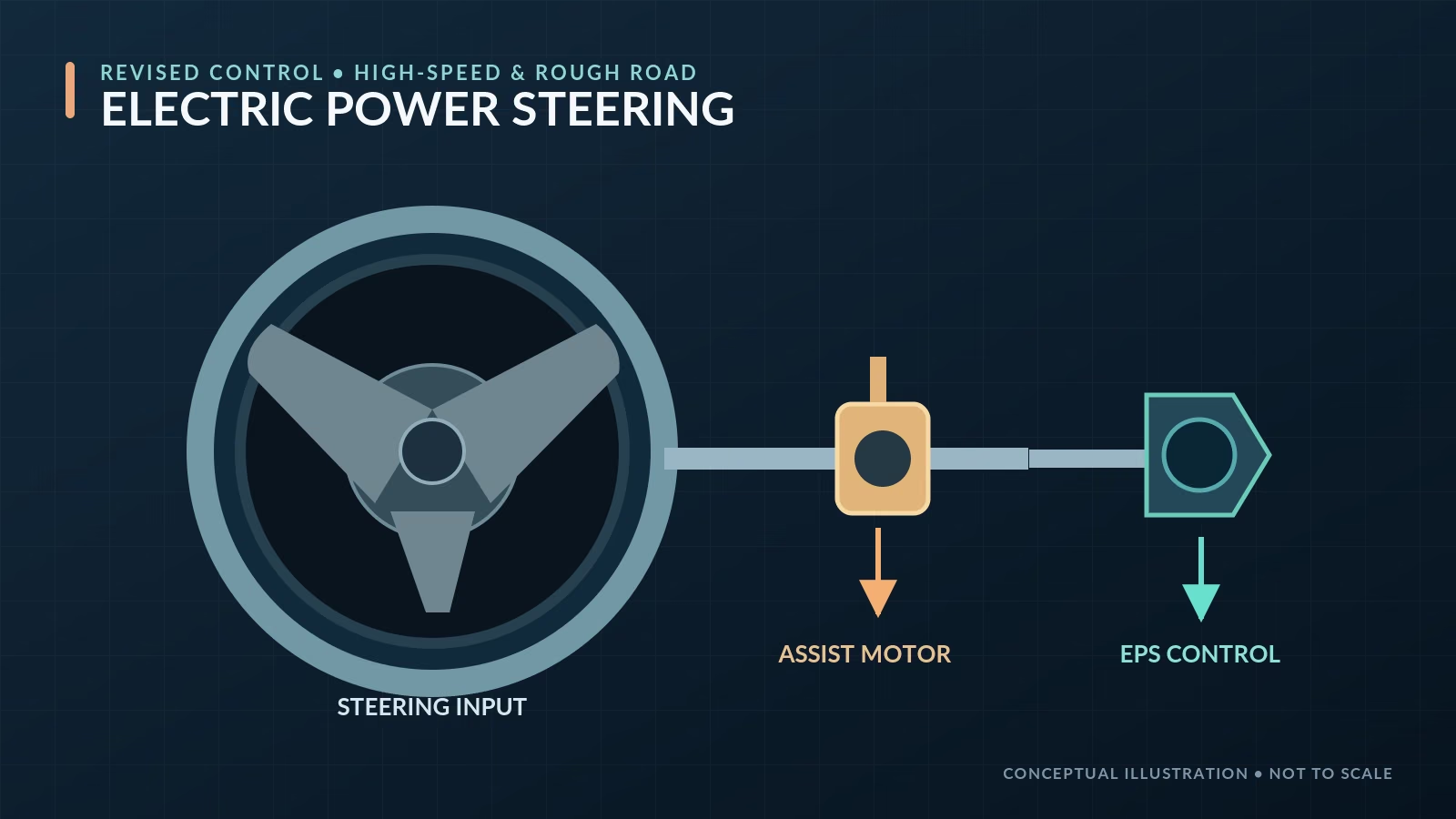
The 2026 Toyota GR86 also receives revised electric power steering (EPS) calibration, developed using knowledge gained through motorsport. Steering quality is especially important in a sports car because it affects how confidently drivers can position the vehicle through a corner. Toyota has concentrated on reducing unwanted steering disturbances while preserving the direct handling characteristics associated with the GR86.
Revised Electric Power Steering (EPS) Calibration
Electric power steering uses an electric motor to assist the driver’s steering inputs. Its electronic control system determines how much assistance to provide under different operating conditions, including changes in vehicle speed, steering input, and road forces.
Toyota revised the GR86’s EPS control to improve precision and consistency. The goal is to help drivers guide the vehicle along their intended path without unwanted steering movement interfering with the experience.
This modification does not require an entirely new steering architecture. Changes to assistance characteristics and control logic can meaningfully affect steering behavior even when the fundamental mechanical layout remains unchanged. Toyota’s announcement describes improved control, although it does not publish detailed calibration maps or independently measured steering-response data. [1]
Better High-Speed Cornering Stability
At higher cornering speeds, small steering corrections can affect the vehicle’s line and the driver’s confidence. Predictable steering behavior helps drivers maintain consistent inputs while the tires respond to changing lateral loads.
Toyota reports that the revised EPS control addresses steering wobble experienced during high-speed cornering. The intended result is a more stable and precise steering response, allowing drivers to follow their chosen line with fewer unwanted disturbances.
This is particularly relevant during long, sweeping corners where the steering wheel remains turned for an extended period. However, improved steering assistance should not be confused with increased mechanical grip or higher maximum cornering capability. Those outcomes also depend on tires, suspension, road conditions, and vehicle dynamics.
Improved Rough-Road Steering Precision
Uneven roads can transmit disturbances through the tires, suspension, and steering system. These forces may require additional driver corrections, particularly when a vehicle has relatively firm suspension tuning and performance-oriented tires.
The refreshed GR86’s EPS calibration is intended to reduce unwanted steering movement on rough surfaces. This could help drivers maintain a more consistent direction when encountering imperfect pavement, although the magnitude of any improvement requires direct comparison testing.
The update does not mean that Toyota has redesigned the suspension or eliminated road feedback. Some feedback is desirable in a driver’s car because it communicates information about the road surface. The objective is to manage unwanted disturbances without removing the connected steering feel that GR86 buyers expect.
How Super Taikyu Series Racing Helped Develop the New Steering Setup
Toyota specifically identifies experience from Japan’s Super Taikyu endurance racing series as an influence on the GR86’s revised EPS control. Endurance racing exposes vehicles to prolonged cornering loads, repeated steering inputs, and changing track conditions, making it a useful environment for evaluating consistency and driver confidence.
Professional racing drivers can identify subtle steering behaviors that might be difficult to detect during routine road testing. Engineers can then investigate the underlying causes and refine the control system through repeated evaluations.
Toyota says professional drivers, internal evaluation drivers, and engineers collaborated during development. The significance is that motorsport experience informed the production vehicle’s calibration rather than resulting in a completely new steering mechanism. [1]
Toyota Refines the Six-Speed Manual Transmission
Manual transmission enthusiasts receive one of the most technically specific improvements in the Japanese-market 2026 GR86. Toyota has made a small mechanical modification intended to improve the shift from fifth gear into fourth. The change does not transform the transmission into an entirely new design, but it addresses an operation that matters during braking and corner preparation.
What Changed in the Six-Speed Manual Transmission?
The Toyota GR86 continues to offer a conventional six-speed manual gearbox, allowing drivers to choose gears directly through the shift lever and clutch pedal. This arrangement is central to the engagement many buyers seek from a relatively lightweight sports coupe.
For the August 2026 update, Toyota focused on improving shift operability rather than changing the number of gears or the gearbox’s basic design.
The modification concerns the shift-interlock mechanism, specifically its geometry as it affects downshifting from fifth to fourth gear. Toyota describes the intended result as smoother operation during demanding corner-entry situations. There is no announced replacement gearbox, additional gear ratio, or increase in engine output associated with this particular refinement. [1]
Fifth-to-Fourth Gear Downshift Improvements
Downshifting from fifth to fourth gear is common when a driver reduces speed before entering a faster corner. The lower gear allows the engine to operate at a higher speed for a given road speed, potentially placing it in a more useful operating range for subsequent acceleration.
An awkward or imprecise shift can interrupt the driver’s rhythm, particularly when braking, steering, and gear selection occur close together.

Toyota’s improvement aims to make this transition more natural and consistent. For enthusiastic drivers, smoother engagement may reduce the attention required to complete the shift, allowing greater concentration on braking and turn-in.
The update targets shift operability, not automatic rev matching or an independently demonstrated reduction in shift time.
The 0.5 mm Shift-Interlock Chamfer Modification
Toyota identifies a precise dimensional change: the chamfer on the shift interlock has been widened by 0.5 millimeters.
A chamfer is a beveled edge on a component. In a transmission shift-control mechanism, such geometry can influence how moving parts interact and guide engagement. Altering the chamfer changes the physical interface within the relevant mechanism.
Toyota says the broader chamfer improves operability during the fifth-to-fourth downshift. Although half a millimeter is a small measurement, shifting mechanisms rely on controlled clearances, component geometry, and movement.
The modification illustrates how detailed mechanical development can improve an existing design without replacing the entire gearbox. Toyota has not published evidence that this change strengthens the transmission or increases its torque capacity. [1]
How the Gearshift Update Affects Corner-Entry Driving Dynamics
Corner entry involves several connected driving actions: reducing speed, selecting an appropriate gear, transferring load toward the front tires, and beginning steering input. Smooth coordination helps the vehicle remain balanced throughout this sequence.
The revised shift-interlock geometry is intended to make one part of that process more consistent. A cleaner fifth-to-fourth downshift may help experienced drivers maintain their preferred rhythm while transitioning from braking to turn-in.
This matters particularly on circuits and winding roads, where repeated gear changes are part of the driving experience.
Nevertheless, the update does not change fundamental braking performance, gear ratios, or the physics of vehicle weight transfer. Its primary purpose is to improve the driver’s interaction with the transmission rather than increase the car’s outright performance limits.
Exterior Design Updates Bring Back a Familiar Toyota 86 Color
Not every part of the 2026 Toyota GR86 upgrade involves mechanical engineering. Toyota has also revised the Japanese-market exterior color selection by bringing back a finish associated with the original Toyota 86. The change gives buyers another styling option without altering the vehicle’s distinctive body shape, proportions, or underlying design philosophy.
Solid Gray Returns to the GR86 Color Palette
Solid Gray is the most prominent exterior styling update announced for the refreshed Japanese GR86. Toyota originally offered this color on the earlier Toyota 86 for approximately six months beginning in 2017.
Its return creates a visual connection between the original 86 and the current GR86 generation. The understated gray finish complements the coupe’s low roofline, pronounced wheel arches, and compact body proportions.
Unlike a redesigned bumper, new lighting assembly, or revised body panel, an exterior paint option does not change vehicle geometry or mechanical performance.
For buyers interested in the 86’s heritage, Solid Gray provides an additional way to personalize the car while maintaining its familiar styling. [1]
Toyota 86 Design Heritage Remains Central to the GR86
The modern GR86 continues a sports-car lineage established by the original Toyota 86, which debuted in 2012. The current generation arrived in 2021, retaining the basic formula of a compact, front-engine, rear-wheel-drive coupe developed in collaboration with Subaru.
The design emphasizes a low driving position, relatively short body, broad stance, and recognizable coupe silhouette. These characteristics support the vehicle’s identity as a driver-focused sports car rather than a luxury grand tourer.
The August 2026 changes maintain this established appearance. Toyota’s focus on a returning historical color reinforces the connection to the original 86 while allowing the manufacturer to concentrate its engineering work on controllability and usability.
What Didn’t Change About the GR86 Exterior?
Toyota’s August 2026 announcement does not identify a comprehensive body redesign. The GR86 retains its two-door coupe configuration, familiar roofline, sculpted body panels, and characteristic front-end styling.
The official Japanese catalog continues to list dimensions of 4,265 mm in length, 1,775 mm in width, and 1,310 mm in height for the referenced 2026 SZ manual model. Its wheelbase remains 2,575 mm. [2]
These measurements demonstrate continuity in the vehicle’s overall package. There is no announced increase in body size or wheelbase as part of this refresh.
Consequently, buyers should regard the exterior update as an evolution of the existing generation, not a new-generation GR86.
Interior Upgrades Make the GR86 Cockpit More Driver-Focused
Toyota has introduced selected cabin improvements intended to enhance the GR86’s perceived quality and control usability. These changes are particularly relevant to the Japanese-market RZ grade, which receives revised switches, darker control finishes, and an updated optional black-and-red interior treatment. The overall cockpit continues to prioritize driving-related controls over extensive cabin redesign.
Toyota GR86 RZ Trim Level Receives Interior Refinements
The RZ sits at the top of the regular Japanese GR86 grade hierarchy, above the SZ and RC. Its updated interior is intended to provide a more polished environment while preserving the vehicle’s performance-oriented character.
Toyota has focused on components that drivers frequently interact with, especially switches and interior trim surfaces. These details may appear relatively minor compared with engine or suspension changes, but they contribute to the perceived quality of everyday operation.
Importantly, Toyota identifies the announced switch and color-treatment changes specifically with the RZ grade. Buyers considering the SZ or RC should check the appropriate grade-specific equipment list rather than assuming that every RZ interior enhancement is included throughout the range. [1]
Redesigned Interior Control Switches Improve Usability
Toyota redesigned selected RZ interior switches to provide improved grip and easier operation. The objective is straightforward: frequently used controls should be easy to locate and manipulate without unnecessary attention.
Switch ergonomics can be particularly important in a sports coupe, where the driver sits low and may be managing several inputs while concentrating on the road. A well-designed physical control offers tactile feedback that helps the driver recognize an operation without relying exclusively on visual confirmation.
Toyota’s announcement emphasizes improved switch usability, although it does not provide comparative measurements of operation time or driver distraction.
The change is therefore best understood as a practical ergonomic refinement rather than a major electronic or infotainment system overhaul.
Cast-Iron-Black Interior Trim and Low-Reflectivity Switchgear
The refreshed RZ incorporates a cast-iron-black finish on selected switches. Toyota describes this finish as having low reflectivity, helping reduce distracting reflections while giving the cockpit a more cohesive appearance.
Reflective interior surfaces can catch direct sunlight or other bright light sources, potentially drawing attention away from the road. Darker, less reflective finishes can reduce this visual distraction, depending on lighting conditions and surface geometry.
The updated treatment also supports the GR86’s functional interior design, where the controls and driving position take precedence over decorative complexity.
These changes should not be mistaken for new electronic features. They primarily concern the physical appearance and usability of existing cockpit controls. [1]
Updated Black-and-Red Interior Upholstery and Red Accents
Toyota has revised the RZ’s factory-optional black-and-red interior color scheme. The updated arrangement places red accents around the driver’s seating environment, creating a more distinctive and visually focused cockpit.

The design references the interior styling of later versions of the original Toyota 86, extending the heritage theme also visible in the returning Solid Gray exterior paint.
Contrasting red accents can make the cabin feel more sporting without changing its underlying dimensions or mechanical features.
However, this color treatment is an option rather than a universal feature of every GR86. Buyers should confirm the available interior combinations for their particular trim level and market before ordering. [1]
The 2026 GR86 Gets a More Advanced EyeSight Safety System
One of the most substantial hardware changes in the refreshed Japanese GR86 is the upgraded EyeSight driver-assistance camera system. Toyota has moved from a two-camera arrangement to a three-camera configuration designed for broader visual coverage. Unlike the throttle and steering refinements, this update involves additional sensing hardware and may be particularly relevant to owners who regularly use their GR86 for commuting.
Subaru EyeSight Driver-Assistance System Explained
EyeSight is a camera-based driver-assistance technology developed by Subaru. It uses visual information from cameras positioned near the windshield to monitor portions of the road ahead and support functions such as collision warnings and braking assistance, depending on the vehicle and its equipment.
The technology appears in the GR86 because the sports coupe shares its development background and fundamental architecture with the Subaru BRZ.
EyeSight belongs to the category of advanced driver-assistance systems, commonly abbreviated as ADAS. These technologies supplement driver awareness and control rather than replacing them.
Subaru emphasizes that EyeSight monitors traffic and can assist with selected driving tasks, but specific functions and their availability differ by model and market. [5]
New Triple-Camera EyeSight Configuration
The updated Japanese GR86 replaces its previous two-camera EyeSight arrangement with a three-camera system.
Toyota’s announcement confirms that the revised setup combines a wide-angle stereo camera arrangement with an additional ultra-wide-angle monocular camera. The primary objective is to extend the area that the system can observe.
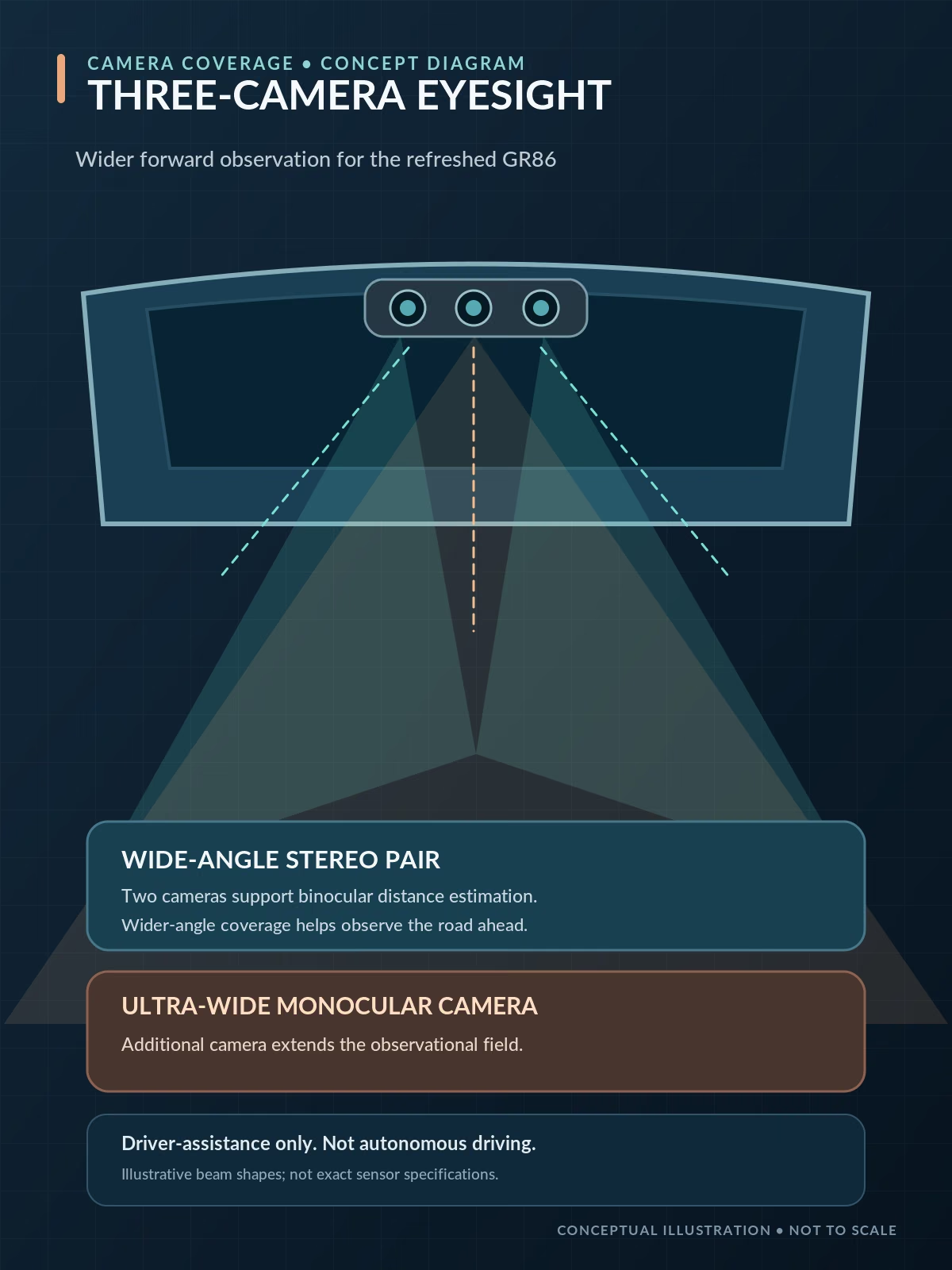
A wider observational field may improve the system’s ability to identify relevant objects in situations where they appear outside the narrower coverage of the previous arrangement.
However, the addition of a camera does not automatically establish better performance in every safety scenario. Actual effectiveness depends on image processing, recognition software, lighting, weather, system calibration, and operating conditions. Toyota has not published an independent accident-reduction study specifically evaluating this GR86 camera upgrade. [1]
Wide-Angle Stereo Cameras and Ultra-Wide-Angle Monocular Camera
Stereo cameras observe the road from two slightly different positions. By comparing the images, a vision system can estimate depth and the relative position of objects within its field of view.
The upgraded GR86 uses wider-angle stereo cameras to expand the area covered by this primary observation system.
An additional ultra-wide-angle monocular camera provides another visual perspective, particularly useful for observing a broader portion of the forward environment. Unlike the stereo pair, a single camera does not obtain depth through binocular disparity by itself.
The system combines camera observations with software processing to support driver-assistance functions. Toyota does not disclose every detail of the sensor-fusion algorithms, so specific internal processing methods should not be assumed. [1][5]
Expanded Field of View for a Low-Profile Sports Car
The GR86’s relatively low vehicle height presents packaging and camera-positioning considerations that differ from those of taller passenger vehicles. Camera placement influences the perspective from which the system observes traffic, pedestrians, and other objects.
Toyota states that its upgraded EyeSight configuration is tailored to the low stance of a sports car. The wider stereo-camera coverage and additional monocular camera are intended to expand the system’s field of view.
Broader coverage can be valuable in complex road environments, including intersections where objects may approach from different directions. Toyota’s U.S. announcement for the 2027 GR86 specifically discusses improvements to object detection around intersections. [4]
Nevertheless, drivers should not interpret broader coverage as eliminating blind spots or guaranteeing detection under every condition.
Why Advanced Driver-Assistance Systems Matter in a Lightweight Sports Coupe
The Toyota GR86 is primarily marketed around driving engagement, but many owners use sports cars for ordinary transportation as well as recreational driving.
During daily commuting, heavy traffic and extended journeys, collision warnings and other assistance features can provide an additional layer of support. A camera system with a wider field of view has the potential to recognize more relevant information within its designed operating conditions.
Modern driver-assistance features do not necessarily reduce the enjoyment of a manually shifted rear-wheel-drive car. Their role is different from the steering, braking, and throttle inputs that define the driving experience.
Drivers must still remain attentive, maintain safe distances, and operate the car appropriately. EyeSight is not an autonomous driving system.
What Didn’t Change Under the Hood of the 2026 Toyota GR86?
Despite the attention given to the latest GR86 engineering changes, Toyota has not introduced a replacement engine or increased the officially rated maximum output of the Japanese-market car. The naturally aspirated FA24 boxer-four remains central to the vehicle’s character, combining a relatively low-mounted powertrain with responsive engine operation and the familiar six-speed transmission choices.
The FA24 2.4-Liter Boxer Engine Remains
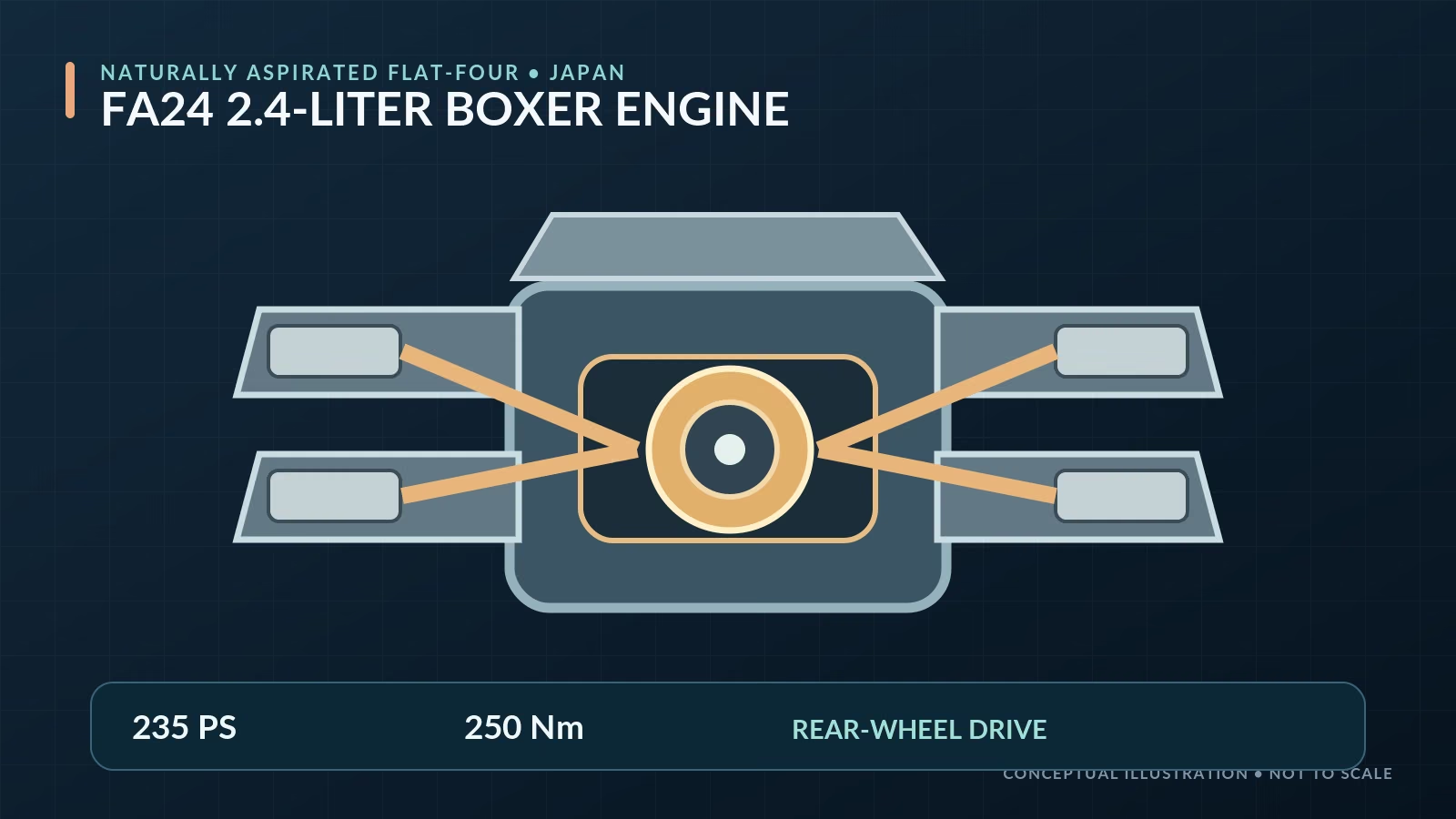
The Japanese-market 2026 GR86 continues to use the Subaru-developed FA24 engine, a naturally aspirated, horizontally opposed four-cylinder gasoline engine with a displacement of 2,387 cc.
In this configuration, the cylinders are arranged horizontally in opposing banks rather than in a conventional inline-four arrangement. This produces a relatively flat engine package, allowing it to be installed low within the vehicle.
The engine also uses Toyota’s D-4S fuel-injection technology, combining direct and port fuel injection.
The refreshed model retains this established mechanical foundation. Toyota’s official Japanese catalog identifies the FA24 engine, its displacement, and its unchanged naturally aspirated configuration, confirming that the update is not an engine replacement or forced-induction conversion. [2]
Japanese-Market Power Output Remains at 235 PS
| Japan-market maximum output | U.S.-market rated output |
|---|---|
| 235 PS (173 kW at 7,000 rpm) | 228 hp (mechanical horsepower) |
The Japanese-market GR86 remains rated at 235 PS, or approximately 173 kW, at 7,000 rpm. This is equivalent to roughly 232 mechanical horsepower when the metric horsepower figure is converted directly.
The U.S. GR86 is separately rated at 228 mechanical horsepower. These figures should not be presented as evidence that the Japanese refresh has gained horsepower over the previous model, because the rated Japanese output remains unchanged.
Different markets may publish different engine ratings and measurement units, making accurate comparisons important. The changes to throttle calibration are intended to improve the controllability of available power rather than increase maximum engine output. [2][3]
Peak Engine Torque Remains 250 Nm
The refreshed Japanese GR86 continues to produce a rated peak torque of 250 Nm at 3,700 rpm.
Peak torque describes the maximum twisting force delivered by the engine at its output shaft under specified conditions. However, actual acceleration also depends on engine speed, transmission gearing, final-drive ratio, vehicle mass, and traction.
A relatively accessible torque peak helps make the GR86 usable without requiring the driver to operate continuously near maximum engine speed.
Toyota’s throttle-control refinements can alter how the driver requests and manages engine torque without changing the published peak figure. Consequently, improved acceleration control should not be interpreted as additional peak torque or a newly developed torque curve unless supported by measured engine data. [2]
Why Toyota Kept the Naturally Aspirated Powertrain Philosophy
A naturally aspirated engine draws air into its cylinders without a turbocharger or supercharger. This avoids the boost-management characteristics associated with forced induction and can provide a relatively direct relationship between engine speed, throttle input, and available torque.
For a driver-focused sports car, that behavior can be appealing because acceleration control is closely connected to engine response. The GR86 also encourages drivers to use its manual gearbox and explore the engine’s operating range.
Naturally aspirated engines have tradeoffs. They may deliver less peak power than similarly sized turbocharged engines, and their torque characteristics differ.
Toyota has not introduced a turbocharger or hybrid system in the August 2026 Japanese GR86 refresh. The company’s announced development priorities instead center on refining the existing engine’s controllability and preserving the car’s established driving character.
The GR86’s Rear-Wheel-Drive Platform and Lightweight Architecture Remain Intact
The GR86 continues to rely on a relatively simple sports-car formula: a front-mounted engine, rear-wheel drive, compact proportions, and a chassis developed to balance agility with driver feedback. None of the announced August 2026 improvements constitutes a wholesale replacement of this architecture. The refresh builds on the current platform through revised control behavior and selected equipment changes.
Front-Engine, Rear-Wheel-Drive Layout Continues
The Toyota GR86 uses a front-engine, rear-wheel-drive arrangement, often abbreviated as FR.
In this layout, the front wheels primarily handle steering while the rear wheels deliver propulsion. Although both axles contribute to vehicle stability and cornering, separating steering and driven-wheel functions creates handling characteristics valued by many sports-car enthusiasts.
Rear-wheel drive also affects how the car responds to accelerator inputs during cornering. Increasing power changes the longitudinal forces at the rear tires, which can influence vehicle balance when the tires are simultaneously generating lateral grip.
This relationship makes Toyota’s revised throttle control particularly relevant. The drivetrain itself remains unchanged, but the driver may be able to manage the existing rear-wheel-drive characteristics more progressively.
Low Center of Gravity Still Defines the Driving Experience
A vehicle’s center of gravity influences how its weight transfers during acceleration, braking, and cornering.
The GR86’s horizontally opposed engine contributes to a relatively low powertrain installation, which supports the car’s low-center-of-gravity design philosophy. Its compact body and low driving position reinforce this approach.
A lower center of gravity can reduce the roll moment generated during cornering, although total body movement also depends on suspension geometry, spring rates, dampers, anti-roll bars, and tire forces.
The August 2026 refresh does not introduce a new engine architecture or fundamentally different vehicle proportions. Instead, Toyota is refining how steering and acceleration respond within the existing chassis, making the established low-center-of-gravity design more central to the driving experience.
Lightweight Sports Coupe Architecture and Chassis Design
The GR86’s relatively compact dimensions help distinguish it from larger performance vehicles. Its structural design incorporates measures intended to provide rigidity while controlling vehicle mass.
A rigid chassis allows suspension components to operate within their intended geometry, supporting consistent handling and steering response.
Toyota’s broader GR86 engineering information describes the use of high-strength steel, aluminum components, structural adhesives, and reinforcement around suspension attachment areas. These are established elements of the current vehicle architecture, not newly announced structural changes for the Japanese August 2026 refresh. [4]
The updated Japanese catalog continues to list a 2,575 mm wheelbase and the same fundamental two-door coupe package.
Because specifications such as curb weight can vary by trim, transmission, and model revision, buyers should compare the exact versions rather than assuming every configuration weighs the same.
Why Toyota Didn’t Replace the GR86 Platform
Toyota has not publicly presented the August 2026 update as a new platform generation. Its announcement focuses on incremental improvements to systems that already define the GR86’s driving behavior.
Retaining a developed architecture allows engineers to concentrate on detailed control characteristics, component operation, and driver feedback. It also preserves the mechanical layout and proportions that appeal to existing owners.
The commercial benefits of such an approach may include reduced development complexity and continuity in manufacturing, but Toyota has not identified cost reduction as the specific reason for these changes.
The more reliable conclusion is that GAZOO Racing chose to enhance the driving experience within the established platform rather than announce a fundamentally different sports car.
Toyota Expands the GR86 Cup Car Basic Motorsport Lineup
The 2026 Japanese-market announcement also includes a change to the competition-oriented GR86 Cup Car Basic. Toyota is expanding this model’s transmission choices to include an automatic version, reflecting an effort to make participation in GR86-based motorsport accessible to a broader group of drivers. This development is separate from the ordinary road-going model’s manual transmission refinement.
What Is the Toyota GR86 Cup Car Basic?
The GR86 Cup Car Basic is a competition-oriented version designed for participation in Japan’s GR86/BRZ Cup racing activities.
Unlike an ordinary road-going GR86 purchased primarily for commuting or recreational use, the Cup Car Basic is intended to provide a suitable starting point for organized motorsport.
Its purpose is connected to competition involving closely related Toyota GR86 and Subaru BRZ vehicles, where regulated vehicle configurations allow drivers to compete within defined categories.
Toyota GAZOO Racing uses these activities to support motorsport participation and maintain the connection between racing and production sports-car development.
Buyers should not confuse the Cup Car Basic with the Japanese RC, SZ, or RZ road-car trim grades, because its intended use and specification requirements are different.
Automatic Transmission Added to the GR86 Cup Car Basic
Toyota announced that the GR86 Cup Car Basic would gain an automatic transmission option, expanding beyond its previously manual-focused configuration.
The objective is to accommodate different driver preferences and make competitive driving more accessible. An automatic transmission allows participants to concentrate on braking points, steering inputs, and racecraft without the same manual clutch and gear-selection requirements.
Toyota’s August announcement scheduled shipments of the automatic Cup Car Basic to begin in December 2026. As of November 13, 2026, that date remains in the future, so the announcement should not be interpreted as proof that customer deliveries have already started. [1]
This addition is a motorsport-lineup change, not evidence that the regular GR86 has received an entirely new automatic gearbox design.
Toyota GR86 and Subaru BRZ Relationship
The Toyota GR86 and Subaru BRZ are closely related sports cars developed through cooperation between Toyota and Subaru.
They share major engineering characteristics, including the boxer-engine arrangement, rear-wheel-drive platform, compact coupe dimensions, and general transmission architecture.
However, the two vehicles are not necessarily identical in every respect. Manufacturer-specific suspension settings, styling, equipment packages, driver-assistance features, and market availability can differ.
The Subaru relationship is also relevant to the EyeSight system, which originated from Subaru’s driver-assistance technology development.
Prospective buyers comparing the vehicles should therefore examine the exact production year, grade, and market. Shared mechanical foundations do not automatically mean that every update reaches both brands simultaneously.
The GR86/BRZ Cup Racing Series
The GR86/BRZ Cup is a Japanese motorsport series centered on competition involving Toyota GR86 and Subaru BRZ cars.
Racing with closely related vehicles places considerable importance on driver ability, vehicle setup, consistency, and operating within the applicable technical regulations.
For Toyota, the series also provides an environment where engineers can observe how vehicles and components perform under demanding conditions.
Although Toyota specifically attributes the refreshed GR86’s EPS development to experience in the Super Taikyu Series, the broader GR86/BRZ Cup contributes to the model’s motorsport ecosystem.
The addition of an automatic Cup Car Basic broadens the range of transmission choices available to competitors, while the regular production GR86 continues to benefit from a development philosophy shaped by driver feedback and racing experience.
2026 Toyota GR86 Trim Levels, Pricing, and Availability
Toyota’s August 2026 Japanese-market update retains the established RC, SZ, and RZ grade structure. The announced prices vary according to grade and transmission, with the RC positioned as the lowest-priced regular model and the RZ at the top of the lineup. These Japanese prices should not be applied directly to U.S. vehicles, which use different grades and model-year timing.
Japanese RC, SZ, and RZ Trim Grades Explained
The Japanese GR86 range includes three regular grades.
The RC is the entry-level model and is available with a six-speed manual transmission. Its positioning makes it relevant to buyers who prioritize the basic rear-wheel-drive sports-car experience or intend to personalize the vehicle.
The SZ occupies the middle of the range and offers both six-speed manual and six-speed automatic choices.
The RZ is the higher-grade version, providing additional equipment and the specific interior refinements introduced for August 2026.
All three grades share the basic naturally aspirated boxer-engine and rear-wheel-drive architecture. However, wheels, interior materials, equipment, and other details can vary, so the appropriate choice depends on the buyer’s priorities rather than engine power alone. [2]
2026 Toyota GR86 Japanese-Market Pricing
Toyota published the following manufacturer’s suggested retail prices for the updated Japanese GR86. The amounts include Japan’s consumption tax and apply to the August 2026 grade lineup.
| Japanese GR86 grade | Six-speed manual | Six-speed automatic |
|---|---|---|
| RC | ¥2,936,000 | Not offered |
| SZ | ¥3,195,000 | ¥3,293,000 |
| RZ | ¥3,518,000 | ¥3,616,000 |
The automatic transmission carries a ¥98,000 premium over the manual within both the SZ and RZ grades.
Toyota notes that prices can vary by region. Optional equipment, registration charges, insurance, and other transaction-related expenses may also affect the final amount paid by the customer.
The pricing structure is useful for understanding the relative positioning of the grades, but it should not be converted directly into an estimated overseas retail price without accounting for import duties, taxation, transportation, and local market conditions. [1]
Japanese-Market Release and Customer Orders
Toyota GAZOO Racing officially announced the upgraded Japanese GR86 on August 6, 2026, and specified August 28, 2026, as the start of customer order acceptance through Toyota dealerships in Japan.
The company also arranged promotional displays of the updated vehicle in Solid Gray, including its appearance at the Toyota showroom in Midland Square in Nagoya.
These dates establish the Japanese-market timeline for the refresh. They do not determine when similar versions become available in the United States, Europe, or other regions.
Automakers frequently use market-specific model years and launch schedules, so a vehicle released in one country during 2026 may be marketed under a different model year elsewhere.
For accurate comparisons, buyers should always identify the sales region and the precise version being discussed. [1]
How the Japanese 2026 Update Differs From the U.S. 2026 GR86
The American 2026 Toyota GR86 follows a different update schedule.
Toyota announced the U.S. 2026 GR86 Yuzu Edition on April 3, 2025. The American lineup consists of the GR86, GR86 Premium, and limited-production Yuzu Edition.
The Yuzu Edition features Yuzu Yellow paint, matte-black 18-inch wheels, yellow interior accents, Brembo brakes, and SACHS dampers. Toyota specified production of 860 Yuzu Editions for the North American market. [3]
The American 2026 model also carries forward throttle tuning improvements introduced in an earlier model year. It is therefore inaccurate to describe its throttle system as entirely unchanged since the current GR86 generation debuted.
On June 1, 2026, Toyota announced further revisions for the U.S.-market 2027 GR86, including updated throttle calibration, improved fifth-to-fourth shift feel, expanded camera coverage, and revised interior treatments.
The U.S. 2027 model also introduces Thunder exterior paint and a Cockpit Red interior option. These should not automatically be treated as identical in availability or specification to Japan’s Solid Gray and RZ interior combinations.
The central distinction is that similar engineering improvements may appear in different model years depending on the market. [4]
Real-World Driving: Do the 2026 GR86 Upgrades Make a Difference?
Toyota’s announced improvements address areas that influence daily driving as well as performance driving. Throttle response, steering behavior, and shift quality can affect how a vehicle feels even when its maximum power remains unchanged. However, manufacturer development objectives should be distinguished from independently verified outcomes. The exact difference experienced by a driver will depend on conditions, driving style, and the version being compared.
Daily Driving and Urban Conditions
In urban environments, the GR86’s revised throttle control may make gentle acceleration easier to manage in situations requiring precise pedal input.
More progressive response can be useful when moving through traffic, negotiating tight turns, or accelerating from low speeds on slippery pavement.
The updated RZ switches may also improve the experience of operating frequently used controls, while the expanded EyeSight camera coverage provides an additional driver-assistance improvement.
These changes do not alter the GR86’s fundamental practical limitations. It remains a low, compact coupe with a relatively small rear seating area compared with conventional passenger cars.
For everyday use, the refresh should be viewed as a collection of usability and control improvements rather than a transformation into a more spacious or comfort-focused vehicle.
Highway Driving and High-Speed Stability
Toyota’s revised EPS control is intended to reduce unwanted steering disturbances during high-speed cornering and over rough surfaces.
On the road, consistent steering behavior can help drivers maintain a stable line and avoid unnecessary corrections, particularly when pavement quality changes.
This could contribute to a more composed driving experience, but the manufacturer has not published a controlled comparison demonstrating a specific improvement in highway steering effort or stability.
The GR86’s relatively compact wheelbase, suspension setup, tire characteristics, and low body position continue to influence how it behaves at higher speeds.
Drivers should evaluate steering refinement during a normal test drive under legal road conditions rather than attempting to reproduce racetrack conditions on public roads.
Spirited Driving and Track Performance
The benefits of the 2026 improvements may be most apparent when several driver inputs occur in quick succession.
During corner entry, improved manual shift operability may make the fifth-to-fourth downshift easier to execute. Through a bend, revised EPS calibration is intended to help maintain the desired steering line. On corner exit, the updated throttle response may allow more progressive acceleration.
These systems interact with the same underlying tires, suspension, drivetrain, and engine.
Toyota’s development work is specifically intended to improve controllability in such situations. Nevertheless, the company has not established that the refreshed Japanese model completes a particular circuit faster than its predecessor.
A faster lap would require a repeatable comparison under equivalent conditions, including the same tires, weather, driver, vehicle setup, and test method.
Are the Improvements Noticeable Enough to Justify Upgrading?
The value of the refreshed GR86 depends largely on which characteristics matter to the driver.
An experienced owner familiar with the previous model’s steering and throttle behavior may be more sensitive to small calibration changes. A driver who regularly participates in track days may also appreciate the more precise manual downshift operation.
For someone who primarily drives at modest speeds, the expanded EyeSight system and revised cabin controls could be more meaningful than the mechanical refinements.
Because the engine output and fundamental chassis architecture remain unchanged, upgrading solely for additional straight-line performance would be difficult to justify.
A direct comparison between equivalent versions is the best way to decide whether the improved control characteristics are worth the financial difference.
2026 Toyota GR86 Versus Previous Models: Complete Upgrade Comparison
The most accurate way to evaluate the 2026 Toyota GR86 upgrade is to separate its mechanical changes from equipment and appearance updates. Comparing the August 2026 Japanese-market version against its immediate Japanese predecessor avoids confusion with U.S. model-year differences. The comparison also demonstrates that the update involves selective engineering development rather than a new engine, transmission architecture, or vehicle platform.
Performance and Mechanical Changes
Toyota’s development work concentrates on driver control rather than higher peak performance figures. The following table compares the revised Japanese model with the preceding Japanese specification and identifies areas where Toyota has announced an actual modification.
| Component | Previous Japanese GR86 | August 2026 Japanese GR86 |
|---|---|---|
| Engine | FA24 2.4-liter boxer-four | Same engine |
| Maximum power | 235 PS | 235 PS |
| Maximum torque | 250 Nm | 250 Nm |
| Throttle control | Previous calibration | Revised for more linear acceleration control |
| Electric power steering | Previous EPS settings | Revised to reduce unwanted steering movement |
| Manual transmission | Six-speed manual | Six-speed manual |
| Manual shift interlock | Previous geometry | Chamfer widened by 0.5 mm |
| Drivetrain | Front-engine, rear-wheel drive | Unchanged architecture |
| Platform | Current-generation GR86 | Current-generation GR86 |
| Overall body dimensions | Established GR86 dimensions | No announced redesign |
The updated model retains its underlying performance specifications. The most significant modifications concern how the driver interacts with the existing drivetrain and steering system.
This distinction explains why Toyota can improve the GR86’s driving characteristics without claiming that the car produces more power or has undergone a complete mechanical redesign. [1][2]
Design, Interior, and Safety Changes
The exterior, interior, and driver-assistance changes vary considerably in their significance. Some are primarily cosmetic, while others affect ergonomics or the information available to active safety systems. Buyers should also pay attention to grade-specific equipment, especially the RZ interior modifications.
| Area | Previous Japanese GR86 | August 2026 Japanese GR86 |
|---|---|---|
| Solid Gray paint | Not in the immediately preceding color range | Reintroduced |
| Exterior body | Current GR86 design | Fundamental design retained |
| RZ switch design | Previous design | Revised for improved grip |
| RZ switch finish | Previous treatment | Low-reflectivity cast-iron-black finish |
| Optional RZ black-and-red interior | Earlier color arrangement | Revised driver-surrounding red accents |
| EyeSight cameras | Two-camera arrangement | Three-camera arrangement |
| Camera coverage | Previous observational field | Wider field of view |
| GR86 Cup Car Basic | Existing manual competition version | Automatic option added |
| Regular road-car grades | RC, SZ, RZ | RC, SZ, RZ |
The three-camera EyeSight upgrade represents an actual change to the vehicle’s driver-assistance hardware, while the returning exterior color and RZ cabin treatment are more closely related to styling and ergonomics. [1]
Major Upgrades Versus Minor Refinements
Not all changes should carry equal weight in a purchasing decision.
The new EyeSight camera configuration is a notable hardware upgrade because it expands the sensing arrangement used by the driver-assistance system.
The throttle and EPS updates may be particularly meaningful for drivers who value precise control, even though they are largely calibration refinements. The manual transmission change is mechanically small but targets an operation relevant to performance driving.
The returning Solid Gray paint and revised interior appearance are less significant from an engineering perspective, although personal preference can make them important to individual buyers.
Overall, the Japanese 2026 GR86 is best classified as an evolutionary product refinement rather than a new generation or a comprehensive mid-cycle body redesign.
Is the Refreshed 2026 Toyota GR86 Worth Buying?
For buyers seeking a naturally aspirated, rear-wheel-drive sports coupe, the refreshed GR86 retains many of the qualities that define the existing generation while addressing selected areas of control and usability. Whether it represents good value depends on local availability, pricing, intended driving conditions, and how much importance the buyer places on the latest calibration and safety changes.
Reasons to Consider the Updated GR86
The strongest reason to consider the updated GR86 is Toyota’s continued attention to the driving experience.
More progressive throttle control, revised EPS assistance, and improved manual downshift operability are all intended to make the car easier to control consistently.
The upgraded EyeSight camera arrangement is another reason to consider the newer Japanese specification, particularly for drivers who use the vehicle regularly rather than exclusively for recreational driving.
The revised RZ interior and returning Solid Gray paint provide additional appeal without changing the vehicle’s established identity.
For someone purchasing a new Japanese-market GR86, these refinements make the latest specification worth evaluating alongside any remaining earlier-model inventory.
Reasons Some Buyers May Prefer an Earlier GR86
An earlier GR86 remains a reasonable choice because the core engine, rear-wheel-drive architecture, and overall coupe design are substantially the same.
Buyers who prioritize the naturally aspirated engine, six-speed manual transmission, and compact chassis may find that an older example already delivers the experience they want.
Used-market pricing and vehicle condition may have greater practical significance than the latest control refinements, especially when comparing a well-maintained older GR86 with a more expensive updated vehicle.
However, the appropriate decision requires careful inspection of the individual car, including service history, tire condition, signs of accident damage, and evidence of previous track use or modifications.
The refreshed model’s improvements should not automatically make every earlier GR86 undesirable.
Who Benefits Most From the 2026 Updates?
Drivers who place a high value on steering precision, throttle modulation, and manual transmission feel are likely to find the engineering changes most relevant.
Track-day enthusiasts may appreciate the combination of revised EPS calibration, more progressive acceleration control, and improved downshift operability, although measurable performance benefits have not been independently established by Toyota’s announcement.
Daily drivers may place greater importance on the expanded EyeSight camera system and updated control ergonomics.
Owners of the original Toyota 86 may also find the refreshed GR86 attractive because it combines the established character of the 86 lineage with the more powerful 2.4-liter engine introduced in the current generation.
Ultimately, the improvements are most compelling for buyers seeking refinement rather than a dramatic increase in horsepower.
Frequently Asked Questions About the 2026 Toyota GR86 Upgrade
Questions about the latest GR86 frequently arise because Japanese and American vehicles follow different model-year schedules. It is also easy to mistake improved throttle behavior for increased power or a mechanical shift-quality improvement for an entirely new transmission. The following answers distinguish Toyota’s confirmed specifications from broader interpretations of the refresh.
What Changed in the 2026 Toyota GR86?
The August 2026 Japanese-market GR86 receives revised throttle calibration, updated electric power steering control, a 0.5 mm wider manual shift-interlock chamfer, and an upgraded three-camera EyeSight system.
Toyota also reintroduced Solid Gray paint and revised selected interior details on the RZ grade.
The GR86 Cup Car Basic lineup gained an automatic transmission option, with shipments scheduled for December 2026.
These changes emphasize improved control, usability, and driver assistance. They do not constitute a new GR86 generation or an increase in the standard Japanese model’s rated maximum engine output. [1]
Does the 2026 Toyota GR86 Have More Horsepower?
No. The August 2026 Japanese-market Toyota GR86 continues to produce a rated maximum output of 235 PS, equivalent to approximately 232 mechanical horsepower.
The American-market GR86 is separately rated at 228 mechanical horsepower.
Toyota’s revised throttle calibration changes how acceleration responds to driver inputs but does not establish an increase in the engine’s maximum output.
Comparisons should use the correct market specifications and distinguish metric horsepower from mechanical horsepower. The refresh aims to improve the driver’s ability to manage existing performance rather than add more power. [2][4]
Did Toyota Change the GR86 Engine for 2026?
Toyota did not introduce a replacement engine in the Japanese August 2026 GR86 refresh.
The car continues to use the FA24 2.4-liter naturally aspirated horizontally opposed four-cylinder engine. Its maximum rated power and torque remain 235 PS and 250 Nm, respectively.
The electronic throttle-control calibration has been revised, but this does not mean that the engine’s basic mechanical architecture has changed.
For buyers evaluating the update, the important distinction is between improved engine-response control and a new or mechanically upgraded powertrain. [2]
Is the 2026 Toyota GR86 Turbocharged?
No. The refreshed Japanese-market 2026 Toyota GR86 retains its naturally aspirated FA24 boxer engine.
Naturally aspirated engines operate without a turbocharger or supercharger, relying on atmospheric pressure and engine intake processes to fill the cylinders.
Toyota has not announced a factory turbocharged GR86 as part of the August 2026 refresh.
The car’s emphasis remains on responsive power delivery, driver control, and the interaction between the engine and rear-wheel-drive chassis.
Aftermarket turbocharger installations may exist, but they should not be confused with official Toyota production specifications.
Did the 2026 GR86 Get a New Transmission?
The regular Japanese-market GR86 did not receive a completely new transmission architecture.
Manual versions retain the six-speed gearbox, with a small modification to the shift-interlock chamfer intended to improve the fifth-to-fourth downshift.
The standard automatic transmission remains a six-speed configuration.
Toyota separately announced an automatic option for the GR86 Cup Car Basic competition model. That announcement expands the motorsport variant’s transmission choices rather than replacing the standard road car’s gearbox.
These two developments should be considered independently when evaluating the 2026 changes. [1]
Is the 2026 Toyota GR86 Safer Than Previous Models?
The Japanese August 2026 GR86 includes an upgraded EyeSight driver-assistance camera configuration that provides a broader field of view than the previous two-camera arrangement.
This represents a technical improvement to the system’s observation capability.
However, increased camera coverage alone does not establish a specific reduction in collision risk or prove improved results in every driving scenario.
Safety performance depends on numerous factors, including system limitations, road conditions, vehicle maintenance, tires, and driver behavior.
It is accurate to describe the refreshed model as having improved driver-assistance sensing hardware, but claims about independently verified safety-outcome gains require additional evidence. [1]
Does the 2026 GR86 Have a New Exterior Design?
The August 2026 Japanese-market GR86 does not introduce a completely redesigned exterior.
Toyota’s main announced appearance change is the return of Solid Gray, a paint finish previously offered on the original Toyota 86 in 2017.
The current vehicle retains its familiar two-door coupe body, low roofline, compact proportions, and existing overall design identity.
There is no announced new platform or fundamental body redesign accompanying this refresh.
Buyers seeking a dramatically different exterior may therefore find that the changes are subtler than those associated with a full model-generation replacement.
What’s the Difference Between the 2026 Toyota GR86 and Subaru BRZ?
The Toyota GR86 and Subaru BRZ share a common development background and major mechanical systems, including the naturally aspirated boxer engine, rear-wheel-drive architecture, and basic coupe platform.
Differences may exist in suspension calibration, steering feel, styling, trim equipment, and available safety features.
Because Toyota and Subaru use market-specific production and update schedules, a particular GR86 model year should not automatically be treated as identical to the BRZ carrying the same model-year label.
Anyone comparing the two should examine the exact vehicle specifications and equipment for the same market, production period, and transmission configuration rather than relying only on their shared platform.
Is the Japanese 2026 Toyota GR86 the Same as the American 2026 Model?
No. The Japanese August 2026 GR86 refresh and the U.S. 2026 GR86 do not represent identical update packages.
The American 2026 lineup includes the GR86, GR86 Premium, and Yuzu Edition. It carries forward previous engineering improvements and retains the U.S.-rated 228-horsepower engine.
Toyota announced comparable throttle, transmission, interior, and driver-assistance refinements for the American 2027 GR86 on June 1, 2026.
Therefore, readers should compare vehicles by market and model year rather than assuming that the same numerical year indicates the same engineering specification worldwide. [3][4]
Is the 2026 Toyota GR86 Worth Upgrading From an Older Model?
Upgrading may be worthwhile for drivers who value improved steering behavior, precise throttle control, and the latest driver-assistance equipment.
The revised manual transmission operation may also appeal to enthusiasts who frequently drive on winding roads or participate in track activities.
However, the basic naturally aspirated engine, rear-wheel-drive layout, and overall platform remain familiar. Existing GR86 owners seeking substantially more horsepower or a redesigned chassis will not find those changes in this refresh.
The most sensible decision depends on the condition and value of the current vehicle, the price difference, and whether the new control characteristics feel meaningfully better during a direct comparison.
Final Verdict: Toyota Improved the GR86 Without Changing Its Core Identity
The 2026 Toyota GR86 upgrade demonstrates how a sports car can evolve through detailed engineering rather than dramatic changes to power or appearance. Toyota has concentrated on improving the relationship between the driver and the vehicle, while preserving the naturally aspirated engine, rear-wheel-drive layout, and compact architecture that make the GR86 distinctive.
The Biggest Improvements
The most meaningful changes concern throttle response, electric power steering, manual transmission operability, and EyeSight camera coverage.
Together, the driving-related refinements target the precision and consistency of the GR86’s responses, particularly during cornering and on imperfect road surfaces.
The transmission update demonstrates Toyota’s attention to small mechanical details, while the three-camera EyeSight system introduces an identifiable driver-assistance hardware improvement.
The RZ interior changes and returning Solid Gray paint provide additional reasons for buyers to consider the refreshed model.
Rather than focusing exclusively on maximum performance figures, Toyota GAZOO Racing has refined the systems that influence how drivers experience the car.
What Toyota Wisely Left Alone
The GR86 retains its naturally aspirated 2.4-liter boxer engine, front-engine and rear-wheel-drive layout, compact two-door body, and low-center-of-gravity design philosophy.

Its six-speed manual transmission continues to offer a direct mechanical driving experience, while the existing chassis provides the foundation for the revised steering and acceleration calibration.
Maintaining these elements means the refreshed vehicle remains recognizable to owners and enthusiasts familiar with the current generation.
The unchanged mechanical specifications may disappoint drivers hoping for greater horsepower, but they also preserve the formula that distinguishes the GR86 from more powerful and complex performance vehicles.
Is the 2026 GR86 a Better Driver’s Car?
Toyota’s engineering changes provide credible reasons to expect a more refined driving experience, especially for drivers who are sensitive to steering consistency, throttle progression, and manual gearshift quality.
However, manufacturer claims about improved controllability should be separated from independently measured results. The announcement does not demonstrate faster lap times, increased tire grip, or improved straight-line acceleration from the refresh alone.
What is clear is that Toyota has strengthened several areas of the GR86’s driver interface while retaining its existing performance foundation.
The 2026 Japanese-market GR86 is not a fundamentally faster or more powerful sports car. It is a more carefully refined version of the same driver-focused machine.
For enthusiasts who value precise control over headline horsepower figures, that distinction may be exactly what makes the upgrade appealing.
Sources
The article is based primarily on official Toyota announcements, Toyota’s Japanese vehicle catalog, Toyota USA product releases, and Subaru’s driver-assistance technology information.
[1] Toyota Motor Corporation, Global Newsroom. GR Launches Upgraded GR86: Carrying Forward the Legacy and Enhancing the Appeal of the 86. August 6, 2026.
https://global.toyota/en/newsroom/toyota/44727958.html
[2] Toyota Japan, Official Vehicle Catalog. GR86 SZ, August 2026 Specification. Engine output, torque, vehicle dimensions, transmission, and vehicle configuration.
https://toyota.jp/ucar/catalog/brand-TOYOTA/car-GR86/202608/10164619/
[3] Toyota USA Newsroom. Toyota Brightens the City Streets with New GR86 Yuzu Edition. April 3, 2025.
https://pressroom.toyota.com/toyota-brightens-the-city-streets-with-new-gr86-yuzu-edition/
[4] Toyota USA Newsroom. Toyota Turns Up the Thrill for 2027 with New Updates to GR86. June 1, 2026.
https://pressroom.toyota.com/toyota-turns-up-the-thrill-for-2027-with-new-updates-to-gr86/
[5] Subaru of America. EyeSight Driver Assist Technology. Technology overview and driver-assistance functionality.
https://www.subaru.com/safety.html
[6] Toyota GAZOO Racing. Official GR86 Grades and Pricing. Japanese-market specifications and manufacturer’s suggested retail prices.
https://toyotagazooracing.com/jp/gr/86/grade/