
Introduction: Meet the 2027 CFMOTO 550MT and 550MT-X
CFMOTO has expanded its adventure motorcycle lineup with the introduction of the 550MT and 550MT-X, two middleweight machines developed around the same engine but designed for substantially different riding environments. Officially unveiled at EICMA 2026 in Milan, Italy, on November 4, the motorcycles represent a new direction for the manufacturer’s MT family.
The road-oriented 550MT emphasizes long-distance comfort, highway travel, and electronic touring equipment. Its more rugged sibling, the 550MT-X, prioritizes off-road maneuverability, longer suspension travel, and greater ground clearance.
Both motorcycles share a newly developed 526cc parallel-twin engine producing a claimed 40 kW (54 hp) at 8,500 rpm and 52 Nm of torque at 6,000 rpm. A bi-directional quickshifter is included on both models, while their wheel configurations, fuel capacities, riding positions, and electronic systems distinguish their intended applications.[1]
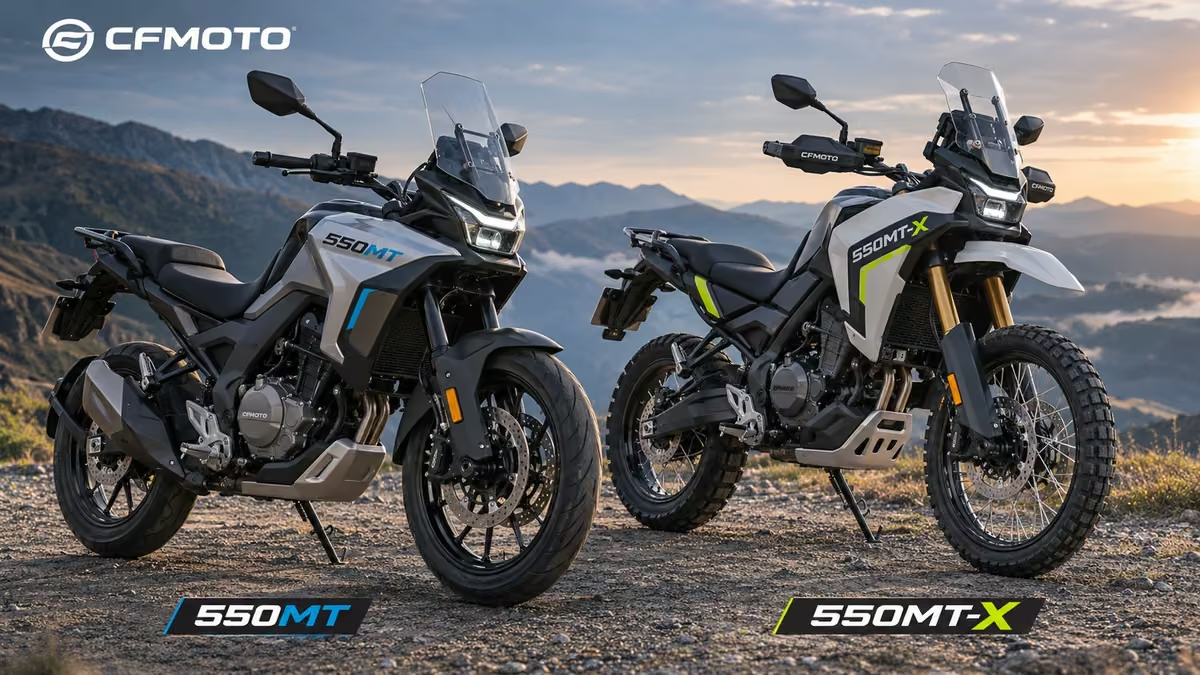
The standard 550MT features a 23-litre fuel tank, cruise control, a large 8-inch instrument display, and IMU-supported electronic safety systems. Meanwhile, the 550MT-X offers 21-inch front and 18-inch rear wheels, 230 mm of front suspension travel, 250 mm of ground clearance, and three riding modes.
These specifications make the new motorcycles particularly interesting for riders searching for an alternative to heavier adventure touring machines without moving into the smallest engine-displacement categories.
However, this is a first-look technical assessment, not an independent road test. CFMOTO identifies the specifications as development-phase information, meaning that some technical details, equipment packages, and production figures may change before the motorcycles reach dealerships.
2027 CFMOTO 550MT and 550MT-X: What’s New?
The most important development is CFMOTO’s decision to introduce two separate adventure motorcycle configurations around a common 526cc powertrain. Rather than offering one machine intended to perform equally well everywhere, the manufacturer has divided its priorities between road touring and more demanding off-road use.
This approach allows each motorcycle to adopt more appropriate wheels, suspension geometry, ergonomics, fuel capacity, and electronic equipment. The result is a pair of motorcycles with shared mechanical foundations but noticeably different riding purposes.
CFMOTO’s New Middleweight Adventure Motorcycle Platform
The 550MT and 550MT-X introduce a new displacement category within CFMOTO’s expanding adventure motorcycle portfolio.
The company already offers motorcycles such as the 450MT and larger models in its MT family. The new 526cc platform creates an additional choice for riders who want greater claimed engine performance without necessarily purchasing a significantly larger adventure motorcycle.
Both motorcycles share a parallel-twin powertrain and important transmission technology. However, their different chassis specifications illustrate how a common engine can support different applications.
The arrangement also gives CFMOTO opportunities to develop additional motorcycles using related mechanical components, although any future variants would require separate confirmation from the manufacturer.[2]
Two Adventure Motorcycles Designed for Different Riders
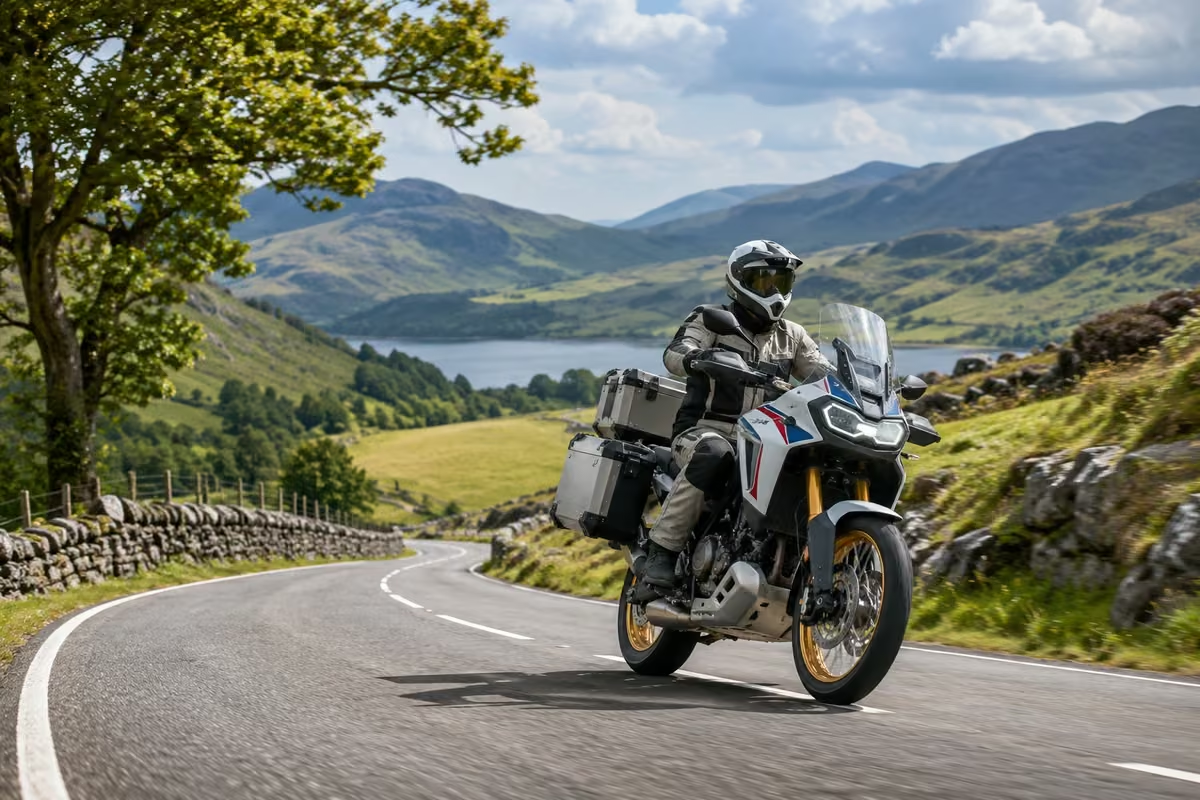
The standard 550MT is aimed primarily at riders spending most of their time on paved roads. Its larger fuel tank, touring-oriented wind protection, lower adjustable seat, and cruise control suit commuting, highway riding, and extended motorcycle journeys.
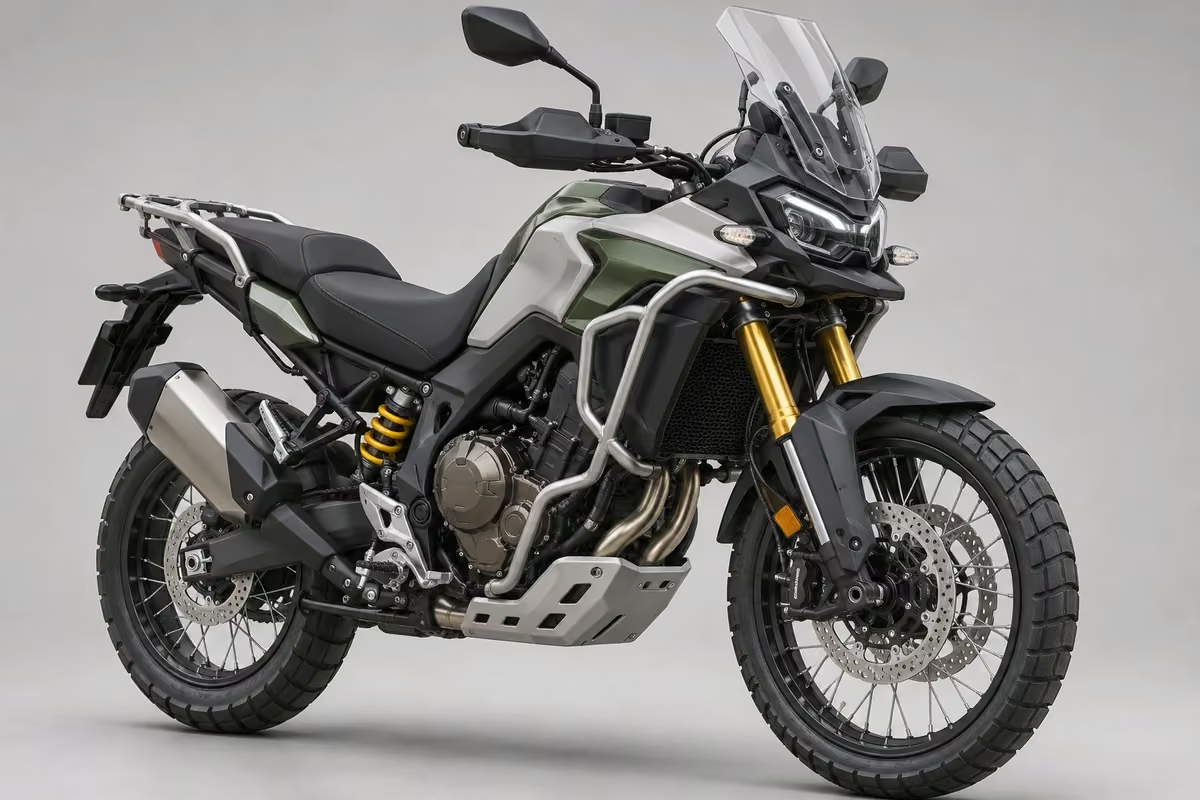
The 550MT-X takes a different approach. It combines taller suspension, larger off-road-oriented wheels, and a narrower body profile intended to improve rider movement when standing on the footpegs.
These distinctions matter because adventure motorcycles face competing demands. A motorcycle optimized for stable highway travel and passenger comfort may not offer the same maneuverability as one developed for technical trails.
Neither configuration is universally superior. Their respective advantages depend on the surfaces and riding conditions a buyer encounters most frequently.
EICMA 2026 Unveiling and First Impressions
CFMOTO formally introduced the motorcycles during EICMA 2026, with the announcement published by CFMOTO Ireland on November 4, 2026.
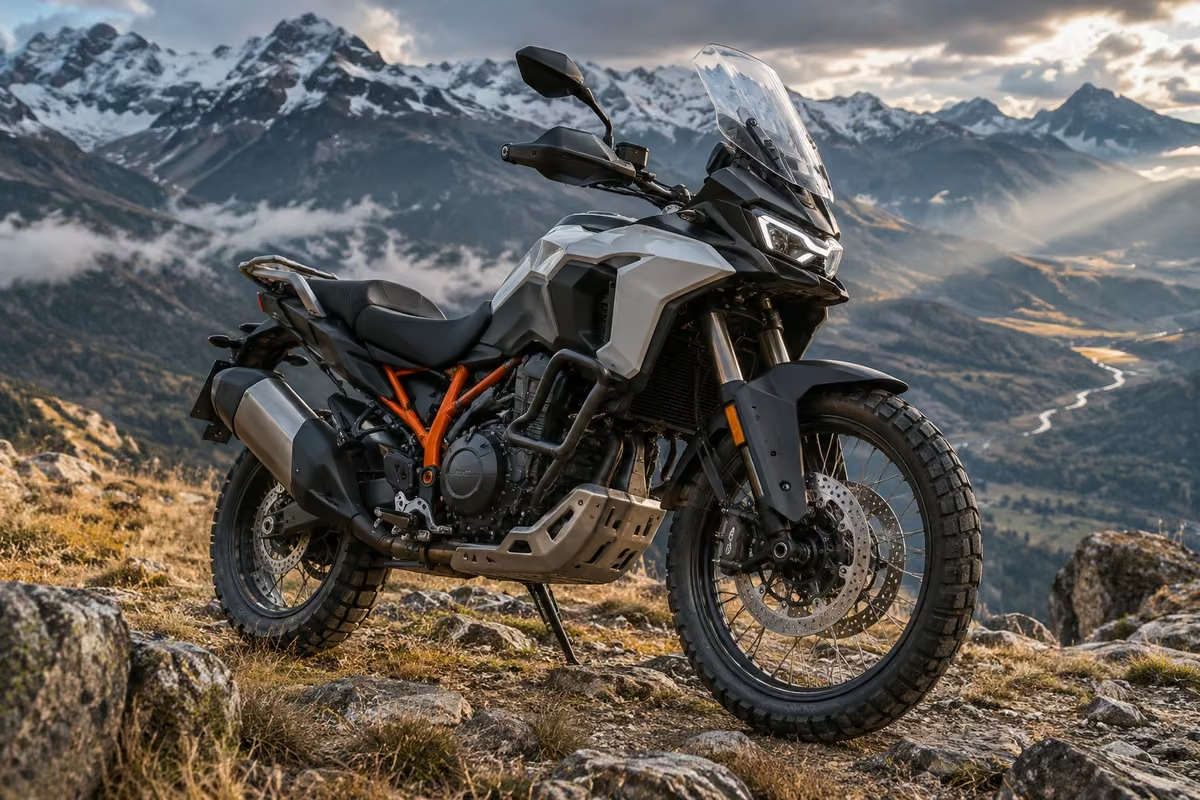
The touring model displayed more substantial bodywork, emphasizing wind protection and luggage-carrying applications. The 550MT-X adopted a slimmer, rally-inspired front end, with a taller riding stance and more off-road-oriented chassis.
CFMOTO also highlighted fully adjustable KYB suspension, electronic rider assistance, and new cockpit technology.
The launch demonstrated a clear separation between the two versions. Nevertheless, displayed motorcycles were development examples, and some pictured accessories may not be included with production models.[1]
Engine and Performance: 526cc Parallel-Twin With 54 Horsepower
Both new adventure motorcycles use the same 526cc two-cylinder engine, providing a common mechanical foundation despite their different chassis configurations.
CFMOTO’s published output figures suggest a useful increase in maximum power and torque over certain existing 450MT versions. However, engine output alone cannot establish real-world acceleration, cruising refinement, or hill-climbing ability. Vehicle weight, gearing, aerodynamic resistance, load, and traction also influence performance.
The first-look figures are promising, but road testing will be necessary to determine how effectively the new engine performs under different conditions.
Shared 526cc Parallel-Twin Engine
The 550MT and 550MT-X use a liquid-cooled parallel-twin engine with a displacement of 526cc.
According to the EICMA organizer’s technical introduction, the engine incorporates a 270-degree crankshaft configuration. This arrangement produces uneven firing intervals and a character often associated with certain V-twin engines.[2]
Parallel-twin construction is particularly common in middleweight adventure motorcycles because it can provide a useful balance of compact packaging, manageable mass, and broad performance.
The additional displacement compared with the 450MT gives CFMOTO the opportunity to improve torque delivery and higher-speed flexibility.
However, peak output figures do not reveal the complete torque curve. Determining whether the engine feels substantially stronger at low and medium speeds will require independent testing.
54 Horsepower at 8,500 RPM
CFMOTO specifies a maximum output of 40 kW, approximately 54 hp, at 8,500 rpm for both motorcycles.
This gives the two models identical advertised peak engine power, but it does not guarantee identical acceleration or maximum speed. Their wheel dimensions, transmission gearing, operating weight, aerodynamic profiles, and tire selections may influence how that power reaches the road.
For touring riders, the additional output may provide greater flexibility when overtaking or traveling with luggage. Off-road riders may appreciate stronger acceleration on open trails.
These are reasonable expectations based on the specifications rather than verified performance conclusions. CFMOTO has not supplied independently tested acceleration figures for the production models.[1]
52 Nm of Torque at 6,000 RPM
The new parallel-twin engine produces a claimed maximum torque of 52 Nm at 6,000 rpm.
Torque is especially relevant to adventure motorcycles because it contributes to the engine’s ability to accelerate under load and maintain speed when climbing gradients.
However, peak torque represents only one point in the engine’s operating range. Riders also need to consider how much torque is available below that speed and how the transmission converts engine output into torque at the rear wheel.
A broad, predictable delivery can be more useful than a narrow peak when negotiating uneven terrain or traveling with a passenger.
Whether the new CFMOTO engine delivers that character remains a question for road testing.
Bi-Directional Quickshifter on Both Models
Both motorcycles come with a bi-directional quickshifter designed to facilitate gear changes without manually operating the clutch lever during suitable riding conditions.
An upshift quickshifter momentarily manages engine torque to reduce the load on transmission components. During downshifts, the system can coordinate engine speed with the lower gear to improve shift smoothness.
This technology can reduce the effort involved in frequent gear changes, particularly on winding roads or when navigating changing gradients.
However, a quickshifter is not the same as an automatic transmission or an electronic clutch. A conventional clutch may still be required when starting, stopping, or performing low-speed maneuvers, depending on the motorcycle’s equipment.
Optional Electronic Clutch System on the 550MT
CFMOTO has announced an optional electronic-clutch version of the road-focused 550MT.
The system is intended to reduce the need for manual clutch operation, particularly during starting, stopping, and urban riding. This could make the motorcycle more convenient in heavy traffic, where repeated clutch use can become tiring.
Unlike a conventional quickshifter, an electronic clutch can assist with engagement and disengagement rather than only facilitating gear changes while moving.
Independent technical coverage describes a system that retains conventional manual control while offering assisted operation.[4]
However, exact production functionality, operating conditions, availability, and regional equipment packages should be confirmed through the final owner’s manual and official market specifications.
2027 CFMOTO 550MT: Built for Long-Distance Touring
The standard 550MT is designed for riders who value road-going comfort and practical touring features more than maximum off-road suspension travel.
Its key advantages include a comparatively large fuel tank, lower seat settings, electronic cruise control, and substantial wind-protective bodywork.
These features are especially relevant to riders covering long distances between cities or traveling with luggage. Nevertheless, touring comfort also depends on seat construction, handlebar position, windscreen performance, and vibration levels, which cannot be fully evaluated from a specification sheet.
Adventure Touring Motorcycle Design and Road-Focused Ergonomics
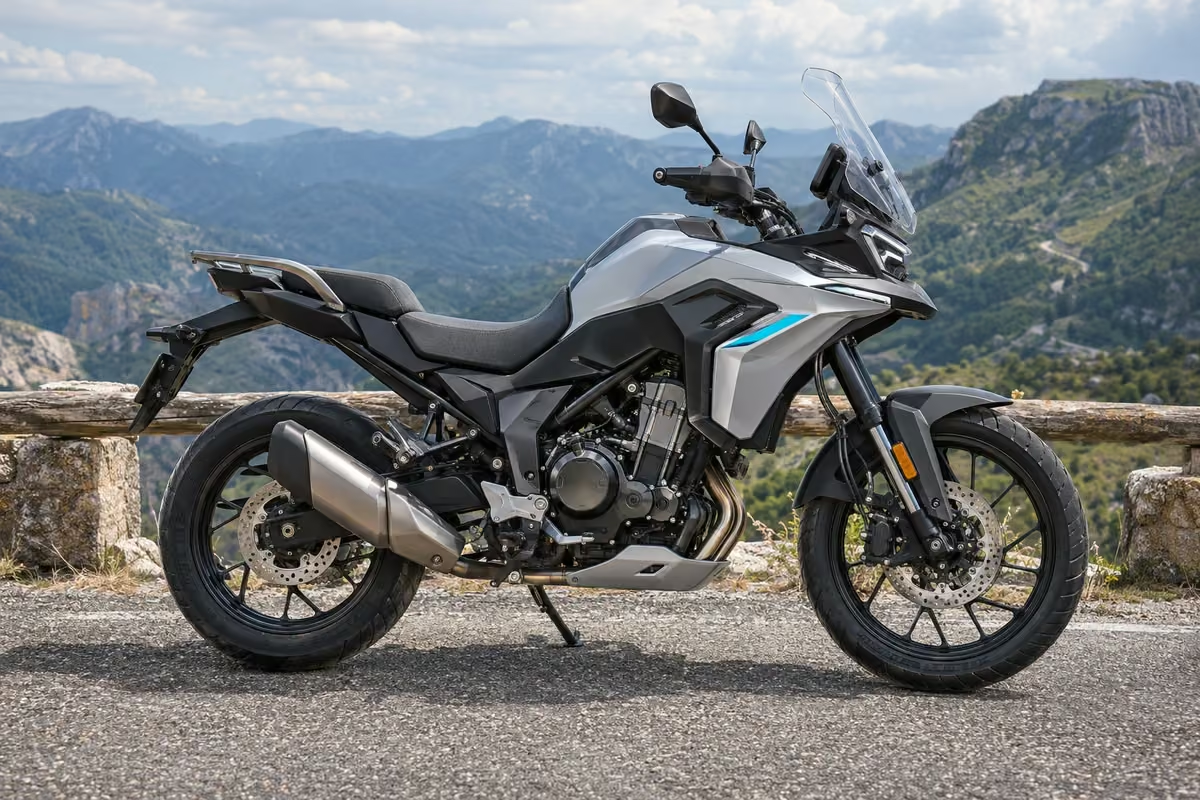
The 550MT adopts substantial front bodywork and a touring-style windscreen intended to reduce wind exposure during longer journeys.
Its upright riding position is consistent with the ergonomics commonly found on adventure touring motorcycles. This arrangement can provide a useful balance between forward visibility, low-speed control, and comfort during extended periods in the saddle.
The motorcycle is also positioned for everyday commuting and weekend travel.
However, a comfortable riding posture depends on individual body dimensions. Handlebar reach, knee angle, seat shape, and footpeg placement can substantially influence fatigue.
Passenger accommodation and long-distance comfort remain important areas for independent testing before the motorcycle can be confidently evaluated as a two-up tourer.
23-Litre Fuel Tank for Extended Touring
One of the 550MT’s most significant touring features is its announced 23-litre fuel tank.
This is seven litres larger than the 16-litre tank specified for the 550MT-X, giving the road-oriented model a substantial advantage in total fuel capacity.
A larger tank can be particularly useful when crossing remote areas or traveling through regions where fuel stations are widely separated.
However, fuel capacity does not establish actual riding range. Consumption changes with road speed, wind resistance, terrain, luggage, passenger weight, and engine operating conditions.
Until reliable fuel-consumption results are available, any precise maximum-range estimate would be speculative.[1]
19-Inch Front Wheel and 17-Inch Rear Wheel
The standard 550MT uses a 19-inch front wheel and a 17-inch rear wheel, a configuration frequently associated with road-oriented adventure touring motorcycles.
Compared with the 550MT-X’s 21-inch front wheel, the smaller front diameter is consistent with a stronger emphasis on paved-road steering and touring tire applications.
The 17-inch rear wheel also provides access to a broad range of road-focused and mixed-surface tire designs, subject to the motorcycle’s approved dimensions.
Wheel diameter alone does not determine handling. Tire construction, steering geometry, suspension tuning, and weight distribution also matter.
The 550MT remains an adventure motorcycle, but its specifications suggest that paved roads are its primary environment.
Adjustable Seat Height: 800 to 820 mm
CFMOTO specifies two seat-height settings for the 550MT: 800 mm and 820 mm.
The lower position may make the motorcycle more accessible to riders who prefer easier ground reach at traffic lights, parking areas, and low-speed stops.
Nevertheless, seat height is only one component of motorcycle fit.
A wide seat can make it difficult to reach the ground even when its published height appears relatively low. Suspension sag, boot thickness, rider inseam, and seat shape also affect real-world accessibility.
Prospective buyers should sit on a properly adjusted motorcycle and evaluate both seated ergonomics and stability at a stop before purchasing.
Cruise Control and Highway Riding Comfort
Cruise control is one of the standard 550MT’s most notable touring-oriented technologies.
The system is designed to maintain a selected road speed without continuous manual throttle input, reducing repetitive wrist movement on suitable highway sections.
When combined with the motorcycle’s larger fuel tank and wind-protective bodywork, cruise control supports the model’s emphasis on longer journeys.
However, conventional motorcycle cruise control is most appropriate on roads with predictable traffic and consistent conditions.
It should not be confused with adaptive cruise control unless the manufacturer explicitly confirms that functionality. Riders must still manage speed, braking, road hazards, and surrounding vehicles.
2027 CFMOTO 550MT-X: Rally-Inspired Off-Road Adventure Motorcycle
The 550MT-X is the more off-road-oriented member of the new 550 family.
Its principal differences include a 21-inch front wheel, an 18-inch rear wheel, substantial suspension travel, higher ground clearance, and a narrower body design intended to improve movement during standing operation.
These choices prioritize the requirements of rough terrain rather than focusing exclusively on highway comfort.
The 550MT-X also introduces configurable electronic assistance, allowing riders to adapt selected systems for loose surfaces.
Rally-Inspired Design and Off-Road Performance
CFMOTO has designed the 550MT-X with a narrow central profile and a front-end appearance influenced by rally motorcycles.
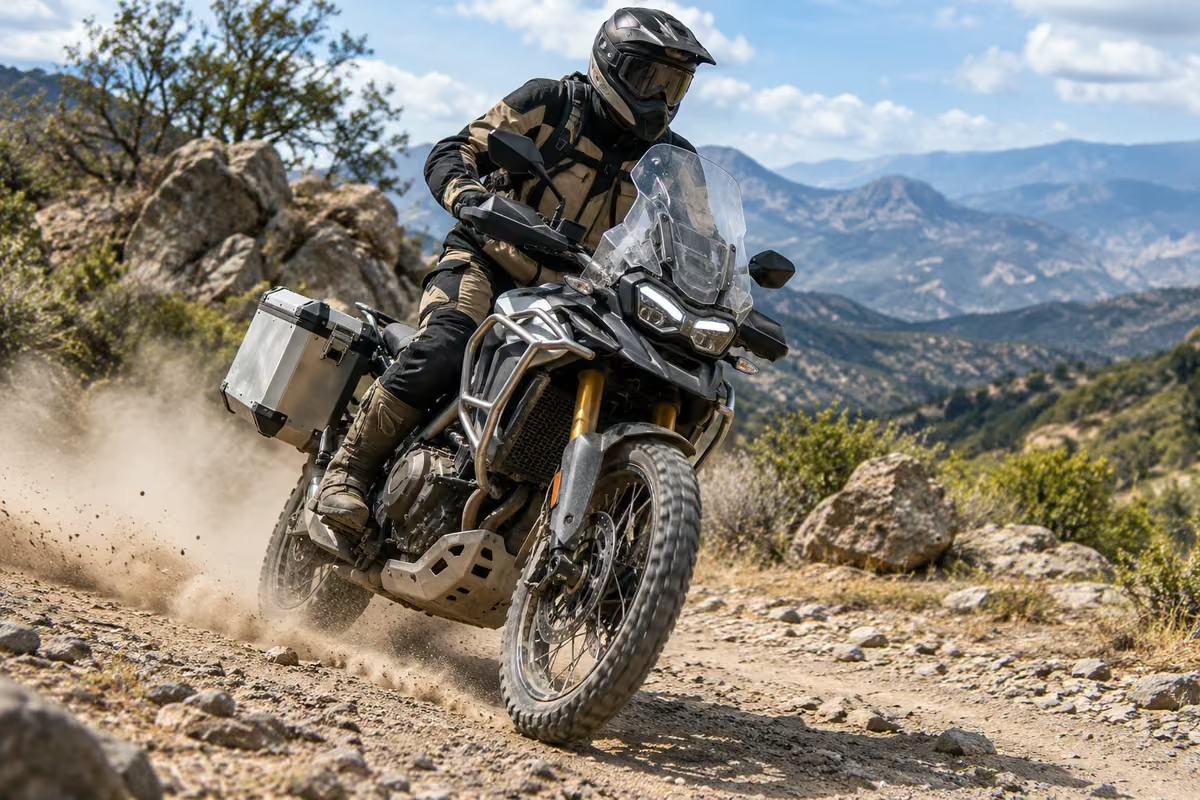
This approach is intended to support rider mobility and standing control when navigating uneven terrain.
Standing on the footpegs can help riders absorb surface irregularities through their legs and adjust body position without transferring every movement directly through the seat.
A narrower tank and seat junction may also make it easier to shift weight forward or rearward when required.
However, rally-inspired styling is not evidence of competition-level performance. Actual off-road capability depends on suspension calibration, traction, gearing, protection, and the rider’s ability to control the motorcycle under difficult conditions.
21-Inch Front Wheel and 18-Inch Rear Wheel
The 550MT-X uses a 21-inch front wheel and an 18-inch rear wheel, a common configuration among off-road-focused adventure motorcycles.
A larger front wheel can negotiate certain obstacles more easily because its rolling geometry reduces the severity of the wheel’s initial contact with an obstacle.
The 18-inch rear wheel also supports tire sizes and construction types commonly used for off-road applications.
Compared with the standard 550MT’s 19/17-inch arrangement, the 21/18-inch configuration emphasizes rough-surface capability.
However, larger wheels do not automatically guarantee better traction. Tire compound, tread design, inflation pressure, and rider technique remain essential factors.
Fully Adjustable KYB Suspension
CFMOTO specifies fully adjustable KYB suspension for the 550MT-X, allowing the motorcycle’s suspension behavior to be adapted to different riding requirements.
Suspension adjustment generally involves controlling spring preload and damping characteristics.
Preload influences suspension sag under the combined weight of the motorcycle, rider, and luggage. Compression damping controls resistance as suspension components compress, while rebound damping influences how quickly they extend afterward.
Appropriate setup can help maintain wheel contact over uneven ground and improve stability.
However, adjustment ranges and recommended settings should be obtained from the production owner’s manual. Incorrect damping or preload adjustments can compromise traction and handling.
230 mm Front and 220 mm Rear Suspension Travel
The 550MT-X provides a claimed 230 mm of front suspension travel and 220 mm at the rear.
These dimensions are significant for a middleweight adventure motorcycle because they allow substantial wheel movement when crossing bumps, depressions, and uneven trails.
Longer suspension travel can help the wheels follow irregular terrain while reducing the likelihood of the suspension reaching the end of its movement.
However, suspension travel alone does not determine ride quality.
Spring rates, damping calibration, chassis balance, operating load, and rider speed affect the suspension’s performance. Long-travel suspension can also influence braking pitch, seat height, and the motorcycle’s response during aggressive paved-road riding.
250 mm Ground Clearance
Ground clearance measures the distance between the ground and the motorcycle’s lowest relevant underside component under a specified measurement condition.
CFMOTO announces 250 mm of ground clearance for the 550MT-X, supporting its intended use on rocky tracks and uneven surfaces.
Greater clearance can reduce the likelihood of the motorcycle contacting obstacles when crossing ruts, embedded rocks, or elevated trail sections.
Nevertheless, clearance is not a substitute for protection equipment or appropriate riding technique.
Suspension compression, added luggage, and rider weight can reduce effective clearance while riding. A properly fitted engine guard or skid plate can help protect vulnerable components, but accessory fitment must be confirmed for the production motorcycle.
172 kg Dry Weight and Reported 183 kg Ready-to-Ride Weight
CFMOTO officially lists the 550MT-X at 172 kg dry weight.
Independent motorcycle publications, including Bennetts BikeSocial and 1000PS, also report approximately 183 kg as a wet or ready-to-ride figure. However, the CFMOTO Ireland specification sheet does not provide a corresponding ready-to-ride weight or define the reporting standard used for that secondary figure.[1][4][5]
Dry weight generally excludes certain operating fluids, while ready-to-ride weight includes specified operating fluids and fuel according to the relevant measurement convention.
These measurements should not be compared directly.
For off-road riders, vehicle mass matters because it affects lifting effort, balance recovery, and low-speed maneuverability. Final production weight and measurement definitions are necessary before making definitive weight comparisons.
16-Litre Fuel Tank for Off-Road Adventures
The 550MT-X carries a 16-litre fuel tank, seven litres less than the standard 550MT.
The reduced capacity reflects a different design priority. The narrower layout is consistent with the off-road model’s emphasis on compact packaging and rider movement.
A smaller fuel tank can also reduce the total mass of fuel carried when full, although it does not automatically prove that the complete motorcycle is lighter.
The trade-off is reduced fuel storage for remote journeys.
Riders planning long-distance off-road travel should calculate fuel requirements using actual consumption figures, account for route difficulty, and identify reliable refueling locations.
Suspension, Brakes, and Tyres: How the Two Models Handle Different Terrain
Although the 550MT and 550MT-X share an engine family, their chassis configurations are developed for different operating conditions.
The road-oriented motorcycle prioritizes predictable paved-road behavior and touring stability, while the off-road version provides greater suspension movement and more suitable wheel dimensions for rough terrain.
Their braking and tire equipment must also accommodate different traction conditions.
Evaluating these systems requires considering how suspension, brakes, tires, and electronics work together rather than treating any individual specification as a complete measure of performance.
KYB Suspension Tuning for Road and Dirt
Both motorcycles have fully adjustable KYB suspension, but their different applications call for different setup priorities.
For road touring, suspension settings should account for stable steering, braking control, passenger weight, and luggage.
Off-road riding places greater emphasis on maintaining traction across irregular ground and allowing the suspension to absorb larger obstacles.
Correct suspension sag is essential in both cases because it influences available suspension movement and steering geometry.
The 550MT-X’s confirmed long-travel setup provides greater movement than many road-oriented adventure configurations.
However, CFMOTO has not yet supplied all final suspension dimensions for the standard 550MT, preventing a complete numerical comparison.
J.Juan Braking System on the 550MT-X
CFMOTO specifies J.Juan braking components for the off-road-oriented 550MT-X.
The braking system must provide sufficient stopping force while allowing the rider to control deceleration on surfaces where available traction can change rapidly.
On pavement, strong tire grip generally permits more aggressive braking before the wheels approach their traction limits.
Loose gravel, sand, and mud introduce different challenges because wheel slip can occur at much lower braking forces.
Brake modulation, electronic intervention, and tire selection therefore become particularly important.
Independent testing will be required to evaluate lever feel, resistance to fade, and controllability under demanding riding conditions.
320 mm Front Brake Disc
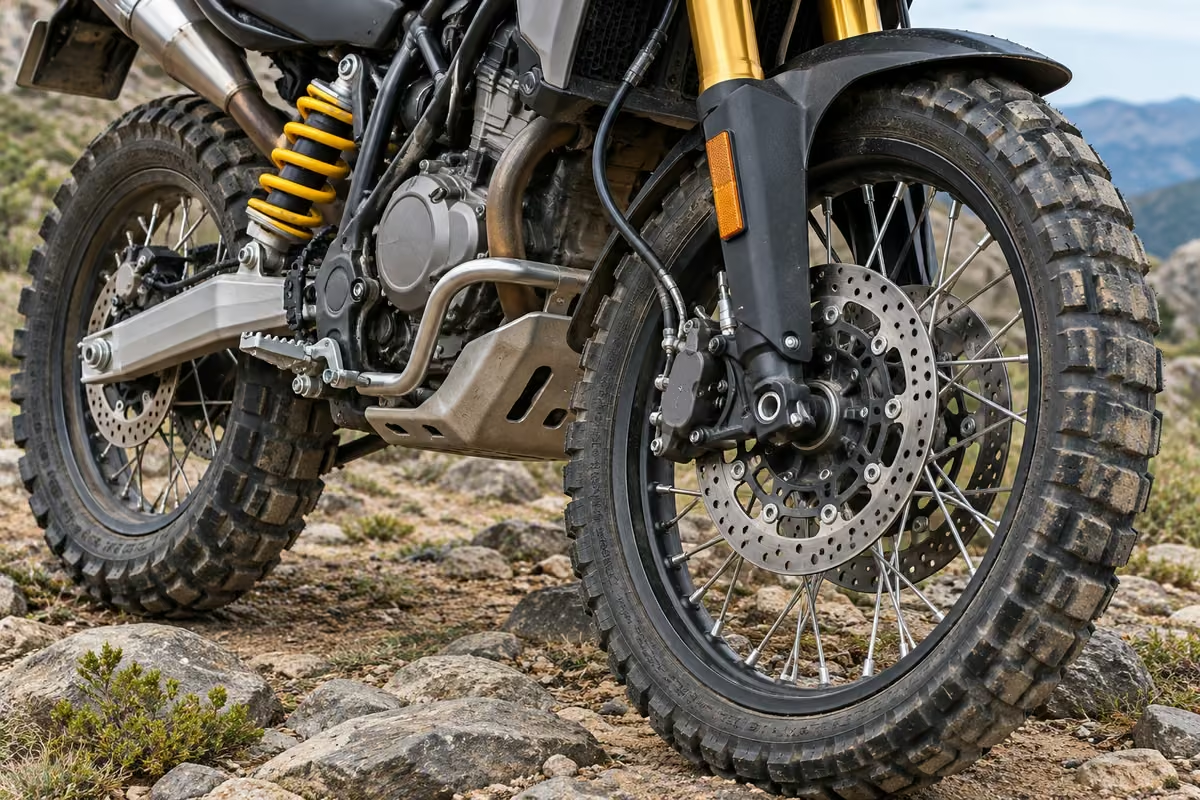
The announced front brake rotor diameter for the 550MT-X is 320 mm.
Independent technical reporting identifies a single front disc with a four-piston J.Juan caliper on the off-road version. By comparison, the road-focused 550MT has been reported with a dual-disc front arrangement, although final market-specific specifications should still be checked.[4]
A larger rotor can increase braking leverage and provide additional surface area for managing heat.
However, rotor diameter does not independently determine stopping distance.
Caliper design, brake-pad materials, hydraulic pressure, tire grip, vehicle load, and road conditions all influence the resulting braking performance.
240 mm Rear Brake Disc
The 550MT-X is equipped with a 240 mm rear brake disc according to CFMOTO’s published specifications.
Rear braking is particularly relevant during low-speed maneuvering and off-road riding, where the rider may use rear-brake input to manage speed and chassis behavior.
The amount of braking force available at the rear wheel varies as load transfers forward during deceleration.
On loose surfaces, excessive rear braking can cause the wheel to lock if electronic assistance is disabled.
The 550MT-X’s configurable ABS system therefore offers additional flexibility, but riders must understand the chosen settings and adapt their technique accordingly.
CST Adventure Tyres and Terrain Versatility
CFMOTO identifies CST as the tire supplier for the 550MT-X.
Adventure tires must balance conflicting demands, including pavement stability, wet-weather grip, tread durability, and traction on loose ground.
A tire with a more aggressive tread may offer advantages in certain off-road conditions while behaving differently from a road-focused tire during high-speed pavement use.
Tire construction and inflation pressure are also important.
Owners should follow the motorcycle and tire manufacturers’ recommendations for approved tire dimensions, load ratings, speed ratings, and operating pressures.
The exact production tire specification and real-world performance should be confirmed when the motorcycle becomes available.
Electronic Safety and Rider Assistance Systems
Electronic rider assistance is an important part of the distinction between the 550MT and 550MT-X.
The touring model emphasizes lean-sensitive braking and traction management, while the off-road model provides rider-selectable assistance intended to accommodate different terrain conditions.
These systems can support motorcycle control, but their effectiveness depends on calibration, tire grip, and the situation encountered.
Electronic assistance cannot overcome the physical limits of traction or replace appropriate riding technique.
Cornering ABS on the 550MT
The standard 550MT features a Bosch-based cornering ABS system supported by an inertial measurement unit.
Unlike conventional ABS, which primarily regulates wheel slip under braking, lean-sensitive systems can use additional motorcycle-motion information to adjust braking intervention.
This is particularly relevant when braking while the motorcycle is leaned into a corner, because the tires must accommodate both cornering and braking forces.
However, cornering ABS does not guarantee that a motorcycle will remain stable under every circumstance.
Sudden steering inputs, extremely low-friction surfaces, and excessive entry speed can still exceed available grip.
Riders should treat the technology as supplementary protection rather than permission to brake aggressively in unsuitable conditions.
Inertial Measurement Unit (IMU)
An inertial measurement unit uses motion sensors to provide information about motorcycle movement and orientation.
Depending on system design, this information can include angular movement and acceleration along multiple axes.
Electronic control systems use these measurements alongside wheel-speed and other sensor data to estimate riding conditions.
On the 550MT, the IMU supports the announced cornering ABS and traction-control functions.
This allows electronic intervention to account for more than wheel rotation alone.
The benefit depends on how effectively the motorcycle’s software interprets sensor information and regulates braking or engine torque. Those calibration details cannot be established solely from the launch specifications.
Traction Control System (TCS)
Traction control is designed to limit excessive driven-wheel slip during acceleration.
Motorcycle systems commonly compare wheel-speed information and other operating parameters to detect conditions that may indicate loss of traction.
When necessary, the system can reduce delivered engine torque to help the rear tire regain an appropriate level of grip.
The 550MT includes traction control within its touring-oriented electronic package, while the 550MT-X provides switchable traction-control functionality.
This distinction matters because controlled rear-wheel slip can sometimes be useful during off-road riding.
However, disabling assistance increases the responsibility placed on the rider, particularly when conditions are unpredictable.
Switchable ABS on the 550MT-X
The 550MT-X features switchable ABS intended to accommodate the different demands of off-road riding.
On some loose surfaces, a rider may prefer a degree of rear-wheel slip or locking behavior that conventional road ABS attempts to prevent.
Independent technical coverage indicates that the rear ABS can be disabled in the appropriate off-road setting.[5]
This can provide experienced riders with additional control options when descending loose surfaces or negotiating technical terrain.
However, the exact production settings and any restrictions affecting front-wheel ABS must be confirmed in the final operating documentation.
On public roads, retaining the appropriate safety systems is generally the more prudent choice.
Three Riding Modes and Ride-by-Wire Throttle
The 550MT-X includes ride-by-wire throttle control and three selectable riding modes.
Ride-by-wire technology replaces a purely mechanical throttle linkage with electronic sensors and control logic that regulate throttle operation.
This architecture allows manufacturers to configure throttle response and potentially coordinate it with other electronic systems.
Different modes may be useful when transitioning between pavement, gravel, and more demanding surfaces.
However, selecting a riding mode does not necessarily change the engine’s maximum available horsepower.
Until CFMOTO publishes the final mode descriptions, the exact throttle maps and relationships between the three modes and electronic assistance should not be assumed.
Displays, Connectivity, and Smart Motorcycle Technology
The two motorcycles also differ substantially in their instrument interfaces.
CFMOTO has given the 550MT a larger landscape-oriented display intended to support touring information and connected services, while the 550MT-X receives a smaller vertical screen suited to its rally-inspired cockpit.
Both systems reflect the increasing integration of digital technology into middleweight motorcycles.
However, screen size alone does not determine usability. Display brightness, menu design, glove-friendly controls, and reliable smartphone connections are equally important.
8-Inch MMI 2.0 Display on the 550MT
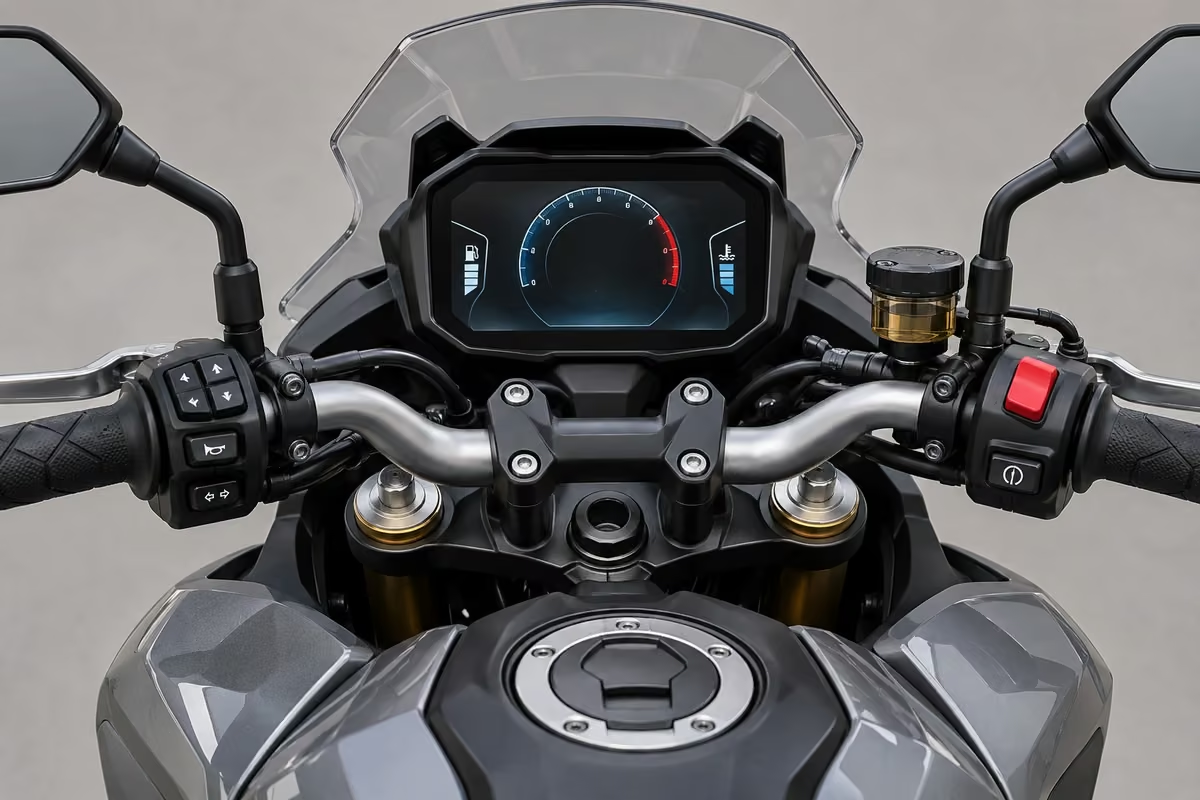
The 550MT features an 8-inch MMI 2.0 digital instrument display.
Its landscape orientation provides substantial screen space for presenting riding information and connected functions.
A larger display can make navigation instructions and important vehicle data easier to identify, provided the interface presents information clearly.
It may also support more complex menus without requiring excessively small text or icons.
However, the practical value of a motorcycle display depends on visibility in direct sunlight, response time, interface layout, and the ability to operate essential functions without distraction.
These characteristics require evaluation on the production motorcycle.
Apple CarPlay Integration
CFMOTO confirms Apple CarPlay support for the 550MT’s MMI 2.0 system.
CarPlay can provide access to compatible smartphone functions through an adapted vehicle interface, potentially improving convenience when using navigation or supported communication services.
However, motorcycle integration may differ from the familiar implementation in passenger cars.
Compatibility can depend on the phone, software version, connection method, and regional service availability.
CFMOTO has not yet detailed every supported application or connection requirement for all markets.
Riders should also avoid interacting with complex menus while moving. Navigation information is useful only when it can be accessed without compromising attention to the road.
Rear Detection System (RDS)
The standard 550MT includes a Rear Detection System, commonly abbreviated as RDS.
The system is intended to improve awareness of traffic approaching or occupying areas behind the motorcycle.
Rearward monitoring can be especially relevant during highway riding, where traffic may approach quickly and surrounding vehicles can enter blind-spot areas.
However, the launch information does not establish every detail of the system’s sensor arrangement, warning interface, or operating limits.
It should not be assumed to provide automatic braking, steering correction, or autonomous collision avoidance.
Riders must continue using mirrors, direct observations, and appropriate lane-changing procedures.
Smart Key System With Bluetooth and NFC
CFMOTO has announced smart-key functionality for the 550MT, including Bluetooth auto-sensing and NFC technology.
Bluetooth can support proximity-based recognition, while NFC provides short-range communication for compatible authentication applications.
Depending on the final system configuration, these technologies can reduce the inconvenience of using a conventional physical key.
However, smart-key convenience also introduces practical considerations.
Owners should understand the system’s response to a depleted key battery, smartphone failure, or electronic authentication problem.
Final documentation should clarify emergency starting procedures, backup access, and supported devices.
These functions should not be confused with guaranteed protection against motorcycle theft.
6.2-Inch Vertical Display on the 550MT-X
The 550MT-X uses a vertically oriented 6.2-inch digital instrument display.
Its portrait layout is consistent with the model’s rally-inspired cockpit design, where navigation information may be presented in a format resembling a vertical route display.
This arrangement can provide a different information hierarchy from the horizontal 8-inch screen used by the touring model.
However, portrait orientation does not automatically mean that the motorcycle includes dedicated rally navigation software.
The actual capabilities will depend on the production interface, connected applications, and any supported accessories.
Visibility and ease of operation while standing should also be evaluated during off-road testing.
MotoPlay Connectivity on the 550MT-X
CFMOTO identifies MotoPlay connectivity as part of the 550MT-X’s digital equipment.
The system is intended to integrate compatible smartphone functionality with the motorcycle’s instrument display.
Navigation-related functions may be especially useful during adventure travel, where riders must follow unfamiliar routes while monitoring vehicle information.
However, supported applications and connection methods can vary between products and regions.
MotoPlay should not automatically be treated as identical to Apple CarPlay, Android Auto, or dedicated offline navigation systems.
Buyers should verify compatibility with their smartphone and preferred navigation applications before relying on the system for remote journeys.
Ergonomics and Rider Comfort Comparison
The 550MT and 550MT-X adopt different ergonomic priorities because their intended environments demand different rider movements.
The touring model places greater emphasis on seated comfort, convenient ground reach, and wind protection.
The off-road model emphasizes standing control, body movement, and clearance over uneven surfaces.
Neither arrangement can be judged solely from seat-height figures.
A proper ergonomic comparison must consider rider height, inseam, body proportions, handlebar reach, footpeg placement, and the relationship between the seat and fuel tank.
Adjustable Seat Height Across Both Models
Both motorcycles provide adjustable seat-height configurations, although their operating ranges differ.
Seat height influences a rider’s ability to reach the ground while stopping, balancing, or maneuvering at low speeds.
However, adventure motorcycles also require appropriate riding geometry when standing on the footpegs.
A seat that feels low and accessible during urban riding may not necessarily correspond to the most suitable position for technical off-road control.
Suspension sag and seat width also change how a motorcycle feels in practice.
Riders should evaluate seated comfort, ground reach, and standing ergonomics rather than selecting a motorcycle solely from published seat measurements.
550MT Seat Height: 800 to 820 mm
The standard 550MT offers seat-height settings of 800 mm and 820 mm.
These figures make it the lower of the two newly announced models, at least according to their published seat-height specifications.
The difference may be meaningful for riders who frequently stop in traffic or maneuver motorcycles in restricted parking areas.
A more accessible seat can help improve confidence during everyday riding.
However, a rider with a shorter inseam may still find a wide motorcycle difficult to support.
A proper fit assessment should include suspension sag, the motorcycle’s actual seat profile, and the rider’s ability to move the machine while seated.
550MT-X Seat Height: 830 to 850 mm
CFMOTO lists the 550MT-X with an 850 mm seat setting that can be adjusted down to 830 mm.
This higher arrangement is consistent with the motorcycle’s longer suspension travel and 250 mm ground clearance.
The additional height may provide appropriate space for suspension movement and support the intended off-road geometry.
However, taller seats can present challenges when stopping on uneven ground, where one foot may need to reach a lower surface than the other.
Riders should consider how confidently they can stabilize the motorcycle during slow maneuvers.
The ability to touch the ground with both feet simultaneously is not the only indicator of suitable fit or safe operation.
Touring Comfort vs. Off-Road Control
The two motorcycles illustrate the ergonomic compromise between seated touring and active off-road riding.
The 550MT’s more extensive front bodywork and touring-oriented cockpit aim to reduce exposure to wind and make extended journeys less tiring.
The 550MT-X’s slimmer profile is intended to allow greater movement when standing and adjusting body position.
These design differences can become important after several hours of riding.
However, wind protection, seat pressure, handlebar vibration, and knee comfort remain untested.
A rider who frequently travels long highway distances may prefer the 550MT, while someone who regularly navigates technical trails may benefit more from the 550MT-X’s layout.
CFMOTO 550MT vs. 550MT-X: Full Specification Comparison
The following comparison combines confirmed manufacturer announcements with clearly identified provisional figures and independently reported information.
CFMOTO states that the motorcycles are still represented by development-phase specifications, so certain values may change before production.
The most important distinctions concern chassis dimensions, fuel storage, seat height, and electronic equipment rather than engine performance.
The two motorcycles share identical advertised peak power and torque, but their different configurations mean they should not be expected to behave identically on the road or trail.
Side-by-Side Technical Specifications
The table below summarizes the principal specifications announced as of November 13, 2026. Most figures come from CFMOTO’s official introduction, while the standard model’s provisional kerb weight is reported by EICMA and the X model’s wet weight appears in independent technical coverage.
These measurement differences matter because comparing dry and kerb weights directly can produce misleading conclusions about maneuverability and actual riding mass.[1][2][4]
| Specification | 2027 CFMOTO 550MT | 2027 CFMOTO 550MT-X |
|---|---|---|
| Primary purpose | Road touring | Off-road adventure |
| Engine | 526cc parallel twin | 526cc parallel twin |
| Crankshaft configuration | 270 degrees | 270 degrees |
| Maximum power | 40 kW (54 hp) at 8,500 rpm | 40 kW (54 hp) at 8,500 rpm |
| Maximum torque | 52 Nm at 6,000 rpm | 52 Nm at 6,000 rpm |
| Front wheel | 19 inches | 21 inches |
| Rear wheel | 17 inches | 18 inches |
| Suspension manufacturer | KYB | KYB |
| Suspension adjustability | Fully adjustable | Fully adjustable |
| Front suspension travel | Not officially specified | 230 mm |
| Rear suspension travel | Not officially specified | 220 mm |
| Ground clearance | Not officially specified | 250 mm |
| Fuel capacity | 23 litres | 16 litres |
| Seat height | 800 to 820 mm | 830 to 850 mm |
| Dry weight | Not officially specified | 172 kg |
| Kerb or ready-to-ride weight | 207 kg reported by EICMA, provisional | Approximately 183 kg reported independently, provisional |
| Braking components | Final details vary by source | J.Juan |
| Front brake | Dual discs reported independently | 320 mm disc |
| Rear brake | 240 mm disc reported independently | 240 mm disc |
| Quickshifter | Bi-directional | Bi-directional |
| Electronic clutch | Optional version | Not confirmed |
| Cruise control | Announced | Not confirmed |
| ABS | IMU-based Bosch cornering ABS | Switchable ABS |
| Traction control | Announced | Switchable |
| Riding modes | Final configuration not established | Three |
| Ride-by-wire | Final configuration not established | Confirmed |
| Display | 8-inch MMI 2.0 | 6.2-inch vertical |
| Smartphone integration | Apple CarPlay | MotoPlay |
| Rear detection system | Announced | Not confirmed |
| Smart key | Bluetooth and NFC | Not confirmed |
| Official pricing | Not confirmed | Not confirmed |
Specification note: These are development-phase figures. The 207 kg figure for the 550MT is published by EICMA, while CFMOTO Ireland lists its dry weight as unconfirmed. The approximately 183 kg figure for the 550MT-X is reported by specialist publications, and its final production measurement standard needs verification.
Which Model Offers Better Road Touring Capability?
The standard 550MT has the stronger road-touring specification.
Its larger 23-litre fuel tank reduces the frequency of refueling stops under otherwise comparable consumption conditions.
The 19/17-inch wheel configuration, lower seat-height options, cruise control, and wind-protective bodywork also support long-distance paved-road travel.
Additionally, the 8-inch display, rear detection system, and optional electronic clutch may improve convenience during everyday use.
The 550MT-X remains suitable for highway travel, but its off-road-oriented chassis represents a different compromise.
Independent testing will be necessary to compare wind protection, vibration, passenger comfort, and actual fuel range.
Which Model Is Better for Off-Road Adventure?
The 550MT-X offers the stronger off-road-oriented specification.
Its 21-inch front wheel and 18-inch rear wheel provide a configuration commonly associated with more demanding unpaved riding.
Longer suspension travel and 250 mm of ground clearance offer additional mechanical capacity for negotiating rough terrain.
The slimmer profile and configurable electronic assistance further support its intended application.
However, these features do not prove that the 550MT-X will outperform every competitor on technical trails.
Real-world capability depends on tire grip, suspension calibration, gearing, vehicle balance, protection, and rider skill.
The specification advantage is clear, but a tested performance ranking is not yet possible.
Which CFMOTO 550MT Variant Should You Choose?
Choosing between the 550MT and 550MT-X should begin with an assessment of the terrain encountered most frequently.
Riders who spend most of their time commuting, touring, or traveling on paved roads have stronger reasons to consider the standard model.
Its larger fuel tank, lower seat, and comfort-oriented equipment directly support those activities.
Riders regularly exploring gravel tracks, rocky trails, or uneven rural roads may find the 550MT-X more suitable.
Other considerations include rider inseam, intended luggage weight, passenger use, availability of authorized service, and local purchase price.
These practical factors can matter more than small differences in headline specifications.
CFMOTO 550MT-X vs. 450MT: How Much Has Changed?
The 550MT-X is particularly interesting when compared with the existing 450MT because the two motorcycles share a broadly similar adventure-riding purpose.
CFMOTO has increased engine displacement and published a higher peak power figure while retaining the off-road-oriented 21/18-inch wheel arrangement.
The new motorcycle also offers additional suspension travel, ground clearance, and electronic features.
However, the magnitude of the power increase depends on which regional 450MT engine specification is used as the comparison baseline.
CFMOTO 450MT vs. 550MT Engine Performance
CFMOTO’s Australian specification for the 450MT lists a 449cc parallel-twin engine producing 32.5 kW at 8,500 rpm and 44 Nm at 6,250 rpm.
The new 550MT-X increases the announced displacement to 526cc, with output rising to 40 kW at 8,500 rpm and 52 Nm at 6,000 rpm.
This represents a meaningful increase in stated peak torque as well as power.
The additional output could improve highway flexibility and acceleration under load.
However, actual performance also depends on gearing, vehicle weight, and engine calibration.
The published specifications do not establish whether the 550MT-X will feel consistently stronger throughout the complete engine-speed range.[1][6]
Approximately 30% Power Increase: Understanding the Claim
CFMOTO describes the 550MT-X as producing approximately 30% more power than the 450MT.
That statement is consistent with comparing 40 kW against a 31 kW version of the 450MT, which yields an increase of approximately 29%.
However, CFMOTO Australia’s published 450MT specification lists 32.5 kW. Comparing that figure with 40 kW produces an increase of approximately 23%.[3][6]
The distinction is important because 450MT output specifications vary across markets.
The manufacturer’s approximately 30% claim should therefore be understood in the context of the specific 450MT version used as its reference.
In either case, the new model offers higher published maximum power, but that does not automatically translate into an equivalent improvement in acceleration.
Suspension, Weight, and Off-Road Geometry Changes
CFMOTO’s published 450MT specification lists 200 mm of suspension travel at both ends and 220 mm of ground clearance.
The 550MT-X increases front travel to 230 mm, rear travel to 220 mm, and ground clearance to 250 mm.
These changes are particularly relevant to riders navigating larger obstacles or uneven terrain.
CFMOTO also states that the new model’s 172 kg dry weight is three kilograms below the 450MT’s 175 kg dry figure.
However, the comparison is based on the manufacturer’s stated dry-weight measurements, not independently verified fully fueled weights.
Changes in suspension geometry, tire selection, and actual vehicle mass will influence how the motorcycles behave in practice.
Does the 550MT-X Replace the 450MT?
CFMOTO has presented the new 550 models as additions to its adventure motorcycle range.
That does not establish a universal plan to discontinue the 450MT.
Independent reporting also indicates that the manufacturer has described the new motorcycles as range expansions rather than direct replacements.[4]
The models may appeal to overlapping groups of buyers, particularly riders seeking relatively manageable adventure motorcycles with off-road capability.
However, final pricing, regional availability, licensing requirements, and product positioning will determine how closely they compete.
Until the manufacturer announces market-specific decisions, claims that the 550MT-X is replacing the 450MT should be treated as speculation.
How the New CFMOTO Models Fit the Middleweight Adventure Segment
The middleweight adventure motorcycle category includes machines that balance road usability with varying degrees of off-road capability.
Manufacturers approach this balance differently. Some prioritize manageable weight and commuting convenience, while others emphasize suspension travel, protective equipment, or long-distance touring technology.
CFMOTO’s two-model strategy creates direct comparisons with motorcycles such as the Honda NX500, BMW F 450 GS, and Kawasaki KLE500.
However, these machines do not necessarily offer identical capabilities or compete at the same price in every market.
Competition in the Middleweight Adventure Motorcycle Market
Middleweight adventure motorcycles appeal to riders who want versatility without the physical size and operating demands of the largest touring motorcycles.
Engine displacement is only one part of the equation.
A motorcycle with moderate power, appropriate gearing, well-calibrated suspension, and accessible ergonomics can be highly capable for everyday travel.
Electronic equipment also increasingly influences purchase decisions.
Cruise control, quickshifters, connectivity, and configurable traction assistance are no longer limited exclusively to flagship motorcycles.
With the 550MT and 550MT-X, CFMOTO is emphasizing different combinations of these attributes.
Whether the motorcycles offer competitive overall value will depend heavily on final pricing and long-term ownership support.
CFMOTO 550MT vs. Honda NX500 and BMW F 450 GS
The Honda NX500 and BMW F 450 GS provide useful reference points for the touring-oriented 550MT.
Honda’s 2026 NX500 uses a 471cc parallel-twin engine with 19-inch front and 17-inch rear wheels. Its published US specification emphasizes straightforward adventure-road usability.
BMW’s F 450 GS uses a 420cc parallel-twin producing 35 kW (48 hp) and 43 Nm, with a published ready-to-ride weight of 178 kg and a 14-litre tank.[7][8]
The CFMOTO counters with a higher claimed maximum output, a larger 23-litre tank, and extensive touring electronics.
However, engine output, equipment lists, and fuel capacity cannot determine an overall winner.
Reliability, handling, warranty coverage, servicing, and local pricing remain essential considerations.
CFMOTO 550MT-X vs. Kawasaki KLE500 and Other Off-Road-Focused Rivals
The Kawasaki KLE500 is another relevant competitor for the off-road-oriented 550MT-X.
Kawasaki’s published European specification lists a 451cc parallel-twin producing 33.4 kW, a 21-inch front wheel, a 17-inch rear wheel, and 210 mm of front suspension travel. Rear travel is listed at 196 mm, with 185 mm of ground clearance for the referenced model.[9]
The CFMOTO offers higher claimed power, more announced suspension travel, and greater ground clearance.
The KLE500 also has an established technical specification, including a published curb mass of 194 kg.
However, that fully equipped weight should not be directly compared with the CFMOTO’s 172 kg dry figure.
Comparative testing and consistent weight measurements are necessary before making performance or maneuverability judgments.
CFMOTO’s Position in the Adventure Touring Market
CFMOTO is broadening its adventure motorcycle lineup by offering more specialized configurations at different displacement levels.
The company is emphasizing technology, engine performance, and application-specific chassis equipment.
The 550MT and 550MT-X reinforce that direction by offering distinct touring and off-road packages around a shared engine.
However, competitive equipment alone does not establish superior ownership value.
Dealer coverage, technician training, parts availability, maintenance costs, warranty support, and resale demand are also important.
These factors can differ substantially between countries.
The new models’ long-term market position will become clearer once retail prices are announced and independent owners accumulate meaningful riding experience.
2027 CFMOTO 550MT and 550MT-X Pricing and Availability
The motorcycles were unveiled in November 2026 and are being discussed as 2027 models, but an unveiling date does not establish when customers in every market can purchase them.
CFMOTO Ireland explicitly lists pricing and arrival dates as unconfirmed.
CFMOTO Australia has also stated that final regional details for the models it plans to introduce from its EICMA showcase will be announced closer to release.
Consequently, market-specific predictions should not be presented as confirmed launch information.
Expected Pricing and Confirmed MSRP
As of November 13, 2026, no universally applicable official MSRP has been established for the 550MT or 550MT-X.
CFMOTO Ireland lists both models’ local prices as to be confirmed.[1]
The motorcycles’ different equipment packages may influence pricing, particularly the standard 550MT’s electronic touring technology and optional electronic-clutch version.
However, this does not establish which model will cost more in a particular market.
Local taxes, import duties, certification requirements, distributor policies, and optional accessories may also affect final retail prices.
Buyers should wait for official regional announcements rather than relying on speculative online estimates.
Expected Launch Date and Market Availability
Both motorcycles were officially revealed at EICMA 2026, but dealership availability remains market-dependent.
The 2027 model-year description should not be interpreted as a guarantee that every regional distributor will receive stock on a particular date.
Production scheduling, homologation, shipping, and local distributor decisions can affect launch timing.
CFMOTO Ireland has not finalized its arrival dates, while other regional announcements may follow different schedules.[1][3]
The most reliable approach for potential buyers is to monitor their authorized national distributor.
A reservation or expression-of-interest form should not be confused with confirmed stock availability or a guaranteed delivery date.
Accessories, Warranty, and Ownership Considerations
Adventure motorcycle buyers commonly consider luggage systems, hand protection, engine guards, skid plates, auxiliary lighting, navigation equipment, and additional electrical accessories.
However, accessories shown on development motorcycles are not necessarily included with the production model.
CFMOTO Ireland explicitly notes that displayed motorcycles may include optional equipment.
Before purchasing, owners should verify genuine accessory compatibility, load limits, and whether installation affects warranty coverage.
Other important questions include the service interval, replacement-part availability, diagnostic equipment, and authorized workshop coverage.
Warranty terms can differ between national distributors, making region-specific documentation essential.
First-Look Verdict: Is the 2027 CFMOTO 550MT or 550MT-X Worth Considering?
Both motorcycles present credible specification-based reasons for consideration, but they appeal to different types of adventure riders.
The standard 550MT emphasizes long-distance travel, road-oriented ergonomics, and integrated electronics.
The 550MT-X places greater importance on wheel dimensions, suspension travel, ground clearance, and configurable off-road assistance.
Their common 526cc engine means that neither model offers an announced peak-power advantage over the other.
The decisive choice is therefore how each motorcycle’s equipment matches its owner’s intended use.
Main Strengths of the 550MT
The 550MT’s strongest attribute is the combination of a 23-litre fuel tank and substantial touring equipment within a middleweight adventure motorcycle.
Cruise control, cornering ABS, traction control, an 8-inch display, CarPlay support, and a rear detection system create a comprehensive technology package.
The adjustable 800 to 820 mm seat height may also make the motorcycle approachable for riders who prefer a lower seating position.
Its 19/17-inch wheel configuration reinforces its road-oriented character.
However, actual touring quality will depend on wind protection, suspension calibration, vibration, seating comfort, and fuel economy once tested.
Main Strengths of the 550MT-X
The 550MT-X combines several specifications that are particularly relevant to off-road adventure riding.
Its 21/18-inch wheel arrangement, 230 mm front and 220 mm rear suspension travel, and 250 mm ground clearance establish clear design priorities.
Fully adjustable KYB suspension and configurable ABS and traction control provide additional opportunities to adapt the motorcycle to different conditions.
The claimed 172 kg dry weight is also noteworthy.
However, the model’s actual maneuverability and trail performance cannot be established from those figures alone.
Its strongest case is the overall combination of off-road-oriented specifications rather than any single measurement.
What Still Needs to Be Tested or Confirmed?
Several important questions remain unanswered.
Independent testing is needed to assess actual fuel consumption, highway vibration, acceleration, braking feel, cornering behavior, and long-distance comfort.
For the 550MT-X, off-road testing should examine suspension response, low-speed balance, traction, protection, and the behavior of its selectable electronic systems.
Production-ready weight figures are also necessary for meaningful comparisons.
Additionally, buyers still need final pricing, service intervals, warranty terms, and confirmed accessory lists.
Regional equipment differences may affect the features customers ultimately receive.
Until these details are available, a definitive performance or value ranking would be premature.
Final First-Look Assessment
CFMOTO’s approach to the 550MT family makes sense because touring comfort and technical off-road control place different demands on a motorcycle.
The 550MT provides a strong specification-based option for riders prioritizing paved-road travel, touring electronics, and convenient ergonomics.
The 550MT-X offers a more specialized chassis for riders who regularly encounter challenging unpaved conditions.
Both share a new engine with a claimed 54 hp output, creating an appealing middleweight performance foundation.
Whether the motorcycles deliver on their potential will depend on production quality, pricing, real-world handling, and long-term ownership experience.
Frequently Asked Questions About the 2027 CFMOTO 550MT and 550MT-X
The following answers address common questions raised by the EICMA unveiling and the initial technical specifications.
Because the motorcycles are still represented by development-phase data, confirmed equipment should be distinguished from provisional measurements and unannounced market information.
The answers reflect information available as of November 13, 2026.
What Is the Difference Between the 2027 CFMOTO 550MT and 550MT-X?
Both motorcycles share a 526cc parallel-twin engine producing a claimed 54 hp and 52 Nm of torque.
The standard 550MT focuses on road touring with a 23-litre fuel tank, 19/17-inch wheels, cruise control, and an 8-inch display.
The 550MT-X is designed for more demanding off-road riding, featuring 21/18-inch wheels, long-travel suspension, 250 mm of ground clearance, and three riding modes.
The primary difference is their intended riding environment rather than engine output.
What Engine Powers the CFMOTO 550MT and 550MT-X?
The motorcycles use a newly developed 526cc liquid-cooled parallel-twin engine with a 270-degree crankshaft arrangement.
CFMOTO quotes maximum power of 40 kW, approximately 54 hp, at 8,500 rpm and peak torque of 52 Nm at 6,000 rpm.
Both models also feature bi-directional quickshifters.
The published figures are development-phase specifications, and the final engine calibration or market-specific output may differ where required by local regulations.
How Much Does the 2027 CFMOTO 550MT-X Weigh?
CFMOTO officially announces a dry weight of 172 kg for the 550MT-X.
Independent technical reports also cite approximately 183 kg as a wet or ready-to-ride figure, although the exact measurement definition and final production specification require confirmation.
Dry weight and fully fueled weight are not interchangeable.
Anyone comparing motorcycles should use measurements obtained under consistent conditions, particularly when evaluating low-speed maneuverability and off-road handling.
Does the CFMOTO 550MT Have Cruise Control and Apple CarPlay?
Yes. CFMOTO has announced cruise control and an 8-inch MMI 2.0 display with Apple CarPlay for the standard 550MT.
The motorcycle also includes an IMU-supported cornering ABS system, traction control, and a rear detection system.
These features reinforce its touring-oriented positioning.
However, the final smartphone connection requirements, application compatibility, and any regional differences in equipment should be verified with an authorized distributor before purchase.
Does the CFMOTO 550MT-X Have Switchable ABS and Riding Modes?
Yes. The 550MT-X includes switchable ABS, switchable traction control, ride-by-wire throttle operation, and three riding modes.
These technologies are intended to help the rider adapt the motorcycle’s behavior to different terrain conditions.
Independent reports indicate that rear-wheel ABS can be disabled in the appropriate off-road configuration.
However, the full production settings and their exact effects on throttle response and electronic intervention should be confirmed through CFMOTO’s final operating instructions.
What Are the Seat Heights of the CFMOTO 550MT and 550MT-X?
The 550MT has two announced seat-height settings: 800 mm and 820 mm.
The 550MT-X has a higher range, with 830 mm and 850 mm settings.
The standard model may be more approachable for riders who frequently stop on paved roads, while the taller X configuration is consistent with its long-travel suspension.
However, actual ground reach depends on seat width, suspension sag, rider inseam, and footwear.
A physical fit assessment remains advisable.
How Much Fuel Can the 550MT and 550MT-X Carry?
The standard 550MT carries 23 litres, while the 550MT-X has a 16-litre fuel tank.
This gives the touring model seven litres of additional fuel capacity.
The difference is significant for journeys involving long distances between refueling opportunities.
However, the motorcycles’ actual riding ranges cannot be determined without reliable consumption measurements.
Engine load, speed, terrain, luggage, and riding conditions all influence fuel use.
Is the CFMOTO 550MT-X More Powerful Than the 450MT?
Yes. The announced 550MT-X produces 40 kW, compared with the 32.5 kW specified for the Australian 450MT.
CFMOTO also claims approximately 30% more power, a figure consistent with comparison against a lower-output 31 kW 450MT specification.
The exact percentage therefore depends on which regional 450MT version is used.
In addition to its higher maximum power, the 550MT-X offers greater advertised peak torque and increased suspension travel.
Actual acceleration and rideability differences still require independent testing.
Is the 2027 CFMOTO 550MT-X Suitable for Highway Touring?
The 550MT-X has a claimed 54 hp parallel-twin engine, so its technical configuration does not limit it exclusively to off-road use.
However, the narrower bodywork, taller seat, smaller fuel tank, and longer suspension reflect a different design priority from the standard 550MT.
Riders expecting predominantly highway travel may find the touring model more appropriate.
The X version could still be a suitable travel motorcycle when the journey includes substantial unpaved terrain.
Actual highway comfort and fuel range remain untested.
When Will the 2027 CFMOTO 550MT and 550MT-X Be Available?
The motorcycles were unveiled on November 4, 2026, at EICMA in Milan.
However, an official global dealership release date has not been established in the reviewed announcements.
CFMOTO Ireland lists arrival dates as unconfirmed, and regional schedules may differ depending on production and local distribution arrangements.
The 2027 model-year description should therefore not be interpreted as a guaranteed delivery schedule.
Prospective buyers should follow announcements from their authorized regional distributors.
How Much Will the 2027 CFMOTO 550MT and 550MT-X Cost?
Official retail pricing remains unconfirmed in the regional launch information reviewed as of November 13, 2026.
CFMOTO Ireland explicitly lists pricing for both motorcycles as to be confirmed.
The final price may depend on the specific market, equipment package, taxes, and availability of options such as the electronic-clutch version.
Although comparisons with existing CFMOTO motorcycles may offer context, they do not establish the new models’ official MSRPs.
Buyers should rely on published distributor pricing rather than speculative estimates.
Conclusion: Two New Directions for CFMOTO Adventure Motorcycles
The 2027 CFMOTO 550MT and 550MT-X demonstrate how two motorcycles sharing the same engine can serve distinctly different adventure-riding requirements.
Both use a newly developed 526cc parallel twin with a claimed 54 hp output and 52 Nm of torque. Yet their differences extend well beyond styling.
The standard 550MT prioritizes long-distance touring through a larger fuel tank, lower seat, road-oriented wheels, cruise control, and extensive connected technology.
The 550MT-X places greater emphasis on off-road capability with its 21/18-inch wheel configuration, long-travel KYB suspension, substantial ground clearance, and configurable electronic assistance.
For riders spending most of their time on highways and paved roads, the 550MT appears to be the more practical choice. For those regularly encountering rough tracks, gravel, and challenging terrain, the 550MT-X offers the more appropriate mechanical specification.
The remaining questions concern actual performance, production weight, fuel economy, pricing, comfort, and long-term reliability.
The new 550 platform looks promising on paper, but its ultimate competitiveness will depend on how well the production motorcycles perform beyond the specifications.
Sources
The article was researched using manufacturer announcements, official technical data, the EICMA organizer’s coverage, and specialist motorcycle publications. Official manufacturer sources were prioritized for specifications and confirmed equipment, while independently reported figures were identified where final manufacturer confirmation remains unavailable.
All information reflects published material reviewed as of November 13, 2026.
[1] CFMOTO Ireland, November 4, 2026. CFMOTO 550MT and 550MT-X unveiled at EICMA 2026. Primary source for engine output, technology, suspension, fuel capacity, seat height, and provisional specifications.
[2] EICMA, November 2026. CFMOTO 550MT and 550MT-X: Two Models for Different Riding Styles. Official event coverage, including the 270-degree crankshaft, wheel dimensions, and provisional 550MT kerb weight.
[3] CFMOTO Australia, November 6, 2026. CFMOTO Reveals New Models and Future Technologies at EICMA 2026. Manufacturer confirmation of the launch, model positioning, and claimed performance improvement.
[4] Bennetts BikeSocial, November 3, 2026. CFMOTO 550MT and 550MT-X (2027): Technical Review. Independent analysis of braking hardware, chassis configuration, reported wet weight, and electronic-clutch operation.
[5] 1000PS, November 3, 2026. CFMOTO 550MT and 550MT-X 2027: Tourer Meets Off-Road. Additional reporting on weight, ergonomics, technology, and off-road settings.
[6] CFMOTO Australia. CFMOTO 450MT Official Specifications. Manufacturer specifications used to compare the existing 450MT’s engine, suspension, weight, and ground clearance.
[7] BMW Motorrad UK. BMW F 450 GS Technical Data. Official engine, wheel, suspension, weight, and fuel-capacity specifications.
[8] American Honda. 2026 Honda NX500 Official Specifications. Manufacturer specifications for the Honda NX500 comparison.
[9] Kawasaki Europe. 2027 Kawasaki KLE500 Official Specifications. Manufacturer data for engine output, suspension, ground clearance, wheel dimensions, and curb mass.