
No, the Toyota Highlander Hybrid does not need to be plugged in. Unlike a plug-in hybrid or fully electric vehicle, the Toyota Highlander Hybrid is a conventional hybrid electric vehicle (HEV). Its gasoline engine and regenerative braking system automatically recharge the hybrid traction battery during operation. There is no external battery charging port, no charging cable to connect, and no requirement to install a home EV charger.
The Highlander Hybrid combines a gasoline engine with electric motors to improve fuel efficiency while maintaining the convenience of conventional refueling. Its sophisticated Toyota Hybrid System manages electricity generation, battery charging, and power distribution without requiring the driver to intervene.
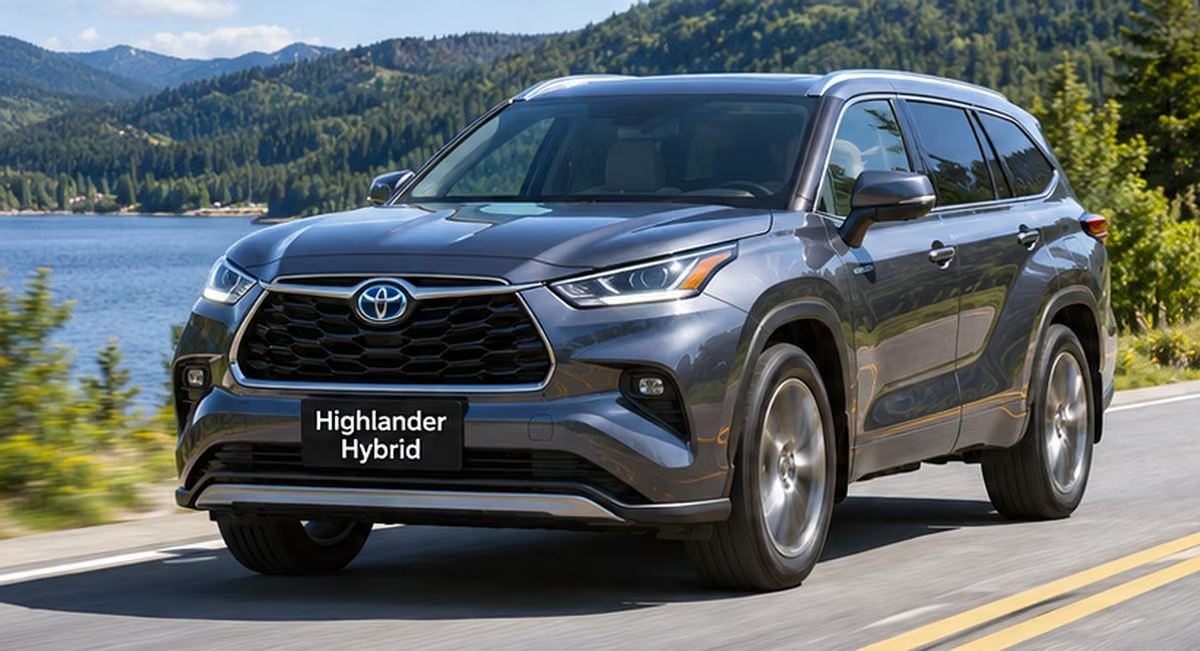
For the 2026 U.S.-market Highlander Hybrid, Toyota specifies a 2.5-liter four-cylinder gasoline engine, electric motor-generators, 243 combined horsepower, standard Electronic On-Demand All-Wheel Drive, and an estimated 35 mpg combined fuel economy. [1][4]
Understanding why plugging in is unnecessary requires examining how the battery charges, when the vehicle uses electric power, how regenerative braking works, and what differentiates the Highlander Hybrid from Toyota’s plug-in models.
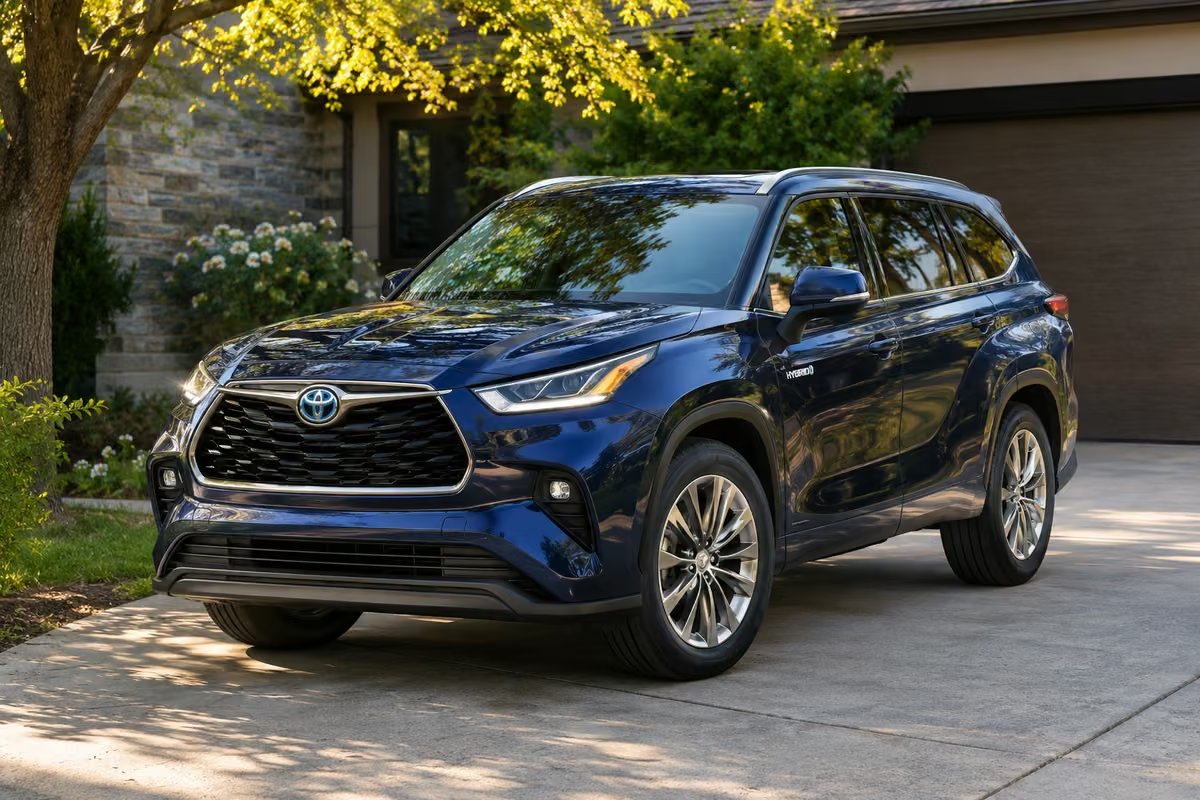
Why Doesn’t the Toyota Highlander Hybrid Need to Be Plugged In?
The Highlander Hybrid is designed to generate and recover the electricity it needs through components already installed in the vehicle. Instead of depending on electricity supplied by an external charging station, it uses its gasoline engine and the energy recovered during braking.
This design allows drivers to benefit from electric motor assistance, automatic engine shutdown, and reduced gasoline consumption without changing their daily refueling routine. Understanding the vehicle’s hybrid classification explains why this arrangement works.
Is the Toyota Highlander Hybrid a Plug-In or a Regular Hybrid?
The Toyota Highlander Hybrid is a full hybrid electric vehicle, commonly abbreviated HEV. It is not a plug-in hybrid electric vehicle, or PHEV.
A full hybrid combines an internal combustion engine with an electric propulsion system powerful enough to move the vehicle using electricity alone under certain conditions. The gasoline engine can also propel the vehicle while the electric motors provide additional torque or recover energy.
Unlike a plug-in hybrid, the Highlander Hybrid does not have an external charging inlet for its high-voltage traction battery. Its electrical energy comes from onboard generation and recovery.
The U.S. Department of Energy distinguishes conventional HEVs from plug-in hybrids based on their charging capabilities. Conventional HEVs replenish battery energy through regenerative braking and engine operation rather than an external power supply. [2]
This is the fundamental reason drivers never need to connect a Highlander Hybrid to a wall outlet.
What Does “Self-Charging Hybrid” Mean?
The term self-charging hybrid describes a vehicle that automatically replenishes its hybrid battery through onboard systems.
In the Toyota Highlander Hybrid, electricity is generated in two principal ways. The gasoline engine can drive an electric generator, and the electric motor-generators can recover kinetic energy when the vehicle slows down.
The resulting electricity is stored in the hybrid traction battery until the powertrain needs it for electric propulsion or other hybrid functions.
However, self-charging does not mean that the vehicle creates electricity without consuming energy. Gasoline remains an important energy source, and regenerative braking recovers some of the energy that would otherwise be lost during deceleration.
Toyota’s Hybrid Synergy Drive technology coordinates these processes automatically. The driver does not need to start a charging cycle or decide when the gasoline engine should recharge the battery. [1][2]
Why Doesn’t the Highlander Hybrid Have a Charging Port or Cable?
A charging port is necessary when a vehicle is designed to accept electricity from an external source. Since the conventional Highlander Hybrid’s traction battery is not externally chargeable, Toyota does not equip it with a plug-in charging inlet.
This eliminates several requirements associated with owning a plug-in vehicle. Highlander Hybrid drivers do not need to purchase charging cables, arrange residential EV charging installation, locate public EV charging stations, or schedule overnight traction-battery charging.
The vehicle does still have an ordinary gasoline fuel filler. It also has electrical connections for vehicle systems and service procedures, but these should not be confused with an external traction-battery charging port.
For owners living in apartments or homes without dedicated parking or charging facilities, this distinction can be particularly useful. Access to an electrical outlet is not a prerequisite for Highlander Hybrid ownership.
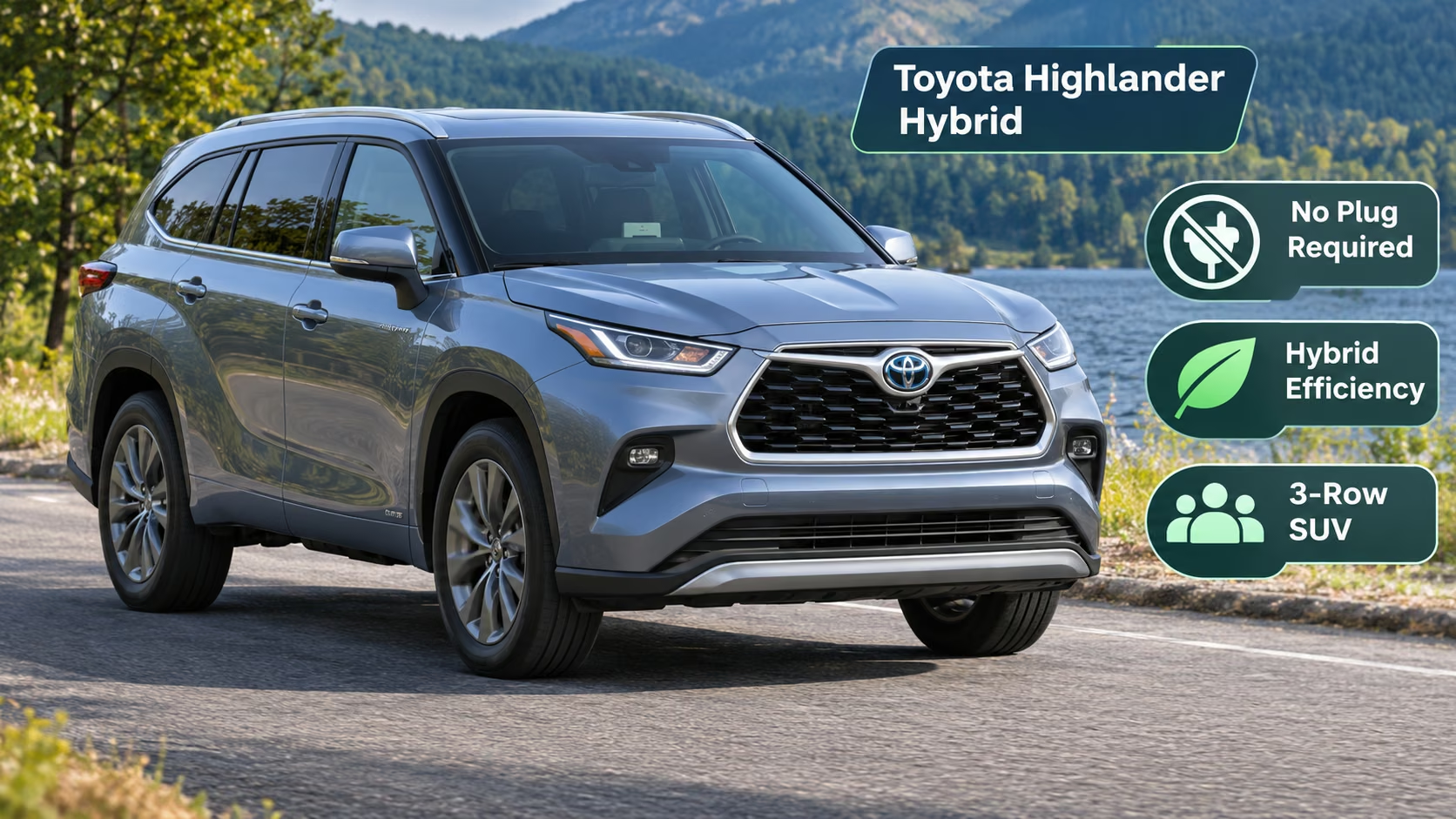
Does the Highlander Hybrid Need Gasoline Instead of Electricity?
The Highlander Hybrid uses both gasoline and electricity for propulsion, but gasoline is the energy source that drivers routinely replenish from outside the vehicle.
The gasoline engine can drive the wheels, supply power for electrical generation, or operate together with the traction motor. Electricity stored in the battery helps reduce the amount of gasoline required under suitable driving conditions.
Regenerative braking captures energy already present in the moving vehicle, but it cannot replace the energy supplied by gasoline indefinitely.
For everyday ownership, the procedure is straightforward. The driver refuels at a conventional gasoline station, operates the vehicle normally, and allows the hybrid system to manage battery energy.
The Highlander Hybrid should not be treated as a vehicle that can continue driving indefinitely after its gasoline supply is exhausted. Battery energy reserves are managed for hybrid operation, not as a substitute for refueling.
How Does the Toyota Highlander Hybrid Charge Its Battery Without Plugging In?
The Highlander Hybrid’s automatic charging capability depends on the interaction between mechanical and electrical components. The gasoline engine, electric motor-generators, power electronics, battery, and transmission operate as one integrated powertrain.
Electricity can be generated using engine power or recovered from the wheels during deceleration. The hybrid control system then determines whether that electricity should be stored, used immediately, or managed to protect the battery. Drivers experience these processes primarily as smooth acceleration, quiet low-speed operation, and reduced fuel consumption.
How Does Toyota’s Hybrid Synergy Drive System Work?
Toyota’s Hybrid Synergy Drive technology combines gasoline and electric propulsion through a computer-controlled energy-management system.
The 2026 Highlander Hybrid uses a 2.5-liter four-cylinder gasoline engine and two principal front motor-generators. The powertrain automatically coordinates engine speed, electric motor assistance, and electrical generation. The system produces a combined 243 horsepower in the 2026 U.S. model. [1]
A central component is the power-split arrangement, which allows gasoline-engine power to be distributed between mechanical propulsion and electric generation.
The hybrid transaxle provides electronically controlled continuously variable operation, commonly called an eCVT. Unlike a conventional belt-and-pulley CVT, Toyota’s power-split hybrid system uses electric motor-generator control and a planetary gear arrangement to regulate the relationship between engine speed and vehicle speed.
This helps the engine operate efficiently while the electric motor supplies additional torque when required.
The result is a powertrain that continually adjusts its energy sources instead of relying on a fixed division between gasoline and electricity.
Which Components Make Automatic Hybrid Battery Charging Possible?
Several interconnected components enable the Highlander Hybrid to generate, store, and use electricity without an external charger.
The high-voltage traction battery stores electrical energy. Motor-generators convert energy between electrical and mechanical forms. The power control electronics regulate voltage and current, while the hybrid control system coordinates propulsion and charging decisions.
These are the principal components and their functions:
| Component | Function in the hybrid system |
|---|---|
| Gasoline engine | Supplies mechanical power for propulsion and generation |
| Hybrid traction battery | Stores energy used by electric motors |
| Electric traction motor | Converts electricity into torque |
| MG1 motor-generator | Supports engine starting, electrical generation, and hybrid power management |
| MG2 motor-generator | Supplies propulsion torque and participates in regenerative braking |
| Power control unit (PCU) | Manages electrical power conversion and distribution |
| Hybrid inverter | Converts DC battery electricity to AC for motor operation and supports conversion in the opposite direction |
| DC-DC converter | Supplies the lower-voltage electrical system from the high-voltage system |
| Battery management system (BMS) | Monitors battery conditions and manages operating limits |
| Power-split device | Helps distribute engine power between mechanical and electrical functions |
| eCVT | Electronically coordinates engine and motor-generator operating speeds |
The U.S. Department of Energy identifies these components as central elements of conventional hybrid electric vehicle architecture. Toyota confirms that both MG1 and MG2 participate in charging the Highlander Hybrid’s battery. [1][3]
Although these components have different functions, they operate under coordinated electronic control.
How Does the Gasoline Engine Charge the Hybrid Battery?
The gasoline engine can supply mechanical energy to a motor-generator, which converts that energy into electricity.
The process begins when the hybrid control system determines that additional electrical energy is needed. The engine operates, and part of its mechanical output can drive an electric generator. Electricity then passes through the power electronics to the traction battery or to components that need immediate electrical power.
This conversion allows the battery to receive energy even when regenerative braking opportunities are limited.
Engine-driven generation also means that the engine may run when the driver is not requesting significant acceleration. For example, the vehicle may need to replenish battery charge, warm the engine, or satisfy cabin climate-control requirements.
These operating decisions are automatic.
However, generating electricity using gasoline is not loss-free. Energy is consumed by the engine, generator, electronics, and battery during conversion and storage. Toyota’s system manages these processes to support overall efficiency rather than to keep the battery permanently full.
How Does Regenerative Braking Charge the Highlander Hybrid Battery?
Regenerative braking converts some of the vehicle’s kinetic energy into electrical energy during deceleration.
In a conventional vehicle, much of the energy associated with slowing down becomes heat through friction braking. A hybrid vehicle can recover a portion of that energy by operating its traction motor as a generator.
When the Highlander Hybrid slows under suitable conditions, wheel rotation drives the motor-generator. The resulting electricity flows through the power electronics and can be stored in the traction battery.
Toyota confirms that regenerative braking in the Highlander Hybrid captures energy from the turning wheels as the vehicle decelerates. [1]
The energy-recovery process can occur during braking and, depending on operating conditions, when the driver releases the accelerator.
Regenerative braking does not eliminate the need for conventional brakes. It supplements the friction braking system and contributes to overall energy efficiency.
How Is Electricity Distributed Between the Battery, Motors, and Wheels?
The Highlander Hybrid’s electronic energy-management system determines how electricity moves between its battery and motor-generators.
During acceleration, energy may flow from the traction battery through the inverter to the electric motor. When the gasoline engine generates surplus electrical power under appropriate conditions, energy can flow toward the battery. During regenerative braking, energy flows from the motor-generator back into storage.
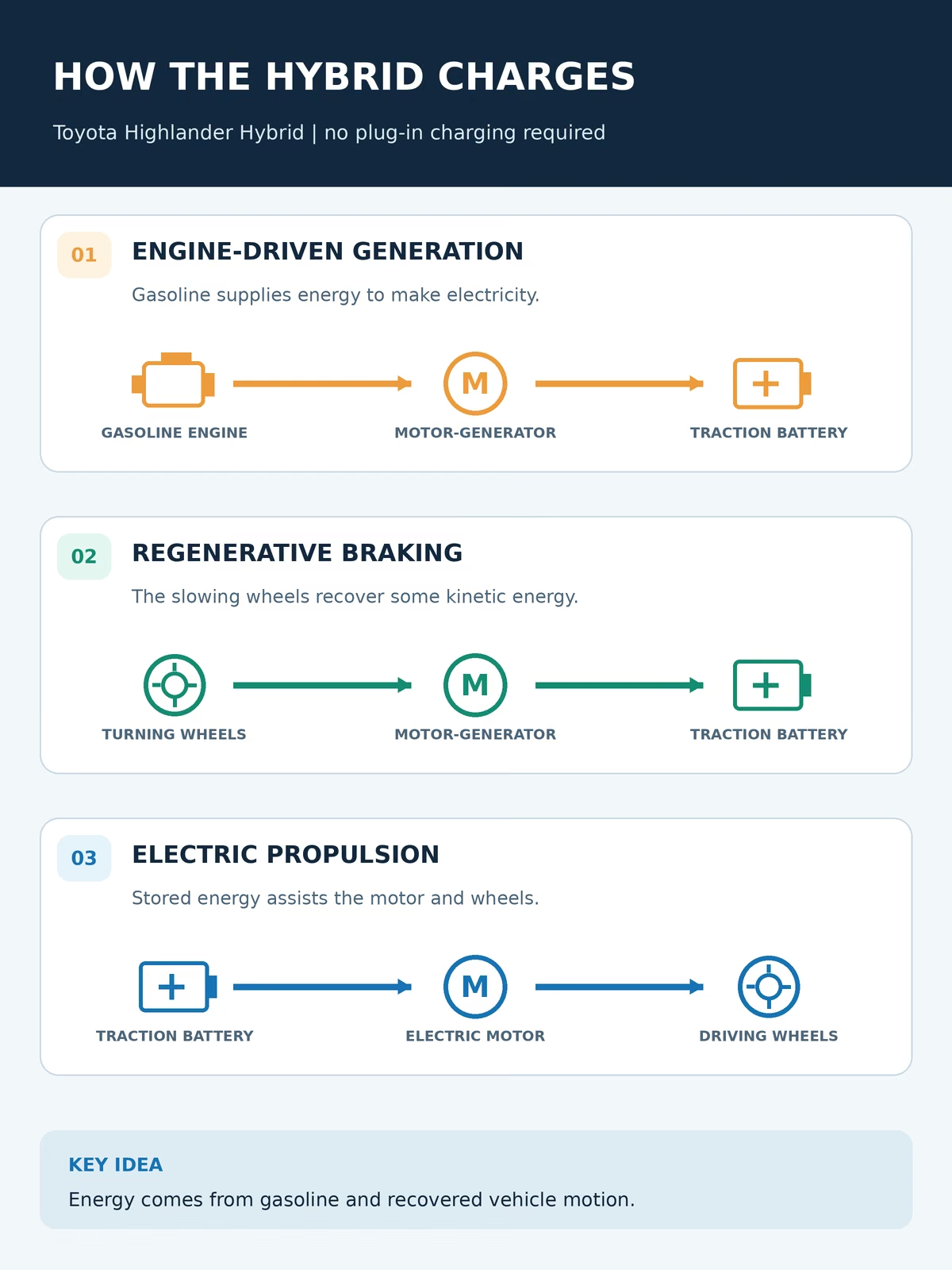
The battery repeatedly charges and discharges as driving conditions change. Its state of charge (SOC) indicates the estimated amount of stored energy relative to the battery’s usable capacity.
The hybrid computer regulates these energy transfers rather than allowing the battery to discharge without restriction or remain at its maximum possible charge. This controlled energy cycling is essential to conventional hybrid operation.
When Does the Toyota Highlander Hybrid Recharge Its Battery While Driving?
The Highlander Hybrid’s traction battery does not charge at one constant rate throughout every journey. Charging behavior changes depending on road speed, acceleration, braking, terrain, battery charge level, and gasoline-engine operation.
At some moments, the battery supplies power to the electric motors. At others, it receives electricity generated by the engine or recovered during deceleration.
Understanding these changes explains why a battery indicator can rise and fall during the same trip without indicating a problem.
Does the Highlander Hybrid Charge While Braking?
Yes. Regenerative braking is one of the Highlander Hybrid’s principal methods of battery charging.
When the driver applies the brakes, the hybrid system can use the electric motor-generator to produce electrical energy while helping slow the vehicle. The electricity is directed toward the traction battery when operating conditions permit.
A portion of the vehicle’s kinetic energy is therefore recovered rather than being entirely dissipated through friction.
The amount of energy recovered depends on braking demand, vehicle speed, battery condition, and other factors.
Smooth, anticipatory braking often provides more opportunity for controlled energy recovery than abrupt last-second braking. However, drivers should always prioritize safe stopping distances rather than trying to maximize battery charging.
The regenerative system is automatic and does not require the driver to select a special charging mode.
Does the Highlander Hybrid Charge During Coasting and Downhill Driving?
The Highlander Hybrid can recover energy while decelerating after the accelerator is released, including during downhill driving when conditions permit.
When gravity contributes to the vehicle’s movement downhill, the hybrid system may use regenerative braking to help control speed and return energy to the battery.
Toyota describes selectable regenerative-braking behavior for the 2026 Highlander Hybrid, allowing drivers to manage deceleration in steps when driving in hilly areas. [1]
However, not all downhill energy can necessarily be stored. Regenerative charging depends on available battery capacity, temperature, and operating limits.
If additional deceleration is necessary, conventional friction brakes provide stopping force. Drivers should follow Toyota’s instructions for downhill driving and should not assume that increased regeneration replaces normal braking precautions.
How Do Regenerative Braking and Friction Brakes Work Together?
The Highlander Hybrid combines regenerative braking with conventional friction brakes through a coordinated braking strategy.
Regenerative braking uses an electric motor-generator to create resistance while recovering energy. Friction brakes use mechanical contact to slow the wheels, converting motion into heat.
The vehicle blends these systems according to stopping requirements and operating conditions.
During moderate deceleration, regenerative braking may contribute significantly. During emergency stops, certain low-speed situations, or periods when regeneration is restricted, conventional brakes remain essential.
The transition between electrical and friction braking can influence the sensation of the brake pedal. Drivers may notice that braking response differs somewhat from a conventional gasoline vehicle.

This does not mean the Highlander Hybrid relies exclusively on battery charging to stop. Safe braking takes priority over energy recovery, and the conventional braking system remains a critical safety component.
What Happens When the Hybrid Battery Is Nearly Full?
The hybrid battery operates within charge limits managed by the vehicle’s electronic controls.
When the battery approaches the upper portion of its permitted state-of-charge range, the system may reduce regenerative charging to avoid storing more energy than the battery can safely accept.
This is especially relevant during long downhill descents, where the vehicle could otherwise generate substantial electrical energy.
The system must then manage deceleration using other available methods, including mechanical braking.
A battery display showing a high charge level is not evidence that the battery can accept unlimited additional electricity. The displayed level is part of Toyota’s controlled hybrid battery management strategy.
For drivers, the practical lesson is simple: a nearly full hybrid battery does not need to be plugged in, and it does not prevent the vehicle from using its braking system normally.
What Happens When the Hybrid Battery Is Low?
When the traction battery’s available charge decreases, the Highlander Hybrid can adjust power distribution and operate the gasoline engine to generate electricity.
The system may also limit electric-only operation or change the balance between engine and motor assistance.
This helps prevent excessive battery discharge during normal driving.
A low battery indication does not automatically signal a malfunction. The traction battery’s charge naturally changes as energy is consumed and recovered.
However, a persistent hybrid-system warning, abnormal operating behavior, or a vehicle that cannot enter READY mode requires a different response. Such conditions should be evaluated using the owner’s manual and, when necessary, qualified Toyota service.
Drivers should not attempt to connect an external charger to the high-voltage traction battery to correct a low-charge indication.
How Does the Toyota Highlander Hybrid Drive Without External Charging?
Because the Highlander Hybrid combines two propulsion sources, it can operate differently from a gasoline-only SUV even though both vehicles are refueled at gasoline stations.
The gasoline engine does not need to run continuously whenever the vehicle is moving. Electric motors can supply propulsion under suitable conditions, and the engine can automatically restart when additional power or battery charging is required.
The transitions are managed by the hybrid control system, so the driver normally does not need to select the energy source manually.
When Does the Highlander Hybrid’s Gasoline Engine Turn On and Off?
The Highlander Hybrid can automatically stop its gasoline engine when the engine is not required for propulsion, charging, heating, or another operating function.
For example, the engine may stop while the vehicle is stationary or during appropriate low-speed driving conditions.
When the driver requests more acceleration, the battery needs additional energy, or the vehicle requires engine heat, the hybrid system may automatically restart the gasoline engine.
Electric launch assistance can also reduce the need for immediate engine output when moving away from a stop.
Cold temperatures, cabin heating, air-conditioning demand, and battery temperature can influence how frequently the engine operates.
Drivers should not interpret an unexpected engine restart as evidence that the vehicle needs plugging in. Engine operation is an ordinary part of maintaining powertrain efficiency and battery energy.
Can the Highlander Hybrid Drive Using Electricity Alone?
Yes. The Toyota Highlander Hybrid is a full hybrid capable of limited electric-only driving.
Toyota provides an EV Drive Mode that allows the vehicle to use electric propulsion at low speeds for short distances when conditions permit. [1]
Unlike a plug-in hybrid, however, the Highlander Hybrid is not designed for an extended daily commute on externally charged electricity.
Electric-only operation depends on factors including available battery charge, acceleration requirements, temperature, and vehicle operating conditions.
The gasoline engine can start automatically when electric propulsion alone is insufficient or when the hybrid system requires engine operation.
For example, gentle movement through a parking area may be possible using electricity alone, while stronger acceleration or a low battery charge could cause the engine to start.
The vehicle therefore offers electric-only capability as part of a broader gasoline-electric operating strategy.
Does EV Mode Mean the Highlander Hybrid Is an Electric Vehicle?
EV Mode refers to an operating condition, not the Highlander Hybrid’s vehicle classification.
The Highlander Hybrid can propel itself electrically for limited periods, but it remains a conventional HEV because its traction battery cannot be replenished through an external charging connection.
A battery electric vehicle, or BEV, uses electricity as its propulsion energy source and normally depends on external charging. A plug-in hybrid combines an internal combustion engine with a battery designed to accept external electricity.
The Highlander Hybrid instead relies on gasoline and onboard energy recovery.
This distinction matters because electric-only driving capability does not establish whether a vehicle needs a charging station.
The correct classification depends on the complete powertrain architecture, including how the vehicle obtains and replenishes its electrical energy. [2][3]
Do the Highlander Hybrid’s Driving Modes Affect Battery Charging?
The 2026 Toyota Highlander Hybrid provides Normal, Eco, and Sport driving modes, along with an EV mode function. These settings adjust aspects of vehicle response and powertrain operation, but they do not change the fundamental method used to recharge the traction battery.
Regardless of the selected mode, engine-driven generation and regenerative braking remain the principal sources of battery energy.
Toyota describes the modes as different ways to balance performance characteristics and driving efficiency. [1]
What Does Eco Drive Mode Change?
Eco Drive Mode is designed to support more fuel-efficient vehicle operation.
Toyota explains that Eco mode prioritizes efficiency from the vehicle’s gasoline and electrical energy sources. In practical driving, this includes modifying how the powertrain responds to accelerator input.
More gradual power delivery can help reduce unnecessary energy consumption, especially when combined with smooth driving habits.
However, Eco mode should not be confused with a special external charging function. It does not allow the Highlander Hybrid to connect to an electrical outlet or independently generate unlimited electricity.
Regenerative braking and engine-driven charging continue to operate as part of the normal hybrid system.
The greatest fuel-saving benefit generally comes from combining appropriate vehicle settings with sensible acceleration, braking, speed, and trip-planning habits.
How Does Normal Drive Mode Balance Performance and Efficiency?
Normal Drive Mode provides the standard balance between everyday acceleration response and efficiency.
The hybrid system continues to determine whether the gasoline engine, electric motor, or a combination of both should supply propulsion power.
Battery energy is automatically managed as the vehicle accelerates, cruises, slows, and stops.
Normal mode does not prevent regenerative braking, disable hybrid battery charging, or require the gasoline engine to run continuously.
Toyota identifies Normal mode as suitable for everyday driving. [1]
For most owners, this means the vehicle can be driven much like a conventional automatic-transmission SUV. There is no need to monitor battery charging constantly or manually coordinate gasoline and electric operation.
Does Sport Drive Mode Drain the Hybrid Battery Faster?
Sport Drive Mode emphasizes more responsive power delivery.
Toyota states that Sport mode quickens the Highlander Hybrid’s throttle response, helping the vehicle respond more promptly to accelerator inputs. [1]
More aggressive acceleration can increase instantaneous power demand, which may increase the use of both gasoline and stored electrical energy.
However, selecting Sport mode does not automatically mean that the battery will become depleted or stop recharging.
The battery management system continues regulating electricity supply and recovery. The gasoline engine remains available to deliver propulsion and support electrical generation.
Drivers should distinguish the effect of the selected mode from the effect of their actual driving behavior. Frequent hard acceleration generally demands more energy than smooth acceleration, regardless of the mode selected.
How Can You Tell When the Toyota Highlander Hybrid Battery Is Charging?
Toyota provides driver-information displays that help owners understand what the hybrid powertrain is doing.
Depending on the model year and equipment, these may include a battery charge indicator, an energy monitor, and a Hybrid System Indicator.
These displays can show whether the vehicle is using electricity for propulsion, recovering energy through braking, or operating the gasoline engine.
Understanding the information helps owners recognize normal charging behavior without assuming that every change in the displayed battery level indicates a problem.
How Do You Read the Hybrid Battery Charge Indicator?
The hybrid battery charge indicator provides an approximate representation of the traction battery’s available energy.
Depending on the display design, the information may appear as segments, bars, or another graphical indicator.
The displayed level commonly rises after periods of regenerative braking and decreases when the electric motor draws energy for propulsion.
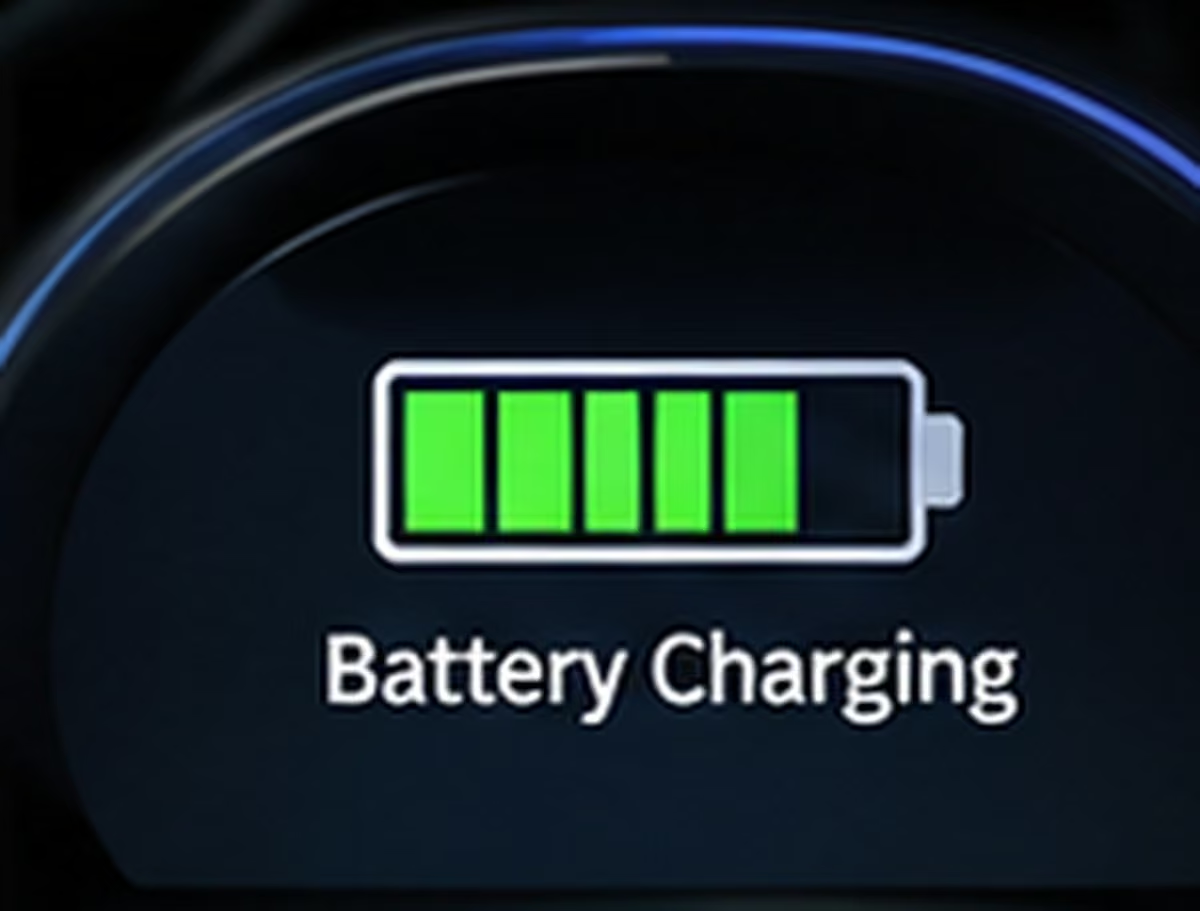
These changes are expected. The Highlander Hybrid is designed to maintain a controlled charge range rather than keep the battery display permanently full.
The battery indicator also should not be interpreted as a direct measurement of the battery’s entire physical capacity.
Toyota’s Highlander Hybrid owner documentation explains that regenerated energy is used to charge the traction battery and describes the relationship between the hybrid system display and vehicle operating conditions. [6]
What Does the Toyota Highlander Hybrid Energy Monitor Show?
The Energy Monitor is designed to illustrate how power moves through the hybrid drivetrain.
Depending on vehicle generation and display configuration, the monitor may show energy transfers between the gasoline engine, electric motors, traction battery, and wheels.
During electric propulsion, the display may indicate electricity traveling from the battery toward the driving wheels.
During regenerative braking, the illustrated direction changes as energy is recovered from vehicle movement.
When the gasoline engine contributes to electricity generation, the monitor may represent engine-powered energy flow toward the electrical system.
These visualizations are useful for understanding automatic charging, but they are simplified representations rather than detailed electrical measurements.
Drivers should consult their model-specific owner’s manual for the meaning of the exact symbols and display arrows.
What Does the READY Indicator Mean?
The READY indicator confirms that the hybrid system is ready to operate.
A Highlander Hybrid may be capable of moving even when its gasoline engine is silent. This is a normal characteristic of hybrid vehicles using electric propulsion.
Therefore, the absence of engine noise does not mean that the vehicle is switched off.
When READY is illuminated, the hybrid system may be active and capable of delivering propulsion power.
Toyota owner documentation also associates the Hybrid System Indicator’s operating conditions with the READY status. [6]
For safety, drivers should select Park, apply the parking brake, and turn the vehicle off when leaving it unattended.
The READY indicator is not a battery charging indicator. It communicates vehicle operating readiness, not a requirement to connect an external charger.
Can the Driving Efficiency Display Help Improve Fuel Economy?
Driving efficiency displays can provide feedback about acceleration, braking, and energy use.
Such feedback helps drivers recognize when power demand is increasing or when regenerative energy recovery is occurring.
For example, an efficiency display may encourage smoother acceleration or earlier deceleration, depending on the vehicle’s instrumentation.
The U.S. Department of Energy reports that research on in-vehicle feedback has found improvements in driving-related fuel efficiency, although the size of the benefit depends on the driver and circumstances. [10]
The purpose of these indicators is not to make drivers continually watch the dashboard while moving. Instead, they help owners learn which habits tend to produce efficient operation.
Drivers should remain attentive to traffic and use efficiency information only when it is safe to do so.
Does the Self-Charging Toyota Highlander Hybrid Save Fuel?
The main purpose of the Highlander Hybrid’s gasoline-electric powertrain is to improve efficiency while retaining the utility and driving range associated with a conventional SUV.
Its electric motors help with acceleration, its gasoline engine can operate efficiently under varying loads, and regenerative braking recovers energy that would otherwise be wasted.
These functions can reduce gasoline consumption, particularly during urban driving. However, actual fuel economy depends on driving style, temperature, terrain, vehicle loading, and operating conditions.
How Fuel-Efficient Is the Toyota Highlander Hybrid in City and Highway Driving?
The 2026 Toyota Highlander Hybrid has an EPA-estimated combined fuel economy of 35 miles per gallon in the United States.
The city and highway ratings differ slightly by trim. The Hybrid XLE is rated at 35 mpg city and 35 mpg highway. The Hybrid Limited and Platinum are rated at 35 mpg city and 34 mpg highway.
For comparison, the 2026 gasoline-powered Highlander AWD is rated at 24 mpg combined. [4]
| 2026 U.S. Highlander model | City MPG | Highway MPG | Combined MPG |
|---|---|---|---|
| Highlander Hybrid XLE AWD | 35 | 35 | 35 |
| Highlander Hybrid Limited AWD | 35 | 34 | 35 |
| Highlander Hybrid Platinum AWD | 35 | 34 | 35 |
| Highlander gasoline AWD | 21 | 28 | 24 |
Source: U.S. EPA and Department of Energy fuel economy records. Ratings apply to the specified 2026 U.S. configurations.
Comparing combined ratings, 35 mpg is approximately 46% higher than 24 mpg in miles traveled per gallon. Measured as fuel consumed per mile, the hybrid uses approximately 31% less gasoline at the respective rated efficiencies.
This comparison illustrates the value of hybridization, although real-world results will vary.
Why Is the Highlander Hybrid Efficient in Stop-and-Go Traffic?
Stop-and-go traffic creates frequent opportunities for regenerative braking.
When a conventional gasoline vehicle slows, energy is primarily dissipated through mechanical braking. The Highlander Hybrid can recover some of that energy and store it for later electric propulsion.
The gasoline engine may also shut off when the vehicle is stationary or when engine output is unnecessary.
Electric assistance can reduce gasoline-engine demand when moving away from a stop.
These capabilities are particularly relevant in urban traffic, where acceleration and deceleration occur repeatedly.
However, heavy congestion still consumes energy, and regenerative braking does not recover everything used during acceleration.
The benefit comes from combining recovered energy, reduced engine idling, and efficient coordination of gasoline and electric power.
Which Driving Habits Help Improve Fuel Economy and Regenerative Charging?
Driving habits influence both the amount of energy consumed and the amount that can be recovered.
Smooth acceleration reduces sudden power demand, while anticipating traffic allows drivers to slow gradually instead of repeatedly braking hard.
Maintaining an appropriate speed, avoiding unnecessary idling, keeping tires properly inflated, and reducing unnecessary vehicle load can also support fuel efficiency.
According to the U.S. Department of Energy, aggressive driving can reduce fuel economy by approximately 15% to 30% at highway speeds and 10% to 40% in stop-and-go traffic. These are general findings, not guaranteed Highlander Hybrid-specific results. [10]
Importantly, drivers should not deliberately accelerate and brake just to charge the battery. Every energy conversion involves losses.
The most efficient strategy is generally to avoid wasting energy in the first place and let regenerative braking recover energy when slowing is necessary.
How Far Can the Toyota Highlander Hybrid Travel on a Tank of Gas?
The 2026 U.S.-market Highlander Hybrid has a 17.1-gallon fuel tank and an EPA combined fuel economy rating of 35 mpg.
Multiplying those figures produces a theoretical range of approximately 598.5 miles. The EPA lists an estimated total range of 598 miles for the 2026 Highlander Hybrid. [4]
This calculation is useful for comparing vehicles, but it is not a promise that every driver will travel almost 600 miles before refueling.
Actual range depends on factors such as driving conditions, fuel consumption, weather, and the amount of usable fuel remaining.
Drivers should refuel before the tank is empty and should not attempt to use the hybrid traction battery as an emergency replacement for gasoline.
Does the Highlander Hybrid Reduce Tailpipe Emissions?
The Highlander Hybrid can reduce gasoline consumption relative to a comparable gasoline-only vehicle, which can also reduce fuel-related carbon dioxide emissions.
The U.S. Environmental Protection Agency and Department of Energy list the 2026 Highlander Hybrid at approximately 253 to 254 grams of tailpipe greenhouse gas emissions per mile, depending on the configuration. The corresponding 2026 gasoline AWD Highlander is listed at approximately 371 grams per mile. [4]
These are standardized estimates rather than measurements of every vehicle’s actual emissions.
The Highlander Hybrid is not a zero-emission vehicle. Whenever its gasoline engine burns fuel, it produces exhaust emissions.
Electric-only operation can temporarily eliminate engine tailpipe emissions, but the electricity was obtained through earlier engine operation or energy recovery.
For an environmental comparison, buyers should consider fuel consumption, vehicle production, battery manufacturing, and overall lifecycle impacts rather than focusing solely on whether a vehicle can drive electrically.
Does the Toyota Highlander Hybrid Battery Need Maintenance or Manual Charging?
The Highlander Hybrid’s traction battery is designed for automatic operation, but this does not mean every electrical component is maintenance-free.
The vehicle contains a high-voltage traction battery, a separate low-voltage auxiliary battery, cooling equipment, power electronics, and monitoring systems.
Each performs a different function and may require different service procedures.
Understanding these distinctions helps owners identify ordinary hybrid behavior, avoid incorrect charging methods, and recognize when professional diagnosis is necessary.
What Is the Difference Between the Hybrid Traction Battery and the 12-Volt Battery?
The Highlander Hybrid uses separate battery systems for different electrical requirements.
The high-voltage traction battery stores energy for electric propulsion and hybrid powertrain functions.
The 12-volt auxiliary battery supports lower-voltage electronic systems and helps enable the hybrid system to start operating.
A DC-DC converter supplies lower-voltage electrical power from the high-voltage system during appropriate operating conditions.
The two batteries should not be confused.
| Feature | Hybrid traction battery | 12-volt auxiliary battery |
|---|---|---|
| Main purpose | Electric propulsion and hybrid operation | Low-voltage electronics and system startup |
| Electrical system | High voltage | Nominally 12 volts |
| Routine charging | Engine generation and regenerative braking | Vehicle electrical system |
| External plug-in charging | Not supported for normal owner use | Maintenance charging may be possible using approved procedures |
| Owner repair | High-voltage work requires qualified professionals | Service procedures depend on the vehicle and battery |
| If discharged | May prevent normal hybrid operation | May prevent the hybrid system from entering READY mode |
The Department of Energy distinguishes auxiliary and traction batteries in its explanation of hybrid vehicle components. [2]
A conventional 12-volt battery charger should never be connected to high-voltage hybrid components.
Can You Jump-Start the Highlander Hybrid If Its 12-Volt Battery Dies?
A discharged 12-volt auxiliary battery may prevent the Highlander Hybrid from starting its hybrid system, even when the high-voltage traction battery has usable energy.
Toyota provides model-specific emergency procedures for addressing a discharged auxiliary battery. These procedures may involve an appropriate external 12-volt power source and specified connection points. [14]
However, the procedure must be followed exactly as described in the owner’s manual for the particular model year.
Jump-starting the auxiliary battery does not directly recharge the high-voltage traction battery.
Owners should also distinguish a discharged 12-volt battery from a hybrid-system fault. If the vehicle does not enter READY mode after following approved procedures, professional assistance may be necessary.
Never connect booster equipment to unidentified high-voltage cables, hybrid battery terminals, or service connectors.
How Long Does the Toyota Highlander Hybrid Battery Last?
The service life of a hybrid traction battery depends on operating temperature, driving conditions, charge management, maintenance, and individual battery condition.
Toyota designs its hybrid battery and control systems to operate through repeated charging and discharging during normal vehicle use.
The battery management system controls operating limits, while cooling systems help maintain appropriate temperatures.
However, Toyota does not guarantee that every Highlander Hybrid battery will last a fixed number of years or miles without degradation.
For U.S.-market Toyota hybrid vehicles beginning with model year 2020, the hybrid battery warranty generally covers 10 years or 150,000 miles, whichever comes first, subject to Toyota’s warranty terms. [7]
A warranty period should not be interpreted as either an expected failure date or a guaranteed service life.
Owners of older vehicles or vehicles sold outside the United States should consult the warranty applicable to their particular market and model year.
Why Are Hybrid Battery Cooling and Thermal Management Important?
Hybrid battery performance is influenced by temperature.
Charging, discharging, and electrical resistance generate heat, while very low temperatures can limit battery power and charging acceptance.
Thermal management systems help maintain operating conditions suitable for performance and battery protection.
Toyota’s Highlander Hybrid documentation describes battery cooling airflow and warns that obstructed intake ventilation can restrict battery charging and discharging. [18]
Owners should keep the appropriate battery cooling air intakes clear of luggage, fabric, dirt, and other obstructions.
If the vehicle displays a warning concerning traction-battery cooling components, the owner should follow the relevant Toyota maintenance instructions.
Cleaning requirements and vent locations can vary by model year, so the correct manual should be used.
High-voltage battery covers and electrical components should not be dismantled as part of routine owner cleaning.
What Happens If the Highlander Hybrid Is Parked for Several Months?
Both the high-voltage traction battery and the 12-volt auxiliary battery can lose stored energy while a vehicle remains unused.
The auxiliary battery may discharge because of natural self-discharge and electrical loads that remain present when the vehicle is parked.
The traction battery can also gradually lose charge during extended storage.
Toyota’s Highlander Hybrid owner documentation includes guidance for avoiding excessive traction-battery discharge during long periods of nonuse. [18]
Owners planning to store a vehicle for weeks or months should consult the model-specific manual and Toyota’s long-term storage recommendations.
A short period of driving should not be assumed to correct every low-battery condition. The appropriate preparation depends on the duration of storage and the condition of both batteries.
If the traction battery becomes sufficiently discharged that the hybrid system cannot start, Toyota service may be required.
What Are the Warning Signs of a Hybrid Battery or Charging Problem?
Changes in the battery indicator alone do not necessarily indicate a fault. The Highlander Hybrid normally alternates between using and recovering battery energy.
More meaningful warning signs include persistent hybrid-system malfunction messages, unusual operating restrictions, difficulty entering READY mode, and warnings concerning battery cooling or electrical components.
The vehicle’s diagnostic system may store diagnostic trouble codes, commonly called DTCs, that help qualified technicians identify detected problems.
A professional hybrid service inspection can assess the relevant battery, power electronics, cooling, and control systems.
Drivers should not attempt to diagnose a high-voltage system by disconnecting its cables or opening the traction battery enclosure.
| Symptom | Possible explanation | Appropriate response |
|---|---|---|
| Charge indicator rises and falls | Normal hybrid energy management | Observe vehicle operation |
| Engine starts while parked in READY | Engine operation or energy management may be required | Follow normal operating and safety procedures |
| READY indicator does not appear | Possible 12V or other startup issue | Consult the owner’s manual |
| Persistent hybrid warning | Detected system malfunction | Arrange qualified diagnosis |
| Battery cooling warning | Airflow restriction or cooling-system issue | Follow Toyota’s inspection instructions |
| Vehicle cannot start after long storage | Battery discharge or another fault | Seek appropriate service assistance |
These are possible explanations, not definitive diagnoses. Toyota’s model-specific warning messages and service procedures take precedence. [14][18]
Toyota Highlander Hybrid vs Plug-In Hybrid vs Fully Electric Vehicles
Conventional hybrids, plug-in hybrids, and battery electric vehicles all use electric motors, but they differ significantly in how they obtain energy.
These differences determine whether a vehicle needs external charging, how far it can travel electrically, and whether gasoline remains necessary.
The Highlander Hybrid belongs to the conventional HEV category. It offers automatic onboard battery charging but does not provide the extended electric-only driving range generally associated with plug-in vehicles.
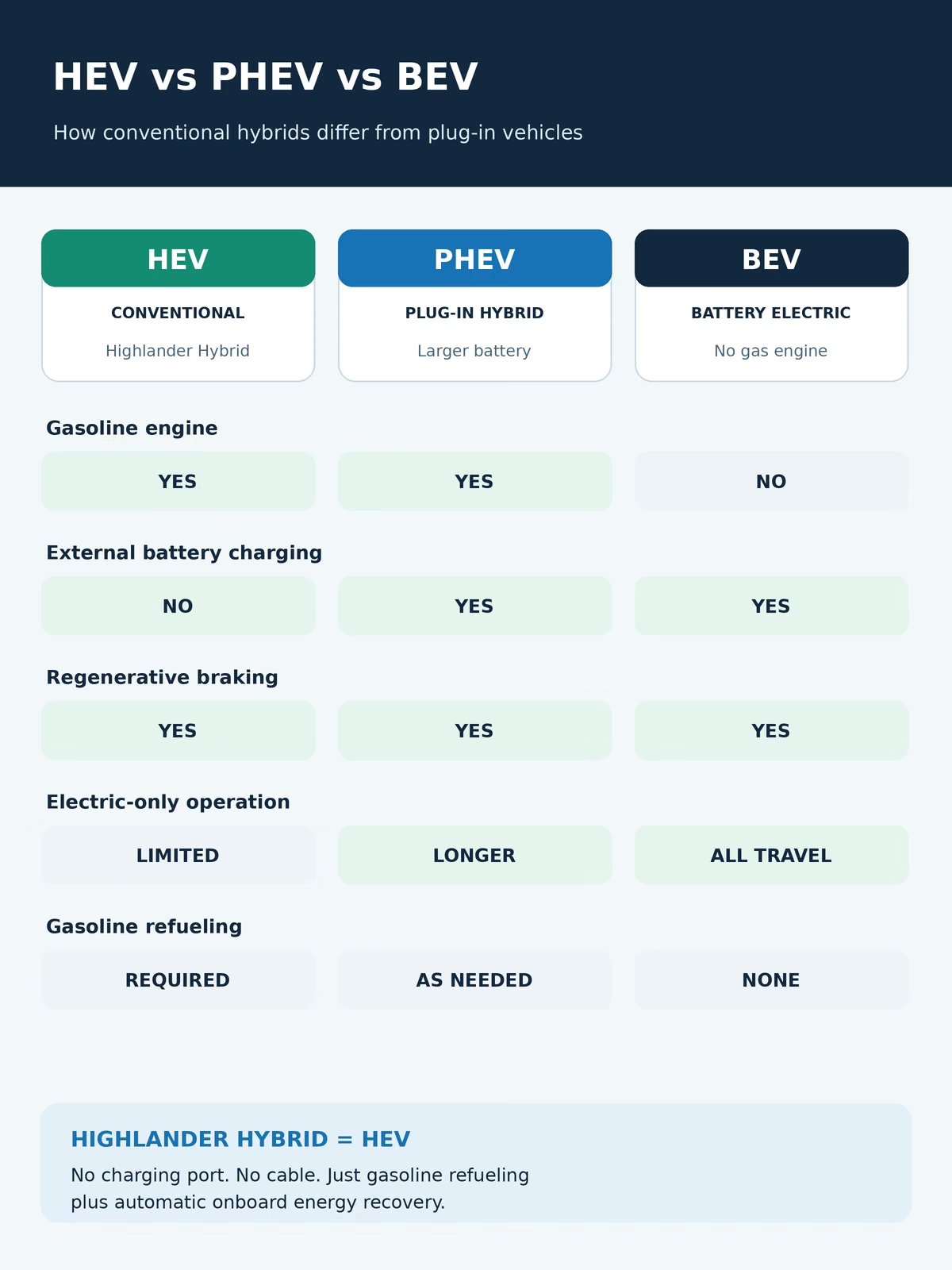
What Is the Difference Between an HEV, PHEV, and BEV?
A hybrid electric vehicle combines an internal combustion engine and electric propulsion without relying on external battery charging.
A plug-in hybrid electric vehicle also combines gasoline and electricity but has a battery designed to accept external electrical energy.
A battery electric vehicle uses electricity as its propulsion energy source and does not have a gasoline engine.
According to the Department of Energy, PHEVs generally have larger battery packs than conventional hybrids, allowing them to travel farther using electricity alone. [8]
| Feature | Highlander Hybrid (HEV) | Plug-In Hybrid (PHEV) | Battery Electric Vehicle (BEV) |
|---|---|---|---|
| Gasoline engine | Yes | Yes | No |
| Electric propulsion | Yes | Yes | Yes |
| External charging connection | No | Yes | Yes |
| Regenerative braking | Yes | Yes | Yes |
| Gasoline refueling | Required | Used when needed | Not applicable |
| Electric-only driving | Limited | Typically longer range | Entire driving range |
| Dedicated home EV charger | Not needed | Optional, depending on charging needs | Often useful, but not always necessary |
| Routine battery charging | Automatic onboard charging | External charging plus onboard energy recovery | External charging |
A PHEV can generally operate without being plugged in, provided it has the necessary fuel and is designed to operate as a hybrid. However, regular external charging is important for realizing its intended electric-driving benefits.
Why Can’t You Charge the Highlander Hybrid at a Public EV Charging Station?
Public EV charging equipment transfers electricity to vehicles equipped with compatible charging inlets and electrical systems.
The Highlander Hybrid does not have an external traction-battery charging inlet, so it cannot use public EV charging equipment to replenish its high-voltage battery.
EV charging stations commonly provide Level 1 AC charging, Level 2 AC charging, or DC fast charging.
Each serves compatible plug-in vehicles, but none provides a normal charging method for a conventional Highlander Hybrid.
| Charging method | Typical U.S. electrical supply | Highlander Hybrid compatibility |
|---|---|---|
| Level 1 AC | 120 volts AC | Not supported |
| Level 2 AC | Commonly 208 or 240 volts AC | Not supported |
| DC fast charging | High-power direct current | Not supported |
The Department of Energy explains that EV charging connectors and supported charging levels vary by vehicle and equipment. [9]
The key limitation is not the availability of electricity. It is the vehicle’s lack of an external traction-battery charging system.
Can You Charge the Highlander Hybrid at a Tesla Supercharger?
No. The conventional Toyota Highlander Hybrid cannot recharge its traction battery at a Tesla Supercharger.
Tesla Superchargers are high-power DC charging stations designed for compatible plug-in electric vehicles.
Even where charging-network access is available to other manufacturers’ vehicles, the Highlander Hybrid remains incompatible because it lacks the necessary external charging inlet and associated battery-charging hardware.
A charging adapter does not change the Highlander Hybrid into a plug-in vehicle.
The same principle applies to other public charging networks using CCS, NACS, or other EV charging connectors.
Drivers should use conventional gasoline refueling facilities for the Highlander Hybrid and allow its onboard systems to manage traction-battery energy automatically.
How Does the Highlander Hybrid Compare With the Toyota RAV4 Plug-In Hybrid?
The Toyota RAV4 Plug-In Hybrid combines a gasoline engine with a larger battery designed for external charging and more substantial electric-only driving.
For the 2026 U.S. RAV4 Plug-In Hybrid, Toyota announced a manufacturer-estimated electric-only range of up to 52 miles on certain grades. The actual range depends on configuration and operating conditions. [12]
Unlike the Highlander Hybrid, the RAV4 Plug-In Hybrid can receive electricity through compatible charging equipment.
Toyota’s 2026 RAV4 plug-in lineup also includes differences in charging capability by trim, including DC fast charging on certain versions.
The practical comparison is based on how the driver intends to use electricity.
Someone who regularly charges at home and drives relatively short daily distances may make substantial use of a plug-in hybrid’s electric-only capability.
A Highlander Hybrid owner, by contrast, does not need to arrange any external charging.
How Does the Highlander Hybrid Compare With the Prius Plug-In Hybrid?
The Toyota Prius Plug-In Hybrid also combines gasoline and electric propulsion, but it is designed to accept electricity from an external charging source.
For the 2026 U.S. Prius Plug-In Hybrid, Toyota describes a 13.6-kWh lithium-ion battery and a manufacturer-estimated electric range of up to 44 miles on the SE grade. [13]
Those capabilities distinguish it from the conventional Highlander Hybrid, which is not externally chargeable and offers only limited electric-only operation.
The Prius is also a smaller passenger car rather than a three-row midsize SUV.
Therefore, comparisons should consider passenger capacity, cargo requirements, electric driving needs, fuel economy, and available charging facilities.
The Highlander Hybrid emphasizes SUV practicality without plug-in requirements, while the Prius Plug-In Hybrid offers a greater opportunity to replace gasoline-powered miles with externally supplied electricity.
How Does the Highlander Hybrid Compare With the Gasoline Highlander and Grand Highlander Hybrid?
The gasoline-only Toyota Highlander uses a conventional internal combustion powertrain without a hybrid traction battery.
The Highlander Hybrid adds electric propulsion, regenerative braking, and automatic energy management to reduce gasoline consumption.
The Toyota Grand Highlander Hybrid is a larger hybrid SUV offering gasoline-electric propulsion and onboard battery charging, although exact drivetrain and powertrain configurations vary by trim.
For the 2026 Highlander, Toyota specifies 35 mpg combined for the hybrid and 24 mpg combined for the gasoline AWD model. [1][4]
The Highlander Hybrid also has a maximum Toyota-rated towing capacity of 3,500 pounds, while the 2026 gasoline Highlander is rated for up to 5,000 pounds. [1]
These figures illustrate why buyers should compare more than fuel economy. Seating, cargo room, towing requirements, drivetrain options, purchase price, and overall operating costs may influence the best choice.
Do Different Toyota Highlander Hybrid Models Charge Their Batteries Differently?
The core charging principle remains consistent across conventional Highlander Hybrid generations: the battery receives electricity through onboard generation and energy recovery rather than external plug-in charging.
However, Highlander Hybrid powertrains have evolved over time.
Different generations may use different gasoline engines, hybrid control systems, battery technologies, drivetrain layouts, and energy-management features.
For technical accuracy, specifications should always be associated with a particular model year and market.
Does All-Wheel Drive Affect Highlander Hybrid Battery Charging?
The 2026 U.S. Highlander Hybrid comes with standard Electronic On-Demand All-Wheel Drive.
Toyota’s system uses a separate rear-mounted electric motor to provide power to the rear wheels when additional traction is required. [1]
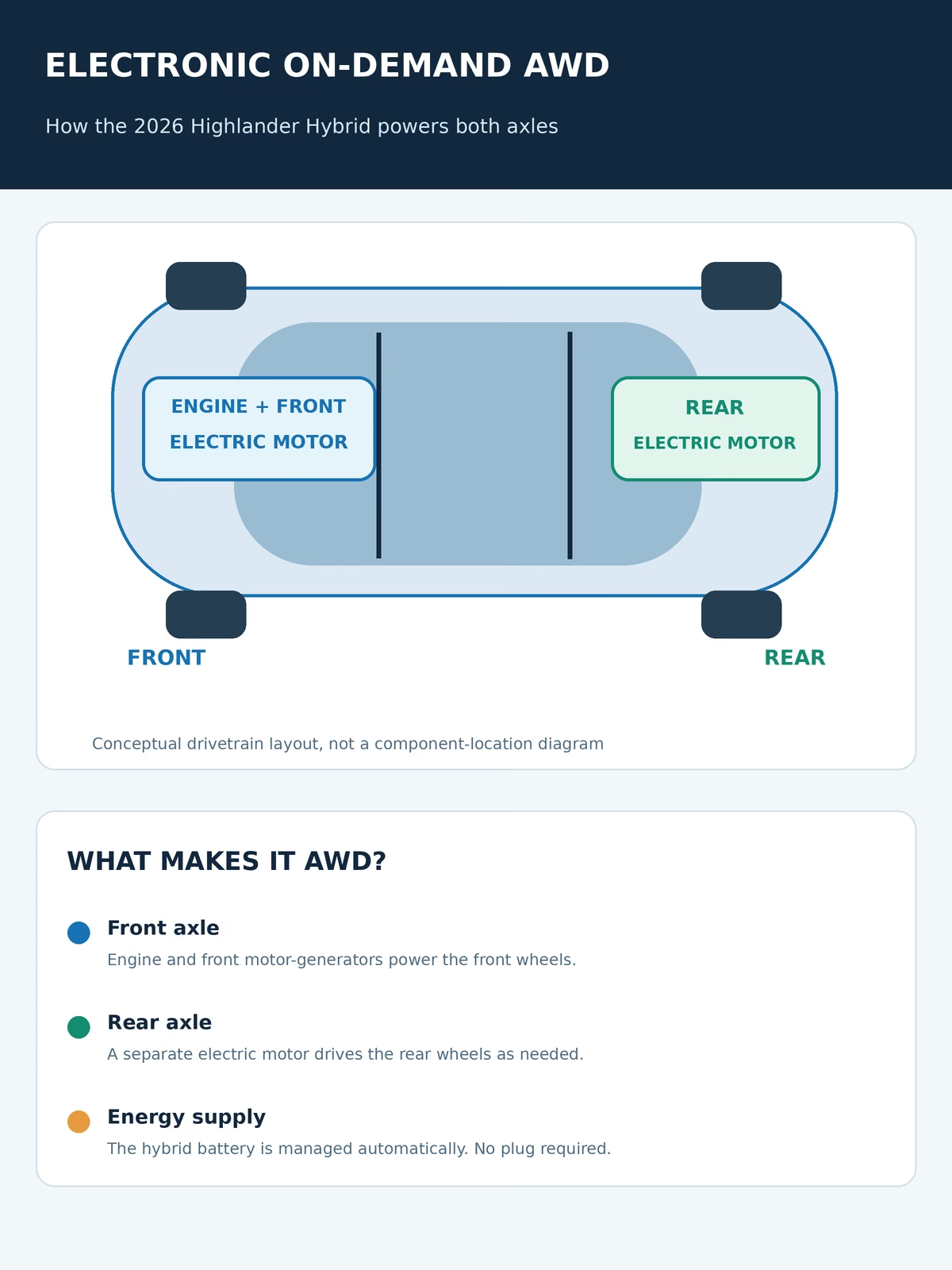
The rear electric motor operates as part of the vehicle’s integrated hybrid drivetrain.
It does not require a separate external charging cable or a dedicated electrical supply.
The hybrid control system coordinates propulsion and energy management according to driving conditions.
All-wheel drive may influence vehicle energy consumption because it changes drivetrain hardware and operating behavior, but it does not transform the Highlander Hybrid into a plug-in vehicle.
Toyota’s 2026 Highlander Hybrid is offered in XLE, Limited, and Platinum grades, all with standard Electronic On-Demand AWD.
Were Older Highlander Hybrids Available With Front-Wheel Drive?
Yes. Certain earlier U.S.-market Highlander Hybrid models were available with front-wheel drive.
Toyota’s historical documentation confirms that the original Highlander Hybrid offered front-wheel drive as standard, with an electric four-wheel-drive configuration available. [11]
Later generations also offered different drivetrain choices.
For example, Toyota’s 2023 Highlander Hybrid lineup included both front-wheel-drive and all-wheel-drive configurations.
The charging principle did not depend on having all-wheel drive. Both conventional hybrid arrangements used onboard electricity generation and regenerative braking.
This is why older Highlander Hybrid specifications should not automatically be applied to the 2026 model.
Anyone researching a used Highlander Hybrid should verify the exact model year, trim, drivetrain, and applicable maintenance documentation.
Does Predictive Efficient Drive Improve Battery Charging?
Predictive Efficient Drive, abbreviated PED, is Toyota technology designed to support efficient hybrid energy management using available driving information.
Toyota states that the 2026 Highlander Hybrid Limited and Platinum include Predictive Efficient Drive as standard equipment. [1]
The system analyzes driving patterns and relevant road and traffic information to help optimize battery energy usage and charging.
For example, a predictive energy-management strategy can preserve room in the battery for expected downhill regenerative braking or help manage charge before anticipated congested traffic.
This does not mean the vehicle can predict all driving conditions or eliminate energy losses.
Predictive Efficient Drive supports decisions about when energy should be stored or used. It does not replace the gasoline engine, regenerative braking system, or battery management controls.
Common Misconceptions About Charging the Toyota Highlander Hybrid
The language surrounding hybrid vehicles can create confusion because the terms charging, electric driving, and self-charging are used in several different contexts.
A hybrid battery may recharge without a plug, a 12-volt battery may require external maintenance charging, and a vehicle can drive electrically without being classified as a plug-in.
Recognizing these distinctions helps owners avoid incorrect assumptions about operation, energy consumption, and vehicle maintenance.
Does Self-Charging Mean the Highlander Hybrid Generates Free Electricity?
No. The Highlander Hybrid does not generate unlimited free electricity.
The energy stored in its traction battery ultimately comes from the gasoline engine or energy recovered from the vehicle’s motion.
When the gasoline engine generates electricity, it consumes fuel. When regenerative braking recovers energy, it converts some of the vehicle’s existing kinetic energy into electricity.
Neither process creates energy from nothing.
Furthermore, mechanical and electrical conversion processes involve unavoidable energy losses.
The advantage of Toyota’s hybrid system is that it can recover energy that might otherwise be wasted and use its power sources efficiently.
Describing the Highlander Hybrid as self-charging is useful when discussing convenience, but it should not be interpreted as meaning the vehicle operates without an external energy source.
Is Charging a Smartphone the Same as Charging the Hybrid Battery?
No. The vehicle’s smartphone charging equipment and its high-voltage traction battery are entirely different systems.
Toyota specifies Qi-compatible wireless smartphone charging as a standard feature of the 2026 Highlander lineup. [1]
A Qi charger transfers electrical energy to compatible mobile devices.
It does not recharge the Highlander Hybrid’s traction battery.
Similarly, USB charging ports and conventional accessory power outlets supply electricity to electronic devices, not to the high-voltage hybrid energy-storage system.
The 12-volt auxiliary battery is another separate component that may sometimes require service or maintenance charging.
Because all these activities involve electricity, they are sometimes collectively described as charging. However, their functions, voltages, safety requirements, and energy sources are different.
Which Toyota Highlander Hybrid Charging Myths Should Owners Avoid?
Several misconceptions arise when conventional hybrids are treated as though they were plug-in electric vehicles.
The most common involve home charging, battery capacity, electric-only operation, and gasoline requirements.
| Common myth | Correct explanation |
|---|---|
| Every hybrid must be plugged in. | Conventional HEVs do not require external charging. |
| The Highlander Hybrid needs a home wall charger. | Its traction battery charges through onboard systems. |
| The battery should always show a full charge. | The system manages charge within an operating range. |
| EV mode means the vehicle is a PHEV. | Limited EV operation is possible in a conventional full hybrid. |
| Regenerative braking eliminates gasoline use. | It only recovers part of the vehicle’s motion energy. |
| The Highlander Hybrid can run indefinitely without gasoline. | Gasoline remains necessary for normal operation. |
| A 12-volt charger can recharge the traction battery. | The batteries use separate electrical systems. |
| Every Highlander Hybrid has the same drivetrain. | Drivetrain configurations vary by model year. |
Understanding these distinctions allows owners to interpret the vehicle’s behavior more accurately.
The central principle remains consistent: the Highlander Hybrid automatically manages its traction-battery energy, but its efficiency still depends on gasoline consumption, recovered energy, and driving conditions.
Frequently Asked Questions About Toyota Highlander Hybrid Charging
Prospective buyers often have practical questions that go beyond whether a charging cable is necessary.
They want to know what happens when the battery charge becomes low, whether the vehicle can move without its gasoline engine running, and what to do if electrical problems develop.
The answers depend on separating normal hybrid-system operation from maintenance and emergency conditions. The following questions address those distinctions using Toyota’s documented hybrid operating principles.
Does a Toyota Highlander Hybrid Need to Be Plugged In Every Night?
No. The Toyota Highlander Hybrid does not need overnight plug-in charging.
Its traction battery is designed to receive electricity through onboard generation and regenerative braking during vehicle operation.
Unlike a plug-in hybrid, the conventional Highlander Hybrid does not have an external battery-charging inlet.
Owners can park the SUV overnight and drive normally the next day, assuming the vehicle is otherwise operating properly and has sufficient gasoline.
However, prolonged parking can affect both the traction battery and 12-volt auxiliary battery, so long-term vehicle storage requires attention to Toyota’s maintenance recommendations.
How Does a Toyota Highlander Hybrid Battery Recharge Itself?
The Highlander Hybrid recharges its traction battery through two principal mechanisms.
First, the gasoline engine can drive a motor-generator that produces electricity for the battery and hybrid system.
Second, regenerative braking converts some of the vehicle’s kinetic energy into electricity while the vehicle slows.
The onboard power electronics and battery management system regulate the flow of electrical energy.
These processes operate automatically, meaning the driver does not need to connect a charging cable or manually initiate a charging session.
The resulting energy is used to support electric propulsion and other hybrid functions.
Can You Charge a Toyota Highlander Hybrid at Home?
You cannot externally charge the conventional Highlander Hybrid’s high-voltage traction battery at home.
The vehicle has no compatible charging inlet for routine connection to a household outlet or dedicated EV charging station.
However, the separate 12-volt auxiliary battery may sometimes require maintenance charging using suitable equipment and Toyota-approved procedures.
That process is fundamentally different from plug-in charging a PHEV or BEV.
Owners should follow the correct model-specific instructions before connecting any battery maintenance equipment.
For normal use, the Highlander Hybrid simply requires gasoline refueling and automatic onboard hybrid battery management.
How Long Does It Take to Charge a Toyota Highlander Hybrid Battery?
The Highlander Hybrid does not have a fixed external charging time because it is not a plug-in vehicle.
Its battery receives electricity automatically through engine-driven generation and regenerative braking.
The rate of energy replenishment changes with engine operating conditions, vehicle speed, braking, battery state of charge, and temperature.
Consequently, there is no meaningful equivalent to the two-hour, eight-hour, or overnight charging sessions associated with plug-in vehicles.
The system manages the battery’s charge continuously as needed during operation.
A specific charging duration should not be assumed from a dashboard battery indicator because that display does not represent a conventional plug-in charging cycle.
What Happens If the Toyota Highlander Hybrid Battery Runs Low?
A low traction-battery charge level normally causes the hybrid control system to adjust how the gasoline engine and electric motors operate.
The vehicle may use engine-driven generation to replenish battery energy and reduce electric-only operation until sufficient charge is available.
This is part of normal hybrid energy management.
However, a low dashboard charge indicator should be distinguished from a persistent malfunction warning or a completely discharged traction battery.
If the vehicle cannot enter READY mode, displays a hybrid system warning, or behaves abnormally, the owner should follow the relevant manual instructions and seek professional assistance when necessary.
Can the Highlander Hybrid Charge Its Battery While Parked?
The Highlander Hybrid may use its gasoline engine to generate electricity while the vehicle is stationary and the hybrid system is operating in READY mode, depending on battery charge and operating conditions.
However, being parked does not automatically mean the traction battery is charging.
If the hybrid system is switched off, normal engine-driven charging is not taking place.
Drivers should never leave a vehicle operating unattended merely to attempt battery charging.
Running a gasoline engine in an enclosed or poorly ventilated area also creates a serious carbon monoxide hazard.
If a vehicle needs battery maintenance or has been stored for an extended period, consult Toyota’s instructions rather than improvising a charging procedure.
Can You Drive a Toyota Highlander Hybrid Using Only Electricity?
Yes, under suitable conditions.
The Highlander Hybrid can use electric propulsion at low speeds for short distances, and Toyota provides an EV mode function.
However, available electric-only operation is limited by battery charge, acceleration demand, temperature, and other operating conditions.
The vehicle is not designed to complete long electric-only journeys using a large externally charged battery.
Its gasoline engine may start automatically when more power or electrical generation is necessary.
For this reason, owners should treat EV mode as a feature of the hybrid powertrain rather than as a replacement for normal gasoline operation.
Does the Highlander Hybrid Need Gasoline to Charge Its Battery?
Gasoline is the primary external energy source for normal Highlander Hybrid operation.
The gasoline engine can provide mechanical power that a motor-generator converts into electricity.
The vehicle also recovers some kinetic energy through regenerative braking, reducing the amount of additional energy it needs from gasoline.
Therefore, not every charging event requires the engine to be operating at that moment.
Nevertheless, regenerative braking does not provide an independent, unlimited source of electrical energy.
The Highlander Hybrid still needs gasoline to operate as intended.
Drivers should not attempt to continue driving after the vehicle runs out of fuel simply because the battery shows some remaining charge.
Does the Hybrid Battery Charge Faster When Driving Downhill?
Downhill driving can create opportunities to recover electrical energy through regenerative braking.
Gravity can contribute to vehicle movement, and controlled deceleration allows the motor-generator to recover some energy that might otherwise be dissipated by friction brakes.
However, the charging rate depends on factors such as speed, slope, battery temperature, state of charge, and regeneration limits.
A nearly full battery may be unable to accept substantial additional energy.
Driving downhill therefore does not guarantee a particular charging rate.
Drivers should prioritize vehicle control, appropriate speed, and safe braking instead of trying to maximize the displayed battery charge.
What Is the Difference Between the Highlander Hybrid and a Plug-In Hybrid?
The primary difference is external charging capability.
The Highlander Hybrid is a conventional HEV that charges its battery through onboard generation and regenerative braking.
A PHEV has a traction battery designed to receive electricity from charging equipment, typically allowing a longer electric-only driving range.
PHEVs generally use larger batteries than conventional hybrids, although capacities vary significantly by model.
Both types can use gasoline engines, and both may recover energy during braking.
The best choice depends on driving patterns, charging access, vehicle requirements, and operating costs.
Drivers who do not want to arrange external charging may find a conventional hybrid more convenient.
What Should You Do If the Highlander Hybrid Won’t Start Because of a Battery Problem?
First, distinguish a possible 12-volt auxiliary battery problem from a traction-battery or hybrid-system malfunction.
A discharged auxiliary battery can prevent the vehicle from entering READY mode, even when the traction battery is not completely discharged.
Toyota provides specific procedures for assessing and addressing some auxiliary battery problems. [14]
If the vehicle displays warning messages, follow the instructions in the owner’s manual.
Do not connect a conventional battery charger to the high-voltage traction battery or attempt to open high-voltage components.
If the cause is uncertain or the vehicle remains unable to start after following appropriate instructions, contact qualified Toyota service or roadside assistance.
Conclusion: Why Plugging In Is Unnecessary for the Toyota Highlander Hybrid
The Toyota Highlander Hybrid is designed to provide the advantages of gasoline-electric propulsion without requiring an external charging routine.
Its traction battery receives energy from the gasoline engine and regenerative braking system, while onboard electronic controls manage charging, discharging, and electric motor assistance automatically.
This arrangement allows the Highlander Hybrid to offer improved fuel economy compared with its gasoline-only counterpart while retaining familiar gasoline refueling and driving habits.
For 2026 U.S. models, the combination includes a 2.5-liter gasoline engine, electric motor-generators, standard Electronic On-Demand AWD, and an EPA-estimated 35 mpg combined fuel economy rating.
Owners do not need a charging cable, residential EV charging installation, or access to public charging stations.
However, the Highlander Hybrid is not independent of gasoline. Its electrical energy ultimately comes from fuel-driven generation or energy recovered from vehicle motion.
Understanding that distinction is essential to appreciating how the hybrid system works.
For drivers who want a three-row SUV with hybrid fuel efficiency but prefer not to manage external charging, the Toyota Highlander Hybrid provides a practical conventional hybrid solution.
Its central advantage is straightforward: the vehicle manages its hybrid battery charging automatically, so plugging it in is unnecessary.
Sources
The following references prioritize Toyota’s official product announcements, manufacturer specifications, owner’s manuals, the U.S. Environmental Protection Agency, and the U.S. Department of Energy. Specifications, warranty terms, and equipment availability are identified by model year and market wherever necessary. The technical explanations are based on conventional hybrid operating principles, while 2026 Highlander figures specifically describe U.S.-market vehicles.
- Toyota USA Newsroom: 2026 Toyota Highlander Gets Standard All-Wheel Drive Across the Lineup. Toyota Motor Sales, September 5, 2025. Official vehicle powertrain, regenerative braking, driving modes, AWD, horsepower, and Predictive Efficient Drive information.
- U.S. Department of Energy: How Do Hybrid Electric Cars Work?. Alternative Fuels Data Center. Authoritative definitions of hybrid vehicle components, electric motors, traction batteries, and onboard charging.
- U.S. Department of Energy: Hybrid Electric Vehicles. Alternative Fuels Data Center. Conventional hybrid classifications, full and mild hybrid distinctions, energy recovery, and battery charging.
- U.S. EPA and Department of Energy: 2026 Toyota Highlander Fuel Economy. Official U.S. fuel economy, driving range, and greenhouse gas comparisons.
- Toyota: 2026 Highlander Specifications. Manufacturer specifications for hybrid powertrains, performance, and equipment.
- Toyota Owners: 2025 Highlander Hybrid Gauges and Meters. Official explanation of the Hybrid System Indicator, READY status, and regenerative energy information.
- Toyota Owners: 2026 Highlander Manuals and Warranty Information. Manufacturer guidance covering hybrid battery warranty terms, maintenance, and owner documentation.
- U.S. Department of Energy: Plug-In Hybrid Electric Vehicles. Authoritative explanation of PHEV operation, battery charging methods, gasoline use, and electric-only range.
- U.S. Department of Energy: Electric Vehicle Charging Stations. Charging connectors, Level 1, Level 2, DC fast charging, and electrical infrastructure.
- U.S. Department of Energy: Efficient Driving to Conserve Fuel. Research-based information on driving behavior, fuel consumption, and efficiency feedback.
- Toyota USA Newsroom: Celebrating the Highlander’s 25th Edition. Official historical information on Highlander Hybrid generations, early front-wheel-drive models, and drivetrain evolution.
- Toyota USA Newsroom: 2026 Toyota RAV4 Hybrid and Plug-In Hybrid. Official information on electric range, charging equipment, and plug-in hybrid specifications.
- Toyota USA Newsroom: 2026 Prius Plug-In Hybrid. Manufacturer information on Prius plug-in hybrid battery capacity and electric-only driving capability.
- Toyota Owners: Highlander Hybrid If the Hybrid System Will Not Start. Official model-specific reference for starting problems and associated emergency guidance.
- U.S. Department of Energy: Maintenance and Safety of Electric Vehicles. Maintenance and safety considerations for hybrid and electric vehicle systems.
- U.S. Department of Energy: Emissions From Electric Vehicles. Explanations of tailpipe emissions and differences among conventional, hybrid, plug-in hybrid, and electric vehicles.
- Toyota USA Newsroom: 2023 Highlander Hybrid Powertrain. Toyota information on motor-generator operation, drivetrain options, and predictive hybrid energy management.
- Toyota Highlander Hybrid Owner’s Manual. Official Toyota manual covering battery charging, hybrid precautions, cooling ventilation, extended storage, and energy-management functions. Consult the manual matching the vehicle’s actual model year.
Research note: Market-specific information may vary. The 2026 figures in this article primarily apply to the United States. Owner instructions, service recommendations, and warranty coverage should always be verified against the documentation supplied for the individual vehicle.