
Choosing between a motorcycle windshield extension and a complete windshield replacement can significantly affect riding comfort, wind exposure, helmet turbulence, and visibility. Both upgrades aim to improve airflow around the motorcycle, but they accomplish this in different ways.
A windshield extension attaches to an existing windscreen, usually to change the height or direction of airflow near its upper edge. A replacement windshield substitutes the original screen with a different design, potentially changing its overall height, width, curvature, and aerodynamic characteristics.
Neither solution is automatically better. The right choice depends on the motorcycle, the rider’s seated height, riding posture, existing windshield geometry, and the particular wind-related problem.
For riders experiencing helmet buffeting or excessive wind noise, a properly adjusted extension may provide sufficient improvement without replacing the factory windshield. However, riders needing substantially more coverage or a different screen shape may benefit more from a complete replacement.
Understanding these differences is essential because better wind protection does not always mean less turbulence, lower wind noise, or reduced aerodynamic drag. The most effective windshield is one that directs airflow appropriately while maintaining clear visibility, secure mounting, and predictable motorcycle handling.
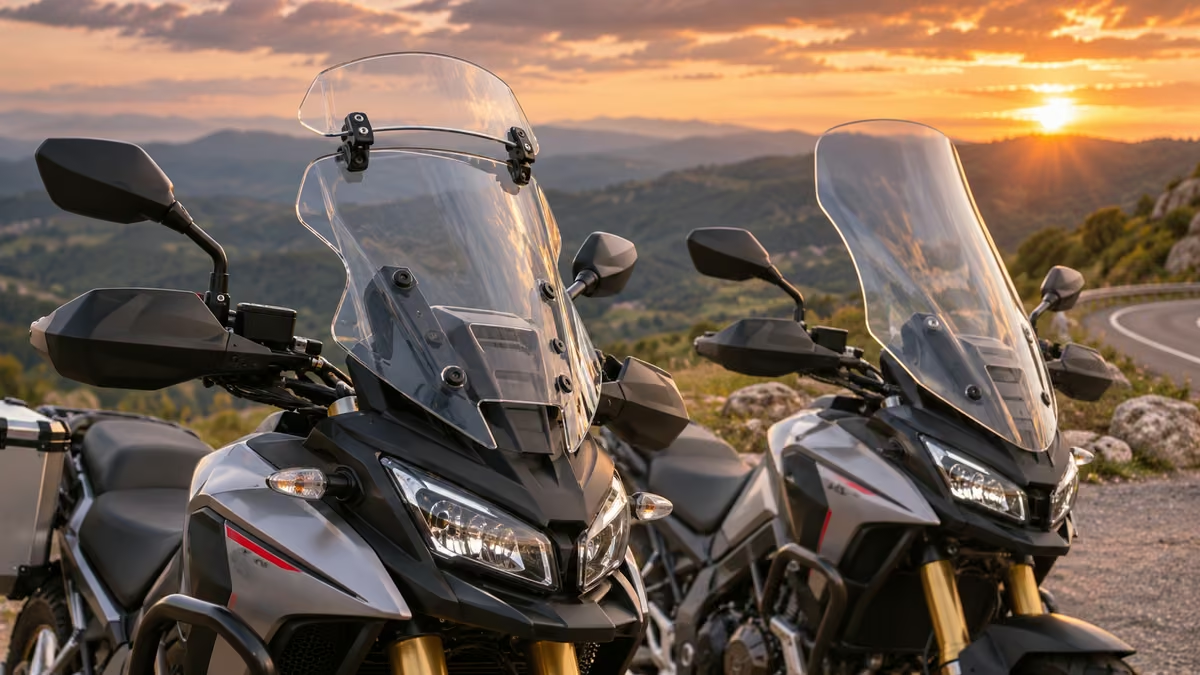
Motorcycle Windshield Extension vs. Replacement: Quick Answer
A motorcycle windshield extension is generally worth considering when the existing windshield is in good condition and needs only a modest change in airflow direction or effective height. Adjustable clip-on spoilers can be especially useful for experimenting with different settings.
A complete windshield replacement is usually more appropriate when the factory screen is substantially too short, too narrow, damaged, or poorly shaped for the rider’s requirements.
The fundamental distinction is that an extension modifies the airflow around an existing windshield, while replacement changes the geometry of the primary windscreen itself.
| Factor | Windshield Extension | Windshield Replacement |
|---|---|---|
| Primary function | Modifies airflow over the original screen | Changes the complete windscreen profile |
| Wind protection | Improves selected airflow areas | Can change overall rider coverage |
| Height adjustment | Often adjustable | Fixed or adjustable, depending on model |
| Width coverage | Usually limited to existing screen width | Can be substantially different |
| Helmet buffeting | May improve or worsen it | May improve or worsen it |
| Wind noise | Depends on airflow and adjustment | Depends on screen design and fit |
| Installation | Often relatively straightforward | Usually involves removing the original screen |
| Mounting system | Clamps or spoiler-specific fasteners | Original or dedicated mounting hardware |
| Compatibility | Depends on existing screen geometry | Usually specific to motorcycle model and year |
| Appearance | Additional component remains visible | Often appears more integrated |
| Initial cost | Often lower | Often higher |
| Best application | Fine-tuning an otherwise suitable windshield | Correcting substantial coverage or design limitations |
The comparison does not establish a universal winner. Research into motorcycle aerodynamic performance shows that windscreen changes can improve protection from direct wind while increasing overall aerodynamic resistance. Consequently, rider comfort, noise, and drag must be evaluated separately rather than treated as interchangeable performance measures.[1]
What Is a Motorcycle Windshield Extension?
A motorcycle windshield extension is an accessory fitted to an existing windshield to alter the airflow reaching the rider. It is also called a windshield extender, wind deflector, windscreen spoiler, or adjustable visor.
Most extensions are positioned near the upper edge of the existing screen. Depending on their design, they may be adjustable vertically, rotationally, or both.
Rather than simply blocking additional air, an extension changes the direction in which airflow leaves the original windshield. This can shift turbulent airflow away from the rider’s helmet or upper body.
The effectiveness depends on the original windshield’s aerodynamic behavior and the extension’s mounting position. An extension cannot necessarily compensate for a factory windshield that is fundamentally unsuitable for the rider.
Clip-On Windshield Deflectors
A clip-on windshield deflector uses mechanical clamps to attach to the upper portion of an existing windscreen. Many designs do not require drilling, making them a practical option for riders who prefer reversible modifications.
A manufacturer example is the GIVI S180T Shield+, which uses an adjustable aluminum mounting assembly and is designed to change the spoiler’s height and inclination. GIVI specifically advises customers to confirm that their original windshield is sufficiently rigid to support the accessory.[2]
Clamp-on installation has important limitations. The original windshield must have suitable thickness, curvature, edge geometry, and mounting strength.
A clip-on deflector should not be assumed compatible merely because it is advertised as universal. Proper installation requires checking the actual product’s instructions and verifying that the clamps engage securely without placing excessive stress on the screen.
Adjustable Windshield Spoilers
An adjustable windshield spoiler allows riders to modify the position of the additional deflector relative to the main windscreen.
Some products offer several tilt settings, while others allow changes to height, angle, or distance from the original screen.
For example, Puig’s Multi-Adjustable Visor 2.0 Clip-On uses a polycarbonate deflector and an adjustable mounting arrangement. The manufacturer also emphasizes the need to check compatibility before installation.[3]
Adjustability is particularly valuable when the rider is trying to reduce helmet turbulence. Small changes in spoiler inclination may alter where the windscreen’s turbulent wake reaches the helmet.
However, an adjustable spoiler is not inherently superior to a fixed design. Its benefits depend on usable adjustment range, mechanical stability, and whether the modified airflow actually improves the riding experience.
Fixed Windshield Extensions
Fixed windshield extensions provide additional deflection without a user-adjustable mechanism. Some use permanent attachment points, while others form part of a replacement windshield assembly.
Their principal advantage is mechanical simplicity. With fewer adjustable joints, there may be fewer components that require positioning or inspection, although actual stability depends on the complete mounting design.
The primary disadvantage is limited tuning capability. If the fixed extension sends turbulent airflow toward the rider’s visor, the rider may have little opportunity to correct the problem without changing the accessory.
Fixed extensions are most appropriate when their dimensions and airflow characteristics are already suitable for the motorcycle and rider. They should not be selected solely because they appear taller than the original windscreen.
Advantages and Disadvantages of Windshield Extensions
The most significant advantage of a windshield extension is the ability to alter airflow while retaining the original windscreen. Many riders can experiment with different positions without purchasing a complete replacement.
Extensions can also be useful when the factory windshield already provides satisfactory chest and shoulder coverage but creates uncomfortable airflow around the helmet.
However, the additional deflector increases aerodynamic loading on the original screen and its mounting system. Poorly supported windshields may flex or vibrate more after installation.
Extensions can also introduce extra visual surfaces, mounting hardware, and potential optical distortion. Their limited width means they may not resolve problems caused by inadequate lateral coverage.
For these reasons, windshield extensions are best viewed as targeted airflow modifications rather than universal replacements for larger touring windscreens.
What Is a Motorcycle Windshield Replacement?
Motorcycle windshield replacement involves removing the existing windscreen and installing a different one, usually using the motorcycle’s original mounting locations or a compatible aftermarket bracket system.
Replacement windscreens are available in different heights, widths, shapes, materials, and finishes. Some are designed to reproduce the original factory appearance, while others prioritize touring comfort or aerodynamic performance.
Unlike extensions, replacement windshields can alter the entire airflow path around the screen.
A wider replacement may provide more shoulder coverage, while a taller design may change where the wind reaches the helmet. Curved or specially shaped screens can also modify airflow without requiring a large increase in height.
Nevertheless, an aftermarket replacement does not guarantee better performance than the original windshield. Results depend on the complete motorcycle and rider configuration.
Touring Windshields
Touring windshields are generally designed to provide greater wind coverage during sustained riding. Depending on the motorcycle model, they may be taller, wider, or differently contoured than factory screens.
A properly fitted touring windshield can reduce direct wind pressure on the rider’s chest and upper body. It may also reduce exposure to rain and airborne debris, although it cannot provide complete weather protection.
Touring screens are particularly relevant for adventure motorcycles, large touring motorcycles, and sport-tourers used for long journeys.
However, excessive height can create visibility problems, especially when the screen becomes dirty or wet. A taller windshield may also relocate turbulence toward the helmet rather than eliminate it.
Therefore, touring windshield selection should account for seated rider height, screen shape, visibility, and compatible mounting hardware.
Sport and Sport-Touring Windshields
Sport motorcycle windshields are usually designed around a more forward-leaning riding position. Their shape may direct air toward the upper body when the rider sits upright but provide different protection when the rider adopts a tucked position.
Double-bubble windshields are common aftermarket designs for sport motorcycles. Their raised central contour changes the flow around the rider’s helmet and upper torso, particularly in more aerodynamic riding positions.
A sport-touring windshield often emphasizes a compromise between wind protection and compact dimensions.
The correct design depends on how the motorcycle is actually ridden. A windshield that performs well while the rider is tucked behind the fairing may produce undesirable turbulence during relaxed upright riding.
Consequently, choosing a sport windshield solely because it is taller or marketed as aerodynamic can lead to disappointing results.
Adventure Motorcycle Windshields
Adventure motorcycles often feature relatively upright seating positions and windscreens designed to balance highway protection with visibility and rider movement.
Aftermarket adventure windshields may offer additional height, greater width, or adjustable mounting mechanisms.
These changes can help riders who experience sustained wind pressure or helmet buffeting during long-distance riding.
However, adventure motorcycles also require consideration of standing riding positions. A tall or protruding windshield can interfere with rider movement or create an injury hazard during abrupt body movement.
The screen must also remain compatible with handlebars, handguards, mirrors, navigation equipment, and factory adjustment mechanisms.
For riders who frequently alternate between highway riding and unpaved roads, a moderate-height screen with appropriate adjustment may provide a better compromise than an excessively tall fixed replacement.
Motorcycle Windshield Aerodynamics: How Wind Protection Actually Works
Motorcycle windshield aerodynamics involves how moving air interacts with the windscreen, fairing, rider, and surrounding motorcycle components.
As the motorcycle travels through the air, the windshield changes the flow around the front of the vehicle. Air travels around its sides and over its upper edge, while pressure differences develop in front of and behind the screen.
Behind the windshield, separated airflow can create an irregular turbulent region called a wake.
The location of this wake is important because the rider’s helmet and upper body may be exposed to different airflow conditions depending on windshield height and posture.
An effective windshield does not necessarily eliminate turbulence. Instead, it seeks to place the most disruptive airflow away from sensitive areas while maintaining safe visibility and reasonable aerodynamic loading.
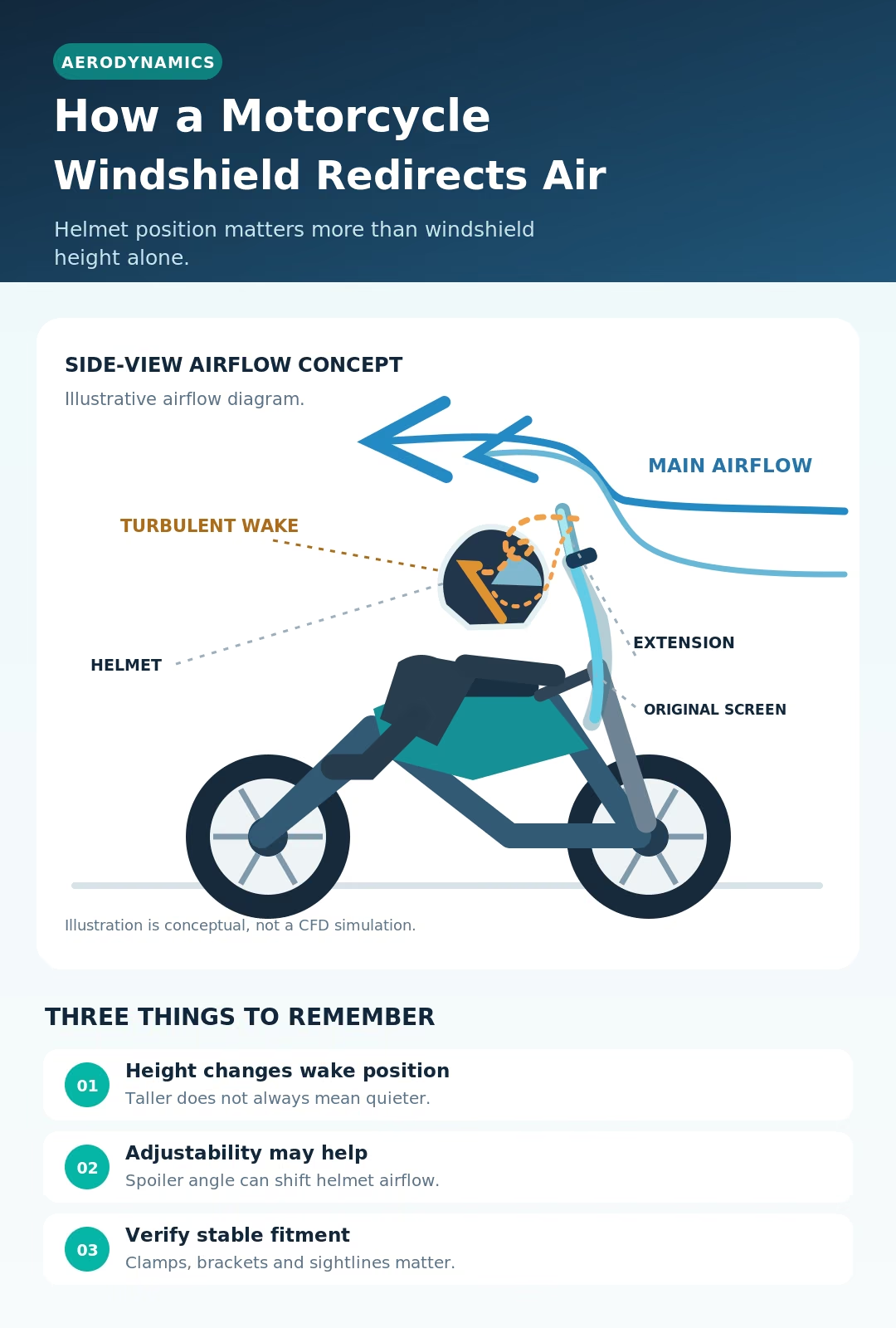
Airflow Deflection and Pressure Distribution
Airflow deflection is the process through which a windshield changes the direction of approaching air.
A short windscreen may direct the main airflow toward the rider’s chest, shoulders, or lower helmet. A taller windscreen may move the upper flow boundary toward the visor or above the helmet.
However, the relationship is not always linear because airflow can separate from the screen and produce turbulent eddies.
An extension may modify the airflow leaving the original windshield, whereas a replacement changes the primary surface interacting with the approaching air.
Some windshield designs also incorporate controlled gaps or vents intended to influence pressure differences and airflow behind the screen. Their effectiveness depends on the complete geometry and cannot be assumed for every motorcycle.
The aim is to improve the rider’s actual exposure to turbulent airflow rather than simply increase windshield surface area.
Windshield Height, Angle, and Rake
Windshield height influences where airflow passes relative to the rider’s head and upper body. Windshield angle, sometimes called rake, describes the inclination of the screen relative to the motorcycle.
These dimensions interact with one another.
A relatively upright windshield may redirect airflow differently from a more rearward-sloping screen of similar overall height. Curvature, mounting distance, and surrounding fairing geometry further influence the result.
Adjustable windshield spoilers can change airflow without necessarily increasing the total screen height by a large amount.
For this reason, a well-positioned extension can sometimes outperform a substantially taller fixed screen for a particular rider.
However, simply tilting an extension backward or forward does not guarantee improvement. The resulting airflow must be evaluated during controlled riding tests, and adjustment must remain within the manufacturer’s approved range.
Aerodynamic Drag and Motorcycle Performance
Aerodynamic drag is the force resisting a motorcycle’s motion through the air.
NASA describes aerodynamic drag using the relationship:
Drag = ½ × air density × velocity² × drag coefficient × reference area.
This equation shows that aerodynamic force depends strongly on speed, as well as the effective size and shape of the object.[4]
For a fixed aerodynamic configuration under otherwise comparable conditions, doubling the airspeed produces approximately four times the drag force.
However, windshield modifications can change both effective frontal area and the drag coefficient. A taller screen might increase drag, while a carefully shaped replacement could change airflow in ways that partly offset that increase.
A 2024 computational fluid dynamics study examined different windshield designs on a Honda CB500X at a simulated speed of 140 km/h. The original windshield produced lower modeled drag than the three aftermarket designs, while the aftermarket screens showed improved airflow deflection away from the rider.[1]
This is an instructive tradeoff, not a universal finding about all replacement windshields. It was a simulation involving specific designs and conditions, not proof that factory windscreens always generate less drag.
Fuel consumption may also change when aerodynamic resistance changes, particularly during sustained highway riding. The direction and magnitude of that change cannot be predicted reliably from windshield height alone.
Wind Buffeting: Which Upgrade Works Better?
Wind buffeting refers to irregular aerodynamic forces that produce uncomfortable pressure pulses, helmet shaking, or vibration around a motorcycle rider.
It differs from steady wind pressure. A rider may tolerate a consistent stream of air but find rapidly fluctuating airflow exhausting.
Motorcycle windscreens can influence buffeting because airflow separates near the edges of the screen and develops complex turbulent structures.
Both windshield extensions and replacements can change these structures.
An extension may redirect turbulent airflow away from the helmet, while a replacement may create a different wake through changes in screen geometry. The best solution depends on where the helmet sits relative to the airflow.
What Causes Helmet Turbulence?
Helmet turbulence occurs when irregular airflow interacts with the helmet’s surface, creating fluctuating aerodynamic forces and noise.
The windscreen’s upper edge is often an important contributor because it can generate a turbulent wake.
Research published through the University of Bath identified three principal airflow conditions around a motorcycle helmet: exposure to relatively undisturbed free-stream air, exposure to the windscreen’s vortex-shedding region, and positioning beneath that region in the windshield’s shelter.[5]
This helps explain why a rider may experience more discomfort after installing a taller windshield.
If the modification moves the turbulent wake directly onto the helmet, shaking and wind noise may increase even though the rider feels less pressure on the chest.
Helmet position, windscreen geometry, riding posture, and the surrounding motorcycle bodywork all influence the outcome.
Can a Windshield Extension Reduce Buffeting?
A windshield extension may reduce buffeting when it changes the direction of turbulent airflow so that less of the windscreen’s wake strikes the helmet.
An adjustable spoiler offers several possible positions for experimentation.
For example, if the existing windshield directs turbulent air toward the rider’s lower visor, an appropriately positioned extension may shift the flow higher.
However, the opposite result is also possible. A poorly positioned extension can introduce additional turbulence, aerodynamic vibration, or wind noise.
The most useful approach is to adjust the spoiler incrementally while the motorcycle is stationary, then test the resulting airflow under comparable riding conditions.
If multiple approved adjustments fail to improve comfort, the original windshield’s geometry may be unsuitable for the rider.
Can a Replacement Windshield Eliminate Buffeting?
A replacement windshield may substantially reduce buffeting when the existing screen has an unsuitable height, shape, or width.
Changing the complete screen can produce an airflow pattern that cannot be achieved by adding a small spoiler.
However, no replacement design can be expected to eliminate turbulence under every riding condition.
Crosswinds, turbulence from nearby vehicles, helmet shape, rider posture, and motorcycle fairing geometry continue to influence airflow.
A taller replacement can also create new buffeting if its wake intersects the helmet.
The best replacement is therefore not necessarily the tallest option available. A shorter, differently curved, or wider screen may sometimes produce more favorable results.
Claims that a particular windshield completely eliminates buffeting should be treated cautiously unless supported by testing relevant to the rider’s motorcycle and conditions.
Wind Noise Reduction: Extension vs. Replacement
Wind noise is one of the most common reasons riders investigate motorcycle windshield upgrades.
At road speeds, turbulent airflow around the helmet can produce considerable noise. The interaction between the windshield’s wake and the helmet is an important variable.
Both extensions and replacements can alter this interaction, but reduced wind pressure does not necessarily correspond to lower sound levels.
A taller windshield might shelter the rider’s chest while directing turbulent air toward the helmet.
Similarly, a smaller extension might improve helmet airflow without substantially changing the rider’s overall wind exposure.
Noise reduction must therefore be assessed independently from perceived wind protection.
What Motorcycle Wind Noise Research Shows
The University of Bath research on windscreen airflow and helmet noise reported differences exceeding 10 dB in measured sound pressure levels under different rider positions and helmet angles.[5]
This does not mean that every windshield adjustment produces a 10 dB reduction. The study demonstrates that helmet position relative to turbulent airflow can significantly influence sound levels.
Other published research has identified excessive wind noise as a concern for motorcycle riders.
A study of motorcycle hearing protection found that suitable earplugs prevented a measured temporary hearing threshold shift following the high-speed riding exposure studied.[6]
These findings support two separate objectives: optimizing airflow around the helmet and protecting hearing.
An effective windshield may make a ride quieter, but it should not be treated as a substitute for appropriate hearing protection during prolonged noisy riding.
Which Option Is Quieter?
Neither windshield extension nor replacement is inherently quieter.
An extension can be effective if the original windshield already provides adequate protection but directs turbulent air toward the helmet. Adjusting the extension may change that flow path.
A replacement can be preferable when the entire windshield contour contributes to unfavorable airflow.
The rider’s helmet also matters. Different shell shapes, visor seals, ventilation openings, and fit characteristics can influence perceived wind noise.
To compare upgrades meaningfully, use the same helmet, clothing, riding posture, and comparable weather and speed conditions.
A subjective reduction in noise can be useful feedback, but precise claims about decibel reduction require appropriate acoustic measurements.
Choosing the Correct Motorcycle Windscreen Height
Windshield height is a major consideration because it influences the location of airflow relative to the rider.
However, the correct windshield height depends on the motorcycle and the rider’s seated position rather than standing height alone.
A taller rider with a relatively short torso may sit lower behind a windshield than a shorter rider with a comparatively long torso.
Seat thickness, suspension sag, handlebars, and normal riding posture further influence helmet position.
A proper fit should balance aerodynamic protection with an unobstructed view of the road.
Rider Height and Windshield Fit
The most useful measurement for windshield selection is the rider’s effective seated height in the normal riding position.
National Cycle recommends measuring while seated on the motorcycle with the suspension settled and the hands positioned naturally on the handlebars.[7]
The manufacturer also notes that riders of the same standing height may need different screens because their torso lengths and riding positions differ.
When comparing windshields, check how the manufacturer measures height.
Some measurements begin at the screen’s bottom edge, while others begin at the headlight cutout, fairing channel, or another reference point.
Consequently, two products advertised with the same height may not provide identical effective coverage when installed.
Should You Look Over or Through a Windshield?
Being able to see over the windshield can be especially valuable when the screen is covered with rain, dust, dirt, or insects.
National Cycle describes a commonly used fitment guideline in which the rider can look just over the windshield’s upper edge and see the road approximately 50 feet, or 15 meters, ahead.[7]
This is manufacturer guidance rather than a universal legal requirement.
A properly designed tall screen may be intended to be looked through, but optical quality and the ability to maintain visibility in adverse conditions become particularly important.
For riders selecting an extension, its upper edge and mounting hardware must not create a distracting obstruction in the normal line of sight.
Always follow the applicable motorcycle and windscreen manufacturer guidance and any relevant local vehicle requirements.
When Is a Windshield Extension Tall Enough?
A windshield extension may provide sufficient additional height when the factory screen already creates a useful sheltered region and only the upper airflow path needs adjustment.
For example, an extension may help a rider whose helmet sits near the turbulent boundary at the top of the original windshield.
The adjustable deflector can potentially redirect that boundary without requiring a much larger screen.
However, an extension has limited ability to change the main windshield’s dimensions.
If the factory screen is substantially too short to protect the upper body, a small spoiler may not produce enough improvement.
The available mounting area and mechanical strength of the original screen also limit how much extension height can be safely added.
When Is a Taller Replacement Necessary?
A taller replacement becomes worth considering when the required improvement exceeds the practical adjustment range of an extension.
This may occur when substantial upper-body wind exposure persists, the existing windshield is unusually low, or the original screen cannot safely support an additional deflector.
A replacement also offers the opportunity to select a different contour rather than simply increase height.
However, greater height introduces considerations involving sight lines, screen movement, and aerodynamic loading.
The replacement should be evaluated using the rider’s actual seated position and its manufacturer-specified mounting system.
Selecting an excessively tall windshield solely to place all airflow above the head can create unacceptable visibility compromises.
Windshield Width and Coverage: Why Height Is Not Everything
Motorcycle windshield width influences airflow around the rider’s shoulders and upper body.
A narrow screen may redirect air away from the center of the chest while allowing substantial wind to reach the shoulders from either side.
This can be particularly noticeable during sustained highway riding.
Most extensions primarily influence airflow near the original windshield’s upper edge. They do not substantially change the underlying screen width.
A replacement windshield can offer broader coverage through a different overall profile.
However, width changes also influence aerodynamic loading, steering clearance, and potentially the motorcycle’s response to crosswinds.
Limitations of Windshield Extensions
An extension is not always a suitable solution when lateral wind exposure is the primary complaint.
Suppose a rider experiences strong wind pressure around both shoulders while the helmet remains relatively comfortable.
Adding a narrow upper spoiler may shift airflow near the helmet without meaningfully changing the wind reaching the shoulders.
Similarly, an extension generally cannot solve problems caused by a very narrow factory screen or inadequate overall fairing coverage.
Some wider extensions may influence a larger portion of the airflow, but their effectiveness remains dependent on the original windscreen.
If broader protection is the objective, a purpose-designed replacement may offer more appropriate dimensions.
Benefits and Tradeoffs of Wider Replacement Windshields
A wider replacement windshield can redirect more of the approaching airflow around the rider’s upper body.
This may improve comfort during touring, especially when shoulder exposure is a significant concern.
However, a wider screen is not automatically more aerodynamic or more stable.
Its impact depends on the shape, mounting position, and interaction with the motorcycle’s fairing and steering system.
Additional surface area can create greater aerodynamic loading, particularly in strong winds or turbulent traffic conditions.
Before installation, verify that the screen and brackets are approved for the motorcycle and that the windshield does not interfere with steering or controls.
The best width is one that provides suitable coverage without compromising visibility, mechanical integrity, or handling.
Highway Riding Comfort: Which Windshield Performs Better?
Highway riding exposes motorcyclists to sustained aerodynamic forces that become more significant as speed increases.
An effective windshield may reduce direct pressure on the chest and upper body, helping the rider maintain a comfortable posture.
However, turbulence and noise remain important even when direct wind pressure decreases.
For long-distance touring, a full replacement windshield may provide broader coverage than an extension.
For riders whose factory windshield already performs well except around the helmet, a small adjustable spoiler may be sufficient.
The relationship between wind protection and comfort therefore depends on the rider’s specific exposure rather than the size of the accessory alone.
City Riding vs. Highway Riding
At lower urban speeds, many riders prefer smaller screens because they provide modest wind protection without unnecessarily obstructing visibility.
During prolonged highway riding, greater aerodynamic protection may become more valuable.
However, the same windshield can behave differently at different speeds because the strength of aerodynamic forces changes and the airflow characteristics may also change.
A windshield extension that feels comfortable during ordinary commuting might produce noticeable vibration or turbulence at higher speeds.
Likewise, a large touring screen may be unnecessary for a rider whose motorcycle is used almost exclusively for short urban journeys.
Choosing an upgrade based on the speeds and conditions most frequently encountered is more useful than selecting the largest available windscreen.
Riding Posture and Ergonomics
Riding posture changes the helmet’s position relative to the windshield.
An upright adventure rider sits differently from a sport motorcycle rider leaning forward over the fuel tank.
These positions can expose the helmet to different parts of the windscreen’s wake, even when the windshield itself remains unchanged.
Seat height adjustments, handlebar modifications, and different riding positions can also alter airflow exposure.
A windshield selected for an upright position may be less suitable when the rider adopts a tucked posture.
Passenger comfort should also be considered on touring motorcycles, although a windshield that improves airflow for the rider will not necessarily provide the same result for a passenger.
The best aerodynamic arrangement must be evaluated in the positions normally used during riding.
Acrylic vs. Polycarbonate Motorcycle Windshields
Motorcycle windshields commonly use transparent thermoplastic materials, particularly acrylic and polycarbonate.
Both materials are available in different grades, thicknesses, finishes, and surface coatings.
Acrylic, also known as PMMA, is valued for its optical clarity and weathering characteristics.
Polycarbonate is generally valued for its high impact resistance and toughness.
However, material selection is not simply a choice between clarity and strength. Manufacturing quality, thickness, protective coatings, screen geometry, and mounting design also affect performance.
National Cycle distinguishes between standard acrylic, high-impact acrylic, and hard-coated polycarbonate, noting that their properties differ substantially.[8]
Acrylic Motorcycle Windshields
Acrylic windscreens can provide excellent transparency and a clean surface appearance.
The material is available in standard and impact-modified forms, which have different resistance to cracking and fracture.
Compared with polycarbonate, standard acrylic is generally more brittle under impact.
However, acrylic’s behavior depends on the particular material formulation and screen design. It is not appropriate to assume every acrylic screen has identical durability.
Acrylic windscreens can also develop scratches or stress damage through improper cleaning, incompatible chemicals, or unsuitable mounting arrangements.
A well-manufactured acrylic windshield may remain serviceable for years when properly installed and maintained.
For riders considering replacement, the quality of the finished product and the manufacturer’s material specifications are more useful than the material name alone.
Polycarbonate Motorcycle Windshields
Polycarbonate is known for high impact toughness and resistance to fracture compared with conventional acrylic.
This makes it suitable for many motorcycle windshield applications.
However, uncoated polycarbonate can be susceptible to scratching, so quality manufacturers often apply protective surface treatments.
National Cycle offers hard-coated polycarbonate products and publishes comparative information about their abrasion and impact properties.[8]
Those performance figures relate to specific materials and coating systems, not every polycarbonate windshield.
A polycarbonate extension or replacement should therefore be evaluated according to its actual material grade, coating, thickness, optical quality, and mounting requirements.
The availability of replacement parts and manufacturer support is also relevant to long-term ownership.
Optical Clarity and Distortion
Optical clarity is especially important when a windshield or extension enters the rider’s forward field of view.
Curvature, manufacturing quality, surface scratches, and material deformation can distort the apparent position of objects.
Adding an extension creates another transparent surface and potentially introduces visible mounting brackets.
Light reflections or the interaction between overlapping surfaces may also become distracting under certain conditions.
These concerns are particularly relevant during rain or nighttime riding when reflections and reduced contrast can make hazards harder to identify.
A replacement windshield may provide a more continuous viewing surface, but it can still have distortion if poorly designed or manufactured.
Always evaluate visibility in the normal riding posture before using a windshield on public roads.
Motorcycle Model Compatibility: What Must Be Checked?
Windshield compatibility is one of the most important factors in a successful upgrade.
An accessory that fits one motorcycle may not fit another, even when the motorcycles appear to have similar windscreens.
Extensions depend heavily on the shape and structural characteristics of the existing screen.
Replacement windshields often rely on specific mounting holes, brackets, fairing shapes, and model-year configurations.
A product advertised for a broad category of motorcycles should not be considered compatible without checking the manufacturer documentation.
Compatibility must include both physical fitment and the ability of the complete mounting system to withstand the loads created during riding.
Compatibility of Windshield Extensions
Before choosing a clip-on deflector, inspect the original windshield’s edge shape, curvature, thickness, and available mounting area.
A clamp designed for a relatively flat screen may not seat properly on a strongly curved edge.
The existing screen must also be sufficiently rigid.
GIVI explicitly makes the rigidity of the original windscreen a compatibility consideration for its Shield+ accessory.[2]
Additionally, the extension must not obstruct the instrument cluster or interfere with adjustment mechanisms.
Check whether the manufacturer permits installation on tinted, coated, flexible, or unusually shaped factory screens.
An extension should never be forced into position using excessive clamp pressure or improvised brackets.
A secure fit under stationary conditions is necessary but does not alone establish that the installation is appropriate for riding.
Compatibility of Aftermarket Replacement Windshields
Replacement windshields should be selected using the motorcycle’s manufacturer, model, model year, and applicable variant.
Changes between model generations may affect fairing contours and mounting positions.
Even when bolt patterns appear identical, windshield curvature and surrounding components may differ.
Check compatibility with mirrors, handguards, navigation mounts, instrument clusters, and other accessories.
Some replacement screens are supplied with dedicated mounting hardware, while others are designed to use factory brackets.
Puig, for example, provides model-specific fitment and approval information for its touring windshield products.[9]
Where road-use approval or certification is relevant, verify the actual product documentation and the regulations applicable in the location where the motorcycle is registered.
A windshield should not be considered road-approved merely because the manufacturer offers approval for other models or markets.
Clip-On vs. Bolt-On Motorcycle Windshield Installation
Installation methods differ according to the accessory.
Clip-on extensions typically use clamps around the edge of the existing windscreen. Some spoiler systems instead use drilled mounting holes and dedicated fasteners.
Replacement windshields generally require removal of the original screen followed by installation of a different assembly.
Neither method is automatically safer.
The quality of the mounting design, compatibility with the motorcycle, installation accuracy, and maintenance are more important than the distinction between clamps and bolts.
Manufacturer instructions should always take priority over generic installation advice.
How to Install a Clip-On Windshield Deflector
A clip-on deflector should be installed only after confirming that the original windshield meets the product’s compatibility requirements.
Begin with the motorcycle securely parked and the windscreen clean.
Inspect the clamps, protective contact surfaces, adjustment joints, and fasteners for damage.
Position the extension according to the manufacturer’s instructions, ensuring that the clamps contact the intended areas.
Tighten the hardware using the specified procedure and torque values, where provided.
Do not exceed the recommended clamping force in an attempt to eliminate movement.
After mounting, verify that the extension remains securely seated, does not obstruct the rider’s view, and cannot contact surrounding components.
Any subsequent angle or height adjustments should be performed while stationary and within the permitted adjustment range.
How to Install a Replacement Motorcycle Windshield
The basic replacement procedure involves removing the factory windshield and installing the compatible new screen using the required mounting components.
Before beginning, read both the motorcycle service guidance and the replacement windshield instructions.
Inspect the original mounting brackets, rubber grommets, spacers, and fasteners.
Some components may be intended for reuse, while others must be replaced with supplied hardware.
Position the new windshield carefully to avoid introducing stress during fastening.
Use the manufacturer’s specified installation sequence and tightening requirements.
Harley-Davidson’s windshield installation documentation emphasizes correct installation, periodic inspection, and verifying unrestricted steering movement after fitting the accessory.[10]
A motorcycle technician should perform the installation when specialized tools, structural modifications, or uncertain fitment are involved.
Windshield Mounting Stability, Vibration, and Flex
Windshield stability is essential because the screen experiences aerodynamic loading during riding.
A windshield extension adds another component that transfers forces through the original windscreen and its mounting hardware.
The amount of movement depends on screen stiffness, mounting geometry, accessory size, and aerodynamic conditions.
Some deflection is normal for flexible materials, but excessive movement may indicate a problem.
Persistent vibration, loosening hardware, cracks, or unexpected movement should not be ignored.
The rider should inspect the entire mounting system rather than assuming that tightening the visible attachment points will solve the underlying issue.
How Windshield Extensions Affect Mounting Loads
An extension changes the aerodynamic loads acting on the windshield assembly.
Those forces pass through the extension’s clamps or fasteners into the original screen and ultimately the motorcycle’s mounting system.
The original windshield may not have been designed to support every additional deflector available on the market.
This is why manufacturer compatibility requirements are important.
A larger extension is not necessarily preferable when the original windshield is thin, flexible, or poorly supported.
If the mounting system cannot support the intended accessory safely, replacing the complete screen with a compatible design may be more appropriate.
Increasing clamp pressure is not a substitute for structural compatibility.
Windshield Vibration and Flex
Windshield vibration may arise from aerodynamic turbulence, insufficient mounting stiffness, loose fasteners, or mechanical resonance.
An extension can change the vibration characteristics of the complete assembly because it adds mass and changes aerodynamic loading.
Visible flex does not automatically mean a windshield is unsafe, but increasing movement or unstable oscillation deserves investigation.
A replacement windshield can also vibrate if it is unusually large, mounted incorrectly, or supported by unsuitable brackets.
Look for signs such as movement at mounting points, distorted rubber components, stress marks around holes, or cracks.
If the screen exhibits unsafe movement, stop using the motorcycle with that accessory until the problem has been corrected.
Windshield Maintenance and Safety Checks
Both extensions and replacements require periodic inspection.
Check the mounting brackets, screws, clamps, rubber isolators, and adjustment mechanisms according to the manufacturer’s maintenance instructions.
Inspect transparent surfaces for cracks, stress marks, scratches, and discoloration.
Verify that the windshield does not interfere with full steering movement or controls.
Harley-Davidson specifically warns against riding with loose windshield mounts because looseness can increase stress on the remaining mounting points and windshield assembly.[10]
Cleaning also requires care. National Cycle warns that alcohol, ammonia, and strong solvents can damage acrylic or polycarbonate screens. Use a compatible cleaner and a soft cloth, following the windshield manufacturer’s instructions.[11]
Routine inspection is particularly important after installation, adjustment, or exposure to unusually rough riding conditions.
Windshield Extension Effectiveness: When Does It Work?
The effectiveness of a windshield extension depends on how closely its aerodynamic effect matches the rider’s actual problem.
Extensions are most useful when the existing windshield already provides reasonable coverage but creates an unfavorable airflow pattern near its upper edge.
The accessory may allow the rider to move that airflow away from the helmet without replacing the entire screen.
However, an extension cannot reliably compensate for every limitation of the original windshield.
Its available width, height, adjustment range, and mounting compatibility impose practical constraints.
The result should be judged by comfort, visibility, stability, and repeatable riding observations rather than advertising claims.
When a Windshield Extension Is the Better Choice
A windshield extension is worth considering when the factory windshield is undamaged, structurally suitable, and reasonably effective.
For example, the rider may experience good chest protection but uncomfortable turbulence around the visor.
An adjustable spoiler may allow enough airflow modification to improve the experience.
Extensions can also appeal to riders who want to retain the original windshield’s appearance or avoid the expense of replacing an otherwise serviceable component.
However, an extension should only be selected when the manufacturer confirms that the existing windshield is suitable for its mounting system.
If the extension improves comfort without creating visibility, vibration, or mounting problems, replacement may be unnecessary.
When a Windshield Extension Is Not Enough
An extension may be insufficient when the original windscreen is substantially too short or narrow.
It may also fail when the underlying problem involves airflow around the sides of the motorcycle rather than over the windshield’s upper edge.
Another limitation occurs when the factory windshield is too flexible to support the added accessory.
Even a compatible extension may produce poor results if its adjustment range cannot move turbulent airflow away from the rider.
In these circumstances, continuing to purchase different spoilers may be less useful than evaluating the complete windshield design.
However, a full replacement should be selected only after considering whether the problem actually originates from the screen.
Aftermarket Windshield Performance: Is Replacement Worth It?
Aftermarket windshield performance depends on the interaction between the screen, motorcycle, and rider.
Manufacturers may optimize replacement screens for wind protection, aesthetics, or specific riding positions.
The resulting design may improve rider comfort compared with the original windshield, but this does not necessarily mean it produces lower aerodynamic drag.
The 2024 Honda CB500X simulation illustrates this distinction: aftermarket designs showed improved modeled protection from direct airflow while the original screen had lower calculated drag in that study.[1]
The findings support evaluating several performance criteria independently.
A replacement is worth considering when it offers a meaningful solution to the rider’s problem rather than merely a different appearance or greater advertised height.
When Full Windshield Replacement Is Better
A complete replacement is often more suitable when the existing windscreen requires substantial changes in overall dimensions.
For example, a rider may need greater shoulder coverage, a different upper contour, or a lower screen that prevents turbulent airflow from striking the helmet.
A replacement may also be necessary when the factory windshield is cracked, severely scratched, or unsuitable for supporting an extension.
Model-specific aftermarket screens can offer integrated contours and dedicated mounting arrangements.
However, the replacement must be selected based on the rider’s actual requirements.
A taller replacement should not be assumed to improve comfort, and an expensive screen should not be assumed to outperform a simpler alternative.
Can an Aftermarket Windshield Perform Worse Than Stock?
Yes. An aftermarket windshield can perform worse than the factory screen for a particular rider.
Its upper edge may place turbulent airflow directly against the helmet, increasing shaking or noise.
A larger screen may also change aerodynamic drag or produce uncomfortable pressure variations.
Poor installation can introduce vibration, while inappropriate curvature may compromise visibility.
This does not mean aftermarket windshields are generally inferior. It means their benefits are configuration-dependent.
The most reliable evaluation combines manufacturer fitment guidance, independent testing where available, and controlled riding observations.
A windshield designed for a different riding posture or motorcycle variant may produce disappointing results even if the product itself is well manufactured.
Motorcycle Windshield Extension vs. Replacement Cost
Cost is an important consideration, but the least expensive accessory is not always the best value.
Windshield extensions often involve a smaller initial purchase because they retain the original windshield.
Replacement windscreens can cost more because they use a larger transparent component and may require additional hardware.
However, prices vary substantially according to material, coating, size, mounting system, brand, and motorcycle compatibility.
A premium adjustable extension may cost more than a basic replacement windshield.
Because product prices differ by market and change over time, exact costs should be compared using current listings for compatible products rather than broad estimates.
Purchase, Installation, and Maintenance Costs
The total cost of a windshield upgrade can include more than the accessory itself.
A replacement may require dedicated brackets, fasteners, or professional installation.
An extension may require a compatible clamp kit or additional mounting hardware.
Long-term expenses can arise from worn components, damaged screens, replacement fasteners, or repeated attempts to correct unsuitable airflow.
| Cost Consideration | Extension | Replacement |
|---|---|---|
| Initial product expense | Often lower | Often higher |
| Existing screen retained | Usually yes | No |
| Additional mounting hardware | Sometimes required | Sometimes required |
| Installation labor | Often relatively low | Depends on motorcycle |
| Adjustability | Common on spoiler designs | Product-dependent |
| Future component replacement | Clamps, joints, deflector | Screen, brackets, fasteners |
| Risk of unsuccessful purchase | Depends on airflow and compatibility | Depends on airflow and compatibility |
| Long-term value | High when a small adjustment solves the problem | High when overall screen geometry must change |
The best value is determined by the total cost of achieving acceptable comfort and safety.
A relatively inexpensive extension may be an excellent investment if it solves the problem. Conversely, repeatedly purchasing incompatible or ineffective extensions can eventually cost more than choosing a suitable replacement from the beginning.
Which Upgrade Offers Better Long-Term Value?
An extension generally offers better value when only minor aerodynamic adjustment is necessary.
Its ability to retain the factory windshield can reduce the need for new mounting hardware and preserve a familiar appearance.
A replacement may provide better long-term value when the original screen’s height, width, or shape is fundamentally unsuitable.
In that situation, a purpose-designed replacement may address more of the underlying problem than an add-on spoiler.
Durability also matters.
A well-supported screen made from an appropriate material may require less corrective maintenance than an unsuitable assembly that repeatedly loosens or vibrates.
The decision should prioritize compatibility, functional improvement, and service life rather than purchase price alone.
How to Choose Between a Windshield Extension and Replacement
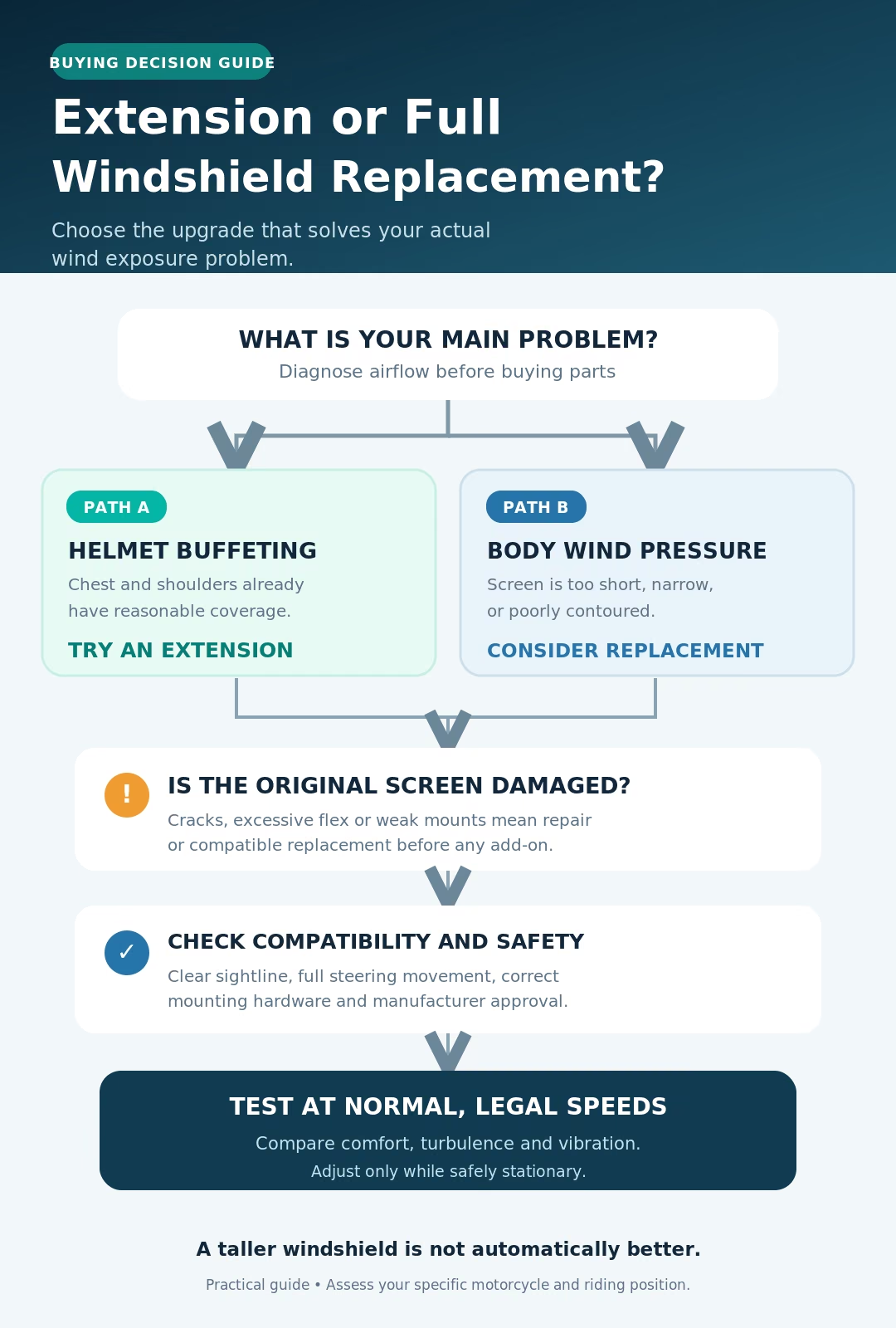
The most reliable way to select a windshield upgrade is to identify the exact problem before buying anything.
Wind pressure on the chest, helmet buffeting, wind noise, poor visibility, and shoulder exposure are related but different concerns.
Each may require a different solution.
A rider with good upper-body protection but excessive helmet turbulence may need an airflow adjustment. A rider experiencing strong wind across the entire upper body may require more substantial windshield coverage.
The following decision framework helps distinguish between these situations.
Choose a Windshield Extension If…
A windshield extension may be the better choice when the original screen is in good condition and already provides reasonable wind protection.
The main concern should be limited enough that changing airflow near the upper edge could plausibly solve it.
An extension is particularly worth considering if the rider wants adjustable airflow control, reversible installation, or a smaller initial investment.
However, compatibility and structural support remain essential.
A suitable extension should fit without damaging the original windshield, maintain unobstructed visibility, and remain secure during normal use.
If these requirements cannot be met, retaining the factory screen is not sufficient justification for using an extension.
Choose a Windshield Replacement If…
A complete windshield replacement may be preferable when the original screen requires a substantial change in height, width, or contour.
It is also appropriate when the factory windshield is damaged or incompatible with available extensions.
Replacement provides the opportunity to select a different overall aerodynamic profile, potentially changing wind exposure across a larger portion of the rider’s body.
However, the new screen must be compatible with the motorcycle and suitable for the rider’s actual seating position.
A replacement should offer a clear functional advantage rather than simply being taller, wider, or more expensive.
Whenever possible, prioritize products with documented fitment, installation instructions, and relevant performance information.
When Neither Upgrade Is the First Solution
Not every wind-related problem originates from the windshield.
A poorly fitting helmet, loose visor mechanism, unsuitable riding posture, or unstable fairing component can contribute to noise or discomfort.
A factory adjustable windscreen may also already provide a usable setting that has not been tested.
Before purchasing an accessory, inspect the existing windshield and mounting hardware and evaluate all factory-approved adjustment options.
If the current screen is loose or damaged, repair may be more appropriate than adding a spoiler.
A windshield upgrade should address a clearly identified aerodynamic or coverage limitation rather than conceal a mechanical or equipment problem.
How to Test a Motorcycle Windshield After Installation
Testing is necessary because the same accessory can behave differently on different motorcycles and with different riders.
A controlled comparison should begin with a properly installed and inspected windshield.
The rider should then evaluate wind exposure, helmet turbulence, noise, and visibility under normal riding conditions.
Testing does not require aggressive riding or exceeding speed limits.
Useful observations can be made at ordinary legal speeds on familiar roads with appropriate traffic and weather conditions.
The goal is to identify repeatable improvements rather than make judgments based on a single brief ride.
Step-by-Step Windshield Testing Procedure
Step 1: Inspect the mounting system. Confirm that all fasteners, clamps, brackets, and adjustment mechanisms are installed correctly.
Step 2: Check visibility. Sit in the normal riding position and verify that the windshield and its hardware do not obstruct the view ahead.
Step 3: Check steering clearance. Confirm unrestricted movement of handlebars and nearby components.
Step 4: Establish a baseline. Record the comfort and turbulence experienced with the original setup, if it remains safe to use.
Step 5: Ride under controlled conditions. Evaluate the windshield at normal, legal riding speeds and in suitable weather.
Step 6: Observe the results. Pay attention to helmet shaking, chest pressure, shoulder exposure, wind noise, and windshield movement.
Step 7: Compare settings. For adjustable extensions, stop the motorcycle before changing one setting at a time.
Step 8: Reinspect the hardware. Check for looseness or signs of unwanted movement following the manufacturer’s guidance.
This process can help determine whether the modification has produced a meaningful improvement.
How to Adjust Windshield Height and Angle
Adjustable spoilers should be tuned systematically rather than moved randomly between positions.
Begin with a manufacturer-approved neutral or recommended setting.
After testing, change only one variable, such as height or inclination.
This makes it easier to identify whether that specific adjustment improves or worsens the airflow.
If the helmet experiences more buffeting, return to the previous setting before trying another.
The rider should also assess whether the new position creates additional windscreen movement or visibility problems.
Never adjust a windshield extension while riding unless the motorcycle manufacturer expressly provides a safe, rider-operated adjustment system designed for that purpose.
Even then, follow the manufacturer’s operating instructions and avoid distraction.
Common Motorcycle Windshield Upgrade Mistakes
Several common mistakes can reduce the effectiveness or safety of an otherwise reasonable windshield upgrade.
One is assuming that taller always means better. A taller windshield may redirect turbulence toward the helmet.
Another is selecting a screen based only on standing height without considering seated posture.
Ignoring windshield width can also lead to disappointment when shoulder exposure remains unchanged.
Poor installation introduces additional risks. Excessive clamp pressure, incompatible brackets, missing grommets, or incorrect fasteners can damage the screen or reduce mounting stability.
Other mistakes include overlooking optical distortion, purchasing a universal accessory without checking dimensions, and using inappropriate cleaning chemicals.
The most reliable approach is to define the problem, check compatibility, select the appropriate design, install it correctly, and evaluate the result under controlled conditions.
Motorcycle Windshield Upgrade Decision Matrix
The best choice depends on the problem being addressed. This practical decision matrix identifies which option is generally worth investigating first.
These recommendations are starting points rather than guarantees because actual airflow depends on the complete motorcycle and rider configuration.
A rider may also require a combination of changes or find that a factory-approved adjustment solves the problem without purchasing anything.
| Riding Problem or Requirement | Better Starting Point | Reason |
|---|---|---|
| Mild helmet buffeting with otherwise good coverage | Adjustable extension | Allows upper airflow tuning |
| Existing windshield is much too short | Replacement | Can provide substantially different height |
| Excessive wind around shoulders | Wider replacement | Changes lateral coverage |
| Factory windshield is cracked or damaged | Replacement | Avoids adding load to a damaged screen |
| Existing windshield is flexible or poorly supported | Repair or compatible replacement | Extension may increase mounting loads |
| Want reversible aerodynamic adjustment | Compatible clip-on extension | Original screen can often remain unchanged |
| Need a different overall screen contour | Replacement | Changes the primary aerodynamic surface |
| Long-distance touring with inadequate general coverage | Touring replacement | Offers broader design options |
| Existing factory screen is adjustable | Test factory settings first | May eliminate need for an accessory |
| Wind noise without a clearly identified screen problem | Diagnose helmet and airflow first | Windshield may not be the primary cause |
A good purchasing decision begins with diagnosis rather than accessory size. For example, an extension may be the most economical solution for a small airflow problem, but it is unlikely to solve extensive shoulder exposure caused by a narrow windscreen.
The selection should always account for mounting strength, visibility, and the rider’s normal riding environment.
Frequently Asked Questions About Motorcycle Windshield Extension vs. Replacement
Motorcycle riders frequently ask whether extensions actually work, whether taller screens reduce noise, and which option is more suitable for highway riding.
The answers depend on the distinction between wind protection and turbulent airflow.
A windshield can reduce direct pressure while creating uncomfortable helmet turbulence, and an extension can sometimes improve comfort without substantially increasing screen height.
The following answers summarize the main practical and technical considerations involved in selecting an appropriate windshield upgrade.
Is a Motorcycle Windshield Extension Better Than a Taller Windshield?
A windshield extension can be better than a taller replacement when the existing windscreen already provides adequate coverage and the rider mainly needs to redirect airflow near its upper edge.
An adjustable spoiler may provide enough flexibility to improve helmet comfort without replacing the complete screen.
However, a taller replacement may be more appropriate when the original windshield is substantially too short or requires a different overall shape.
Neither option is universally superior because the outcome depends on motorcycle geometry, rider posture, and the turbulent airflow produced by the complete assembly.
Do Motorcycle Windshield Extensions Really Work?
Motorcycle windshield extensions can work by changing the path of airflow leaving the existing windscreen.
Their effectiveness depends on the dimensions of the original windshield, the rider’s helmet position, and the deflector’s height and angle.
A properly positioned extension may reduce direct airflow or helmet turbulence.
However, it may also make conditions worse if it redirects the turbulent wake toward the helmet.
The most convincing evidence for an individual rider is a repeatable improvement during controlled testing with a compatible, securely installed accessory.
Can a Windshield Extension Reduce Helmet Buffeting?
Yes, a compatible windshield extension may reduce helmet buffeting by moving turbulent airflow away from the rider’s helmet.
An adjustable spoiler is useful because different positions can change where the airflow reaches the rider.
However, reducing buffeting is not simply a matter of increasing windshield height.
The geometry of the original screen and the helmet’s position relative to its turbulent wake are critical factors.
If the existing windshield creates excessive turbulence across a broad area, an extension may provide little improvement, and another screen design may be necessary.
Does a Taller Motorcycle Windshield Reduce Wind Noise?
A taller windshield may reduce wind noise if it redirects turbulent airflow away from the helmet.
However, increasing height can also place the windscreen’s wake directly against the helmet, potentially increasing noise.
Published research demonstrates that helmet position relative to windshield-generated turbulence can substantially influence measured sound pressure.[5]
Therefore, windshield height alone is not a reliable predictor of noise reduction.
Helmet design, visor sealing, riding posture, and hearing protection also affect the rider’s experience.
The best result comes from appropriate aerodynamic positioning combined with suitable personal protective equipment.
Are Clip-On Windshield Deflectors Safe at Highway Speeds?
A clip-on windshield deflector can be suitable for highway riding when the manufacturer approves the installation and the original windscreen can safely support it.
However, safety depends on more than clamp tightness.
The accessory must be compatible with the existing screen, mounted correctly, and free from excessive vibration or movement.
The rider must also maintain clear visibility and unrestricted steering.
A poorly fitted or unsupported extension should not be used simply because it appears secure while the motorcycle is stationary.
Always follow the product’s operating limitations and inspection requirements.
Can a Windshield Extension Damage the Original Windshield?
Yes. An incompatible or incorrectly installed extension can place stress on the original windshield.
Potential problems include scratches from clamp contact, stress around attachment points, cracking, and increased flex caused by additional aerodynamic loading.
Damage risk depends on the original screen’s material, thickness, curvature, mounting design, and the extension’s fastening system.
Protective clamp pads may reduce contact damage, but they do not eliminate structural compatibility requirements.
Do not compensate for poor fitment by overtightening clamps.
If the factory windshield is already cracked, damaged, or excessively flexible, adding an extension may be inappropriate.
What Is the Best Windshield Height for My Motorcycle?
The best windshield height depends on the rider’s seated torso height, motorcycle geometry, posture, and intended riding conditions.
National Cycle describes a commonly used fitting approach in which the rider can look just over the windshield and see the road approximately 50 feet ahead.[7]
This is a useful starting point, not a universal fitment rule.
A windshield should also direct airflow in a comfortable way and maintain adequate visibility in different conditions.
Choose based on the actual installed height and sight line, not just the manufacturer’s advertised screen dimensions.
Is a Wider Motorcycle Windshield Better Than a Taller One?
A wider windshield may be more effective when the rider’s main complaint is wind pressure around the shoulders and upper body.
A taller windshield may be more relevant when airflow reaches the helmet at an uncomfortable height.
However, both dimensions influence aerodynamic loading and airflow behavior.
The correct choice depends on which part of the rider is exposed to undesirable wind.
A wider screen cannot be assumed to eliminate helmet turbulence, and a taller screen may not provide adequate shoulder protection.
Some riders benefit from a replacement that changes both width and overall contour.
Do Windshield Extensions Increase Aerodynamic Drag?
A windshield extension can increase aerodynamic drag, but the exact effect depends on its size, shape, position, and interaction with the existing windshield.
Because drag depends on both the effective reference area and drag coefficient, adding a deflector does not produce a universally predictable change.
An extension may improve rider comfort while changing aerodynamic resistance.
The effect on fuel consumption also depends on the motorcycle and riding conditions.
Reliable claims about drag reduction or increases require appropriate testing or analysis of the specific configuration rather than assumptions based on appearance alone.
Are Aftermarket Windshields Better Than Factory Windshields?
Aftermarket windshields can provide better protection or comfort for riders whose needs differ from those accommodated by the original factory design.
However, aftermarket products are not automatically aerodynamically superior.
Some replacement screens prioritize greater wind coverage, while factory screens may offer a different balance of protection, visibility, drag, and appearance.
A 2024 simulation involving a Honda CB500X found that the original windscreen generated less modeled drag than the aftermarket designs examined, although the replacement designs improved modeled airflow deflection away from the rider.[1]
The best choice depends on the individual rider’s priorities and the quality of the specific product.
Can I Install a Motorcycle Windshield Extension Myself?
Many clip-on extensions are designed for relatively straightforward installation, but successful installation still requires mechanical care.
The rider must confirm compatibility, position the clamps correctly, use suitable protective materials, and follow the manufacturer’s fastening requirements.
After installation, the accessory must not obstruct visibility or interfere with steering and other components.
If the extension requires drilling, specialized hardware, or modifications to the original screen, professional installation may be advisable.
Do not attempt to modify a windshield in a way that conflicts with the product manufacturer’s instructions.
What Is the Difference Between Acrylic and Polycarbonate Windshields?
Acrylic and polycarbonate are transparent plastics used in motorcycle windshield manufacturing.
Acrylic is valued for its optical clarity and is available in different impact-resistant grades.
Polycarbonate generally offers greater impact toughness and crack resistance than standard acrylic.
However, scratch resistance depends heavily on protective coatings and manufacturing quality.
A hard-coated polycarbonate windshield may offer excellent durability, while an uncoated product can be more vulnerable to surface damage.
Material thickness, curvature, optical quality, and mounting design also matter.
For the best comparison, examine the specifications of the actual windshield products rather than relying solely on material type.
Is Replacing a Motorcycle Windshield Worth the Money?
Replacing a motorcycle windshield can be worth the expense when the existing screen cannot provide suitable coverage or aerodynamic comfort.
A replacement may be particularly useful when the current windshield is too narrow, poorly shaped, damaged, or incompatible with an extension.
However, replacement may offer little benefit if the main problem can be resolved through factory adjustments or a small compatible deflector.
The value depends on the improvement achieved relative to the total purchase, installation, and maintenance costs.
A windshield should be judged by functional performance and safety rather than price or size alone.
How Do I Know Whether I Need an Extension or Replacement?
Begin by identifying the primary wind-related complaint.
If the factory windshield provides comfortable chest and shoulder coverage but creates helmet-level turbulence, an adjustable extension may be worth investigating.
If the screen is substantially too short or narrow, a complete replacement may provide a more suitable solution.
Also evaluate the condition and structural strength of the existing windshield.
If the original screen is damaged, excessively flexible, or incompatible with available extensions, replacement or repair becomes more appropriate.
The final decision should be based on safe fitment, visibility, and the actual airflow improvement achieved.
Final Verdict: Motorcycle Windshield Extension vs. Replacement
There is no universal winner between a motorcycle windshield extension and a full windshield replacement.
A windshield extension is often the better starting point when the factory windshield is already suitable and the rider needs only a modest change in airflow direction. Adjustable spoilers can provide useful flexibility for addressing helmet turbulence without replacing the original screen.
A complete windshield replacement is generally more appropriate when the existing screen requires substantial changes in height, width, curvature, or overall wind coverage. It may also be necessary when the factory windshield is damaged or structurally unsuitable for an extension.
Both options have limitations. A larger screen does not automatically mean less buffeting, lower noise, reduced drag, or improved handling.
The most effective windshield upgrade is one that addresses the specific source of discomfort while maintaining appropriate visibility, secure mounting, and compatibility with the motorcycle.
Before purchasing, evaluate the current windshield, identify the airflow problem, verify product fitment, and consider how the motorcycle is normally ridden.
A carefully selected and properly installed windshield can improve comfort considerably, but its effectiveness should always be established through realistic, controlled riding conditions rather than assumptions based on its size or appearance.
Sources
The following sources include aerodynamic research, peer-reviewed or published technical studies, motorcycle manufacturer documentation, and windshield manufacturer guidance. Older studies are retained where they provide foundational evidence about motorcycle airflow and helmet noise. Manufacturer sources are used primarily for product features, materials, fitment, and installation requirements, while independent research is used to support broader aerodynamic and hearing-related conclusions.
[1] Ghazali, F., and Abdul Ghafir, M. F. (2024). Investigation of Different Windshield Designs for Aerodynamic Drag Force in Motorcycle. Progress in Aerospace and Aviation Technology, 4(1), 49–56. A computational study examining drag and airflow distribution around different Honda CB500X windshield configurations.
[2] GIVI. S180T Universal Deflector Clear. Manufacturer specifications covering adjustable deflector construction, mounting requirements, and original windshield rigidity.
[3] Puig Hi-Tech Parts. Multi-Adjustable Visor 2.0 Clip-On. Manufacturer guidance on adjustable windshield spoilers, polycarbonate construction, installation, and compatibility.
[4] NASA Glenn Research Center. Drag Equation. Technical explanation of aerodynamic drag, velocity, reference area, and drag coefficients.
[5] Kennedy, J., Carley, M., Holt, N., and Walker, I. (2011). The Effects of Windscreen Flow on Noise in Motorcycle Helmets. Research presented at the Acoustical Society of America Meeting, DOI: 10.1121/1.3646304. Investigation of motorcycle windscreen wake behavior and helmet noise.
[6] McCombe, A. W., et al. (1996). Hearing Protection for Motorcyclists. Research indexed by the U.S. National Library of Medicine examining earplug use and temporary hearing changes following motorcycle noise exposure.
[7] National Cycle. Windshield Bible: Get the Right Height. Manufacturer recommendations for windshield selection, rider seated height, sight lines, and fitment measurement.
[8] National Cycle. National Cycle and ZTechnik Frequently Asked Questions. Technical material comparisons involving acrylic, high-impact acrylic, polycarbonate, protective coatings, durability, and maintenance.
[9] Puig Hi-Tech Parts. Touring Screen. Manufacturer specifications, model-specific fitment, construction details, and relevant product documentation.
[10] Harley-Davidson. VRSC Quick Release Detachable Windshield Kit: Installation Instructions. Official installation guidance covering mounting, steering clearance, safety, and hardware inspection.
[11] National Cycle. Windshield Bible: Caring for Your Windshield. Manufacturer instructions and precautions for maintaining acrylic and polycarbonate motorcycle windshields.